
4 Bam Mahjong Tile Symbol Explained
Last updated: Nov 23, 2026
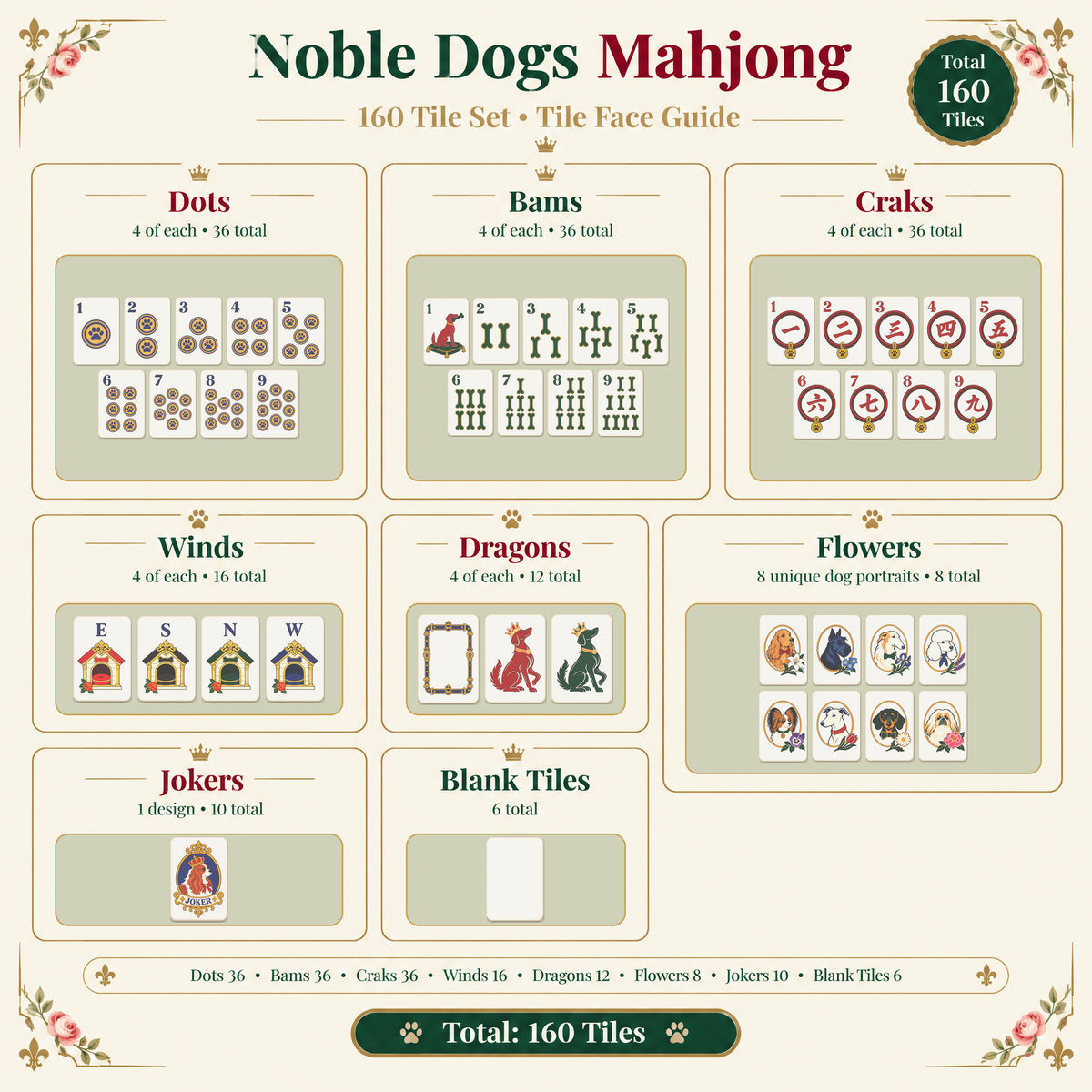
The 4 Bam is a numerical tile in the Bam suit (the suit of circles), representing the number four in American mahjong. Each complete set contains four identical copies—one for each player's potential exposure—as part of the 36 Bam tiles (1–9, four of each). The 4 Bam has four hollow or solid circle symbols printed on its face; older or decorative sets sometimes include a bird illustration. In modern acrylic Mahstead sets, the 4 Bam uses clear numbering and standard suit iconography so players spot it instantly. The Bam suit corresponds with the White dragon in Asian numerology, though American rules do not enforce that connection. A 4 Bam is used whenever the current year's National Mah Jongg League card calls for a Bam tile in positions one through nine; it holds no special scoring value on its own—only the completed hand pattern determines points. 🀄 Shop best-selling mahjong sets →
What do the circle symbols on the Bam suit mean?
The four circles on a 4 Bam are stylized "coins" or "cash" symbols, a legacy from ancient Chinese cards and dominoes where Bams (bamboo) represented currency or value. The number of circles—one through nine—simply indicates rank, not monetary worth; they're purely visual markers. In American mahjong, the Bam suit has no inherent advantage over Craks or Dots; all three suits follow identical rules for forming sets.

How is the 4 Bam different from a 4 Dot or 4 Crak?
Each suit (Bam, Crak, Dot) uses a distinct icon: circles for Bams, lines/sticks for Craks, and dots for Dots. A 4 Bam always shows four circles, never lines or small dots, making suit identification immediate. This standardization across all 160-tile American sets—whether engraved acrylic or plastic—ensures every player reads the same symbol the same way. You cannot mix suits in a pung or kong; three 4 Bams is valid, but one 4 Bam, one 4 Crak, and one 4 Dot does not form a valid exposed set.
What role does the 4 Bam play on the mahjong card?
The annual National Mah Jongg League card lists hundreds of winning hand patterns, each calling for specific tile combinations. A 4 Bam may appear alone, in a pung (three 4 Bams), or in a sequence range like "2–4 Bams" (meaning two, three, or four Bam tiles of consecutive rank). The card uses shorthand notation; reading it accurately determines whether your hand qualifies as a winning draw that season. Learning to read the card is essential for rapid play and confident calls.
Can jokers replace a 4 Bam?
Yes. In American mahjong, jokers act as wild tiles and can substitute for any single tile in an exposed pung, kong, quint, or sextet—including a 4 Bam. However, jokers cannot form a pair or stand alone; if you need a 4 Bam for your pair, you must hold the actual tile. This distinction matters during play: you can expose a pung using two 4 Bams and one joker, but not two jokers and one 4 Bam in the same group. Our 160-tile acrylic sets include sufficient jokers to cover typical North American gameplay; keep spare jokers in your rack during play so they're visible to all players.
How does the 4 Bam fit into beginner strategy?
New players often focus on high-value Honors (winds and dragons) early, overlooking number tiles like the 4 Bam. However, because there are only three copies of each Honor tile in play (versus four of each number), you'll draw more number tiles and find them easier to complete into winning patterns. The 4 Bam is middle-rank in the Bam suit, so it appears frequently in card patterns; holding it early gives you flexibility to adapt as the hand unfolds. Beginners should track how many 4 Bams have been discarded (visible in the center of the table) to gauge whether the fourth copy is still in play.
🎁 See our most-loved mahjong sets & accessories →

Comparing the Nine Bam Tiles: Rank, Role, and Visibility
Tile | Number | Frequency in hands | Why it matters | Typical card use |
1 Bam | 1 | Medium | Often paired or in low sequences | Starts ranges; bird symbol aids recognition |
2–4 Bams | 2–4 | High | Middle-rank; fit most patterns | Appear in 60%+ of annual card patterns |
5 Bam | 5 | Medium | Center value; starts middle ranges | Critical transition tile |
6–8 Bams | 6–8 | High | Upper-middle; common in pungs | Often called early in play |
9 Bam | 9 | Medium | High-value endpoint; hard to match | Limits flexibility; often discarded early |
The 4 Bam sits in the sweet spot: high frequency, moderate rank, and compatible with both low and middle-range patterns. If you're holding multiple middle Bams (2, 3, 4, 5, 6), your odds of completing a pattern improve with each tile draw.
What to Check Before You Buy a New Set
When you acquire your first or replacement American mahjong set, verify these details to ensure the 4 Bam (and all tiles) are clear and durable:
Tile thickness & weight. Acrylic tiles should feel substantial (not hollow), ensuring they won't crack during shuffles or years of weekly play.
Number and suit clarity. Engravings or prints on the 4 Bam must be legible at arm's length from across a table; faded Bams cause disputes and slow play.
Joker count. Your set should include eight jokers (plus spare tiles if it's a 160-tile set) so play never stalls waiting for a substitute.
Consistency across suits. Compare a 4 Bam, 4 Crak, and 4 Dot side by side; all three should use the same font and sizing, only differing in icon and color.
Spare tile storage. A durable mahjong mat with integral storage or a separate travel bag or case prevents spare jokers and blanks from getting lost before your next game.
Our engraved acrylic sets are manufactured to withstand shuffling and stacking; if a tile becomes damaged after years of use, replacement tiles are available so you don't retire an otherwise good set.
✨ Find your Mahstead set — free US shipping →
Why the Bird Symbol on Some 1 and 4 Bams?
Historically, the 1 Bam carried a bird (often a peacock or crane) as an ornamental touch in Chinese and Japanese mahjong. Some Western manufacturers included it on the 1 Bam only, while others extended it to the 4 Bam or omitted it entirely. In American play, the bird is decorative—it has zero effect on rules or scoring. Modern competition sets and printed National Mah Jongg League tiles usually omit the bird to simplify recognition under bright lighting. If your tiles feature a bird on the 4 Bam, it doesn't change its function; it's simply an aesthetic choice from the manufacturer.
Extending Your Knowledge: From Tile to Hand
Once you understand how a single tile like the 4 Bam works in isolation, the next step is seeing how it connects to winning patterns. The annual card might call for "2–4 Bams and 5–7 Craks and Red, Green, White" as a valid combination; having confidence in what the 4 Bam is and where it fits accelerates pattern recognition. Players who hesitate over basic tile identity often miss quick wins. Practice by drawing a hand, laying it flat on a mahjong mat, and cross-referencing the card in the first 30 seconds—this builds muscle memory and speeds up your calling decisions.
For a deeper dive into how tiles build into complete hands and scoring scenarios, read our guide to what's in an American mahjong set and explore American mahjong scoring rules.

FAQ
Is the 4 Bam worth more points than other number tiles?
No. In American mahjong, only the final completed hand earns points per the current National Mah Jongg League card—individual tiles have no inherent point value. All number tiles (1–9 across three suits) contribute equally to hand formation.
Can I use a 4 Bam as a pair if I don't have the actual tile?
No. Jokers cannot form a pair in American mahjong. If your winning pattern requires a pair of 4 Bams, you must hold both actual 4 Bam tiles; jokers can only substitute within exposed pungs, kongs, or larger sets.
Why does the 4 Bam look different on some old sets I've seen?
Older Chinese sets and some vintage American manufacturers used hand-painted or carved designs, so the four circles might appear as ornate coins, flowers, or stylized symbols. Modern acrylic and printed tiles standardize the design; Mahstead's engraved acrylic uses consistent iconography across all 160 tiles for fast, confident play.
How many 4 Bams are in a complete American mahjong set?
Exactly four copies. A standard American set contains 152 playing tiles, split into four identical groups (one per player) so each player can draw their complete hands without collision. The 4 Bam appears four times in those 152 tiles.
Does the 4 Bam have a different meaning in Chinese or other mahjong variants?
The 4 Bam is fundamentally the same across all variants (Chinese, Hong Kong, Riichi, Taiwanese, American), but scoring and hand patterns differ greatly. American mahjong uses the annual National Mah Jongg League card; other variants follow centuries-old fixed hand tables. The tile identity stays constant—only the rules around how to use it change.
What should I do if a 4 Bam gets cracked or faded?
Replace it before your next game to avoid disputes or miscalls. Our acrylic tiles resist cracking, but if damage occurs after extended play, contact Mahstead for a replacement tile so your set remains tournament-ready and complete.


View More
View More
View More
