
2027 Mahjong Card Tips for Beginners: Read Fast, Play Right
Last updated: Nov 23, 2026
The National Mah Jongg League card is your bible. Every hand you win must match a row on that year's card, printed in tiny black text on a laminated sheet you'll hold up, squint at, and gradually memorize. It's not a optional guide—it's the law. Beginners often feel overwhelmed because the card is dense, organized by symbol rather than by logic, and printed small. But the card follows a learnable structure. The moment you understand that structure, you stop panicking and start playing.
How is the card actually organized?
The card arranges hands in sections by type: pairs first, then hands with exposed sets (pungs, kongs), then hands with jokers. Within each section, rows are sorted by the symbols used—Bams, Craks, Dots, winds, dragons, flowers—and by number or quantity. The layout is not alphabetical; it's hierarchical by tile family. If you flip to the "pairs" section and scan down, you'll see rows listing two-pair hands, then three-pair hands, then four-pair hands, all grouped by suit. This means you don't hunt randomly. You know before you look which section your hand type belongs in, so you cut search time in half.
The card also marks every row with joker count—the number you're allowed in that hand—written clearly in a column. This is critical: one row might allow jokers freely; the next row might forbid them entirely. Joker rules change per hand. Beginners skip this column and claim hands that aren't legal, so your first move when you find a matching hand is to verify the joker column against the tiles in your hand.

What do beginners miss when reading the card?
Most new players make one of three errors. First: they find a row that looks close, don't check the column rules, and call it a win. The card's tiny font makes it easy to misread a tile symbol (is that a 4 or a 9?) or to miss a joker restriction. Second: they confuse the hand structure. American mahjong has no sequences (chows); all melds are identical sets—three or four of the same tile. Beginners sometimes spot a row with mixed numbers and think it's a legal sequence, when actually the row requires three identical 5 Dots and three identical 3 Dots. Third: they don't account for flowers and winds as mandatory pieces in some hands. A row might demand two Winds and a pair of Flowers; if you don't hold Flowers, that row doesn't work, and you'll waste time trying to force a fit.
To avoid these: before your first game, spend 15 minutes scanning the card top to bottom. You don't need to memorize; just get familiar with the sections and the font size. At the table, slow down. Call over a dealer or an experienced player to verify your hand before you claim it. The three seconds you spend checking the joker column and tile count now save you from a rule violation and table confusion later.
What's the fastest way to spot a hand on the card?
Start with hand type. Ask yourself: do I have a pair? Exposed pungs or kongs? Mixed numbers and sets? Jokers? This tells you which section to open. If you have a pair, two exposed pungs, and a joker, you're in the "pairs with exposed sets and jokers" section, not the "pairs with flowers" section. Narrowing the section cuts your search zone by 80%.
Next, scan the symbols. Run your eye down the left side of your target section and match the tile families in the rows to the tiles in your hand. You're looking for a row that lists the same suits and suits count as your hand. If your hand is 3 Dots, 3 Dots, 3 Dots (pung) + 5 Bams, 5 Bams, 5 Bams (pung) + pair of Winds, scan rows that have Dots + Bams + Winds in that order. This narrows further.
Finally, verify the exact numbers and joker count. Once you land on a candidate row, read the tile counts slowly—are they three 3-Dots or two 3-Dots and one joker? Check the joker column: is it 0, 1, 2, or "any"? Count your jokers and confirm they match. Only then call Mahjoang.
A laminated current-year card is non-negotiable. If your set comes with a paper card, have it laminated or print a fresh copy at home so you can mark notes in pencil. Pencil marks help you flag hands you've already won (so you don't repeat) and sections you find tricky.
How do jokers change the card reading?
Jokers are wildcards, but the card strictly regulates how many each hand allows. One row might say "no jokers"—your hand must be made entirely of real tiles. Another row allows one joker, or two, or any number up to five. Here's the trap: some hands look similar but have different joker allowances. A hand with "3 Dots, 3 Dots, 3 Dots + pair" might allow no jokers, while "3 Dots, 3 Dots (joker as third), pair" allows one. You must match your exact tile count including jokers to find the right row.
Also, jokers have strict rules in American mahjong: they cannot be used as a single tile (e.g., a joker standing alone as a win), and they cannot be part of a pair. So if you hold two Dots and two jokers, you cannot claim the pair as a win, because the pair itself contains jokers. You must find a hand where the jokers fill sets (pungs or kongs), never the pair. This is why the joker column matters: it tells you exactly which parts of the hand allow jokers.

What does "two-hand" or "three-hand" on the card mean?
Some rows are labeled "two-hand," "three-hand," or "six-hand." This refers to how many different sets or melds you're building. A two-hand might be two exposed pungs plus a concealed pair. A three-hand might be three exposed pungs plus a concealed pair. These labels help you navigate the card by complexity. Beginners often ignore them and end up in the wrong section. If you have three exposed kongs and a concealed pair, you're a three-hand, so look only at three-hand rows. This speeds up your search and prevents claiming a hand that violates the card's hand-type structure.
Some cards also note "FF" (flowers with flowers) or "CC" (consecutive like-number sets) or other pattern codes. These are shortcuts the League uses to organize the card. Learning five or six common codes—or keeping a cheat sheet at the table—makes card reading feel less like decryption and more like pattern matching.
🀄 Shop best-selling mahjong sets →
Which beginner setup makes card reading easier?
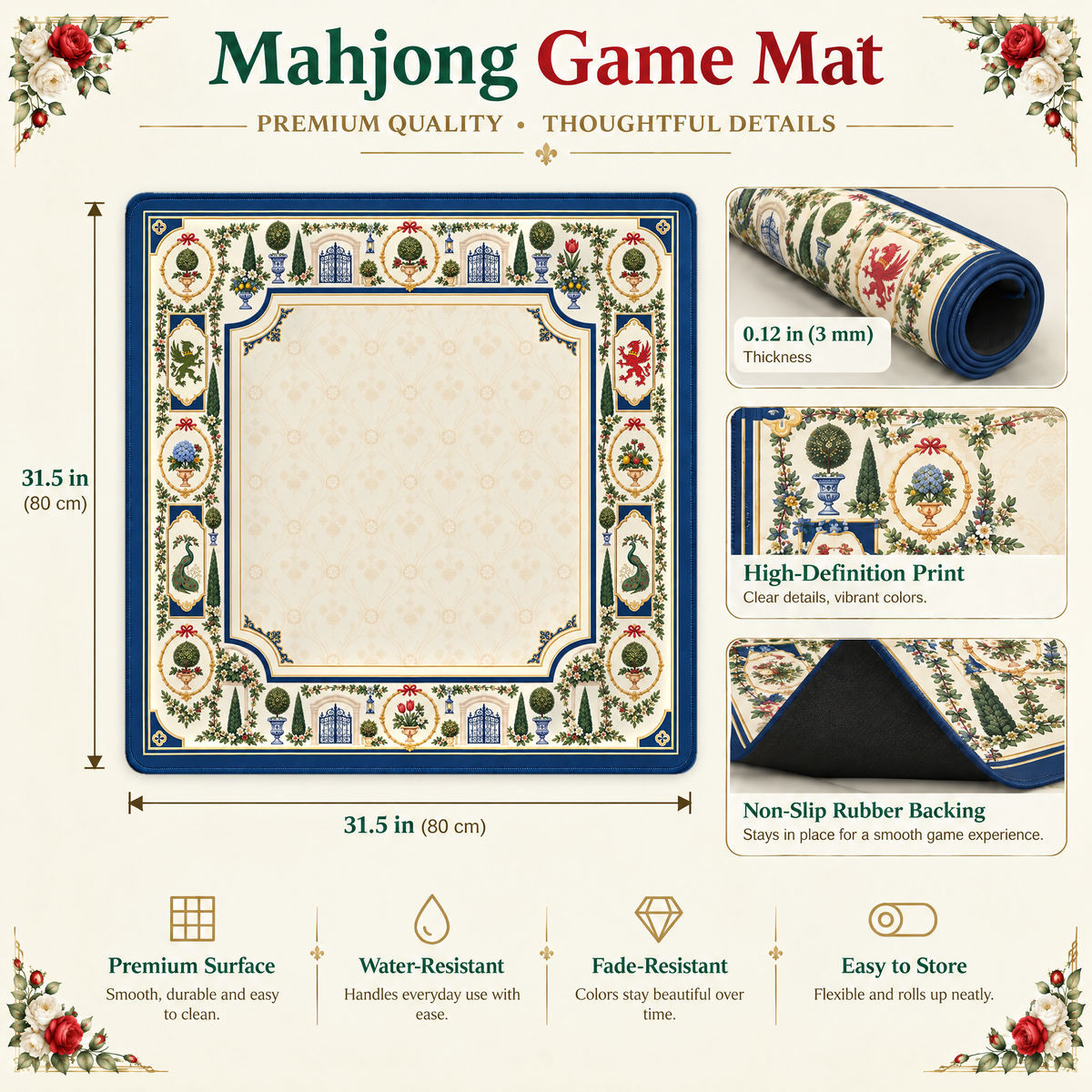
Invest in three things: a large, durable playing surface (a mahjong mat or table cover keeps tiles from sliding); a set of racks with pushers (so your tiles stay organized and upright, making it easier to count and verify them); and a laminated current-year card that lives on the table. With racks, your tiles line up in neat rows by suit and number—you can glance and count. Without racks, tiles tumble, you miscount, and you claim a hand that doesn't match the card. A mat with a card sleeve keeps your reference card flat and legible, so you're not squinting at a bent card under poor light.
Before your first game, set up your mat, load your tiles into racks, and place the card in front of you. Now practice a mock hand: pick eight real tiles (say, 3 Dots, 3 Dots, 3 Dots, 5 Bams, 5 Bams, 5 Bams, 1 Wind, 1 Wind), organize them in your racks by suit, and hunt the card. Time yourself. Most beginners find and verify a legal hand in under 30 seconds after one practice round. That confidence translates directly to your first night of real play.
Setup Element | Beginner Value | Why It Works |
Laminated current card | Essential | Survives spills, stays flat, easy to read under table lights |
Racks with pushers | High | Tiles stay organized; you count accurately; claim speed increases |
Mat with card sleeve | High | Protects card, defines boundary, prevents tile scatter |
Pencil for notes | Medium | Mark hands you've claimed; flag tricky rows for next time |
Printed backup card | Low | Insurance if main card tears; optional if you have a digital copy on phone |
🎁 See our most-loved mahjong sets & accessories →
Common card mistakes: how to spot and fix them
Mistake 1: Claiming a hand that matches the card but is out of season. The card changes every spring. If you're playing in June 2027 with a 2026 card, some hands will be illegal. Always check the card's year before play. Your best-selling set from this year includes the current card.
Mistake 2: Confusing "any number" joker rules with "no joker" rules. Some rows allow jokers in any position; others forbid them in the pair or in specific sets. Read the joker column slowly. If it says "no," there are no jokers in that hand. Period.
Mistake 3: Misreading tile symbols. The 1 Bam usually shows a bird; the 1 Crack shows a design. The card uses tiny symbols. If you're uncertain, ask the dealer to confirm before you claim.
Mistake 4: Not checking all columns. The card row includes tile symbols, counts, and joker rules. Many beginners read the symbols and skip the count column. Always read left to right: tiles, quantity, jokers, any special notes.
What to check before you buy a beginner set
Verify the set includes the current-year card. A best-selling set ships with the 2027 card if purchased in 2027. Confirm on the product page.
Ensure tiles are readable. Engraved or embossed tiles last longer than printed ones and resist fading. Check photos to see if you can read the symbols clearly.
Confirm the set has 152 playing tiles plus jokers. American mahjong uses exactly 152 tiles per game. A 160-tile set includes spares.
Test the mat or table cover. A non-slip surface keeps tiles from sliding and makes card reading safer. Our mahjong mats feature reinforced edges and card sleeves.
Check your lighting. If your game table is dimly lit, get a set with high-contrast tiles and a laminated card that reflects light well. Print a second copy of the card if your first is hard to read.

FAQ
Can I use an old card if I already own one?
No. The National Mah Jongg League issues a new card every spring. Hands change year to year. Using an old card means claiming hands that may not be legal in the current season. Always use the current year's card printed on the set or purchase a fresh one.
How long does it usually take a beginner to read the card without help?
Most beginners take 45–90 seconds to find and verify a hand in their first game. After three or four games, you'll cut that to 15–30 seconds. By your tenth game, under 10 seconds. Speed comes from familiarity, not memorization.
What if my set card is too small to read?
Have it laminated at office supply store (1–2 dollars) or print a fresh copy at home. You can also zoom in on a digital photo of the card on your phone during play, though many players prefer a physical card for fewer distractions.
Are there any shortcuts to memorize the card faster?
Focus on the sections you play most (you'll likely claim pairs and two-hand pungs in your first season). Learn the symbols for your favorite suits first. Spend 15 minutes before each game scanning the current card. You don't memorize—you build pattern recognition.
Can I claim a hand if I'm unsure it's on the card?
Never claim a hand you cannot find on the card. Call the dealer over. The three seconds you spend verifying prevents a rule violation and keeps the table's trust. American mahjong is built on accuracy, not speed.
What's the difference between reading American mahjong and Chinese or Hong Kong cards?
American mahjong requires hands to come exactly from the current card; Chinese and Hong Kong variants have fixed hand patterns players memorize. The American card is your source of truth; in other variants, players rely on learned combinations. This makes the American card essential reading; other games have more flexibility.


View More
View More
View More
