
Yakuman in Riichi Mahjong Explained: Hands, Rules & Value
Last updated: Nov 23, 2026
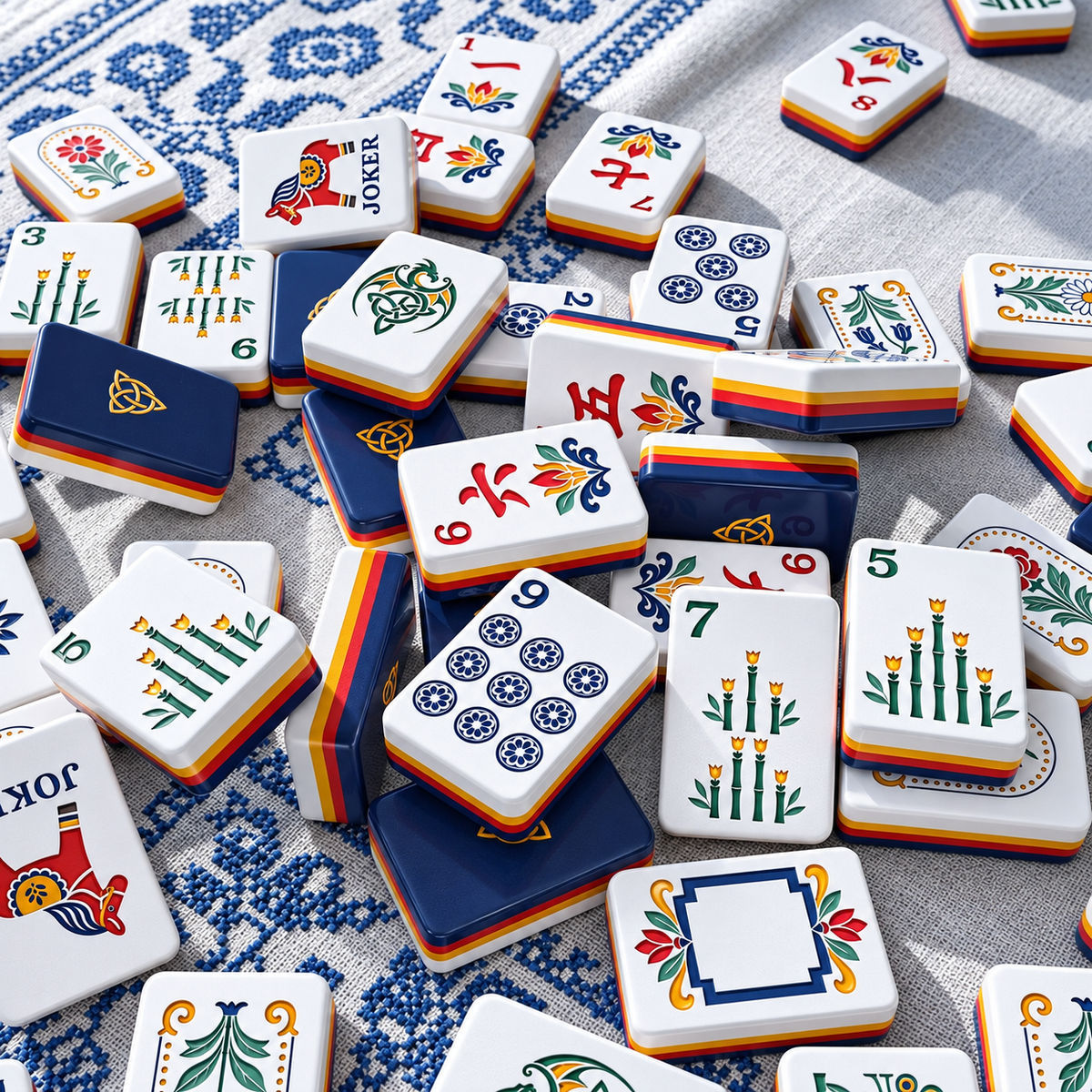
Yakuman (役満, literally "tile limit") are the premium scoring tier in riichi mahjong, each worth a base of 8,000 points or 12,000 when riichi wins. A yakuman hand uses all 14 tiles (13 melds plus the winning tile) to form a single defined pattern—such as all honors tiles, all terminals, or a sequence of identical melds—drawn from an official yakuman list that differs by regional ruleset and tournament. The most common yakuman include Kokushi (one each of all 13 terminal and honor tiles plus a pair), Suuanko (four hidden pungs), Daisangen (all three dragon pairs/melds), Shousuushii (three wind pairs and one wind meld), and Chinroutou (all terminals). Unlike American mahjong's rule-based hand validation, riichi yakuman require exact pattern matches; a single wrong tile disqualifies the hand. Yakuman rank above all other hands, so a player declaring yakuman wins instantly. Learning yakuman prepares you for play in Japan, online riichi rooms, or international tournaments, though casual games often omit them to keep scoring simpler. Our best-selling mahjong sets include jokers for friendly variants; riichi purists use a standard 136-tile set with no jokers, and serious players often keep separate sets for each variant.
Yakuman are the premium scoring tier in riichi mahjong, each worth a base of 8,000 points or 12,000 when riichi wins. A yakuman hand uses all 14 tiles to form a single defined pattern drawn from an official list that differs by regional ruleset and tournament. The most common yakuman include Kokushi (one each of all 13 terminal and honor tiles plus a pair), Suuanko (four hidden pungs), Daisangen (all three dragon pairs or melds), Shousuushii (three wind pairs and one wind meld), and Chinroutou (all terminals). Unlike American mahjong's rule-based hand validation, riichi yakuman require exact pattern matches; a single wrong tile disqualifies the hand. Yakuman rank above all other hands, so a player declaring yakuman wins instantly.
What's the difference between yakuman and other riichi hands?
In riichi mahjong, hands score through combinations of fu (a base multiplier, like 30 or 40) and han (scoring layers, where 1 han doubles the base, 2 han quadruples it, and so on). A typical winning hand might be 3-han, worth 2,000–4,000 points depending on fu. Yakuman jump directly to a fixed value—8,000 points minimum, or 12,000 if you declared riichi and won—skipping the fu and han calculation altogether. This makes yakuman genuinely rare; most players see only a handful in a season of weekly games. Some rulesets allow double yakuman (two distinct patterns in one hand, worth 16,000+), and advanced variants recognize counted yakuman that stack on top of regular scoring. In casual play, yakuman often feel anticlimactic because the hand is so restrictive; in tournament play, they're celebrated as landmarks. The key difference: riichi hands are built around scoring multipliers and specific melds; yakuman are built around patterns, and the pattern is everything.

Which yakuman are easiest to complete?
Kokushi and Suuanko are statistically the two most achievable yakuman because they reward luck more than perfect meld alignment. Kokushi ("orphans hand") needs one tile from each of the thirteen terminal and honor tiles—1 Bam, 9 Bam, 1 Crak, 9 Crak, 1 Dot, 9 Dot, and the four winds and three dragons—plus a pair of any one of those 13 types. You can wait for any terminal or honor; this flexibility makes it the second-most common yakuman. Suuanko ("four concealed triplets") requires four hidden pungs (triplets you drew yourself, not won from other players) and a pair, with no riichi declaration—drawing the exact tiles is luck-based, but building four of the same number across suits is mechanically straightforward. By contrast, Shousuushii ("small four winds") needs three wind pairs and one wind meld of four identical wind tiles, which is almost impossible in casual play because opponents rarely discard wind tiles once they see you hunting for them. Daisangen ("great dragons") requires all three dragon pairs or melds and is moderately achievable if other players discard dragons freely. As a new riichi player, expecting Kokushi or Suuanko is realistic; expecting Shousuushii or Daishuushii ("all honors and terminals") is a long-term dream.
🀄 Shop best-selling mahjong sets →
How does yakuman scoring work in tournament play?
Most tournaments use the Nihon Keii (Japanese rating) or similar ruleset in which yakuman is always worth exactly 8,000 points for a non-riichi hand, or 12,000 if riichi was declared before winning. A few tournaments score yakuman by seating: if you are dealer (East), yakuman is 16,000 points; if you are non-dealer, it's 8,000. Double yakuman (two counted patterns) typically scores 16,000 or 24,000 depending on ruleset. Mangan (2,000 non-dealer or 3,000 dealer) and haneman (3,000 non-dealer or 4,500 dealer) are mid-tier fixed scores below yakuman; yakuman sits firmly above all of them. In casual games, many players house-rule yakuman to 10,000 or 20,000 just to make them feel less like a coin flip and more like an earnable achievement. Tournament organizers always publish their yakuman list and scoring table before play; never assume a hand counts as yakuman without checking the official list for that event. Variation between tournaments is a real issue: some recognize renhou (winning on the discard of the player to your right within the first round) as yakuman, while others score it as a high-value hand instead. Always read the rules card before you sit down.
What's the official yakuman list, and does it change?
The Modern Japanese Ruleset (used by the Mahjong Association of Japan) recognizes approximately 13 base yakuman and several regional or optional variants. The core 13 are: Kokushi, Suuanko, Daisangen, Shousuushii, Chinroutou (all terminals), Honroutou (all honors and terminals), Shousangen (two dragon pairs and the third as a triplet—wait, that's not yakuman; Shousangen is a high hand worth 6-han), Ryuuiisou (all green—Bams 2, 3, 4, 6, 8 and Green Dragons), Tanyao (all simples, no yakuman in modern rules but 1-han), Anohan (one completely hidden hand before winning), Renhou (win on the discard of the player to your right), Chankan (win by replacing a kong tile), Haitei (win on the final tile of the wall), and Houtei (win by the discard of the final tile). The exact list is not fixed; regional tournaments, online platforms (Tenhou, Mahjong Soul, Rento), and casual home games all have slightly different yakuman lists. Before traveling for tournament play or logging into an online room, download or memorize that ruleset's yakuman list. Casual players often skip yakuman altogether to keep scoring simple and focus on 1-han to 5-han hands, which are more common and fun.
🎁 See our most-loved mahjong sets & accessories →

How do yakuman differ between riichi and American mahjong?
American mahjong uses the current-year National Mah Jongg League card, which lists all legal winning hands in pattern form but has no yakuman tier; instead, American hands are ranked by point value on that year's card. Riichi mahjong uses scoring multipliers (fu and han) and yakuman as a separate, infinite-value tier. American mahjong prohibits sequences (chows) from being declared, and only allows exposed pungs, kongs, quints, and sextets; riichi allows sequences and hidden melds, which opens up far more complex hand types. A riichi hand that looks like a disaster in American mahjong—all terminals, or all one suit, or every tile in sequence—can be a yakuman in riichi. The two games also differ in tile counts: American mahjong uses 152 tiles plus 8 jokers, while riichi uses 136 tiles with no jokers. If you want to learn both games, keep separate sets and don't mix the rules; many players find riichi's scoring algebra harder at first but more elegant once it clicks. How to play American mahjong provides a complete introduction to the American variant if you're curious about the comparison.
Yakuman | Pattern | Difficulty | Who sees it first? |
Kokushi | One each of all 13 terminals/honors + pair | Medium | Most skilled players in 50+ hands |
Suuanko | Four hidden triplets + pair | Medium | Players who get lucky draws |
Daisangen | All three dragons (pairs or melds) | Medium-High | Players with active discard feeding |
Shousuushii | Three wind pairs + one wind meld | Very High | Rare even in tournament play |
Chinroutou | All terminals (1s and 9s only) | High | Specialist players pursuing it |
Honroutou | All honors and terminals combined | High | Seen in extended tournament play |
Ryuuiisou | All green (Green Dragons + Bam 2,3,4,6,8) | High | Very rare in casual games |
What to check before you start learning yakuman
Know your ruleset first. Yakuman lists vary by tournament, online room, and region. Download the official rules document before sitting down; don't guess. Start with riichi fundamentals. If you're new to riichi mahjong, learn fu, han, and non-yakuman hands first (1-han through 5-han). Yakuman is a capstone, not a foundation. Play casual games without yakuman initially. Many house games omit yakuman to keep scoring simple and focus on hand-building. Once you're comfortable recognizing 2-han and 4-han patterns, yakuman becomes less exotic and more like a natural extension. Keep a yakuman reference card at the table. Print or laminate a one-page summary of the yakuman list for your ruleset and keep it next to your hand while you play. No one will judge you for checking; even experienced players verify edge cases. Understand the tile draws matter more than play. Most yakuman are won by luck, not skill; you either draw the tiles or you don't. Don't expect to hunt yakuman deliberately in your first season—focus on winning regular hands instead.
A decision framework: Should I learn yakuman?
Your situation | Yakuman matters? | Why |
You play American mahjong weekly | No | American mahjong has no yakuman; focus on the NMJL card. |
You play casual riichi at home | Optional | House rules often omit yakuman to keep scoring fast. |
You want to play riichi tournaments | Yes | Every tournament ruleset recognizes yakuman; you must know them. |
You play online riichi (Tenhou, Mahjong Soul) | Yes | Yakuman appear regularly; the platform shows the yakuman list in-game. |
You visit Japan or play internationally | Yes | Riichi is the de facto standard; yakuman are a core mechanic. |
✨ Find your Mahstead set — free US shipping →
If you play American mahjong exclusively, skip yakuman and invest your study time in the National Mah Jongg League card. If you're learning riichi, yakuman are inevitable; start with the most common ones (Kokushi, Suuanko) and build from there. For tournament and online play, yakuman knowledge is non-negotiable—treat it as a required skill, like understanding discards or tile probability.

FAQ
Is yakuman the same in every riichi ruleset?
No. Different regions, tournaments, and online platforms recognize different yakuman lists. Always check the official ruleset before play; some recognize renhou and chankan as yakuman, others score them as high hands instead.
Can you declare riichi and then win with yakuman?
Yes. If you declare riichi (committing to a specific waiting hand) and win with a yakuman pattern, you score 12,000 points instead of 8,000. The riichi bonus stacks on top.
What's the difference between yakuman and a very high-scoring hand?
Yakuman is a fixed tier (8,000 points minimum) based on exact pattern matching. High-scoring hands (5-han, 6-han, mangan, haneman) are calculated through fu and han multipliers and can score less than yakuman depending on fu.
Can you win with two yakuman patterns at once?
Yes, but only if your ruleset permits "double yakuman" or "counted yakuman." In most casual play, you score the single best yakuman; in tournaments, read the rules. Some platforms allow stacking; others don't.
How long does it take to see your first yakuman?
In casual weekly games, 6–18 months of regular play is typical. In tournament play with skilled opponents, it might never happen—yakuman are drawn events, not earned achievements.
Should I learn American mahjong or riichi mahjong first?
American mahjong is simpler to learn initially (no scoring algebra, hand validation is direct), but riichi is deeper and more popular worldwide. Start with whichever variant your local community plays.


View More
View More
View More
