
Wright-Patterson Mahjong for Beginners: Rules & Setup
Last updated: Nov 23, 2026
American mahjong is a four-player tile game where you build hands from a current-year chart using 152 tiles (Bams, Craks, Dots, winds, dragons, flowers, and jokers). A game lasts roughly 1–2 hours and plays in rounds; on your turn, you draw one tile and discard one, aiming to complete a hand pattern before anyone else. You'll pass tiles in three directions during the opening "Charleston" ritual, then read your hand from the annual National Mah Jongg League card. Beginners often struggle with tile recognition and the discard strategy; we recommend learning how to play American mahjong step-by-step and practicing with a quality engraved set so tiles are impossible to confuse. Mahstead's best-selling mahjong sets come with clear symbols and storage, designed exactly for new players in military and civilian clubs alike. 🀄 Shop best-selling mahjong sets →
What does "American mahjong" actually mean?
American mahjong is the only variant that plays from a printed hand-list (refreshed every spring by the National Mah Jongg League). You cannot play sequences (1-2-3 chows); instead, you build identical tile groups: pungs (three matching), kongs (four), or longer runs using jokers as wildcards. This is radically different from Chinese, Hong Kong, or Riichi mahjong, where sequences are core and chows can be exposed. American gameplay is slower, more strategic, and heavily card-dependent—new players spend their first month just learning to read the chart. The 152-tile set (three suits numbered 1–9, four of each; winds, dragons, flowers, and eight jokers) is standard everywhere, so you'll plug in instantly whether you play at Wright-Patterson, a synagogue, or a home game.

How do I read the current year's mahjong hand card?
The annual card lists every legal hand pattern in narrow columns organized by suit and joker count. Each hand row shows tile groups (like "P 123" for 1–2–3 Bam pairs, or "C 5 5 5" for three 5 Craks), how many jokers are allowed, and what pairs finish it. To use it in play: after the Charleston, count your tiles, scan the card by suit and joker total, then find rows that match your hand. Rows are ordered left to right by ease; beginners gravitate to hands on the left (simpler patterns) and shouldn't force rare right-side hands until you're comfortable. How to read the mahjong card walks through this with real examples. Many players copy their card to a plastic sleeve or frame it so it's visible during play—no shame in that.
What tiles do I need to recognize instantly?
You must know: (1) the three suits—Bam (sticks, usually 2–9 show bundles; 1 Bam is a bird), Crak (Chinese currency; red numerals and symbols), Dot (circles, 1–9); (2) winds (North, East, South, West); (3) dragons (Red with Crak, Green with Bam, White "Soap" with Dot and also acts as zero); (4) flowers (numbered 1–4); and (5) jokers (usually bright or blank). Misidentifying a tile mid-game costs you real money (in scoring) and table time. Engraved sets with clear, large symbols help hugely. If your set has tiny or poorly contrasted tiles, you'll lose focus fast. When shopping, check that numbers are bold, suit symbols are unmistakable, and jokers stand apart visually—these details matter far more than color alone.
🎁 See our most-loved mahjong sets & accessories →
What mistakes do beginners make most often?
Mistake 1: Forcing a hand instead of adapting. New players lock onto one pattern early and discard tiles that could help other hands. Fix: scan your card every turn; stay flexible until the last three draws.
Mistake 2: Not tracking discards. You can see what others threw; if a player tossed two 3 Dots in a row, they don't need Dots. Using that intel cuts your wait time and raises your win rate fast.
Mistake 3: Misplacing the Charleston. The passing ritual (right, then across, then left; each player sends three tiles) sets your entire hand. Passing sloppily—or forgetting a rule mid-pass—throws off the whole table. One practice Charleston before your first real game prevents hours of frustration.
Mistake 4: Joker misuse. Jokers are wildcards, not strategy tools. You can't use one in a single-tile call or a pair; exposed sets (pungs, kongs, etc.) can use jokers to fill in one tile at most. And you can never call "joker for joker"—that's not a legal use. Misreading joker rules leads to called hands being rejected.
Mistake 5: Playing too fast. Beginners rush to discard, miss scoring opportunities, and forget to announce their hand aloud. Pause, check your card one more time, say "mahjong" clearly. Speed comes after six months; accuracy comes first.

Beginner Tile Recognition & Setup Checklist
Task | When | Why It Matters |
Learn the three suit names (Bam, Crak, Dot) | Before your first game | You'll reference these constantly on the card. Mixing them up costs time and accuracy. |
Identify dragons by color and card link | During Charleston | Red goes with Crak, Green with Bam, White "Soap" with Dot. Confusing them torpedoes hand-reading. |
Spot the 1 Bam (bird) on sight | During play | Most-confused tile in beginner sets. Lock in its face now. |
Shuffle tiles face-down in the center | Before Charleston | Ensures randomness and prevents collusion. Shuffle at least 10 seconds. |
Agree on wall-building order | Before the first hand | Clockwise or counter-clockwise? North starts? Settle it in advance. |
Practice one full Charleston before game | 5 min before play | Most common beginner error; live practice saves real-money mistakes. |
A well-made engraved set from our best-selling collection has tiles large enough and symbols clear enough that you'll pass this checklist easily. Cheap acrylic or bamboo sets with faint markings will slow your learning by weeks.
What equipment do beginners actually need?
A beginner needs four things:
A 160-tile set with clear engravings. You play with exactly 152 tiles; the extra 8 spare tiles are backups if any crack or lose their face. Engraved sets are easier to read than printed ones under table lights or outdoors. Avoid sets with muddy colors or tiny numerals—your eyes will thank you.
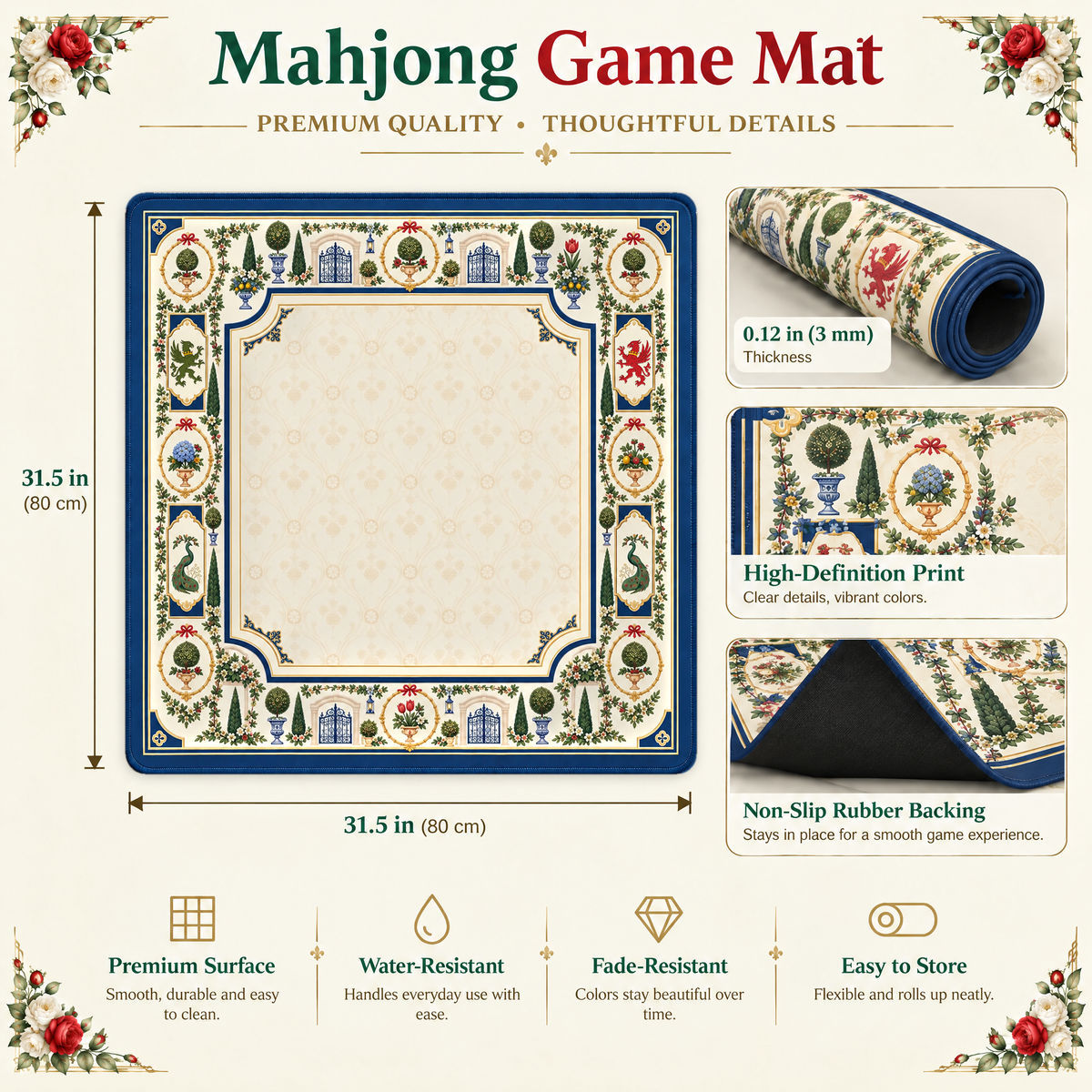
A mat or playing surface. A cloth or rubber mat keeps tiles from sliding, reduces noise, and marks each player's discard area. If you're playing at Wright-Patterson's community center or someone's dining room table, ask if a mat is provided; if not, a standard mat costs far less than the set and lasts years.
Racks with pushers (optional but recommended). Racks hold your hand vertically so others can't peek, and pushers help you nudge tiles without dropping them. Beginners find racks invaluable for staying organized and building confidence. They also prevent accidental "table talk" reveals.
The current year's National Mah Jongg League card (required). You cannot play American mahjong without it. Buy or print one; many clubs provide it. Learn to read it before your first game using how to read the mahjong card.
Our mahjong mats and racks with pushers are designed for exactly this beginner setup. You don't need them immediately, but adding them after your first game transforms your comfort and speed.
How long until I can play a real game?
Most new players are ready for their first real match after one practice round (30 minutes of setup, shuffling, and one hand). Three to five practice hands, and you'll know the rhythm. The real learning curve is months, not days. You'll improve tile speed in 4–6 weeks, hand-reading in 8–10 weeks, and strategic discard choices over a season. But you can play now—today. Expect to lose your first dozen games; everyone does. The joy is in the learning, not the score.
✨ Find your Mahstead set — free US shipping →
What to check before you buy your first set
Tile size & weight. Hold tiles for 10 minutes without hand fatigue. Acrylic sets weigh less than bamboo; both are fine. Avoid sets where tiles are smaller than a postage stamp.
Engravings or printing. Engravings last years under table wear; printing can fade. Check a sample tile under table light (not just bright showroom light).
Storage clarity. Your set should arrive with a box that holds all 160 tiles plus rack dividers. If not, you'll lose tiles within months. Mahstead sets ship in organized storage designed for beginner keeping.
Spare tiles. Confirm the set includes backups. Over a year, you will crack or lose one tile. Extras prevent mid-game panic.
Joker vs. blank distinction. Jokers must be visually distinct from blanks (spares). If they look identical, you'll confuse them during play.

FAQ
Can I play American mahjong at military bases outside Wright-Patterson?
Yes. Nearly every large military community—Fort Hood, Camp Lejeune, Joint Base Pearl Harbor-Hickam, and others—hosts active mahjong groups. Contact your base community center or recreation office to find a player list or standing game.
Do I need to memorize the entire hand card before my first game?
No. Keep the card in front of you during play. After 10–15 games, you'll recognize common patterns without looking; after a season, muscle memory kicks in. Beginners who memorize first waste weeks on low-value hands.
What's the difference between American mahjong and the mahjong my grandmother played?
Your grandmother likely played Chinese or Hong Kong mahjong, where chows (sequences like 1-2-3) are core and you can call exposed groups from anyone's discard. American mahjong uses no chows, plays only from a legal hand-list, and requires an annual card. Strategy and pace are totally different.
How much does a beginner set cost?
See current price on our best-selling mahjong sets product page. Beginner sets start accessible and hold value for years if stored in their cases.
If I lose a tile, can I keep playing with 151?
No. A legal game is always 152 tiles plus 8 jokers. If you lose one, you cannot win that hand. That's why buying a set with spares matters—swap in a backup, finish the game, then replace the lost tile.
Is the Charleston required, or can we skip it?
The Charleston is required before every game. It randomizes your starting hand and is part of the official rules. Skipping it gives unfair advantage to the dealer. Learn it first; it's the hardest part for beginners, but after two games it's automatic.
Can I play online or do I have to play in person?
Both exist. Online platforms exist for asynchronous play; live games are face-to-face at clubs, bases, and homes. Beginners learn fastest in person because you see tile recognition, discard strategy, and table culture in real time.
What if my local group plays a house rule I haven't heard of?
Ask. House rules vary by region and club. Common ones: whether you can show a tile before accepting it in the Charleston, or whether "fishless" (no winning tile left in the wall) is a dead hand or a win. Get clarity before money changes hands.


View More
View More
View More
