
What to Look for in a Mahjong Travel Bag
Last updated: Nov 23, 2026
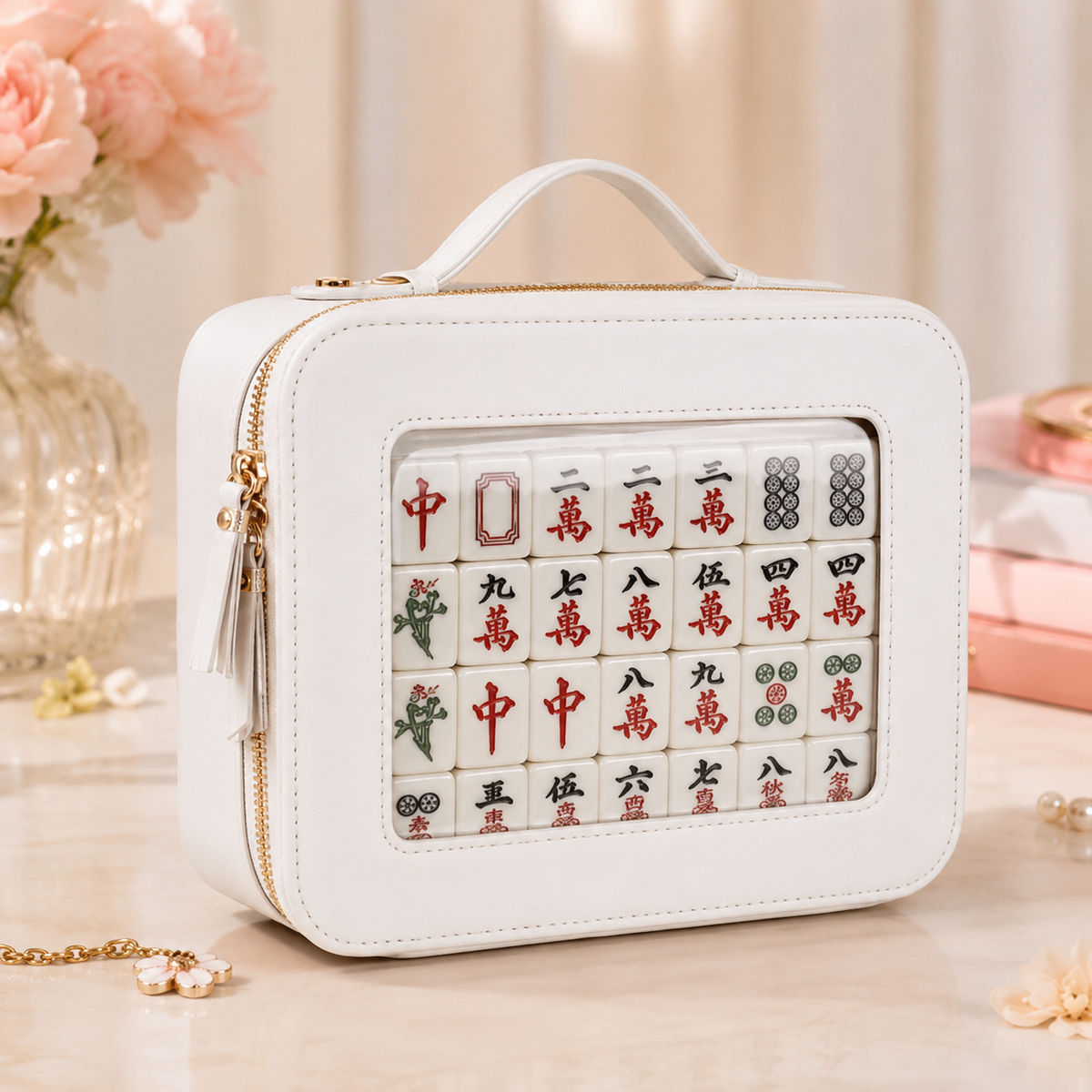
A mahjong travel bag is a padded carrying case designed to hold a complete 160-tile acrylic set, racks with pushers, a mat, and dice in separate compartments. Your choice depends on how often you travel, whether you host games at home or take your set on the road, and how much gear you carry. Most travel bags accommodate a standard acrylic set plus a rolled mat and one or two racks; some have expandable sections or external pockets for score sheets and pushers. The key is checking internal dimensions against your specific set and mat size before ordering—a mat that's 30" × 30" won't fit a bag designed for 24" × 24" tiles. Mahstead's travel bag collection includes designs with reinforced handles, internal dividers, and ventilation, each built for different use cases: casual weekend play, regular league games, or frequent traveling between homes.
A good mahjong travel bag is a padded carrying case designed to hold a complete 160-tile acrylic set, racks with pushers, a mat, and dice in separate compartments. Your choice depends on how often you travel, whether you host games at home or take your set on the road, and how much gear you carry. Most travel bags accommodate a standard acrylic set plus a rolled mat and one or two racks; some have expandable sections or external pockets for score sheets and pushers. The key is checking internal dimensions against your specific set and mat size before ordering—a mat that's 30" × 30" won't fit a bag designed for 24" × 24" tiles. Mahstead's travel bag collection includes designs with reinforced handles, internal dividers, and ventilation, each built for different use cases: casual weekend play, regular league games, or frequent traveling between homes.
Do you need a travel bag or a table cover?
Travel bags are rigid or semi-rigid cases with shoulder straps or handles; they're built for transport and storage in closets or car trunks. Table covers (also called mats) stay on the table during play and protect the surface underneath. If you're playing only at home and your table isn't precious, a mat alone works fine. If you move your set between locations—different friends' homes, clubs, or your two residences—a travel bag is non-negotiable. Many of us use both: a mat for at-the-table protection and a bag for transport. Choose a bag if you travel more than twice a month; otherwise, store your set in its original box with bubble wrap.
🀄 Shop best-selling mahjong sets →

What size bag do you actually need?
A 160-tile American set in its base form is compact: acrylic tiles stack about 5–6 inches high in the tile holder, and racks are roughly 10 inches long. Your real constraint is the mat. Standard Mahstead mats come in 24" × 24" and 30" × 30" sizes. A 24" × 24" mat rolls to about 24 inches long and 4 inches in diameter; a 30" × 30" mat rolls to 30 inches long and about 5 inches in diameter. A bag claiming "fits a complete set with mat" should have internal depth at least 32 inches (to hold a rolled 30" mat) and width at least 15 inches to accommodate the set container and racks side-by-side. Measure your existing mat or check Mahstead's mat sizing guide before ordering. Bags marketed as "compact" often hold tiles and racks only—fine if you'll carry your mat separately or play at a single venue. Oversized bags (36"+ depth) invite overpacking and are awkward to lift; avoid them unless you're transporting multiple sets.
What material lasts and handles moisture?
Travel bags are typically canvas, nylon, or faux leather. Canvas breathes but absorbs water and stains; nylon resists moisture and cleans easily but can feel flimsy in cheap versions; faux leather looks polished and wipes clean but can crack in cold weather. Acrylic tiles are durable but sensitive to humidity and temperature swings—tiles can warp or become sticky in high moisture. A good travel bag has a water-resistant exterior, sealed seams, and ventilation slots to prevent condensation inside. Avoid bags with vinyl-only interiors that trap moisture. If you live in a humid climate or transport your set between air-conditioned and hot spaces, prioritize nylon or sealed canvas with breathable vents. We've seen plenty of bags that work fine for a year then fail at the zipper or handle; look for reinforced stress points and double-stitched seams in product photos before checkout.

How should compartments be organized?
The best layouts include a main tile compartment (padded, with a rigid base so tiles don't get crushed), separate slots for two racks (or a single larger pocket), a mat pocket (ideally along the side or back to keep weight balanced), and exterior pockets for dice, pushers, score sheets, and the current-year National Mah Jongg League card. Some bags have a transparent window pocket—helpful for checking contents without opening the bag. Avoid bags with a single cavernous cavity; tiles and racks will shift during travel, and racks can bend. A divider or flexible separator between the tile holder and rack slots prevents them from sliding into each other. Interior pockets should be deep enough that small items don't fall out when you tilt the bag. If you also carry engraved American mahjong sets as gifts or backups, you'll want a bag with two separate tile compartments or one large enough to stack two tile holders. Check the listing photos closely; many bags advertise "four pockets" but only two are sized for actual mahjong gear.
What makes a bag durable for weekly play?
Durability hinges on zipper quality, handle reinforcement, and base construction. Full-length zippers that split the bag in half are more convenient than partial zippers but create a point of failure; reinforced slider zippers rated for heavy use are non-negotiable. Handles should be padded and attached with heavy-gauge stitching into a reinforced base panel—not just glued to the exterior. The bottom should have a rigid board or thick padding so the bag doesn't collapse when set on the ground. Feet or corner guards prevent wear on fabric. We've noticed bags that hold up beautifully for two years then split at a zipper or handle in year three; those usually skimped on stitching or used a single-layer zipper. Mahstead's mahjong bags and cases guide covers materials in depth, but the short version: if the product photos show reinforced seams and thick padding, and the description mentions sealed seams or double-stitched handles, it's a safe bet. Read reviews carefully for real-world failure modes—handles ripping, zippers sticking, padding compressing—not just praise.
Feature | Casual Player | Weekly Leaguer | Road Warrior |
Bag type | Soft canvas or nylon | Semi-rigid nylon | Rigid hard-shell or reinforced canvas |
Interior organization | Single tile pocket, one rack slot | Two rack slots, mat pocket, dice holder | Three+ compartments, exterior weatherproofing |
Mat size supported | 24" × 24" or mat not included | 30" × 30" rolled | 30" × 30" rolled, expands for backup mat |
Weight empty | Under 2 lbs | 2–3 lbs | 3–4 lbs |
Handle style | Single strap or handles | Padded dual handles | Padded dual handles + shoulder strap option |
Durability priority | Style over structure | Balanced | Maximum reinforcement at stress points |
Best for | Occasional play at home | Weekly games at friends' homes | Multi-city play or frequent venue changes |
What to check before you buy
Measure your mat. If you already own a mat, measure it rolled (length and diameter) and unrolled (width and length). If not, assume a standard Mahstead 30" × 30" mat—it's our most-bought size. Match the bag's internal depth to at least the rolled length plus 2 inches.
Verify tile compartment size. Most acrylic tile holders are 8–10 inches square. The bag's main pocket should be at least 12 inches wide and 6 inches deep to prevent jamming or crushing tiles during removal.
Count actual compartments. Ignore marketing language like "multi-pocket"; look at product photos and count separate, padded sections. You need at least three: tiles, racks, mat. Bonus: external pockets for dice and the League card.
Check zipper construction. Photos should show a continuous, sturdy slider. If the listing doesn't specify the zipper, assume it's standard-grade and may fail in year 2–3 of weekly play.
Test the return policy. Good sellers allow 14–30 days to open, inspect, and return. Mahstead includes return options in checkout; verify the timeline before you buy.
Look for ventilation. Tiny drainage holes or mesh vents in the bottom or corners prevent moisture buildup—especially important in humid climates.
Check handle attachment. Photos should show stitching that extends into a reinforced base panel, not just surface glued. If you can't see stitching clearly, ask the seller for close-up images.
🎁 See our most-loved mahjong sets & accessories →
Don't buy a travel bag until you know whether you'll carry a 24" or 30" mat, how many racks you typically take, and whether you host games or travel to them. A bag that's perfect for Friday-night rotation at friends' homes is too small for weekend tournaments; conversely, a tour-grade case is overkill if you play once a month in your living room. Once you know your travel pattern, prioritize seam quality and zipper construction over color or pockets—you'll forgive a dull bag that lasts five years faster than you'll forgive a pretty one that splits in two.
✨ Find your Mahstead set — free US shipping →

FAQ
Can I fit a 30" × 30" mat in a bag designed for a 24" × 24" mat?
No. A 30" × 30" mat rolls to approximately 30 inches long and 5 inches in diameter; most "24" bags" have internal depth under 28 inches. Forcing a larger mat will compress tiles, strain zippers, and make the bag harder to close. Measure your mat first, then verify bag depth.
What if my acrylic tiles come in a rigid case—do I need to remove them for the bag?
Not necessarily. If your tile case is under 3 inches tall and fits flat in the bag's main pocket, you can leave tiles in it. However, most travel bags assume you'll remove tiles from their original box to save space and weight. Check the bag's tile-compartment dimensions against your case height before ordering.
Should I store my mahjong racks with pushers inside the bag full-time or remove them between games?
Remove them. Racks should be stored flat and dry to prevent warping. Leaving them in a sealed bag for weeks can trap moisture and bend the wood or plastic. Store racks flat in a drawer or shelf, and pack them into the bag only when you're about to travel.
Do travel bags come with dividers or do I need to buy them separately?
Most Mahstead bags include basic internal compartments; some have removable or adjustable dividers. Check the product listing to see whether dividers are included. If you're adding custom compartments, thin foam sheets (available at fabric or craft stores) can be cut to fit and secured with non-permanent adhesive tabs.
Can I wash the inside of my travel bag if tiles get dusty?
Yes, but carefully. Use a soft brush or vacuum with a low-suction hose to remove dust from fabric or mesh. For stubborn debris, wipe with a barely damp cloth (not soaking) and air-dry fully before packing tiles back in. Never machine wash or soak a travel bag; water can degrade padding and cause mold inside tile compartments.
What's the difference between a travel bag and a mahjong case?
A travel bag typically uses soft or semi-rigid materials, padded compartments, and external handles for casual transport. A case is usually hard-shell plastic or wood, locks, and is designed for long-term storage and professional transport. For weekly games and travel between homes, a bag is lighter and easier to carry; for tournament play or multiple backups, a case offers more protection.


View More
View More
View More
