
4 Dot Mahjong Tile Meaning & Role in American Play
Last updated: Nov 23, 2026
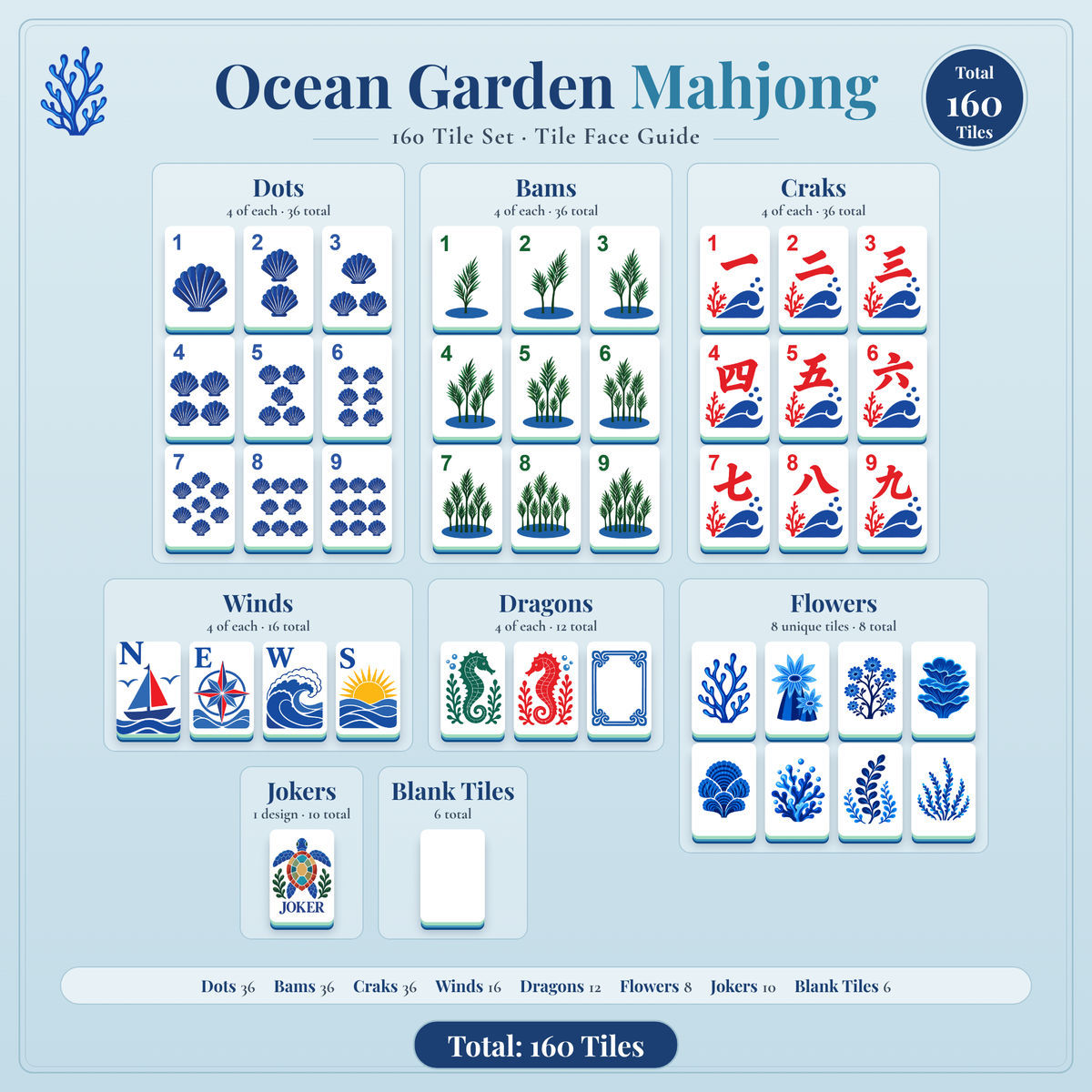
In American mahjong, the 4 Dot is one of nine Dot suit tiles (1–9), represented by four circular symbols on each of the four identical 4 Dot tiles in the set. It has no special power or ranking—Dots are simply one of three suits, alongside Bams and Craks—but its mid-range position (4 of 9) makes it moderately common in hand-building situations. A hand containing 4 Dots earns points only if those tiles appear in a valid combination (pung, kong, or pair) listed on the current year's National Mah Jongg League card; the tile itself has no intrinsic score. Players often hold or discard 4 Dots depending on what hand pattern they're chasing and what other players are claiming. Every 160-tile American mahjong set, like those from Mahstead, includes four 4 Dot tiles to ensure fair play across all four players.
The 4 Dot is one of the workhorse tiles in American mahjong—unremarkable by itself, yet central to dozens of winning patterns. Unlike the 1 Bam (which often bears a bird symbol) or special wind and dragon tiles, the 4 Dot announces itself plainly: four dots, no ornament. But that simplicity is part of its power. Because it sits neither at the edge (1–2 Dots, rarer in some hands) nor at the premium end (8–9 Dots, often wanted late-game), the 4 Dot becomes a tactical tile—one that players hold, exchange, or surrender based on pattern recognition and position.
Understanding the 4 Dot's role in a hand teaches you how American mahjong differs from other variants. In Chinese, Hong Kong, or Riichi mahjong, tiles like 4 Dot have ranking or points baked into the rules themselves. American mahjong flips this: every tile is neutral until it matches a pattern on the card. The 4 Dot is "worth" something only when grouped into a pung (three identical 4 Dots), kong (four identical 4 Dots), or pair (two 4 Dots) and that group appears in a hand listed on the current year's card. No hand on the card? No points, no win.
What does a 4 Dot tile look like, and where is it found?
The 4 Dot tile displays four small circular dots arranged on its face, typically in a square or diamond pattern depending on the tile manufacturer's design. In a full 152-tile American mahjong set, there are exactly four identical 4 Dot tiles (one for each player). They're part of the Dot suit, which runs 1–9 and includes 36 tiles total (four copies of each number). Visually, 4 Dots sits between 3 Dots and 5 Dots; the difference is immediate and easy to spot during the fast pace of play, which is why new players rarely confuse it with other Dot values. Most 4 Dot tiles are engraved or printed with black symbols on a light background, though design varies across our best-selling mahjong set styles.

How does the 4 Dot score in a winning hand?
The 4 Dot tile itself carries no inherent point value in American mahjong. Instead, points come from the hand pattern on the National Mah Jongg League card that contains one or more 4 Dot tiles. For example, a hand might require a pung of 4 Dots (three 4 Dot tiles together) plus two other groups and a pair; if you meld exactly that pattern, you win and score the points listed beside that hand description on the card—often 30 or 50 points depending on the year and hand complexity. The 4 Dot contributes to the win only as part of a legal combination. A single 4 Dot, or two 4 Dots, or five 4 Dots scattered across your hand with no matching pattern, earn zero points and cannot form a winning hand by themselves. This is why reading the card and spotting patterns is the core skill in American mahjong, not memorizing tile values.
Why do players hold or discard the 4 Dot strategically?
Players decide whether to keep or discard a 4 Dot based on three factors: the hand patterns they're chasing, the tile count remaining in the wall, and the tiles other players are claiming. Early in the game, during the first few turns, a 4 Dot might stay in your hand because it fits multiple possible patterns on the card. As the game tightens and you commit to one or two target hands, the 4 Dot either becomes essential (if your chosen hand requires a 4 Dot pung or sequence) or expendable (if your target hand has no Dots at all). A skilled player also watches which Dots other players are claiming; if East player has picked two 4 Dots already, the remaining 4 Dot tiles become less available, which changes the probability that a 4 Dot pung is achievable and thus affects your decision to hold or drop one. New players often discard 4 Dots early out of habit rather than strategy, only to regret it later when a hand pattern suddenly requires them. Conversely, holding too many 4 Dots (or any single number) clogs your hand and blocks flexibility.

How does the 4 Dot fit into the three suits?
American mahjong's three suits—Bams, Craks, and Dots—each contain nine ranked tiles (1–9), creating 27 "number" tiles and 108 of the 152 standard playing tiles (the rest are winds, dragons, flowers, and jokers). The 4 Dot's position as a mid-value Dot tile mirrors the 4 Bam and 4 Crak in structure. In hand-building terms, mid-range numbers (4, 5, 6) often appear in "run" or progression-style hands on the card—though in American mahjong these must be achieved through separate groups (pung or kong), never a single exposed sequence. The 4 Dot carries the same probability as any other numbered tile: four copies per suit, one suit out of three. This balance is why the 4 Dot is neither "lucky" nor "cursed"—it is strategically neutral until the card and the game state make it relevant.
How does the 4 Dot differ in other mahjong variants?
In Chinese mahjong and Hong Kong mahjong, the 4 Dot is a basic tile with low point value (typically 1–2 points per combination), and players may form open sequences (chows) like 3–4–5 Dots that can be claimed from discards. In Riichi mahjong (Japanese), the 4 Dot holds no special rank but is scored only when combined into specific melds as part of a hand that also satisfies a yaku (hand pattern requirement). In Taiwanese mahjong, scoring often involves tile bonuses (e.g., a 4 might be worth more if it's a player's lucky number that round), an element absent from American mahjong. American mahjong strips away all of these: no open sequences allowed (except for specific exposed pungs, kongs, quints, and sextets), no hand-independent tile bonuses, and points entirely derived from the card-listed pattern. This means the 4 Dot is equally mundane and useful across all four players—no cultural or numerical ranking applies—making American mahjong more accessible to beginners who might otherwise stumble over superstition or number symbolism.
Scenario | Should You Hold a 4 Dot? | Why |
Turn 1–2, hand has 2 Dots already | Yes, tentatively | Multiple hand patterns may fit; gather data before committing. |
Turn 5+, chasing a "2468" hand pattern (no Dots) | No | Discard it; it blocks your flexibility. |
East player has claimed three 4 Dots | No | Probability of a 4 Dot pung drops sharply. |
Your hand shows "4 Dot pung + 5 Crak pung + …" on card | Yes, actively | This tile directly builds your target hand. |
Wall shows 8+ tiles remain, hand still undecided | Yes | Extra wall tiles increase your draw chances; hold options open. |
🀄 Shop best-selling mahjong sets →
What to check before you buy a mahjong set with clear, readable Dot tiles
When choosing a mahjong set, ensure the Dot tiles—including 4 Dots—are large enough to read at arm's length during rapid play. Smaller or low-contrast sets can slow the game and cause misreads. Look for sets where the dot symbols are deeply engraved or high-contrast printed; acrylic sets with engraved symbols hold their clarity through hundreds of plays. If your table has poor lighting or players with vision challenges, prioritize sets with larger tiles (typically 1.5 inches or wider per tile). Test a tile in hand before committing; the weight, balance, and symbol contrast all affect gameplay comfort. Our engraved American mahjong set designs are sized for standard play and custom-engraved for permanent legibility, and each includes a full 152 playing tiles plus spares.
🎁 See our most-loved mahjong sets & accessories →
Grasping the 4 Dot's role in American mahjong—neutral until matched, strategic only in context—builds your pattern-reading intuition and deepens your play. The 4 Dot is a reminder that American mahjong is a game of combination, card literacy, and table position, not tile superstition. Once you internalize that the 4 Dot is just a puzzle piece waiting for the right hand outline, you'll hold it or discard it with confidence.
✨ Find your Mahstead set — free US shipping →

FAQ
Is the 4 Dot tile special or lucky in American mahjong?
No. The 4 Dot has no inherent rank, score, or luck. It earns points only when it matches a pattern on the current year's card. All numbered tiles (1–9 across three suits) are mechanically equal; strategy and card reading determine its value, not superstition.
Can I use the 4 Dot to make a sequence like 3–4–5 Dots?
No. American mahjong does not allow open sequences (chows). You may only form and expose pungs (three identical tiles), kongs (four identical), quints (five), and sextets (six). A 3–4–5 combination violates the rules.
How many 4 Dot tiles are in a standard mahjong set?
Exactly four 4 Dot tiles (one for each player) appear in every 160-tile American mahjong set. This ensures balanced play; every player has equal access to the tile throughout the game.
What's the difference between a 4 Dot and a 4 Bam or 4 Crak?
Visually, a 4 Dot shows four circles, a 4 Bam shows four bamboo stalks, and a 4 Crak shows four coins. Mechanically, they are identical—all three are mid-range suit tiles—and each appears four times in the set. The suit symbol tells you which suit group it belongs to.
Can jokers replace a 4 Dot tile in a hand?
Jokers can substitute for missing tiles in a pung, kong, or higher group (quint or sextet) if the hand pattern on the card allows it. However, jokers cannot form a single tile by themselves or a pair; they are wild substitutes only within a larger combination that includes at least one natural (non-joker) 4 Dot tile.
How do I know if my target hand needs a 4 Dot?
Read the National Mah Jongg League card for the current year. Locate your target hand and check which suit tiles it lists (Bams, Craks, Dots, or all three). If the hand requires any Dot tiles, check whether it specifies 4 Dots or a range that includes 4. If the hand shows only Bams and Craks, 4 Dots are not needed and should be discarded.


View More
View More
View More
