
What Is Same Tile in American Mahjong
Last updated: Nov 23, 2026
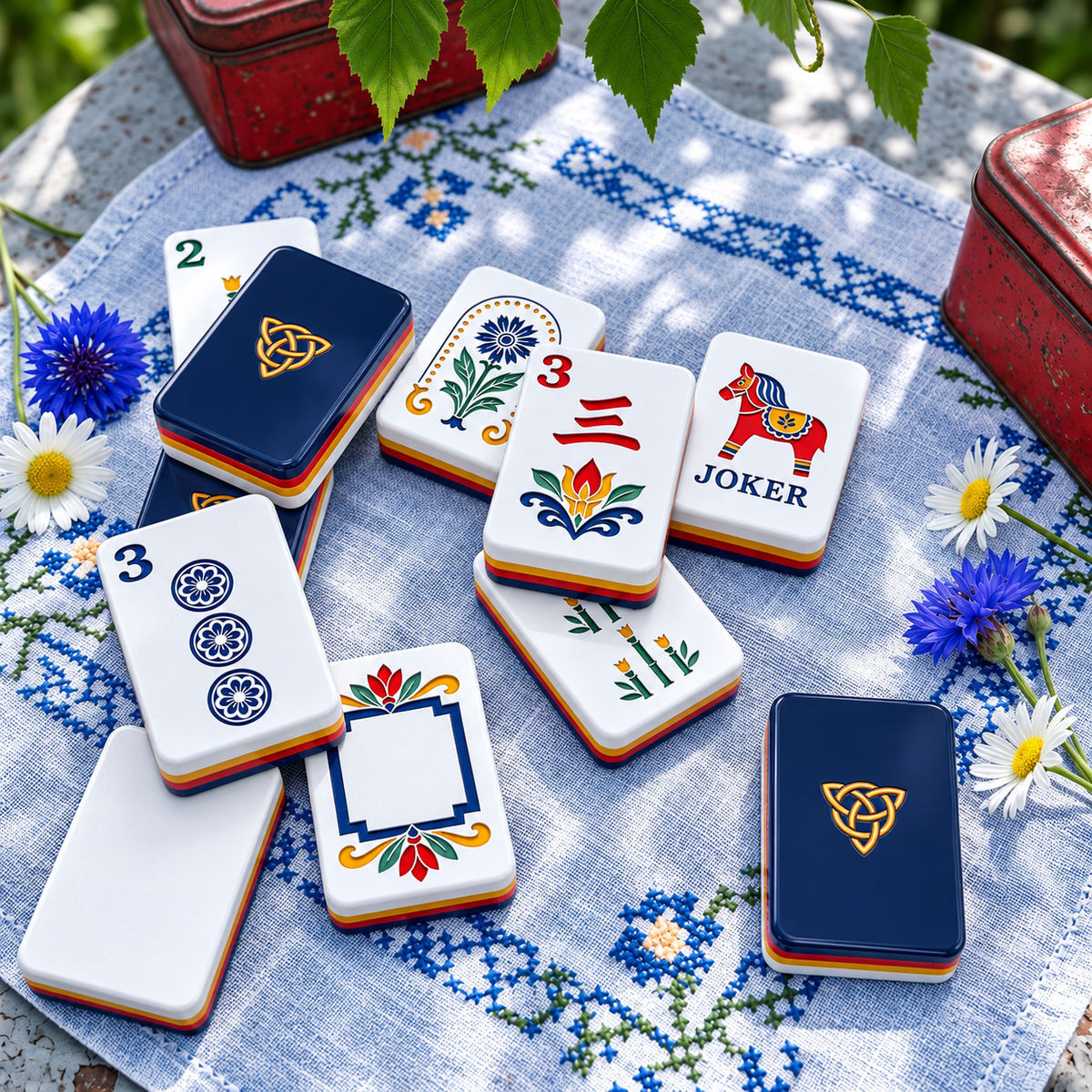
A "same tile" in American mahjong means two or more tiles that are absolutely identical: same suit (Bam, Crak, or Dot), same number (1–9), and same image. The standard deck contains four copies of every numbered tile, plus four each of winds and dragons. You use same tiles to build pungs (three identical), kongs (four identical), quints (five identical), and sextets (six identical)—the only exposable melds in American mahjong. Unlike Chinese variants, American mahjong does not allow sequences or chows; every exposed group must consist of same tiles only. Jokers can substitute for any tile within a group but cannot form a single tile, a pair, or any group by themselves. If you expose tiles, they must be genuine same tiles or jokers standing in for them. This rule is why the best-selling mahjong sets come with exactly four of each tile—so you and three other players can each hold or play any tile at once.
Why does American mahjong require same tiles only?
American mahjong evolved from Chinese and Riichi variants but adopted a hand-based system tied to the National Mah Jongg League card, issued each spring. The card lists legal hands—all of which consist only of same-tile groups (pungs, kongs, quints, sextets) plus pairs. This design prevents the confusion of calling sequences and makes hands standardized and verifiable. Every legal hand on the card can be checked instantly by counting identical tiles. No sequences means no ambiguity about whether a tile "belongs" in a run; if you see three tiles together, they must be the same Dot, the same Crak, or the same Bam.

What tiles count as identical?
Two tiles are identical if they match suit, number, and artwork exactly. A 5 Bam and a 5 Crak are different tiles; so are a 5 Bam and a 5 Dot. The winds (North, East, West, South) are four separate identities—all Norths are identical to each other, but a North and an East are different tiles. The same applies to dragons: all Red dragons match each other, all Green dragons match each other, and all White (Soap) dragons match each other. Flowers are typically one identity per set, so all flowers are interchangeable in some variants, though American rules treat them as a single tile type. When you hold or play a tile, you're working with one of four copies in the deck; when you see another player's tile, you know there are three left in the deck—or fewer, if others have already played them.
How do jokers replace same tiles?
A joker is a blank tile that can stand in for any single tile you need within an exposed group (pung, kong, quint, or sextet). If you expose three 7 Dots and you hold a joker, you can swap the joker in and play one of your other tiles. The joker then belongs to that group and stays exposed on the table. Jokers do not create same-tile groups by themselves: you cannot play three jokers as a valid pung. You cannot use a joker as a single tile or a pair. This restriction keeps jokers as helpers, not shortcuts. When you look at an opponent's exposed group, count the same tiles and jokers together; if there are three real 9 Craks and one joker, that's a valid kong-equivalent. Our 160-tile sets include 8 jokers plus spare tiles so you always have enough for substitution without losing game integrity.
Scenario | What counts as same tile? | Can a joker help? | Why or why not? |
Three 2 Dots | Identical tiles, same suit & number | Yes, joker replaces one | Pung valid with or without joker |
2 Dot, 2 Crak, 2 Bam | Different suits, different identities | No | Not same tile; joker cannot bridge suits |
Four 4 Dots | Identical tiles × 4 | Yes, joker replaces any one | Kong valid; can also have 3 + joker |
Three Norths | Identical winds | Yes, joker replaces one | Wind pung valid with or without joker |
5 Dot + joker | One real, one joker | Only if the joker represents a 5 Dot | Pair + joker is invalid; joker cannot form pair alone |

What mistakes do players make with same tiles?
The most common error is thinking you can use a sequence. In American mahjong, a 3 Bam, 4 Bam, and 5 Bam are three different tiles and do not form a valid group. You cannot expose them or call them unless the current year's card specifically lists them as a valid hand (which it won't, because American mahjong does not allow chows). A second mistake is trying to make a group with tiles that look similar but are not identical—for instance, mixing a 1 Dot (usually shown as a single dot) with any other Dot number. Every numbered tile 1–9 has a distinct image; sameness requires the exact same image. A third error is leaving a joker in your hand and thinking it counts toward your hand composition. Jokers in your hand are just helpers; they only "work" when you substitute them in an exposed group during play. Until then, they are not part of your tile count toward a specific hand. Fourth: players sometimes assume a joker can be part of a pair. It cannot. If you need a pair of 8 Dots, you must hold two real 8 Dots; a joker + 1 real 8 Dot does not count as a pair.
🀄 Shop best-selling mahjong sets →
How do you verify same tiles on the card?
The National Mah Jongg League card lists every legal hand for the current year. When you mark a hand as a goal, you're committing to collecting the exact same-tile groups shown. Each line on the card specifies the suit, number, and quantity (e.g., "Pung of 3 Bams," "Kong of Red Dragons," "Quint of 5 Dots"). Read the card section by section: Consecutive numbers form a pung/kong/quint/sextet of those numbers, all in the same suit. Identical honors (winds, dragons) form same-tile groups by definition. Once you collect all tiles in your target hand during play, you declare "Mahjong" and lay down the entire hand for the table to verify. Your hand is valid only if every group matches the card exactly: correct suit, correct numbers, correct count, and correct use of jokers (if any). Verifying takes seconds if everyone understands that same tiles must be identical in every respect. If you're unsure whether a tile in your hand matches a tile on the table, ask the table; a single mismatch invalidates the hand.
🎁 See our most-loved mahjong sets & accessories →
What to check before you buy
Tile clarity. Order a set with clear, bold imaging on each tile so identical tiles are unmistakable at a glance. Acrylic sets with engraved or embossed tiles eliminate fading and make same-tile verification instant.
Joker count. A standard 160-tile set includes 8 jokers—enough for most games. If you play four-person American mahjong regularly, eight jokers is the norm and should never be a constraint.
Set completeness. Verify your set contains exactly four of each numbered tile (Bams 1–9, Craks 1–9, Dots 1–9), four each of the winds, four each of the dragons, and eight flowers. Any shortage of same tiles breaks the game.
Storage after play. Use a mahjong bag or case to keep tiles from getting lost, marked, or mixed with other sets. Same tiles in a damaged or incomplete set are useless.
✨ Find your Mahstead set — free US shipping →
FAQ
Can a 1 Bam and a 1 Dot be used as the same tile?
No. A 1 Bam (usually shown as a bird image) and a 1 Dot are different tiles. They belong to different suits. Same tile means identical suit, number, and image. You cannot mix them in any group.
If I hold one joker and two 6 Dots, do I have a pung?
Yes. Three identical tiles—two real 6 Dots plus one joker standing in for a 6 Dot—form a valid pung. You can expose it or keep it hidden until you need to meld.
Why can't I use a joker as a single tile in my hand?
American mahjong rules restrict jokers to substitution within groups (pungs, kongs, quints, sextets) or as exposed melds. A joker alone is not a tile; it's a placeholder. Without a group to fill, it has no value and cannot help you win.
Are all White dragons the same tile?
Yes. All four White dragons (sometimes called Soap) are identical tiles. Any other White dragon is interchangeable with any other. They form a single-suit pung, kong, or larger group just like numbered tiles do.
What if I think I see two different versions of the same number—say, two 5 Dots that look slightly different?
Check the tile size, shade, and image. In a new set, every tile of the same number should be identical. If two 5 Dots look different, one may be worn, marked, or from a different set. Do not mix sets during play. If the difference is only wear, both tiles still count as the same; if the image or character differs, you may have a damaged or mislabeled tile and should replace it.


View More
View More
View More
