
What Does the Soap Tile Look Like in Mahjong?
Last updated: Nov 23, 2026
The Soap tile is a blank or plain white square—the White Dragon—one of three dragon tiles in American mahjong (Red, Green, and White). It appears once in the what's in an American mahjong set as four identical copies, like all American tiles. The Soap tile pairs visually with the Dots suit and numerically represents zero when a hand calls for a 0 in a sequence. Unlike jokers, the Soap cannot substitute for any tile; it only appears in specific hands listed on the current year's National Mah Jongg League card. On an acrylic set from Mahstead, it has the same smooth finish and weight as all other tiles, making it indistinguishable to touch until you see its blank face.
The Soap tile—formally called the White Dragon—is one of the most misunderstood pieces in American mahjong. New players often confuse it with jokers, while seasoned players know it's essential to completing certain hand patterns. Understanding what it is, how it looks, and when to use it can be the difference between a winning hand and a missed opportunity.
Where exactly is the Soap tile on a mahjong set?
The Soap tile sits among the dragon tiles, alongside the Red Dragon and Green Dragon. In a standard American mahjong set, you'll find 12 dragon tiles total: four Red, four Green, and four White (Soap). On most sets—including best-selling mahjong sets—the Red Dragon displays a red symbol, the Green Dragon a green symbol, and the White Dragon appears as a blank face or minimal marking. When you open a 160-tile set, the dragons occupy their own visual section separate from the four numbered suits (Bams, Craks, Dots, and flowers). The Soap sits physically in the tile rack like any other tile, taking up one space.
🀄 Shop best-selling mahjong sets →

Does the Soap tile look different across American mahjong sets?
Yes. The appearance varies by manufacturer and design choice. Some sets show the White Dragon with a thin border and completely blank center; others add a subtle etched line or symbol. On hand-painted ceramic sets, Soap tiles sometimes have a faint character or pattern. On acrylic sets from Mahstead, the Soap tile is cleanly molded as a solid, uniform white piece with no engraving—it reads immediately as "blank" from any angle. Design sets with engraved American mahjong titles never engrave the Soap tile itself (it must remain blank to function as zero), but the rest of the set carries custom text. The key: all Soap tiles in a regulation American set are identical to one another, so mixed-origin tiles will never match perfectly.
Why is it called "Soap"?
The nickname "Soap" comes from the Yiddish word tseifes, referring to something white or blank. American players, many of whom learned the game from Jewish families in the mid-20th century, adopted the colloquial term alongside the formal name White Dragon. It stuck in casual play because it's faster to say—"I need a Soap" rather than "I need a White Dragon." The term appears in club play across the U.S., though newer players sometimes only hear the formal name from instructional materials or the National Mah Jongg League. Both names refer to the exact same tile.

How does the Soap tile function in a hand versus a joker?
This is where confusion peaks. A joker can stand in for any tile you need; a Soap tile is a specific tile with a specific function. The Soap only appears when a hand on the current year's card explicitly calls for a "0" (zero) in a numerical position. For example, a hand might list "0-1-2 Dots / 0-1-2 Craks," meaning you must play literal Soap tiles in those zero slots—not a joker or a Red Dragon. Jokers, by contrast, are wild and can fill gaps anywhere. You cannot use the Soap as a joker, and you cannot substitute a joker for a Soap in a hand that requires it. Once locked into a specific hand, the Soap tile is locked; jokers remain jokers. This is why reading the how to read a mahjong card guide matters: the card tells you exactly when Soap appears and when jokers apply.
🎁 See our most-loved mahjong sets & accessories →
What happens if you mistake a Soap for a joker or vice versa?
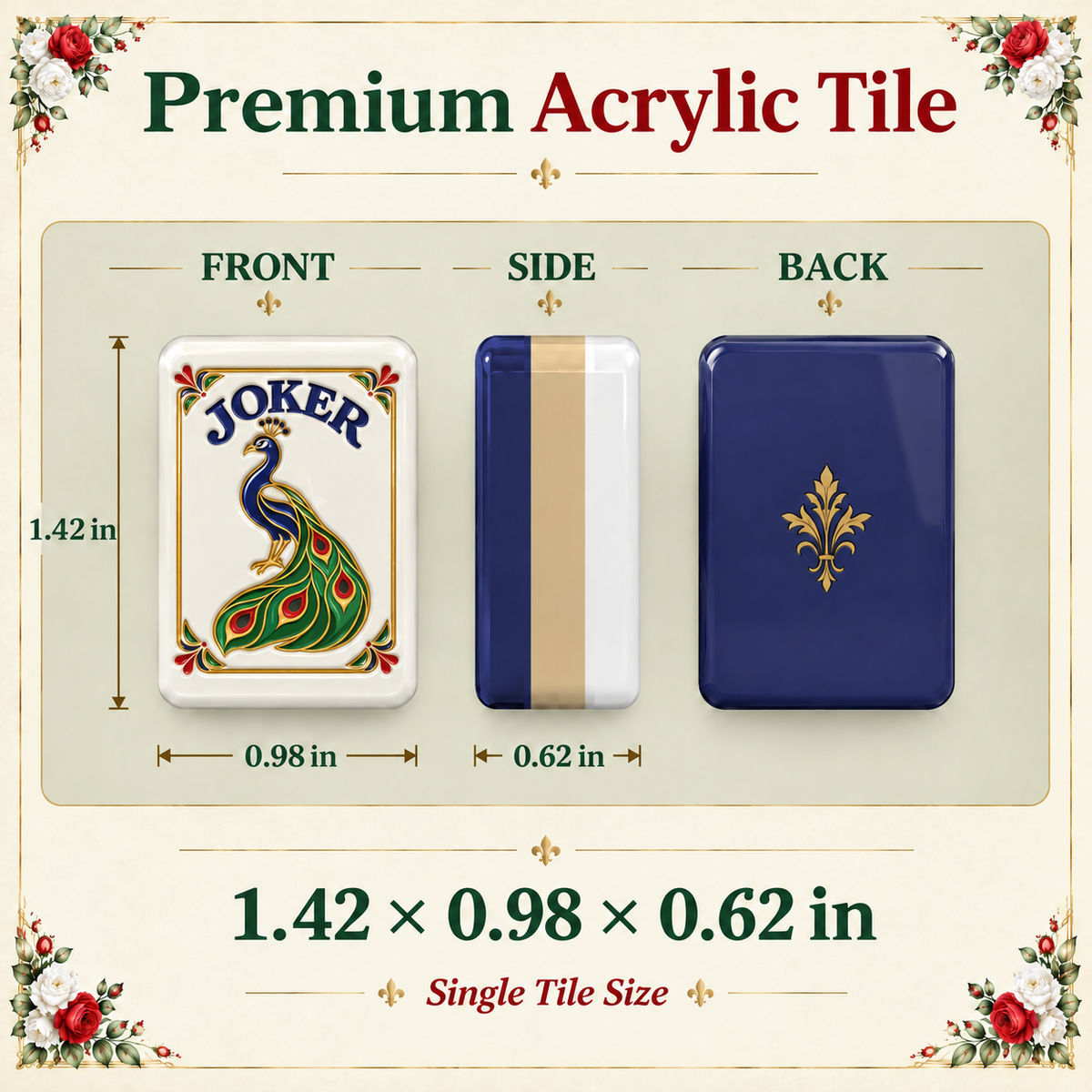
Common error: a player sees a blank tile and assumes it's a wild joker. Result: they build the wrong hand or commit to an impossible pattern. At the table, this usually surfaces when someone declares ready and the hand is audited—if a Soap is in the wrong place, the hand is dead and play moves to the next player. To avoid this, familiarize yourself with the set's design before the first hand; know how many jokers have a symbol (they always do) versus how many Soaps are blank. In a 160-tile acrylic set from Mahstead, jokers come clearly marked with "Joker" text and often a decorative graphic, while the four Soaps are plain white—the contrast is immediate. Never assume; ask the game host or check the tile set documentation at the start of play. Mixing up these two categories is one of the top five beginner mistakes in American mahjong.
Quick reference table: Soap vs. Joker vs. other dragons
Tile | Appearance | How many | Function | Can substitute |
Soap (White Dragon) | Blank white face | 4 | Stands only for zero in specific hands on current card | No—appears only where explicitly listed |
Red Dragon | Red symbol or character | 4 | Pairs with Craks; appears in hands on current card | Only if hand calls it |
Green Dragon | Green symbol or character | 4 | Pairs with Bams; appears in hands on current card | Only if hand calls it |
Joker | Printed "Joker" + symbol | 8 in standard 160-tile set | Substitutes for any tile | Yes—fills any gap anywhere |
✨ Find your Mahstead set — free US shipping →
What to check before you buy
When ordering a set, verify the tile count. A 160-tile set contains 152 playing tiles (four of each: Bams 1–9, Craks 1–9, Dots 1–9, all four winds, all three dragons, all eight flowers) plus eight jokers, totaling 160. The four Soap tiles are included in those 152. If you receive a set and the Soap tiles don't match the rest in weight, finish, or color, contact the seller; they should be uniform. For mahjong mats and racks with pushers, confirm these are compatible with your tile size; smaller tiles require proportional equipment. Always unpack and inspect before your first game; if a Soap tile is chipped or discolored, request a spare tile set.

FAQ
Is the Soap tile the same as a blank tile?
Yes. In American mahjong, "Soap tile" and "blank tile" refer to the same piece—the White Dragon. It is never engraved and has no symbol. All four Soap tiles in a set are identical blanks.
Can I use a Soap tile as a joker?
No. A Soap tile only appears when a hand on the current year's National Mah Jongg League card explicitly calls for a zero. You cannot substitute it elsewhere or use it as a wild joker. Jokers are separate tiles.
Why does the Soap tile pair with Dots?
The three dragon tiles each pair with one suit: Red goes with Craks, Green with Bams, and White (Soap) with Dots. This pairing is arbitrary but consistent across all American mahjong games and hands on the annual card.
How many Soap tiles are in a standard American set?
Four. Like all tiles in American mahjong (except flowers and jokers), the Soap appears exactly four times in a 152-tile deck. This allows players to build matching sets (pungs or kongs) if a hand calls for them.
What if my set has a Soap tile that looks different from the others?
This indicates a defective or mismatched tile, possibly from a different set or manufacturer. All four Soaps should be identical in color, finish, and weight. If buying from a trusted maker, request a replacement or spare tile set.
Does every American mahjong hand use a Soap tile?
No. Only hands that include a "0" (zero) position on the current year's card require Soap tiles. Many hands do not call for zeros at all, so Soap tiles may sit unused in that game. Check the card each season, as hand patterns change yearly.


View More
View More
View More
