
What Does the Season Tile Look Like in Mahjong?
Last updated: Nov 23, 2026
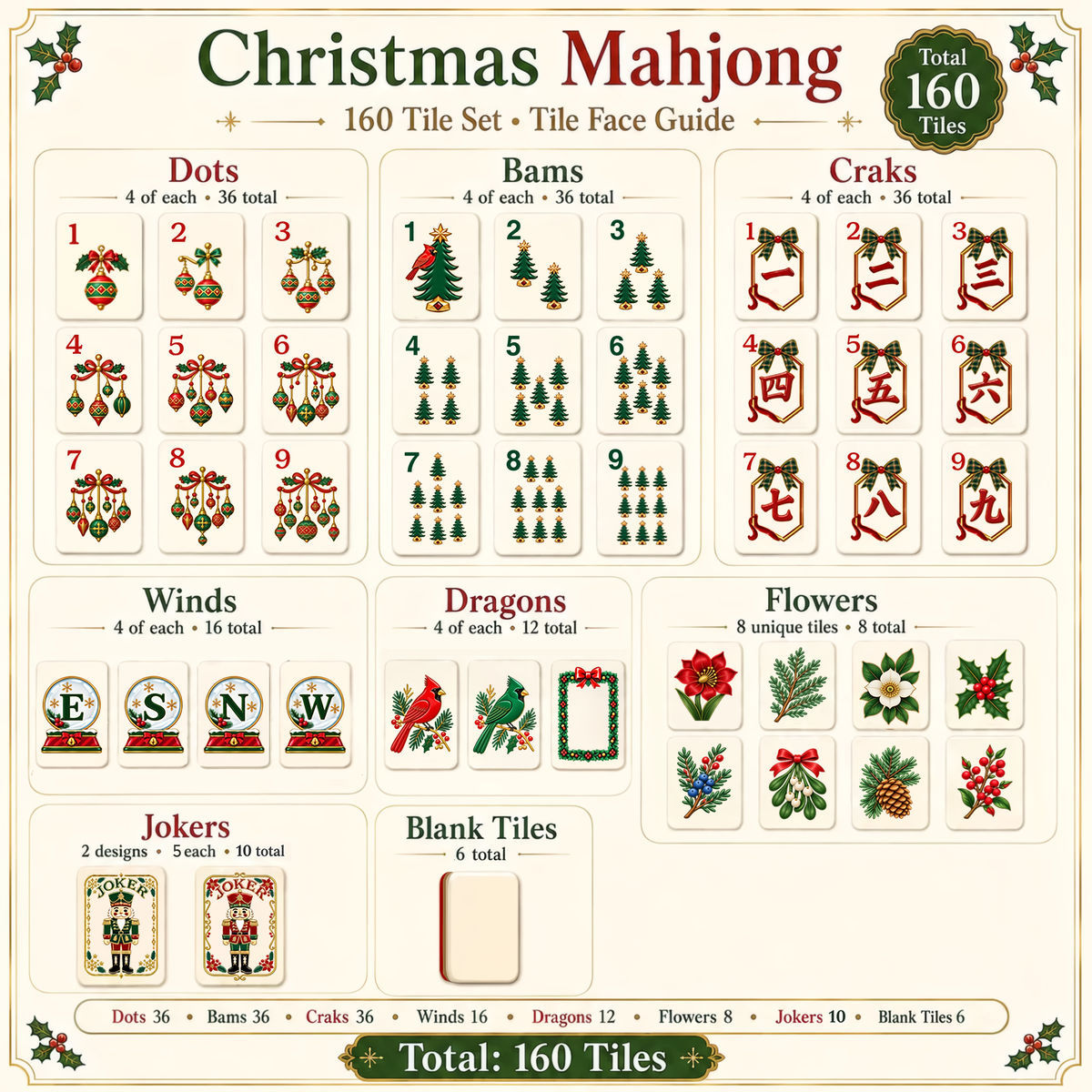
In American mahjong, there are eight bonus tiles total: four season tiles and four flower tiles. The season tiles are numbered 1 (spring), 2 (summer), 3 (autumn), and 4 (winter), each adorned with a stylized symbol representing that time of year—plum blossoms, a lotus or bird, chrysanthemums, and bamboo respectively. Unlike winds or dragons, you cannot use season tiles to build melds in your hand; instead, you draw them as replacement tiles during play and score them immediately per the current year's National Mah Jongg League card. Each season tile typically adds 4 points to your final hand score when exposed on the table. Players often confuse seasons with flowers because both are bonus tiles, but they're distinct: flowers pair with directions (1 Flower = East, 2 = South, etc.), while seasons stand alone. Quality sets, like those from our best-selling mahjong sets collection, feature clear, high-contrast engravings so season symbols are instantly recognizable across a table. 🀄 Shop best-selling mahjong sets →
What do the four season symbols actually look like?
Spring (1) traditionally shows a plum blossom or flowering branch—a delicate floral motif symbolizing renewal. Summer (2) often depicts a lotus flower or a small bird in flight, representing warmth and abundance. Autumn (3) displays chrysanthemums, the hardy autumn bloom, sometimes with leaves. Winter (4) features bamboo stalks or a simple geometric pattern suggesting frost and dormancy. On tile faces, these images are rendered in miniature, so clarity matters. Acrylic tiles with deep engravings hold ink in the grooves, making symbols pop; flat-printed tiles fade with handling. When you're selecting a set, examine the season tiles under light—you should instantly recognize each symbol without squinting or referring to the box.

How are season tiles different from flower tiles?
Both bonus tile types appear in American mahjong and consist of four individual tiles, but they function differently. Flower tiles (also called flower tiles or bloom tiles in some contexts) are numbered 1–4 and paired with compass directions: 1 Flower = East, 2 = South, 3 = West, 4 = North. Season tiles are independent; they don't pair with directions. On the National Mah Jongg League card, both are listed separately in scoring sections. When you draw either a season or a flower tile, you immediately lay it face-up, replace it from the wall, and score according to the card—but the scoring values differ. Flower tiles typically appear in hands requiring "flowers" or "bonus" combinations; season tiles appear less frequently in hands but can complete specific bonus-heavy patterns. Beginners often shuffle them mentally until they see them side by side in a quality set. What's in an American mahjong set explains both in detail.
🎁 See our most-loved mahjong sets & accessories →
Do all mahjong variants include season tiles?
No—season tiles are specific to American mahjong and some Asian variants. Chinese Classical (Hong Kong style) includes seasons alongside flowers, but uses them differently in hand composition. Riichi mahjong and Taiwanese mahjong do not use season or flower tiles at all; they rely entirely on numbered suits, winds, dragons, and honor tiles. Japanese mahjong adds 8 tiles called "flowers" (kamicha style) but does not include a separate "season" category. If you're learning American mahjong specifically, expect season tiles; if you travel abroad or play online with players from other regions, verify the ruleset first. The National Mah Jongg League card (updated annually, issued in spring) governs all season and bonus tile scoring for American play. Understanding which variant you're playing prevents frustration when a friend insists "we don't use those" or claims different scoring. Our how to play American mahjong guide clarifies variant rules.
How much are season tiles worth in scoring?
Per the National Mah Jongg League card, each season tile you expose typically scores 4 points when drawn during play and laid on the table. However, scoring values vary by specific hand combination; some hands require seasons as part of a bonus pattern and score higher if completed. The card is released fresh each spring and contains all legal hands for that year—no season tile combinations exist outside the current card. If you draw a season tile during play, you must lay it down, draw a replacement tile from the wall, and immediately note the points if your hand calls for it. Beginners mistake season scoring as a "freebie"; instead, seasons only count if your hand specifically includes a bonus section that requires them. Consult the current card or ask a seasoned player at your table if you're unsure whether your hand scores a particular season. Knowing this prevents costly scoring disputes.

What to check before you buy
Feature | Why it matters | What to look for |
Engraving depth | Symbols wear smooth on low-quality tiles | Run your thumb across the 1–4 season faces; grooves should catch slightly |
Contrast | Faded symbols become unreadable mid-game | Test under table lighting; symbols must be visible from 6 feet away |
Set completeness | Missing even one tile breaks the game | Verify all 8 bonus tiles (4 seasons + 4 flowers) in the box before playing |
Material (acrylic vs. resin) | Acrylic holds engraving longer; resin can blur | Ask the seller; acrylic sets from Mahstead retain clarity for years |
Size consistency | Small or oversized bonus tiles are awkward | All tiles should stack evenly and fit standard racks with pushers |
High-quality acrylic sets hold their detail through hundreds of games; cheaper plastic tiles blur season symbols within a season. If you're hosting weekly games, invest in a durable best-selling set so your season tiles remain instantly recognizable.
Why season tiles matter for beginners
New players often overlook season tiles because they appear less frequently than winds or dragons. However, recognizing them instantly during play speeds up the game and prevents misdeclares. A misdeclare—calling "mahjong" when your hand doesn't match the card—triggers a penalty and damages table rhythm. When you know what seasons look like, you spot them immediately upon drawing, lay them correctly, and resume without hesitation. Experienced players test newcomers partly by watching their tile-reading speed; handling seasons confidently signals that you've studied your set. If you're joining a weekly game, spend 15 minutes with your tiles beforehand: look at each season, say its number and symbol aloud, and practice laying it on your rack. This muscle memory prevents costly pauses.
✨ Find your Mahstead set — free US shipping →
Choosing a set with season tiles you'll love
When shopping for an engraved American mahjong set, pay special attention to how season symbols are rendered. Some designs use traditional brush-stroke imagery; others use modern geometric or stylized icons. If you're hosting a weekly game, select a set whose bonus tiles match the aesthetic of your entire collection—clashing seasons look sloppy on the table. Acrylic sets allow deep engraving, so symbols stay crisp; consider storage in a quality mahjong bag or case if you transport your set regularly. Seasons fade fastest on the spine edge due to handling, so inspect that area closely. If you play year-round, your season tiles earn heavy use; don't skimp on material quality. Mahstead's 160-tile acrylic sets include all bonus tiles with professional-grade engraving, so seasons remain legible through years of play.
Season tiles in online and live play
If you play mahjong online or in live tournaments, season tile recognition becomes even more critical because digital interfaces may render them differently than physical tiles. In live play at a club or competitive venue, verify the set in use before sitting down; ask which variant and confirm the bonus tiles. Some casual games omit seasons entirely or play house rules that reassign their value. Always check the current year's National Mah Jongg League card before each session—no exceptions. When playing with unfamiliar sets, spend two minutes handling the bonus tiles and asking "Is this the summer season?" to a veteran. Online platforms vary: some hide season tiles until drawn, while others highlight them in color. Adapt your reading speed accordingly. The core principle remains: know what each season looks like, and know when it scores in your hand.

FAQ
Can I use season tiles to build a pung or kong?
No. In American mahjong, season tiles are bonus tiles only—you cannot meld them. When drawn, you lay them down immediately and take a replacement tile from the wall. They appear only as standalone exposures or as part of specific bonus-tile hand patterns on the card.
Do season tiles have the same back design as regular tiles?
Yes. The back of a season tile is identical to every other tile in the set—usually a solid color or decorative pattern. The only difference is the face (the numbered side with the symbol), which makes seasons instantly recognizable the moment you flip them.
What happens if I accidentally draw a season tile and forget to expose it?
If you keep a season tile in your hand unannounced, it's a dead hand and play stops. You must expose season and flower tiles immediately upon drawing. If you forget, alert the table as soon as you notice; house rules vary on penalty, but typical play voids the hand and restarts.
Are season tile symbols the same in all American mahjong sets?
Symbols follow traditional imagery (plum, lotus/bird, chrysanthemum, bamboo), but artistic renderings vary by manufacturer. Mahstead sets use consistent, clear engravings across designs so symbols remain recognizable. Check the product photos to see how seasons are rendered before purchasing.
Can I score a season tile if my hand doesn't call for it?
No. Season tiles only score if your current hand combination—as listed on the National Mah Jongg League card for that year—explicitly includes a bonus-tile section. If you draw a season but your hand doesn't require it, you still must expose and score it per the card, but it won't contribute to your final score unless the hand pattern includes bonus combinations.
How do I tell a season tile from a flower tile at a glance?
Season tiles are numbered 1–4 and show natural symbols (plum, lotus, chrysanthemum, bamboo). Flower tiles are also numbered 1–4 but are marked differently on the face (usually with a flower pot, vase, or stylized bloom icon). Mahstead's high-contrast engravings make this distinction clear, so you'll never confuse them mid-game with a quality set.


View More
View More
View More
