
What Does the 8 Dot Tile Look Like in Mahjong?
Last updated: Nov 23, 2026
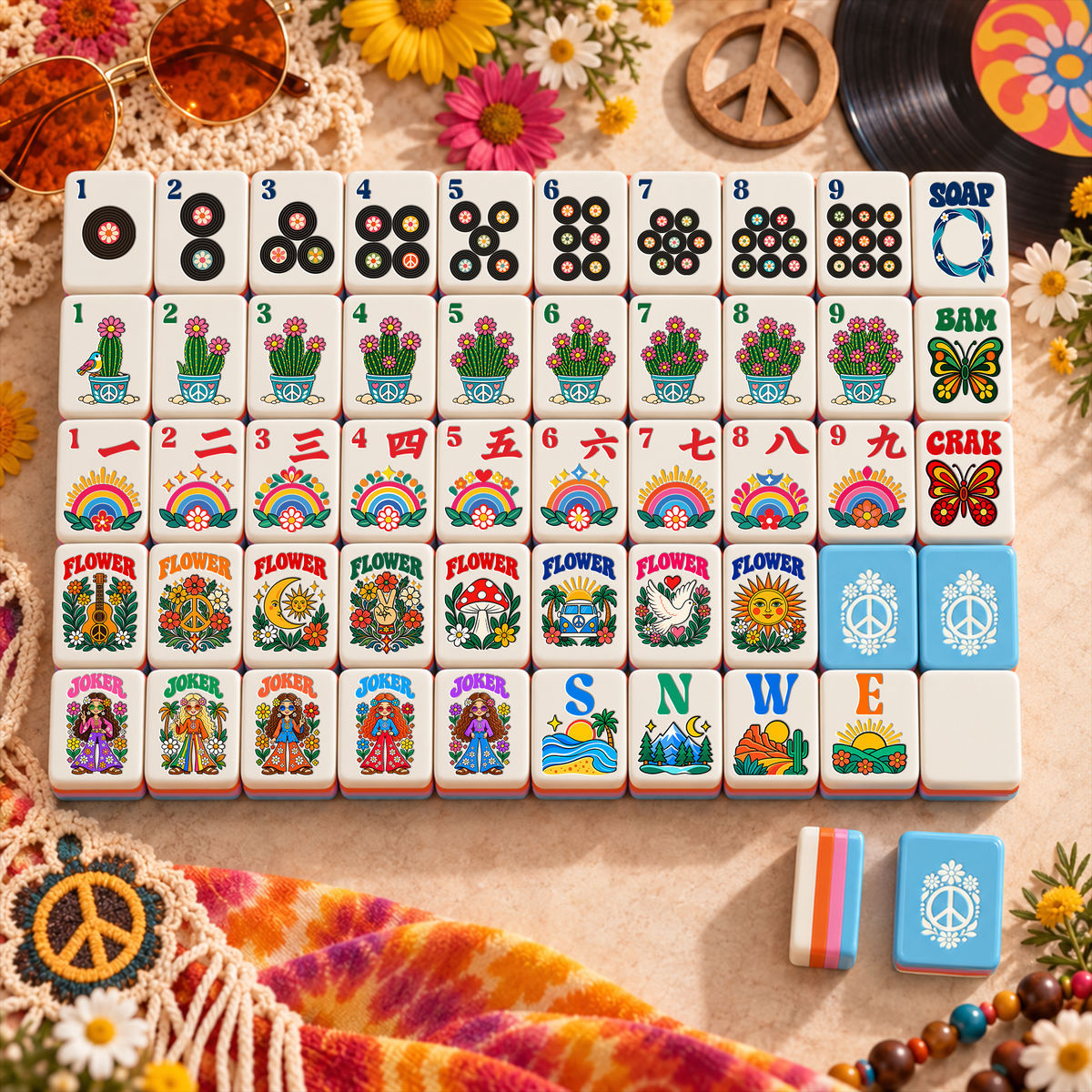
The 8 Dot tile displays eight red circles (or pips) arranged in a grid pattern on a white or cream-colored background, depending on your set's design. It belongs to the Dot suit—one of three numbered suits in American mahjong, alongside Bams and Craks. Each suit runs 1–9, and every number exists in four copies within a standard 152-tile game. The 8 Dot appears frequently in hand patterns on the National Mah Jongg League card; because it sits mid-range numerically, it often bridges consecutive groups or stands as part of matched sets. On quality acrylic sets, the red pips are crisp and easy to read under table light, which matters during fast play. If your tiles feel slippery or the pips blur together, upgrade to sets with engraved surfaces that grip your fingers and print.
The 8 Dot is one of 36 numbered tiles in the Dot suit—one of three core numbered suits in American mahjong, alongside Bams and Craks. Each suit runs from 1 to 9, and every number exists in four identical copies within a standard 152-tile game, meaning four 8 Dot tiles are in play. In American mahjong, we use only the current year's National Mah Jongg League card to build hands, and the 8 Dot fills many patterns—from consecutive runs to matched pungs. Knowing what it looks like instantly helps you scan your rack faster and call winning hands without delay.
Why Is the 8 Dot Red, Not Black?
The Dot suit always appears in red, while the Bam suit prints in black or dark color, and the Crak suit typically uses black outlines with colored accents. This color convention—red for Dots, black for Bams—has been standard in American mahjong for decades. The red color makes Dots easier to distinguish at a glance during rapid play. If you've played Chinese or Hong Kong mahjong, Dots there are also traditionally red, so the visual carries across variants. When you're holding 14 tiles and need to spot the 8 Dot among Bams, Craks, winds, and dragons, that red pop saves seconds.

How Are the Eight Pips Arranged on the Tile?
The 8 Dot displays eight small circles (pips) in two columns of four, or in a 2×4 grid, centered on the tile face. This arrangement follows the traditional pattern used in playing cards and dominoes, making it instantly readable even from arm's length across the table. The pips are proportionally sized to the tile—large enough to see clearly, but small enough that eight fit without crowding. On engraved acrylic tiles, the pips have sharp edges and sit slightly raised, so light reflects off them and contrast jumps out against the white or cream base. Cheap tiles with flat or faded printing make the pips blur into the background; after an hour of play, your eyes tire and you misread the number.
What's the Difference Between a 7 Dot and an 8 Dot?
The 7 Dot shows seven pips in a slightly sparser arrangement (often 3–4 in one column, 3–4 in the other), while the 8 Dot fills two columns with four pips each, creating a denser, more symmetrical look. At a glance, 7 feels sparse and 8 feels full. If you're new to the game, the jump from 7 to 8 to 9 (which wraps all pips densely) becomes muscle memory within a few games. The 9 Dot is the densest: typically a 3×3 grid of nine pips, nearly filling the tile face. Confusion between 7 and 8 rarely happens once you've sorted your rack once; the pattern difference is obvious under any reasonable table light.
How Often Does the 8 Dot Appear on the Mahjong Card?
The 8 Dot and other numbered tiles are core building blocks on the National Mah Jongg League card each year. Because there are 36 numbered tiles (3 suits × 9 numbers × 4 copies), and hands often use pairs, pungs, kongs, and quints of numbers, most games feature multiple instances of the 8 Dot in winning patterns. The card changes every spring, so the exact frequency shifts yearly; but in our weekly games, we see the 8 Dot in roughly 40–50% of winning hands—sometimes as a pair, sometimes as part of a pung or kong. High-frequency tiles like mid-range numbers (5, 6, 7, 8, 9) tend to be safer building blocks than extremes like 1 and 9, which are locked into edges of sequences. This makes the 8 Dot a workhorse tile if you're learning to read the card.

Can You Mix 8 Dot Tiles from Different Sets?
Yes, you can mix tiles from different manufacturers or sets, provided they're all American mahjong tiles and the same size (typically 1.25 inches or 1 inch for travel sets). However, mixing creates practical headaches: tiles with different finishes (engraved vs. smooth, acrylic vs. plastic) feel different in your hand and make gripping consistent harder; colors or pip clarity may drift, causing momentary hesitation when reading your rack under poor light; and if one set wears faster than the other, the mixed set becomes unreliable. We recommend keeping one complete, cohesive best-selling set and replacing all tiles together when wear shows, rather than patching in tiles from older games. A unified set also makes choosing a matching mat and rack easier—they're designed to work as a system.
🀄 Shop best-selling mahjong sets →
What to Check Before You Buy a Mahjong Set
When shopping for a set, verify:
Tile clarity: Print or engraving is sharp and readable at arm's length.
Suit colors: Red Dots, black Bams, black Craks are standard; confirm the seller's design matches.
Set completeness: 152 playing tiles + 8 jokers are mandatory; anything less is incomplete.
Tile size: Standard American mahjong tiles are 1.25 inches; travel sets are 1 inch. Check your table and hand size.
Finish: Engraved acrylic grips better than smooth plastic and lasts longer under weekly play.
Storage: Does the set come in a sturdy bag or case? This protects tiles during transport and extends their life.
A high-quality set costs more upfront but saves money over years of play because you won't need replacements.
Feature | Budget Set | Mid-Range Set | Premium Set |
Tile finish | Smooth plastic | Engraved acrylic | Engraved acrylic, special finishes |
Pip clarity | Flat, may fade | Raised, sharp | Raised, crystal-clear |
Durability (years) | 1–2 | 3–5+ | 5–10+ |
Comfort in hand | Slippery | Grips well | Grips excellently |
Storage included | Bag only | Bag + rack options | Bag, case, mat options |
🎁 See our most-loved mahjong sets & accessories →
Why Tile Quality Matters for Game Speed
During a real game, you hold 13 or 14 tiles and need to identify each in under a second. If pips are unclear, tiny, or faded, you'll squint, pause, and slow the table. Smooth tiles slip out of your hand unexpectedly—embarrassing and disruptive. Engraved tiles grip your fingers, stay in place, and let you move quickly. Our weekly games run about 2–3 hours for four players; poor tile quality turns that into 3–4 hours because every draw and discard stalls. Over a season, a quality set saves you dozens of hours and makes the game enjoyable instead of frustrating. We've seen groups replace cheap sets after one season and never look back.
✨ Find your Mahstead set — free US shipping →
Learning to Read the Full Tile Suit Hierarchy
Once you recognize the 8 Dot, spend time with the full Dot suit pattern: 1 Dot (one pip, top-left usually), 2 Dot (two, top-left and bottom-right diagonal), 3 Dot (three, vertical line or diagonal), and so on through 9 Dot (dense grid). The Bam and Crak suits follow the same 1–9 sequence but in their own colors and symbols. Memorizing these patterns takes about three games if you play weekly. After that, tile recognition becomes automatic—you see the tile, your brain registers the number instantly, and you're back to strategy. Beginners often overthink tile identification; veterans spot the 8 Dot without conscious effort.

FAQ
What does an 8 Dot tile have in common with 7 Dot and 9 Dot?
All three are numbered tiles in the Dot suit, shown as red pips on a white background. They rank numerically 7, 8, 9 and appear in four copies each in a standard 152-tile set. They're often grouped in consecutive patterns on the mahjong card.
Can the 8 Dot appear in a pair, pung, or kong?
Yes. In American mahjong, you can form a pair (2 tiles), pung (3 identical tiles), kong (4 identical tiles), or quint (5 jokers standing in for tiles). The 8 Dot can be any of these, depending on the hand pattern on the current year's mahjong card.
Why don't some tiles look exactly alike even if they're from the same set?
Acrylic tiles are hand-assembled; slight variations in pip printing position or ink opacity are normal and invisible during play. If pips are illegible or tiles feel warped, that's a defect—contact the seller for replacement.
Is the 8 Dot the same in American, Chinese, and Hong Kong mahjong?
The symbol (eight red pips) is the same, but the games use different tile sets, hands, and rules. Chinese and Hong Kong mahjong have different total tile counts and hand structures. American mahjong is the version we play here in the US with the League card.
If I can't see the 8 Dot clearly during play, what should I do?
Ask another player to confirm the number—there's no penalty for double-checking. If you consistently misread tiles, the set may be low-quality or you may need better table lighting. Consider upgrading to an engraved set with a dedicated mahjong mat that includes built-in light-reflecting surfaces.
How does the 8 Dot help me win?
The 8 Dot is a neutral, mid-range tile that fits into many patterns on the mahjong card. Because four copies exist and it's not rare, you'll often have one available for your hand. Recognizing it quickly lets you spot winning combinations faster and call "Mahjong" before opponents.


View More
View More
View More
