
Vietnamese Mahjong Tips: Rules, Strategy & Setup Guide
Last updated: Nov 23, 2026
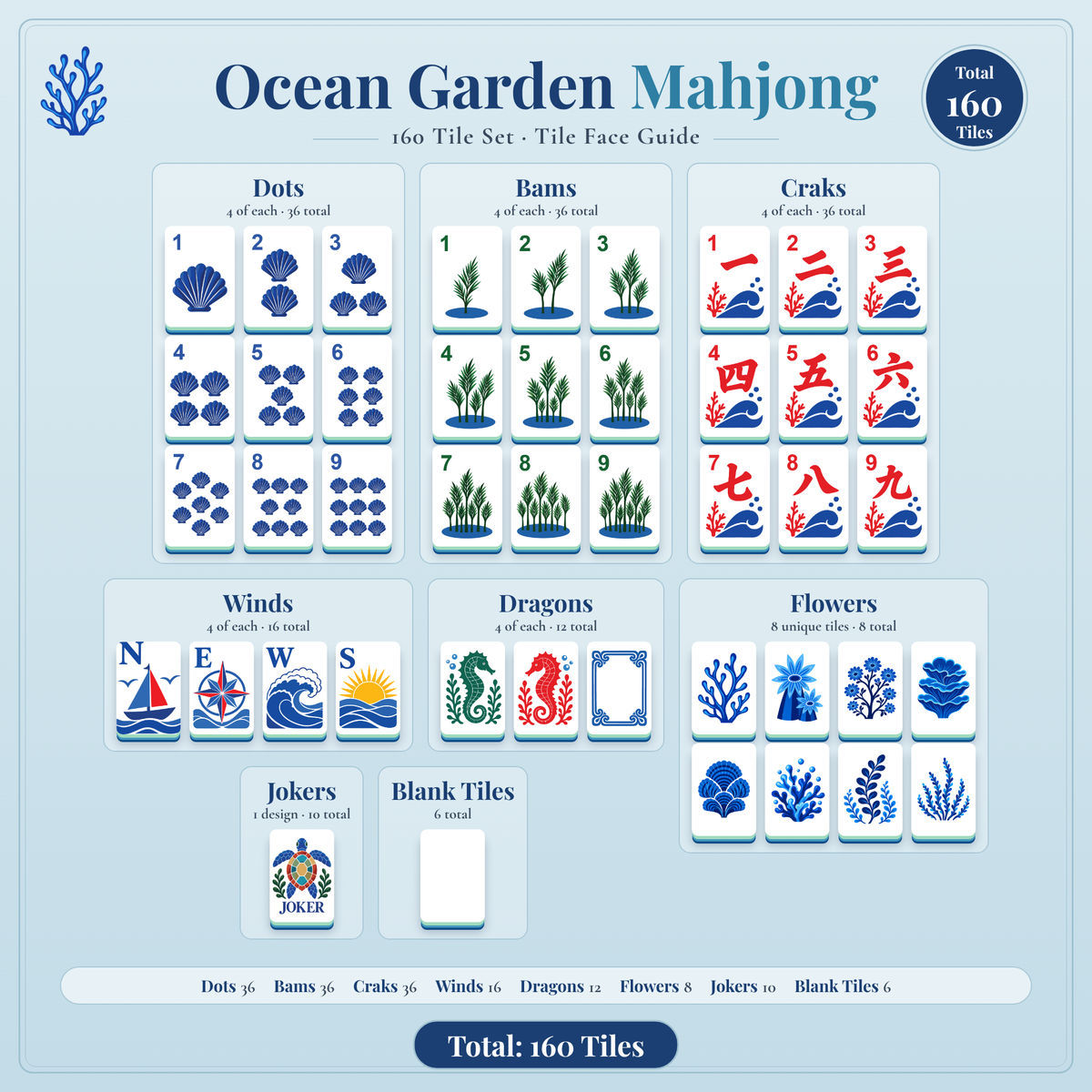
Vietnamese mahjong (Mah-Jongg Việt) uses 144 tiles—three numbered suits (Bams, Craks, Dots 1–9) plus winds, dragons, and flowers—scored by completed hand patterns, not a fixed card. Unlike American mahjong, which relies on an annual card and allows exposed melds only of pungs, kongs, and jokers in specific roles, Vietnamese mahjong permits chows (sequences of three consecutive numbered tiles in the same suit), exposed pungs (three identical tiles), and kongs (four identical tiles), giving players more flexibility in building hands. Games are typically shorter, rounds play faster, and the hand requirements vary by region and table rules. A standard set contains 144 tiles; no jokers are used. We recommend starting with a clear house rule sheet before your first game, since Vietnamese variants differ widely—some tables play "all simple tiles" (no terminals or honors), others add bonuses for all-one-suit hands. Focus on learning your group's specific rule set first, then master tile reading and discard strategy.
How Do Hand Patterns Differ from American Mahjong?
American mahjong requires hands to match patterns from the current year's National Mah Jongg League card—fixed combinations like "2 Pungs, 1 Kong, 1 Pair." Vietnamese mahjong is more organic: any combination of melds (chows, pungs, kongs) plus a pair wins. A chow is three consecutive tiles of the same suit—for example, 3 Bam, 4 Bam, 5 Bam. You can expose chows, pungs, and kongs by placing them face-up on the table; in American play, only pungs, kongs, and joker-based melds may be exposed. This fundamental difference means Vietnamese players build hands with many more paths to victory, but also requires sharper tile-reading and discarding discipline. Many Vietnamese tables also award bonus points for special hands: seven pairs, all one suit, all terminals, or concealed hands (drawn entirely from your own hand without exposure). Clarify your table's bonus rules before beginning—they significantly affect strategy.

What Tiles Do You Need and How Many?
A Vietnamese mahjong set contains exactly 144 tiles: 36 Bams (1–9, four copies each), 36 Craks (1–9, four copies each), 36 Dots (1–9, four copies each), 16 winds (four each of North, East, South, West), 12 dragons (four each of Red, Green, White), and 8 flowers (one through eight, one copy each—some sets duplicate flowers to reach 144). Because no jokers are used, every tile is live. The 144-tile count is strict; adding spare jokers would break the game. When shopping for a set, confirm it's labeled as 144 tiles, not 152 or 160 (those are American sets with extra jokers). Check that flowers are included—some budget sets skip them, which breaks hand-scoring rules at many Vietnamese tables. Look for clear tile markings, especially on honor tiles (winds and dragons), since they're smaller and harder to read at a glance. We stock engraved American mahjong sets in full sizes and our best-selling mahjong sets for reference on tile clarity and durability; many Vietnamese players upgrade to clearer acrylic sets after a season of play.
How Should You Organize Your Rack and Discard Piles?
In Vietnamese mahjong, tile order and visibility directly affect game speed and fairness. Arrange tiles on your rack by suit and number: all Bams left-to-right (1–9), then Craks, then Dots, then honors (winds, dragons, flowers). This layout lets you spot winning melds instantly and prevents accidental reveals. Many Vietnamese tables use a center discard wall: each player discards face-up in front of their position, in sequence, so all players can count and read discards equally. This differs from American practice, where discards often pile randomly. Keep your discard stack linear and spaced so others can count your discard history—crucial for tracking which tiles are safe to claim and which have been discarded twice (dead). Organize discards in rows of six, left to right, then wrap to a new row below; this pattern makes tile counting effortless. Use mahjong racks with pushers to keep tiles aligned and prevent accidental shifts; pushers help you move tiles cleanly without bumping neighbors' racks. A mahjong mat with marked discard zones (zones for each player's discard area) adds structure and speeds play, especially if your table is tight on space.
What's the Correct Order of Play and Claiming Rules?
Vietnamese mahjong follows turn order: East (dealer) draws first, discards, then South, West, North in order. After East's discard, the next player in sequence may claim that tile (or any discarded tile, per house rules) to complete a pung, kong, or chow, or anyone can claim to win (go out). Claiming for a chow is most often restricted to the player immediately after the discarder; claiming a pung or kong can come from any player in the discard order. When you claim a tile, you must immediately expose the meld (lay it face-up on the table with the claimed tile marked). After exposure, play passes to the next player in turn order, not to the person who claimed. This contrasts with American play, where only certain melds can be exposed and joker rules are strict. Never claim a tile silently and then decide later—once your hand touches it, the claim is binding. Always call out "chow," "pung," "kong," or "win" clearly so all players confirm. If two players claim the same discard, priority usually goes to the player closest in turn order: win beats kong beats pung beats chow. Lock your table's priority rules in writing before the first hand.
Which Tiles Should You Discard First and Why?
Your discard strategy is the engine of Vietnamese mahjong wins. In the opening round, discard honor tiles (winds, dragons, flowers) that don't match your hand trend, since drawing a matching pung is rarer than drawing number tiles. Next, discard extreme number tiles (1s and 9s—called "terminals") that don't complete a pair or meld; these are harder to use in chows. Middle tiles (4, 5, 6) are safest to hold early because they're flexible: they can form chows with many neighbors. As the game progresses, count discards carefully. If two rounds have passed and a certain tile (e.g., 2 Craks) hasn't been discarded, assume opponents are holding or building with it—discard cautiously. Track your opponents' claims: if East claimed a 5 Bam pung, don't discard any 5 Bam or tiles that could help East complete a kong. Watch for dead tiles (discarded twice in the same hand round); these are safe to discard again if you must, though most tables forbid it. The golden rule: discard oldest tiles first in early rounds, then shift to strategic discards based on the board state. Beginners often hold too many similar tiles; be ruthless about cutting low-probability melds by round four.

What Common Mistakes Do New Vietnamese Players Make?
Mistake | Why It Costs You | Fix |
Exposing a meld you didn't have to | Telegraphs your hand pattern and gives opponents free information | Claim only if it directly advances your win path or blocks an opponent |
Discarding in random order | Opponents read your hand progress; you lose control of the tempo | Discard strategically: honors first, then unmatched terminals, then middle tiles by suit |
Not counting discards | Can't track dead tiles or what opponents might hold | Count aloud every few rounds; use a second player to verify the discard count |
Mixing up honor tiles by shape alone | Misidentifies winds or dragons in fast play | Read tile characters carefully before drawing; use a set with large, clear engravings |
Claiming after hesitation | Other players assume you misread and may dispute your win | Call your claim immediately or stay silent; once you touch it, you own it |
The most costly error we see is over-exposing melds early. American players sometimes expose too quickly because they're used to the American card structure; in Vietnamese play, every exposed meld leaks information. Stay patient, hold concealed melds longer, and expose only when forced to claim or when you're confident in the win path.
How Does Scoring Work in Vietnamese Mahjong?
Vietnamese scoring awards base points for winning plus multipliers for hand quality. A basic win (any legal combination of melds plus pair) earns 1 point or 1 unit, depending on house rules. Bonus hands multiply that: all one suit (2×), all terminals (2×), seven pairs (2–3×), concealed win (3–4×), and some tables add bonuses for all simple tiles (no terminals or honors, 1.5×). If East wins, the payout is often doubled. Losers usually pay the winner equally, though some Vietnamese tables use a three-way split where the discarder pays double. Before sitting down, confirm your table's point scale: is 1 point a dollar, a chip, or 10¢? The multiplier cascade varies—some tables stack bonuses (all one suit + concealed = 4–6×), others apply only the highest bonus. Write the scoring rules on a card and place it in the center; disputes over scoring end friendships faster than bad tiles. Unlike American mahjong, where scoring is tied to the National Mah Jongg League card, Vietnamese scoring is entirely community-driven, so verify every rule with your host or group leader before the game starts.
What Should You Check Before You Buy a Vietnamese Mahjong Set?
Before purchasing, confirm these essentials:
Tile count is exactly 144 (not 152 or 160—those are American). Verify the set includes flowers (eight tiles, usually numbered 1–8 or 1–4 duplicated).
Tiles are clearly marked. Hold a set under light and read character tiles (winds, dragons, flowers) from arm's length; if you squint, others will too, and play will drag.
Weight and balance matter. Acrylic or bakelite tiles should slide smoothly on a mat without sticking; ceramic tiles are durable but wear table surfaces faster.
Storage is included or planned. A 144-tile set needs a bag or case to travel; loose tiles in a shoebox is a path to lost or damaged tiles.
House rule compatibility. If your table plays all-terminals hands, ensure your set has visually distinct terminal tiles (1s and 9s) so you can spot them fast.
We recommend starting with our best-selling mahjong sets because they prioritize tile legibility and durability—critical for Vietnamese play where every tile must be readable in fast rounds. Acrylic tiles are easier on the eyes than ceramic over four-hour sessions.
🀄 Shop best-selling mahjong sets →
How Is Vietnamese Mahjong Different from Hong Kong and Chinese Variants?
Vietnamese mahjong inherited rules from both Hong Kong and Chinese variants but evolved distinct features. All three allow chows, pungs, and kongs—American play does not. However, Vietnamese tables typically use only 144 tiles (no flowers duplicated, no jokers), Hong Kong uses 108 tiles with a shorter game, and classical Chinese uses 136–144 with more complex bonus scoring. Vietnamese bonus hands are simpler: mostly all-one-suit, all-terminals, and seven pairs; Hong Kong adds "eyes" (pair bonuses) and "limits" (hand value caps); Chinese includes "character hands" (all winds, all dragons) and intricate point-doubling rules. Vietnamese play is often fastest because rounds reset quickly and fewer bonus rules need verification. If you've played Hong Kong mahjong, Vietnamese will feel familiar but faster; if you come from American mahjong, expect to relearn meld exposure rules and accept that hands are fluid, not card-locked. The transition is easiest if you practice two games with experienced players before wagering.
🎁 See our most-loved mahjong sets & accessories →
Honest Tips for Your First Vietnamese Mahjong Game
Start by sitting out one full round as an observer. Watch tile flow, discard patterns, and how players track the wall. Ask your host to explain each bonus hand as it's scored. Write down the house rules—especially claiming priority, discard legality, and bonus multipliers—and refer to them without embarrassment; Vietnamese players expect newcomers to ask.
Organize your rack methodically and don't rush; clear tile placement prevents costly mistakes. Count your hand at game start (should be 13 tiles plus 1 drawn = 14) and after each draw/discard cycle. If you're unsure whether a tile is safe to discard, ask the group; silence is not consent, and a question beats a wrong move.
Most importantly: Vietnamese mahjong is social. Losing your first games is normal. Veteran Vietnamese players will coach you; take the feedback warmly. By your fourth or fifth game, patterns emerge and instinct kicks in. The transition from American to Vietnamese play takes about six hours of table time; after that, you'll read hands fluidly.
✨ Find your Mahstead set — free US shipping →

FAQ
Can I use an American mahjong set (152 tiles) to play Vietnamese mahjong?
No. American sets have 152 tiles plus 8 jokers; Vietnamese requires exactly 144. Using jokers breaks Vietnamese hand-scoring rules. Buy or borrow a proper 144-tile set.
Is Vietnamese mahjong faster than American mahjong?
Yes. Vietnamese rounds typically take 20–30 minutes; American rounds often run 45–60 minutes because American hands must match a fixed card. Vietnamese hand patterns are simpler and more numerous, so games flow quicker.
What does "chow" mean and how do I use it?
A chow is three consecutive tiles of the same suit—for example, 5 Bam, 6 Bam, 7 Bam. You can claim a discard to complete a chow, or draw from the wall. Chows are the main tactical tool in Vietnamese play.
Do Vietnamese players use jokers?
No. A standard Vietnamese 144-tile set has no jokers. Every tile is a live, standard tile. American sets include jokers; Vietnamese sets do not.
How do I know if a hand is a valid win in Vietnamese mahjong?
A valid hand is any combination of melds (chows, pungs, kongs) plus one pair, all drawn or exposed legally. Confirm your table's rules on concealed vs. exposed wins and bonus hand requirements before playing.
What's the most important strategic skill for Vietnamese mahjong beginners?
Discard discipline. Track which tiles have been discarded, which honors are dead, and which number tiles your opponents are claiming. Discard strategically rather than randomly, and you'll win more than you lose within a few sessions.


View More
View More
View More
