
Hong Kong Mahjong vs Vietnamese Mahjong: Rules & Tile Differences
Last updated: Nov 23, 2026
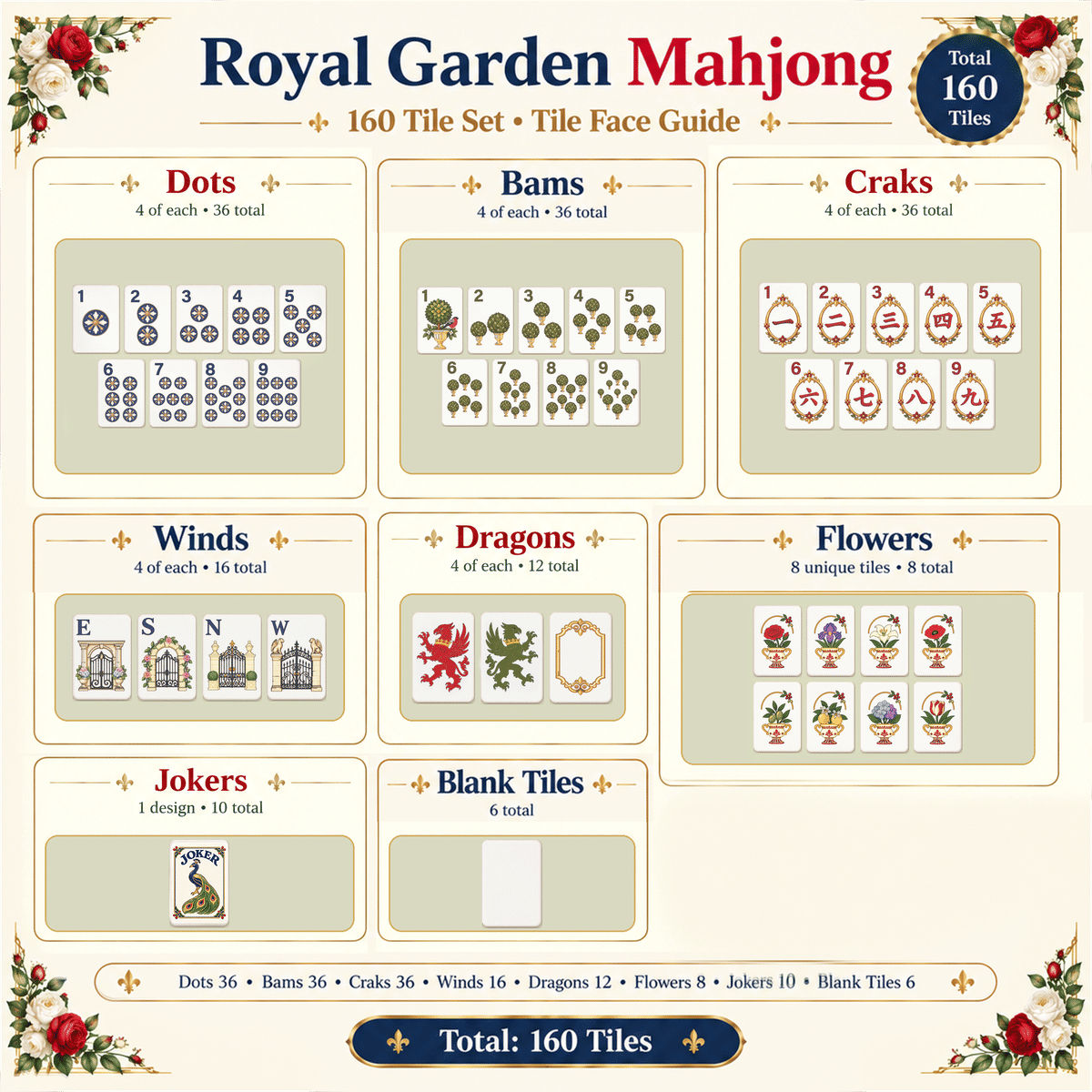
Hong Kong mahjong uses 144 tiles (three suits numbered 1–9 in four copies each, plus winds, dragons, flowers, and seasons—no jokers) and requires players to form melds and a winning pair within 13 or 14 tiles. Vietnamese mahjong typically uses 144 tiles as well but often includes a joker tile and runs shorter rounds; hand patterns rely less on rigid sequences and more on flexible combinations. Neither variant is played in American mahjong—which uses 152 tiles, a seasonal card, and jokers as wildcards. The key difference: Hong Kong emphasizes classical chow (sequence) and pung (triplet) combinations; Vietnamese allows more regional house rules and faster, more casual play. If you're hosting a mixed group, confirm the variant before purchasing tiles, as Vietnamese and Hong Kong sets aren't always interchangeable.
How many tiles are in each variant?
Hong Kong mahjong plays with exactly 144 tiles: 108 from three numbered suits (Bams, Craks, Dots, each 1–9 in four copies), plus 16 winds (four each: North, East, West, South), 12 dragons (4 Red, 4 Green, 4 White), 8 flowers, and 8 seasons. Vietnamese mahjong also typically uses 144 tiles but sometimes adds jokers (usually 1–4) depending on house rules; some regions omit flowers or seasons entirely. American mahjong, by contrast, plays 152 tiles without flowers and seasons as separate honors—instead, it adds eight jokers as wildcards and uses a seasonal card printed on paper. The 144-tile standard in Hong Kong and Vietnamese play means fewer wildcards and tighter, more deterministic hands than American games.

What's the core difference in hand-building rules?
Hong Kong mahjong requires you to form melds from actual tile sequences and triplets: a winning hand always contains four melds plus a pair, and you must declare "win" immediately when you complete a legal combination. Chows (sequences: 1-2-3, 2-3-4, etc.) are fundamental and can be called from the discard pile. Vietnamese mahjong simplifies this: players often allow more flexible grouping, with some house rules permitting jokers to fill gaps or substituting flowers and animals for suit tiles. American mahjong differs dramatically—it has no chows at all; only pungs (triplets), kongs (quads), and higher sets are exposed; and all hands come from a printed annual card that defines winning patterns. If you're learning both variants, expect Hong Kong to demand precision and Vietnamese to feel more relaxed and forgiving.
How does scoring differ between the two?
Hong Kong mahjong scoring is point-based and can vary by region: wins are typically worth 1, 2, 4, or 8 points depending on hand difficulty (whether it's concealed, whether it includes rare tiles, whether it involves honor tiles or terminal sequences). Payments flow from all three losers to the winner, or sometimes from the discarder only. Vietnamese mahjong often simplifies to a flat payment system: each loser pays the winner a fixed amount, with occasional bonuses for rare hands. American mahjong uses an entirely different model: every hand is scored based on the NMJL card and point multipliers; winners collect double payment from one specific player and single payment from the other two. The lesson: never mix scoring systems mid-session—agree on your variant and rulebook before the first hand.
Which variant is faster—and does it matter for hosting?
Vietnamese mahjong typically plays faster than Hong Kong because house rules often allow more substitutions and fewer rigid combinations. Rounds in Vietnamese games can finish in 10–15 minutes with looser play; Hong Kong rounds demand more deliberation and usually run 12–20 minutes per hand due to the precision required. American mahjong sits somewhere in between: rounds take 10–18 minutes depending on how quickly players read the card. For hosting, Vietnamese play suits casual social groups and dinner parties; Hong Kong appeals to competitive players who enjoy mathematical puzzle-solving; American play is best for established leagues and regular clubs that commit to learning one card each season. Choose your variant based on your audience's patience and expertise level, not on what tiles you happen to own.

Can you play Hong Kong or Vietnamese mahjong with an American set?
Technically, no—and here's why. American sets contain 152 tiles built around a seasonal card system with eight jokers and no individual flower or season tiles; they're designed specifically for American mahjong hand patterns. Hong Kong and Vietnamese sets use 144 tiles with distinct flowers, seasons, and (in some Vietnamese sets) joker integration that American sets don't include. American sets also include blank tiles in some versions, which aren't used in traditional Hong Kong or Vietnamese play. If you own an American set and want to host a Hong Kong or Vietnamese game, you'd need to:
Source or substitute the missing tiles (flowers, seasons, joker count).
Remove 8 tiles from play (unbalancing the game mechanics).
Remap American jokers to regional rules (often impossible without confusion).
The safest path: 🀄 Shop best-selling mahjong sets → and confirm your set matches your group's variant before playing. If your community plays mixed variants, consider owning two sets.
Aspect | Hong Kong | Vietnamese | American |
Tile count | 144 (no jokers) | 144 (1–4 jokers, house rules) | 152 (8 jokers + extras) |
Flowers/Seasons | Both included (8 ea.) | Often omitted or flexible | Neither (jokers instead) |
Chows allowed? | Yes, core mechanic | Yes, but flexible | No, never exposed |
Hand source | Regional rulebook | House rules | Annual NMJL card only |
Typical round length | 12–20 min | 10–15 min | 10–18 min |
Best for | Competitive clubs | Casual social play | Leagues & regular groups |
🎁 See our most-loved mahjong sets & accessories →
Which variant should you learn first?
If you're new to mahjong altogether, American mahjong is the easiest entry point because the National Mah Jongg League card removes ambiguity—every legal hand is printed for you. Hong Kong mahjong demands you memorize hand structures and scoring rules before you can play confidently; it's ideal if you plan to visit Asia or join a traditional club. Vietnamese mahjong suits players who value speed and social fun over rigid rules. For a US-based home game with rotating players, American mahjong offers the fastest onboarding and the most consistent ruleset. If your group includes players with family ties to Asia, honor their preference and learn their variant—the effort builds community and preserves tradition.
What to check before you buy
Confirm your group's variant in writing before purchasing a set (even if someone says "just mahjong").
Count the tile types: 144 tiles (Hong Kong/Vietnamese) vs. 152 tiles (American) is the quickest check.
Ask whether your group uses house rules (especially for Vietnamese play; they vary widely by region).
Test a borrowed set first if possible; tile weight, size, and grip feel differ significantly between variants.
Check for jokers: If your Hong Kong set has jokers and your group forbids them, verify you can set them aside without confusion.
✨ Find your Mahstead set — free US shipping →
Hosting Hong Kong or Vietnamese mahjong at home
If you're hosting either variant, you'll need a mat large enough for four players, tiles that feel substantial in hand (thicker acrylic or bone tiles, not thin plastic), and mahjong racks with pushers to organize your tiles visibly. For Vietnamese or Hong Kong play, a travel bag or case with secure dividers keeps your tiles protected and sorted—critical if you own multiple variants. A printed rulebook or scoresheet taped to your mahjong mat prevents mid-game disputes. We recommend buying a set designed for your specific variant rather than adapting an American set; the investment pays off in clarity, speed, and player confidence.

FAQ
Can I use the same tiles to play both Hong Kong and American mahjong?
No. Hong Kong uses 144 tiles without jokers; American uses 152 tiles with eight jokers and is played by seasonal card only. Trying to convert creates rule conflicts and tile confusion mid-game.
How many jokers does a Vietnamese mahjong set typically include?
Vietnamese sets vary by region and house rules. Traditional Vietnamese play may use 0–4 jokers; confirm with your group's preferred rulebook before buying.
Is Vietnamese mahjong easier than Hong Kong mahjong?
Generally yes—Vietnamese house rules are more flexible, rounds play faster, and fewer rigid hand patterns are enforced. Hong Kong demands memorization of hand structures and scoring.
What's the main advantage of learning American mahjong if I already know Hong Kong?
American mahjong removes rule ambiguity (the card is your guide) and fits US league play. It's faster to onboard new players because there's one official ruleset per season.
Can I host a game with mixed variants at the same table?
Not safely. Different tile counts, hand definitions, and scoring systems create too much confusion. Keep one variant per session and separate your tile sets clearly.
Where can I find a rulebook for Vietnamese mahjong?
Vietnamese rules vary by region and family tradition—there's no single official guide like the NMJL card for American mahjong. Ask players from that community or your local Vietnamese cultural center for their house rules.


View More
View More
View More
