
Three Player Mahjong Quick Start Guide
Last updated: Nov 23, 2026
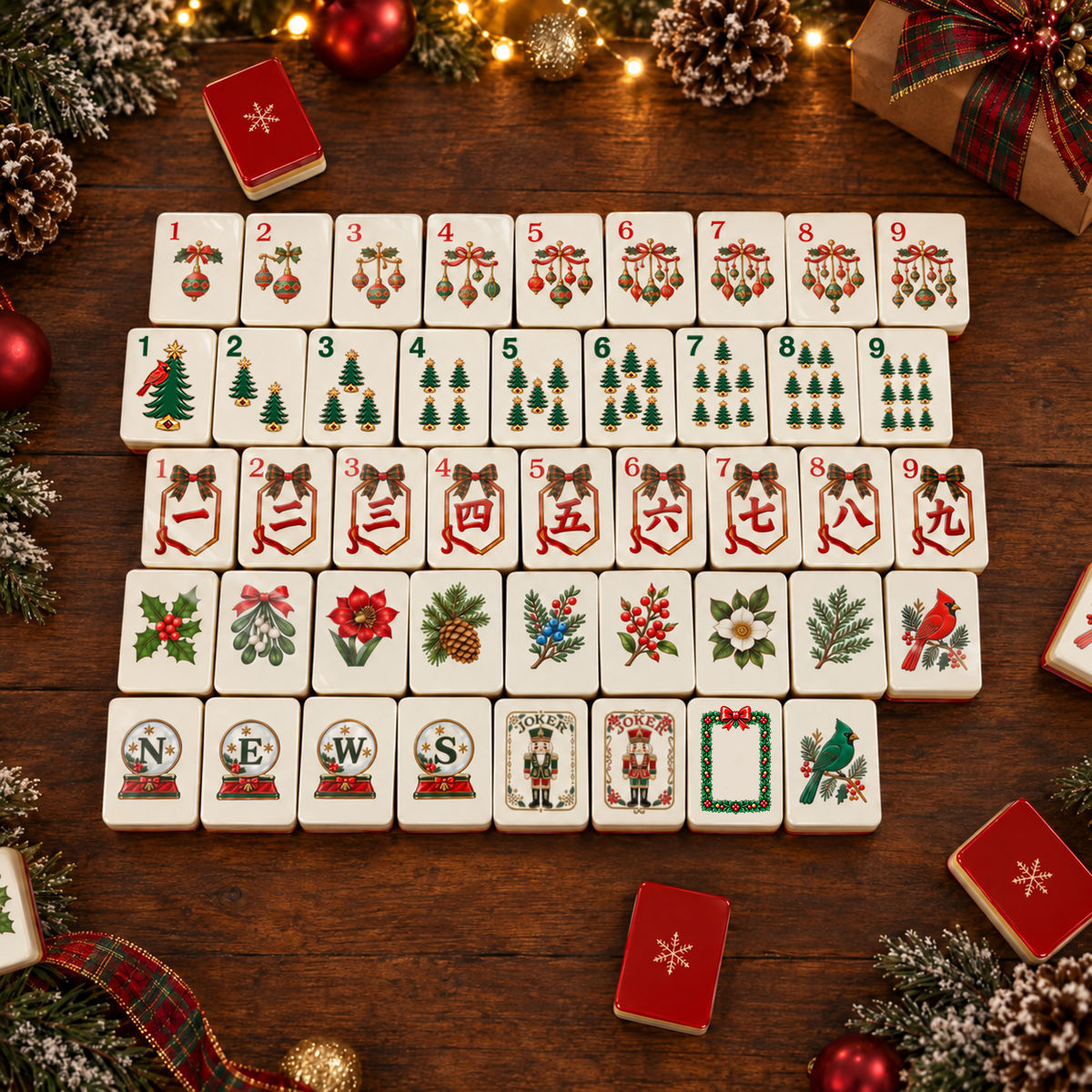
Three-player American mahjong uses the same 152-tile set and 8 jokers as four-player but removes the East seat and shrinks the wall from 34 to 25 tiles per side. Each player draws 13 tiles instead of 14; the dealer (typically East) draws first and passes dead tiles to the left. The two-pass Charleston replaces the three-pass version—you pass eight tiles right, then eight left, skipping the middle pass. Hands come only from the current National Mah Jongg League card. All exposed melds (pungs, kongs, quints, sextets) work identically; jokers cannot replace a single tile or form a pair. Winning happens when you complete a valid hand pattern and call Mahjong. Games finish faster (45–75 minutes) because fewer players means fewer turns before the wall empties, making three-player ideal for lunch-hour sessions or when a fourth can't make it.
How do three players change the table layout?
Remove the South seat entirely. East sits in the north position, South (now your left) takes the opposite chair, and West (now your right) takes the final chair. The wall forms a smaller perimeter—each player builds a wall of 25 tiles stacked two-high, totaling 100 tiles in play instead of 108. The dealer's wall breaks two tiles in from the right corner; the discard area shrinks proportionally, so your mahjong mat layout may feel tighter than four-player. Orient your mat so it marks the three positions clearly.

What is the two-pass Charleston for three players?
🀄 Shop best-selling mahjong sets →
The Charleston begins after the initial deal (13 tiles each). Pass eight tiles face-down to your right neighbor without seeing theirs; they pass eight back simultaneously. Next, pass eight to your left neighbor; they pass eight back. Stop—skip the middle pass that a fourth player would take. This shortcut keeps the ritual alive while respecting three-player tempo. If all three players agree to skip the Charleston entirely (rare but legal), deal fresh and play; some fast-play groups do this at lunch. Most serious sessions keep the two-pass Charleston because it balances hand randomization fairly.
What hand patterns work the same, and what changes?
All exposed meld types remain identical: a pung is three identical tiles, a kong is four, a quint is five, a sextet is six—jokers can substitute in any exposed meld except a pair or single tile. The valid hand patterns themselves don't change; the current year's National Mah Jongg League card governs them equally in three-player. However, because one fewer player means one fewer opportunity per round to discard high-risk tiles, defensive play tightens: players hoard honors (winds and dragons) longer, and exposing early pungs becomes riskier. Winning a hand—meeting the card pattern and calling Mahjong—works identically, and the winner receives payment from all three opponents based on the hand's point value.
How do you score a three-player win?
Scoring follows the same point table as four-player American mahjong, but payment differs. In four-player, a winner collects the hand's point value from each opponent; in three-player, the winner still receives the full point value from each of the two opponents. A 40-point hand pays 40 from each opponent (80 total to the winner). A 60-point hand pays 60 from each (120 total). Some groups use a "dealer double" rule: if the dealer (East) wins, the payment is doubled from each opponent, and non-dealer winners receive standard payment. Confirm payment rules before play starts—they vary by region and group. Scoring is fastest when one player keeps a running sheet, especially over multiple games.

When should you not play three-player, and what's your backup plan?
Three-player is ideal for ad-hoc sessions or when a regular player cancels last-minute. If you're teaching beginners, stick with four-player: the extra seat spreads chaos and reduces pressure on each player, easing the learning curve. If you're playing for stakes or in league play, check your league rules first—most formal American mahjong leagues require four players. If no fourth can arrive within 15 minutes and all three want to play, three-player works; if you want to wait for a replacement, keep your dealt hands in racks and pause. Two-player variants exist but require additional tile adjustments; stick with three-player as your go-to adjustment.
What gear do you actually need for smooth three-player play?
A 152-tile American mahjong set is non-negotiable—quality matters because worn tiles slip or stick mid-game, eating into your tight 45-minute window. A mat or table cover keeps the smaller wall stable; the three-player layout fits standard mats, though the feel is cozier. Individual racks with pushers are optional but powerful: they hide your tiles from opponents, keep your hand organized, and work in three-player exactly as they do in four-player. Skip them only if all three players are comfortable reading tiles openly. Have a current-year National Mah Jongg League card at the table—no card, no valid hands to claim. Dice roll for East as usual. A pen and paper or scoring app tracks points across multiple games.
✨ Find your Mahstead set — free US shipping →
Comparison: Three-Player Setup vs. Standard Four-Player
Factor | Four-Player | Three-Player | Impact |
Player count | 4 | 3 | Fewer turns; game 30–45 min faster |
Wall tiles per side | 34 | 25 | Smaller perimeter; play area tighter |
Starting hand | 14 (dealer) + 13 (others) | 13 (all) | Dealer loses 1-tile advantage |
Charleston passes | 3 | 2 | Faster setup; less tile randomization |
Payment per win | From all 3 opponents | From both opponents | Same per-opponent rate; lower total stakes |
Skill variance | Balanced across 4 | Heightened 1-v-2 dynamics | Aggressive early play increases |
What to check before you buy a set for three-player
Tile count: Confirm the set has 152 tiles plus 8 jokers. Any set with fewer tiles won't work legally.
Rack fit: If buying individual racks, test that three racks fit comfortably on a table with a mat; older styles may crowd.
Mat size: A standard mat fits three-player, but measure your table first—three-player walls are 25 tiles wide, about 2 feet shorter per side than four-player.
Tile visibility: Acrylic tiles photograph well in photos but can glare under bright lights; matte finishes reduce glare if three-player plays are at midday or outdoors.
Weight: Heavier tiles resist wind and accidental bumps; at three players, the table sees fewer simultaneous tile movements, so weight matters less than in four-player but still helps with wall stability.
🎁 See our most-loved mahjong sets & accessories →

FAQ
Can I play three-player mahjong with a 144-tile set?
No. American mahjong requires exactly 152 tiles plus 8 jokers to form a valid game. A 144-tile set (some Chinese and Hong Kong variants use this) leaves you short and breaks American rules.
Do I need the National Mah Jongg League card for three-player?
Yes. The card dictates valid hand patterns in all American variants, including three-player. Without it, you can't confirm a winning hand.
How is three-player different from two-player mahjong?
Two-player removes 32 tiles from the set and redesigns Charleston and wall structure entirely. Three-player keeps the standard 152 tiles and tweaks only the wall size and pass count—far simpler to learn if you know four-player.
What if two players keep calling Mahjong on the same turn?
The player closest to the discarder in clockwise order (typically the next player to play) has first claim. Simultaneous claims are illegal; East resolves ties. House rules vary—agree beforehand.
Can the dealer change mid-session in three-player?
Yes. After each game, the winner becomes the new dealer (or you rotate seats East→South→West). Some groups keep East fixed for simplicity—agree before the first deal.
Does one player get a mechanical advantage in three-player?
Slightly. The dealer (East) plays first and discards last, gaining slight timing advantage. The next-to-discard player (West) sees more opponent discard patterns. This is minor and normal—standard American scoring adjusts via point differentials.


View More
View More
View More
