
Cantonese Mahjong Terms and Glossary for Players
Last updated: Nov 23, 2026
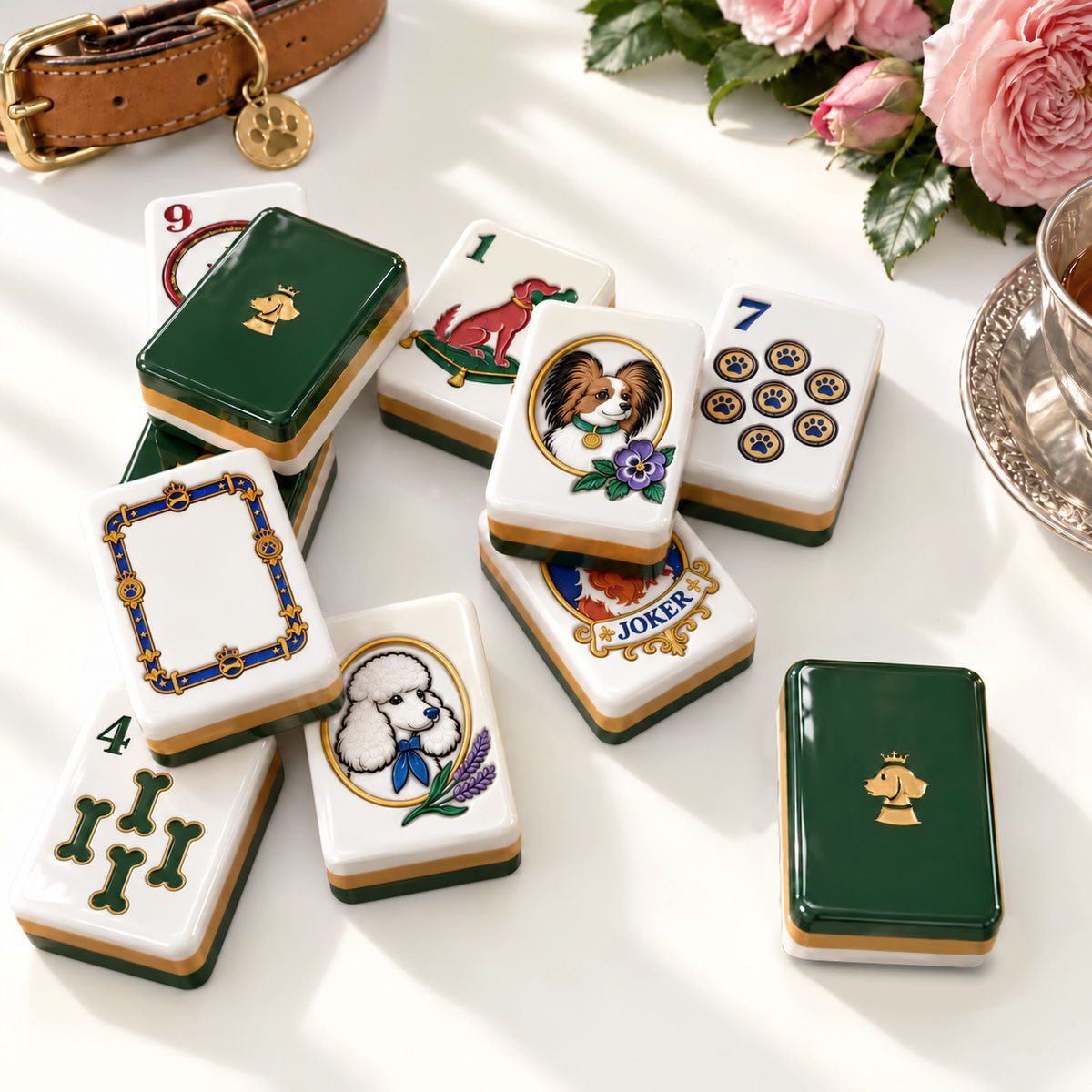
Cantonese mahjong terminology reflects the Hong Kong variant's unique rules and 144-tile structure. Core terms include: suits (万 "man" for characters, 筒 "pin" for circles, 索 "sou" for bamboo), honor tiles (風 "wind," 龍 "dragon"), and melds (刻子 "pung," 順子 "chow"). Winning hands are called 和牌 "ho pai" (lit. "joining the winning tile"). Key phrases: 碰 "pung" (claiming a discard for a pung), 吃 "chow" (forming a sequence), 明杠 "kong" (declaring a four-of-a-kind), 暗杠 "concealed kong," and 聽牌 "ting pai" (waiting for one tile to win). Scoring terms include 番 "fan" (points multiplier) and 台 "tai" (scoring unit). Unlike American mahjong, Cantonese uses sequences and allows strategic discard calling—skills that carry across many Asian variants and deepen your play regardless of which set you use.
Cantonese mahjong vocabulary opens a door to one of the world's most beloved tile games. If you've learned American mahjong on our best-selling mahjong sets, you'll recognize the basic tile structure—but the Cantonese dialect, hand names, and calling rules are distinctly their own. This glossary covers the terms you'll actually hear at a Hong Kong-style table, the logic behind them, and how they differ from other variants you may play.
What are the four basic Cantonese suit names?
Cantonese mahjong divides tiles into three suits, each with a Cantonese name and a character symbol. 萬 (man, literally "ten thousand") represents character tiles numbered 1–9. 筒 (pin, literally "coins" or "dots") shows circles 1–9. 索 (sou, literally "rope" or "string") displays bamboo 1–9. Each suit appears in four copies, giving 108 suited tiles total. These names help players call melds aloud and keep track of hand composition during play. The names come from historical tile designs: characters represented wealth, coins represented currency, and rope represented everyday materials in Tang Dynasty China.

How do you name the honor tiles in Cantonese?
Honor tiles include winds and dragons. The four winds are 東 (East), 南 (South), 西 (West), 北 (North)—called 風 ("fung," wind) collectively. Dragons are 紅中 (red, literally "red center"), 發財 (green, literally "prosperity"), and 白板 (white, literally "white board"). In Cantonese, players often shorten these: 中 for red, 發 for green, 白 for white. When declaring a pung of winds, a player might say "東碰" (East pung). Honor tiles are crucial because they're bonuses: matching the prevailing wind or dragon often doubles your score. Unlike American mahjong's fixed-hand system, Cantonese scoring depends heavily on which honors you hold.
What do "pung," "chow," and "kong" mean in Cantonese play?
These three terms name the melds you can declare and expose:
碰 (pung): Three identical tiles. Player calls "pung" and immediately exposes the meld on the table.
順子 (chow, literally "sequence"): Three consecutive numbered tiles in one suit only (e.g., 4–5–6 Bamboo). Cantonese mahjong uniquely allows chows; American mahjong does not.
明杠 (kong, literally "declared four"): Four identical tiles. Player declares "kong," adds a replacement tile from the dead wall, and continues.
暗杠 (concealed kong): A kong drawn and melded in hand before exposure. Scoring often rewards this hidden strength.
The ability to form and call chows is the biggest strategic difference from American mahjong. A chow requires careful sequencing logic: 1–2–3, 4–5–6, and 7–8–9 are the only legal sequences per suit. You cannot wrap around (e.g., 8–9–1 is illegal).
What does "ting pai" mean and how does it shape strategy?
聽牌 (ting pai, literally "waiting for tiles") describes a hand that needs only one more tile to win. When you declare ting pai, you announce your hand is complete except for one tile—your opponents then know exactly how close you are and often become more defensive. This term embodies a core Cantonese mahjong strategy: balancing aggression (pushing toward ting pai) with caution (not discarding tiles that could help opponents). Many hands involve a choice: meld early and signal ting pai, or hold tiles back and keep options hidden. The phrase also extends to the specific tile you need: "聽白" (waiting for white), for example, tells the table you need that specific honor to win.
How do "fan" and "tai" determine the winner's payment?
番 (fan) and 台 (tai) are Cantonese mahjong's scoring units, and they directly control payouts:
番 (fan, multiplier): Each winning hand earns a base fan count (usually 1–10+ depending on hand type, bonuses, and melds). Fan categories include basic (pung, chow, honored tile), halfway (all one suit), and limit hands (all pungs, all terminals and honors, etc.).
台 (tai, stake unit): One tai is the smallest payment unit. A hand worth 1 fan = 1 tai × the table's agreed stake. A hand worth 3 fan = 8 tai (doubling occurs at each fan level; rules vary by region).
Unlike American mahjong's fixed National Mah Jongg League card hands (where hands are either won or not), Cantonese scoring rewards hand quality: a basic win might pay 4 tai; a hand with all pungs and an honored tile might pay 32 tai or more. This flexibility makes the game faster and more dynamic—some rounds end in moments if a high-scoring hand wins early.

What are the key differences between Cantonese and American mahjong terms?
Concept | Cantonese Term | American Equivalent | Key Difference |
Meld type | 順子 (chow) | N/A (not allowed) | Cantonese permits sequences; American does not |
Winning declaration | 和牌 (ho pai) | "Mahjong" | Cantonese names the tile itself; American names the action |
Winning hand source | Discards or wall tile | Fixed card hands only | Cantonese hand types vary; American uses printed card |
Tile count | 144 tiles (standard) | 152 tiles (American set) | American includes extra jokers and blanks |
Honor bonus | 風 + 龍 melds double score | Fixed hand value | Cantonese scoring is dynamic; American is static |
Kong declaration | 明杠 (open) or 暗杠 (hidden) | Kong (no distinction) | Cantonese rewards concealment; American treats all kongs alike |
Joker use | No jokers (traditional) | 8 jokers per hand (critical) | American mahjong is impossible without jokers; Cantonese never uses them |
The biggest mental shift: Cantonese mahjong rewards adaptability. You build winning hands as tiles appear, not from a fixed list. This makes it ideal for players who prefer improvisation over memorization—and it explains why Cantonese players often thrive when learning American mahjong: they're already comfortable with strategic tile reading.
🀄 Shop best-selling mahjong sets →
What should you check before learning Cantonese terms at a real table?
Before sitting down at a Cantonese mahjong game, clarify these house rules with your hosts—they vary by region and venue:
Tile count: Confirm whether you're playing standard 144 tiles or a local variant (some regions add extra jokers or blank tiles, though purists avoid this).
Scoring rules: Ask if you're using the classic 16-tai limit or a higher cap. Some casual games use simplified scoring (every win pays the same); others use the full fan-tai system.
Concealed kong policy: Establish whether drawing a replacement tile after a concealed kong is mandatory or optional.
Chow restrictions: In rare variants, chows may be limited to certain suits or banned entirely. Confirm upfront.
Robbing a kong: Clarify whether a player can win off the tile another player draws for a kong (this rule varies widely).
Dead wall access: Confirm how many tiles stay in the dead wall and whether players can count them aloud.
If you're sourcing a set specifically for Cantonese play, a traditional 144-tile set without jokers is most authentic, though many casual players enjoy mixing American and Cantonese rules on an American 152-tile set for fun. The terms themselves don't change—only the strategic context around them.
🎁 See our most-loved mahjong sets & accessories →
How do you announce melds and calls in Cantonese at the table?
When calling a meld, announce the meld type aloud in Cantonese:
Pung: "碰!" (Pung!) — Point to the discard, take it, and set your three identical tiles face-up on the table edge.
Chow: "吃!" (Chow!) — Take the discarded tile, meld it with two tiles from your hand, and expose the sequence.
Kong: "杠!" (Kong!) — If open, declare immediately; if concealed, draw first, then announce. Draw a replacement from the dead wall's end.
Win: "和!" (Ho!) or "胡!" (Hu!) — These are regional: Cantonese speakers often say "和" (ho), while Mandarin speakers say "胡" (hu). Both mean "mahjong."
Speed matters: fast, clear calls prevent disputes. If you hesitate or fail to declare before the next player draws, the call may be forfeited. This is where table etiquette and the physical mahjong racks with pushers come in handy—organized, visible hands and smooth tile placement make calls instant and unambiguous.
Real scenario: Understanding a Cantonese hand at the table
Imagine you're holding:
東東東 (East pung) — declared and exposed
5–6–7 Bamboo (chow)
中中中 (Red dragon pung) — in your hand, not yet exposed
4 Bamboo, 5 Character, 6 Character, 7 Character, 8 Character
The player to your left discards a 9 Bamboo. You have a choice: meld it into a chow (9–1–2 is invalid, so only a new sequence works if you hold 7–8–9 Bamboo, which you don't), or stay hidden. Instead, the right discard comes: another East. You call "碰!" (Pung!), expose your second East pung, and continue. Now your hand is:
東東東東 (two exposed East pungs)
中中中 (concealed Red dragon pung)
4 Bamboo, 5 Character, 6 Character, 7 Character, 8 Character
You're waiting for a 5 Bamboo or another Character tile to complete a chow and win. You're 聽牌 (ting pai). When you draw a 5 Bamboo on your turn, you meld it mentally and declare "和!" (Ho!) — winning hand. Your score is calculated: two wind melds (East pung + exposed) earn points, the hidden dragon pung earns points, and the chows contribute. Exact payment depends on house rules, but you've won and your opponents owe you.
This fluency—recognizing melds, calling them correctly, and reading the unfolding strategy—comes from practice and a solid grasp of Cantonese term meanings.
✨ Find your Mahstead set — free US shipping →
Bonus: Regional variations in Cantonese terminology
Cantonese mahjong evolved differently across Hong Kong, Macau, Guangdong Province, and overseas Chinese communities. You may hear:
Hong Kong style (most common internationally): Uses the terms above and emphasizes the fan-tai scoring system. Limit hands (like all pungs or all terminals) are highly valued.
Macau style: Often allows more flexible scoring and occasional joker use. Terminology is similar, but payout rules differ.
Singapore/Malaysia style: Adds extra tiles or uses simplified point systems. Players sometimes use English mixed with Cantonese (e.g., "all pung" instead of 全碰).
Taiwanese style: Uses Mandarin names instead of Cantonese (e.g., 萬 "wan" instead of 萬 "man," though both refer to the same tiles). Strategic play emphasizes concealed melds.
When joining a new game, ask experienced players to clarify the regional house rules. The core terms are universal, but the scoring and legal melds shift. A mat designed for multiple player styles can help you host games with clear, comfortable tile layouts regardless of which regional rules your group prefers.

FAQ
Is Cantonese mahjong harder to learn than American mahjong?
No, just different. Cantonese requires fewer rules to memorize (no fixed card) but more strategic thinking (you build hands on the fly). American mahjong has more memorization (152-tile structure, 8 jokers, printed card hands) but more rigid structure. Most players find one easier based on their learning style.
Can I play Cantonese mahjong with an American 152-tile set?
Technically yes, though it's not traditional. American sets include 8 jokers; Cantonese purists avoid jokers entirely. Many casual players enjoy hybrid games using American equipment with Cantonese rules—just agree upfront with your table about how jokers count (if at all).
What does "和牌" (ho pai) literally mean?
"Ho" means "join" or "unite"; "pai" means "tile." Literally, it means "joining the tile"—the winning tile that completes your hand. It's more poetic than the English "mahjong," which comes from the Chinese 麻將 "ma jiang" (sparrow game).
How are Cantonese and Riichi mahjong terms different?
Riichi (Japanese) uses completely different suit names (萬 "man," 筒 "pin," 索 "sou" — identical to Cantonese—but with Japanese pronunciation and extra honor tiles like "kazehai"). Riichi also has calling mechanics (like "riichi," declaring you're waiting) that Cantonese doesn't use. Cantonese terminology is closer to traditional Chinese mahjong.
Do I need to learn Cantonese language to play Cantonese mahjong?
No. Many international players learn the few essential calls phonetically without understanding Cantonese grammar. That said, learning the meanings of terms deepens your understanding of hand logic and strategy—worth the small effort.
What's the difference between 明杠 (open kong) and 暗杠 (concealed kong) in scoring?
An open kong (明杠) is declared immediately when you have four identical tiles, and you draw a replacement. A concealed kong (暗杠) is when you draw the fourth identical tile into a set you already held hidden, then declare it. Concealed kongs are often worth more points because they hide information from opponents.
Can I use jokers in Cantonese mahjong like I do in American mahjong?
Traditional Cantonese mahjong does not use jokers at all. Each tile is played as-is. Some casual games add jokers for fun, but purists consider this a breach of classic rules. If jokers are allowed, clarify their use (can they be used as any tile? only for kongs?) with your table first.


View More
View More
View More
