
Taiwanese Mahjong vs Malaysian Mahjong: Rules & Key Differences
Last updated: Nov 23, 2026
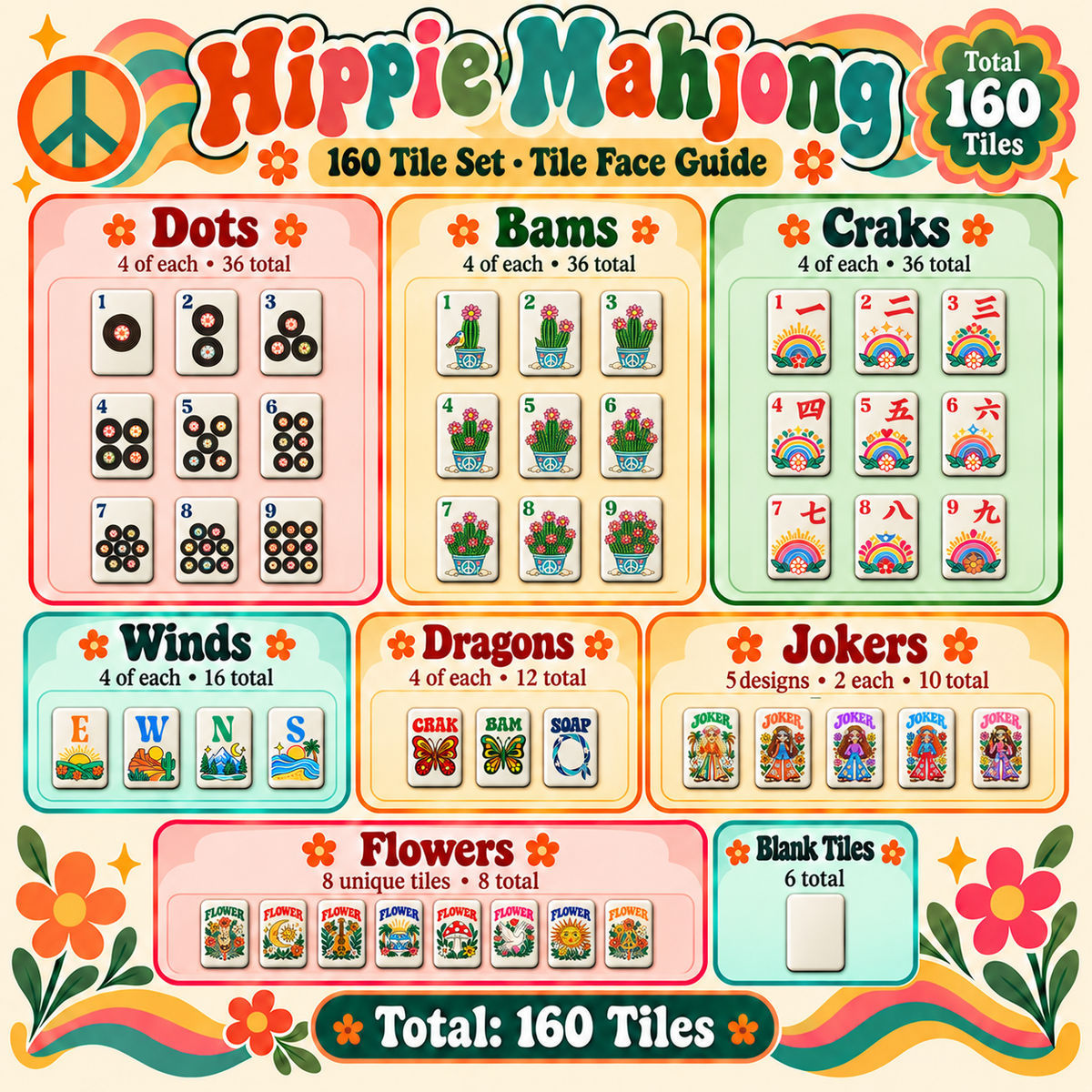
Taiwanese mahjong uses 144 tiles and typically involves two players drawing from a central wall, with hands made of melds (pungs, kongs, chows) and a final pair. Malaysian mahjong, also called Guangdong mahjong or Hong Kong style in some regions, uses 136 tiles in four-player games with similar meld structures but stricter rules around concealed versus exposed sets and bonus scoring from flowers and seasons. Taiwanese play emphasizes speed and calculation; Malaysian play involves higher-complexity hand declarations and frequently draws from tile discard. Neither uses jokers (unlike American mahjong's eight-joker requirement). Both require knowledge of their specific pattern books rather than a single annual card. Taiwanese games end when one player wins by completing a full hand; Malaysian games may include draws or limit rounds by wind rotations.
Taiwanese mahjong and Malaysian mahjong sound related, but they're separate games with distinct equipment, rules, and strategy. We host players familiar with both variants, and the confusion is real—most Westerners know only American mahjong, so these Asian regionals feel like variations on one theme. They're not. Understanding the core differences helps you choose which game suits your table, or learn a second variant without mixing mechanics mid-hand.
How many tiles does each variant use and why?
Taiwanese mahjong plays with 144 tiles: four sets of 1–9 in three suits (108 tiles), 16 winds (four each of North, East, South, West), and 12 dragons (four each of Red, Green, White). Malaysian mahjong also uses 144 tiles but distributes them differently—some regional rules add flower and season tiles that function as bonus scoring rather than playable hand tiles, effectively reducing the working deck. Taiwanese players draw tiles individually into a hand of 13 or 14; Malaysian players follow similar sizing but allocate tiles based on turn order and whether a player declares a win from the discard or draws from the wall. The tile count reflects geography and speed preference: Taiwan favors rapid, two-player or three-player casual rounds; Malaysia emphasizes four-player games with formal seating and stricter dealer rules.

What hand patterns are required to win in each?
Taiwanese mahjong wins require specific hand types declared before or at the moment of winning. Common patterns include all pungs (a.k.a. "all pung" or "pung hand"), mixed sequences (chows mixed with pungs), and special hands like "all terminals" or "all honors." A winning hand must have zero points—a phrase that sounds contradictory but means the hand meets the exact pattern with no extra "junk" tiles. Malaysian mahjong (in Cantonese-influenced play) also requires pungs, kongs, and chows but adds a greater emphasis on concealment—a player who reveals tiles early forfeits bonus points, and the hand that wins by drawing from the wall (called a "self-drawn" win) scores higher than one won from a discard. Pattern complexity in Malaysian play is often greater; many hands have sub-rules about which tiles must be paired, sequenced, or honored.
Is concealment more important in one variant than the other?
Yes. Taiwanese mahjong allows moderate exposure of pungs and kongs as play progresses, and concealment affects scoring but not eligibility. Malaysian mahjong penalizes exposure far more heavily. If a Malaysian player exposes a pung early in the round, they lose the "concealment bonus" when they eventually win—and that bonus can equal or exceed the base hand score. Taiwanese play is more forgiving of visible strategy; Malaysian play rewards secrecy and tight discarding. This difference means Malaysian rounds often feel slower and more tense, while Taiwanese games emphasize rapid calculation and pattern recognition. Both require sharp attention to what tiles opponents discard and which suits they're building.
How does scoring differ between the two?
Taiwanese mahjong scoring is pattern-based: each hand type (pung hand, sequence hand, terminal hand) has a fixed point value, often written in a rulebook or reference card specific to the region or club. Doubling is rare; most hands are assigned a single score unless a special bonus (like winning on a special draw or completing a rare pattern) applies. Malaysian mahjong uses a point accumulation system where every tile combination, flower, season, and method of win adds incremental points. A concealed pung might earn 2 points; a self-drawn win adds 1 point; holding flowers adds 1 point each. The final score is a sum of these components. This means Malaysian hands can balloon to much higher totals—a well-played hand might be worth 8 or 10 points versus 2 or 3 in Taiwanese play. Payment is usually settled at the table in chips or currency according to the region and house rules.
Can you play either variant casually with a standard set?
Partially. Both Taiwanese and Malaysian play use standard Chinese mahjong tiles—144 tiles, same suits, same winds and dragons—so a single set covers both rules mechanically. However, you'll need a rules reference for whichever variant you're learning, because hand patterns and scoring are not interchangeable. If you learn Taiwanese patterns and then sit into a Malaysian game, you'll misdeclare hands and miscount points. Most casual players purchase a set without jokers (since neither variant uses them) and rely on a printed hand chart, club-specific rules sheet, or an experienced player to call hands and settle scores. If you're hosting regular two-player Taiwanese games, a best-selling mahjong set with clear, large tile markings and a durable rack makes sorting 13-tile hands faster. For four-player Malaysian rounds, a mat with player zones and a tile holder for the wall is essential to avoid confusion.
🀄 Shop best-selling mahjong sets →
How do dealer and turn order work?
Taiwanese mahjong typically rotates the dealer (called "East" or the primary position) after each hand or after each player has dealt once. The player to the dealer's right draws first from the wall. Turn order proceeds counterclockwise (common in Taiwan) or clockwise (some house rules), and the direction affects which player draws from which wall section and which discard pile they feed. Malaysian mahjong also rotates dealers, but the dealer holds the position for four hands—one for each wind position—and then the dealer passes. Discards in Malaysian play sit in a central pool that all players can see, whereas some Taiwanese variants keep individual discard stacks. Understanding dealer movement is crucial because it determines who draws first, who has a positional advantage, and how scoring multipliers may apply (some regions award double points to or from the dealer).

What's the biggest strategic difference for new players?
In Taiwanese mahjong, you're competing primarily against the pattern card in your head—memorizing which combinations are valid and worth points. Strategy centers on rapid assessment and discarding cards that don't contribute to your hidden hand, while watching for signs of what pattern your opponents are building. In Malaysian mahjong, you're reading opponents more intensely because exposure penalties and concealment bonuses make the psychology of the table matter as much as the tiles. A good Malaysian player delays revealing their strategy longer and pays close attention to which tiles opponents throw away—that tells you which suits and honors they're not collecting. A Taiwanese player focuses on hand math and speed; a Malaysian player focuses on observation and restraint.
Aspect | Taiwanese Mahjong | Malaysian Mahjong |
Tile count | 144 | 144 (+ flowers/seasons as bonuses in some rules) |
Typical player count | 2–3 players (casual) | 4 players (formal) |
Winning hand requirement | Exact pattern match, zero waste | Pattern match + concealment bonus scoring |
Dealer rotation | After each hand or full round | Four hands per dealer |
Exposure penalty | Minimal scoring impact | Heavy penalty (loss of bonus) |
Scoring system | Pattern-fixed points | Tile-by-tile accumulation |
Speed of play | Fast | Slower, more deliberate |
Table atmosphere | Casual, calculation-focused | Formal, psychology-focused |
🎁 See our most-loved mahjong sets & accessories →
What tiles should you never confuse between the two?
Neither variant uses the tiles the same way as American mahjong, so if you're switching from American play, unlearn jokers first—neither Taiwanese nor Malaysian uses them. Within each other, the core tiles (1–9 Bams, Craks, Dots, winds, dragons) are identical. The confusion arises with regional house rules: some Malaysian tables add an extra flower or season tile that functions as a wild or draws immediately from the hand, while Taiwanese play treats flowers strictly as bonus markers that don't affect playable tile count. If you're visiting a new table, always ask: "Do flowers and seasons draw from the hand or sit outside?" and "Are jokers in play?" These two questions clarify more than any handbook.
What equipment helps you play each variant well?
For Taiwanese mahjong, a clear set with large numerals and suit symbols is essential, because two-player or three-player rounds move quickly and misreading a tile costs time. A mahjong mat with marked player zones is optional but helpful for tracking discard direction. For Malaysian mahjong, a mat is more valuable because four players need defined discard areas and wall sections. Racks with pushers are useful in both variants to organize hand tiles vertically and prevent accidental exposure. Neither variant demands jokers, so a standard 144-tile set suffices; however, many modern sets sold globally are 160-tile American sets, which include 8 jokers you'll simply not use. If you're buying a new set specifically for Taiwanese or Malaysian play, confirm the tile count is 144 and the tiles are unmarked by suits beyond the traditional four (no extra blanks or variant tiles).
✨ Find your Mahstead set — free US shipping →
How do you transition from one variant to the other at the same table?
Don't—or do it knowingly. Many casual clubs in diaspora communities host both games on different nights or back-to-back rounds with a clear rule shift announcement. If players know in advance ("First round is Taiwanese; second round is Malaysian after a 10-minute break"), everyone mentally switches pattern cards and scoring systems. Mid-game switches cause misdeals and frustration. If you're learning both, start with one exclusively for 4–6 weeks—play 20–30 hands until hand recognition becomes automatic. Then learn the second variant with a cheat sheet at the table. Mixing them real-time leads to false meld declarations and payment disputes. We've seen friendly games turn tense because one player declared a hand valid in Malaysian rules on a Taiwanese-rules table; always confirm rules before the first tile is drawn.
What to check before you buy
Tile count: Confirm 144 tiles, not 160 (160-tile sets are American and include 8 jokers you won't use).
Regional rules: Clarify whether your local club plays standard Taiwanese, Cantonese-influenced Malaysian, or a house variant; get a written rules sheet or a mentor.
Hand reference: Purchase or download a hand chart for your specific variant—they are not interchangeable.
Tile size: If you play with players over 50 or with vision concerns, larger tiles (standard or jumbo) are worth the cost difference.
Rack quality: If you're building a permanent collection, racks with smooth pushers reduce accidental tile exposure and speed up play.

FAQ
Can I use a standard American mahjong set to play Taiwanese or Malaysian mahjong?
No—not practically. American sets include 8 jokers and often 160 tiles total, neither of which belong in Taiwanese or Malaysian play. You need a standard 144-tile Chinese set without jokers. The tile symbols are similar, but rule sets and hand patterns are entirely different.
Which variant is easier to learn for someone who knows American mahjong?
Malaysian mahjong shares more strategic depth with American play (exposure penalties, concealment bonuses, reading opponents) but the hand patterns and tile mechanics are entirely separate. Start from scratch either way; cross-training creates confusion. Neither variant uses jokers, the Charleston, or annual pattern cards.
How long does a typical game take in each variant?
Taiwanese two-player rounds last 30–45 minutes per hand; multiple hands over an evening means 2–3 hours total. Malaysian four-player games take 45–60 minutes per hand due to stricter rule enforcement and observation. Casual play is faster; formal club play adheres to dealer rotations and scoring verification that add time.
Are there online communities or clubs where I can learn each variant?
Yes—many diaspora communities in North America host regular Taiwanese or Malaysian mahjong nights through community centers, libraries, or recreation clubs. Search "[your city] mahjong club" or ask at local Asian community centers. Some regions have formal clubs with membership fees; others host casual drop-in rounds.
If I buy a set for Taiwanese mahjong, can I later use it for Malaysian or American play?
Taiwanese use standard 144-tile sets, so yes to Malaysian (same tile set, different rules). American mahjong requires 160 tiles and 8 jokers, so no—you'd need a separate set. Keep your rules reference sheet with each set to avoid mid-game confusion.
What's the best mat for playing Taiwanese mahjong with two or three players?
A smaller mat (3×3 feet or less) with light-colored backing works well because it saves table space and keeps the game intimate. For three players, a triangular or three-zone layout helps. For two players, a simple surface with a clear discard area is enough.


View More
View More
View More
