
Taiwanese Mahjong Setup: Tiles, Rules & Equipment Guide
Last updated: Nov 23, 2026
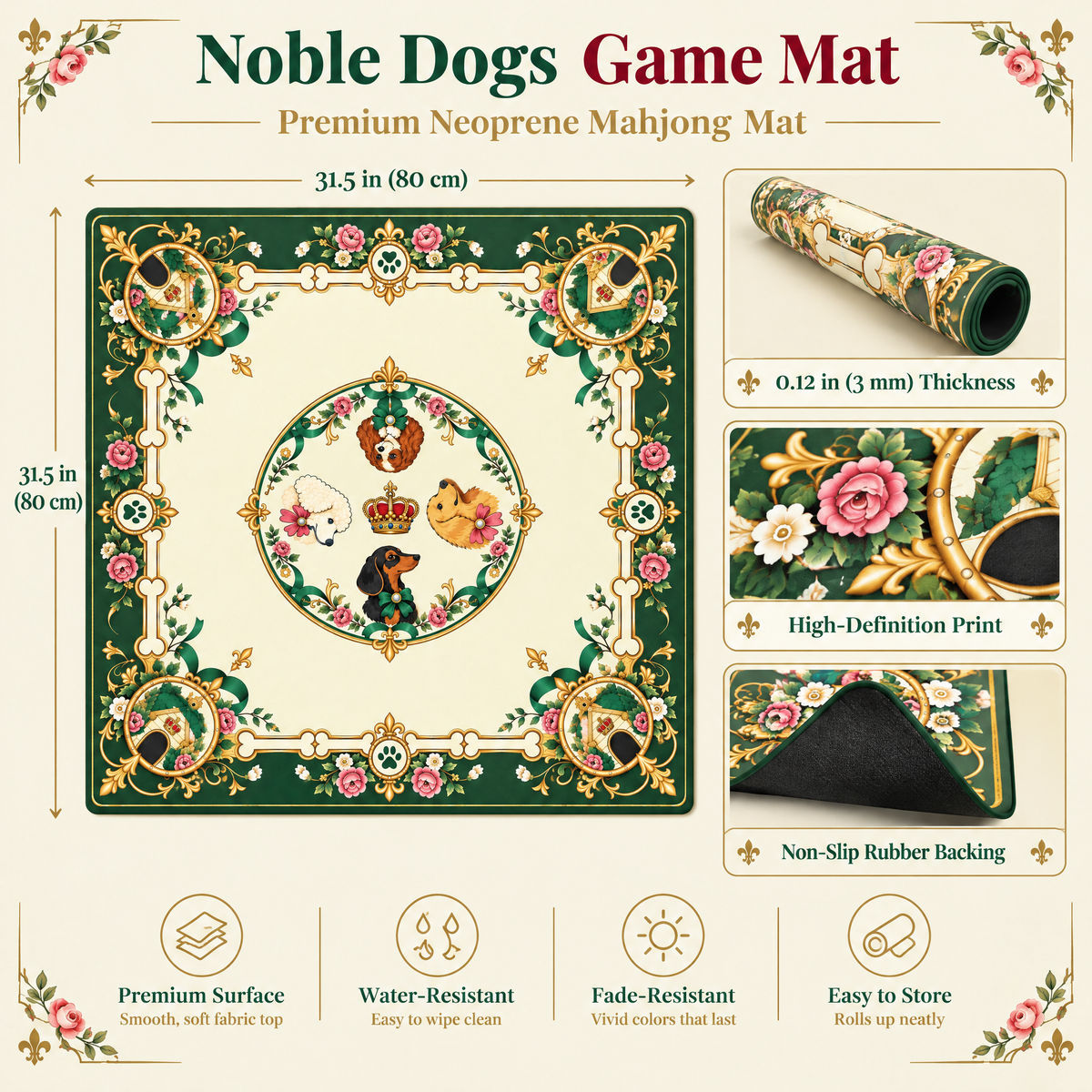
Taiwanese mahjong is played with 144 tiles—fewer than the American 152—and uses a simpler hand structure: sequences (chows: 1-2-3, 4-5-6, etc.) are allowed and count equally with sets of identical tiles (pungs). There's no annual card, no Charleston, and no jokers; players draw and discard one tile per turn to form a winning hand of four melds plus a pair. Games move faster and feel more open because you can read what others need from their discards. Setup takes minutes: shuffle all 144 tiles face-down, arrange them in a wall, and deal 13 tiles per player. A standard set works fine, though many Taiwanese players prefer a dedicated mat to track the wall and draw order clearly.
What tiles do Taiwanese mahjong sets contain?
Taiwanese mahjong uses exactly 144 tiles: three numbered suits (Bams, Craks, Dots) each running 1–9 with four copies per number (108 tiles), plus 16 winds (four each of North, East, West, South), 12 dragons (four each), and 8 flowers. That's 36 tiles per suit + 28 honor tiles + 8 flowers = 144 total, with no blanks or jokers. Each tile is identical to three others of the same kind, so you'll see repeating designs. This smaller count makes the wall shorter and hands complete faster than in American play, where you're working with 152 tiles plus 8 jokers.

How is Taiwanese mahjong different from American mahjong?
The biggest difference is that Taiwanese play allows chows (sequences like Green 1, Green 2, Green 3 Bam) as valid melds—American mahjong bans sequences entirely. Taiwanese hands also need only four melds plus a pair; American hands vary by the card's pattern. There's no National Mah Jongg League card to follow, no Charleston (pre-game tile swap), and zero jokers. Taiwanese players also call winning hands more simply: any four melds plus a pair wins, no bonus scoring for pairs or patterns. Play is looser and faster, making it feel more improvisational and social than the rule-bound American game.
What's the step-by-step setup for a Taiwanese game?
Step 1: Shuffle all 144 tiles face-down on the table or mat (1–2 minutes). Step 2: Stack tiles in a wall—arrange them in two rows of 18 tiles each per player, creating a square wall around the center of the table. Step 3: Decide who goes first (often East wind, or roll dice—highest number leads). Step 4: Deal 13 tiles to each player, one at a time, face-down. East gets the first tile and draws an extra one (14 total). Step 5: East discards one tile face-up to the center to begin play. Step 6: Players take turns drawing from the wall and discarding, melding (exposing) pungs, kongs, or chows as hands develop. Step 7: First player to form four melds plus a pair and declare Hu (win) ends the round.
Using a mat with zone markers helps beginners track the wall and draw sequence without confusion.
How do hand patterns work in Taiwanese mahjong?
Any four melds plus a pair wins—no complex pattern requirements. Melds can be pungs (three identical tiles), kongs (four identical tiles), or chows (three consecutive numbered tiles like Green 5, 6, 7 Bams). Flowers and winds are worth zero points in basic play; only numbered suits and dragons score, and scoring is often kept simple (1 point per meld, or winner takes all). This openness means new players see results faster and don't need to memorize a printed card. Once your fourth meld is complete and you hold a pair, you win; there's no waiting for a specific tile or pattern combination.

What equipment do you need for a Taiwanese game?
You'll need a complete mahjong set with all 144 tiles, a mat to define zones and wall positions, and optional but helpful items like racks with pushers to organize your hand and dice to determine play order. A travel bag or case keeps your tiles protected between games. Unlike American play, you won't need the current year's hand card or jokers. Many Taiwanese sets come pre-marked on the tiles or mat with suit symbols and wind/dragon icons for quick recognition, so beginners can focus on strategy rather than tile naming.
Item | Why It Matters | Taiwanese Play | American Play |
Tile count | Determines hand size & wall shape | 144 tiles, no jokers | 152 tiles + 8 jokers |
Mat with zones | Tracks wall & draw sequence | Highly recommended | Often helpful |
Racks | Organizes your 13–14 tiles | Optional but speeds play | Common |
Hand card | Defines valid patterns | Not used | Required annually |
Setup time | Time to start playing | ~3 minutes | ~5 minutes (Charleston) |
🀄 Shop best-selling mahjong sets →
What common mistakes do new Taiwanese players make?
Forgetting the extra draw: East draws 14 tiles on the first turn, not 13—beginners often overlook this and throw off the opening. Mixing up chow directions: A chow must be three consecutive numbers in the same suit (Red 3, 4, 5 Craks), not different suits or out of sequence. Exposing melds too early: Showing pungs and chows speeds up your hand's visibility; opponents then know what you're holding and adjust discards, so timing is strategic. Ignoring discard piles: Unlike American play where discards are listed but not formally exposed, Taiwanese players build public discard rows that telegraphed need—watch them to read the table. Miscounting the wall: If tiles aren't stacked and arranged clearly, the wall can shift mid-game. A good mat or clear marking prevents chaos.
🎁 See our most-loved mahjong sets & accessories →
What should you check before buying a Taiwanese mahjong set?
Make sure the set contains exactly 144 tiles, no blanks or jokers (confirmed on the product page). Verify that tiles are sized to your hand—standard acrylic tiles (roughly ¾ inch) work for most adult hands, while engraved or custom sets are easier to read under poor lighting. Check that flowers and winds are clearly marked with symbols so you don't waste setup time identifying them. Test the weight and balance of one sample tile if possible; heavier acrylic feels more professional and lasts longer than thin plastic. If you're hosting regularly, pair a set with racks and a protective mat to reduce wear and improve play speed. Finally, confirm free US shipping is included, since mahjong sets are heavy and shipping costs add up.
✨ Find your Mahstead set — free US shipping →
Taiwanese vs. Other Variants: Where Does It Fit?
Taiwanese mahjong sits between the rule-heavy American game and the faster, looser Hong Kong style. American play demands pattern memorization and joker strategy; Taiwanese play emphasizes reading the wall and discards without a fixed hand list. Hong Kong mahjong adds bonus points for flower combos and special melds, making it even more complex. If you're new to mahjong and want something fast, social, and not rule-bound, Taiwanese is ideal. If you prefer structured strategy and annual updates, American play is your match. Most players find Taiwanese rules easiest to teach newcomers because "four melds and a pair" is instantly clear.

FAQ
Can I use an American mahjong set to play Taiwanese mahjong?
Yes, but remove the 8 jokers and any blank tiles, leaving exactly 144 tiles for play. The tile designs are identical across variants, so an acrylic American set works fine—you'll just ignore jokers and discard them before setup.
How long does a typical Taiwanese game take?
A single round (one hand) usually finishes in 10–20 minutes, depending on player experience and pace. American hands average 20–30 minutes because patterns are more complex. Taiwanese games are ideal for short sessions or casual gatherings.
Do I need a mat specifically labeled "Taiwanese" to play?
No, but a mat with clear wall zones and draw-order markers helps beginners track play flow. Any mahjong mat will work; look for one with printed suit symbols and compass positions (North, East, South, West) for reference.
What's the best tile size for Taiwanese mahjong?
Standard ¾-inch acrylic tiles suit most adult hands and fit easily on a mat or rack. Smaller tiles (⅝ inch) are harder to manipulate; larger tiles (1 inch) take up more space. Test one tile's weight and thickness before ordering a full set.
How many players can play Taiwanese mahjong?
Taiwanese mahjong is designed for exactly four players, one at each compass position. Three-player and two-player variants exist but use modified rules and hand counts; the four-player game is standard and most balanced.
Is scoring in Taiwanese mahjong the same as American?
No. Taiwanese play often keeps scoring simple—winner takes the pot, or each player pays 1 point. American play uses a detailed scoring card with multipliers for pairs, pattern bonuses, and tile combinations. Taiwanese scoring is much faster and less mathematical.


View More
View More
View More
