
Singapore Mahjong with 3 Players: Rules & How to Play
Last updated: Nov 23, 2026
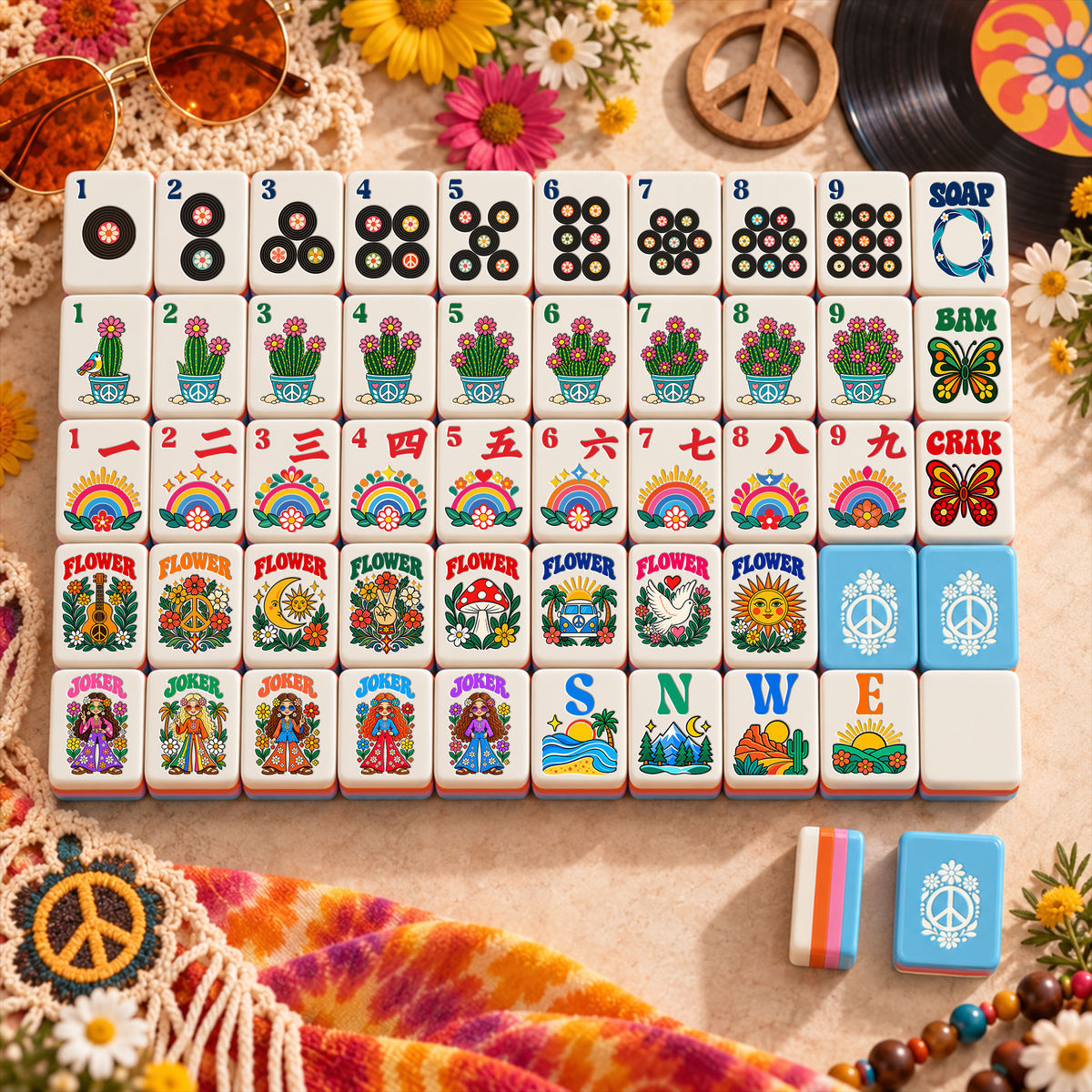
Singapore three-player mahjong removes the fourth wind (usually North or West), leaving 144 tiles in play: three suits, numbers 1–9 (four copies each), eight winds instead of sixteen, twelve dragons, eight flowers, and no jokers. Each player draws 17 tiles at the start instead of 13, and the wall is reduced from 32 to 24 tiles per side. Melds are identical to four-player—pungs (triplets), kongs (quads), quints, and sextets only. Hand complexity and winning patterns simplify compared to four-player variants; a single winning hand typically requires two or three melds plus a pair, not the elaborate combinations found in American play. Games last 20–40 minutes per round. You can play with a standard four-player tile set (simply set aside one wind suit) or purchase a dedicated three-player set.
How does setup differ from four-player mahjong?
In three-player Singapore mahjong, remove one complete wind suit (all four tiles of one compass direction) before mixing. Shuffle the remaining 144 tiles and build a wall 24 tiles long on each side (96 tiles total), not 32 tiles per side. Each player draws 17 initial tiles instead of 13—typically dealt in groups of six, six, and five to equalize the hand. No dealer-breaker or seating ceremony is required; position rotates clockwise, and the player opposite the void (missing) wind sits as opener. The discard phase begins immediately after initial draws.

What tile draws and melds stay the same?
Pungs (three identical tiles), kongs (four identical), and exposed melds (melded sets called on another's discard) follow standard four-player conventions. You cannot call a pung or kong on your own discard; only your immediate right opponent can call your discarded tile. After someone melds, play passes left (counterclockwise). Dead wall pulls (tiles taken after a kong is declared) remain in use—after a kong, the declaring player draws one tile from the dead wall, not two as in some variants. Winning conditions are simpler: typically one pung or kong, one pair, plus winning the final tile—though advanced players may require two melds plus a pair or impose other local restrictions.
Which scoring system applies in three-player Singapore games?
Three-player Singapore mahjong uses a simplified fan-based scoring adapted from Hong Kong or Taiwanese rules, not American League cards or point-based systems. Most commonly, wins are scored as "base points" (8–16 points per win depending on melds and patterns), and losers split payment equally among the three. If you declare a win, the player whose discard triggered it may pay a bonus, or all three pay equal portions. Commonly a winning hand = 8 points (basic two-meld win), 16 points (three melds), or 32 points (all melds or special patterns). Payouts are split; each losing player pays one-third of the declared points, not one pays all. Agree on scoring before play begins—house rules vary by region and social group.
What mistakes do beginners make in three-player format?
The most common error is forgetting that a removed wind cannot be drawn or discarded—players mistakenly draw from a pile believing all suits are present. Second, beginners often miscalculate initial hand size, drawing 13 instead of 17. Third, many misjudge wall depletion: with only 24 tiles per side and no dead wall in some house rules, the game can end in a draw (no winner) far faster than in four-player play. Fourth, players sometimes call an exposed meld on an opponent's discard after a longer delay than the rule allows (typically one turn). Fifth, scoring confusion arises when players assume four-player Hong Kong or American point values apply directly—always clarify payment terms before game one. Keep a running tally on paper, not mental math.
Can you use a standard four-player set, and what's the best practice?
Yes. Any standard four-player tile set (Mahstead's best-selling mahjong sets include American-standard 160-tile sets with four of each wind, twelve dragons, and eight flowers) can be adapted to three-player by simply removing one complete wind suit before each session. Store the removed wind tiles separately so they are not shuffled back in. Do this physically each time you set up, not by memory. For serious three-player players, purchasing a dedicated three-player set removes setup error and saves five minutes per game session. Dedicated three-player sets come with exactly 144 tiles and often include a marked bag or separate container for the void wind—useful if your group rotates which wind is removed.
Comparison: Four-Player vs. Three-Player Singapore Setup
Aspect | Four-Player | Three-Player |
Total tiles in play | 152 | 144 |
Winds per suit | 4 | 3 |
Initial hand size | 13 | 17 |
Wall per side | 32 tiles | 24 tiles |
Total wall | 128 tiles | 96 tiles |
Melds required to win | 1–2 | 1–2 |
Minimum hand complexity | 2 melds + pair | 1 meld + pair (house-dependent) |
Average round duration | 25–35 min | 20–30 min |
Scoring method | Points or fan-based | Fan-based (simplified) |

What equipment works best for three-player games?
A mat sized for three seats (rectangular or triangular layouts 36–48 inches on the long edge) accommodates three players comfortably. Standard four-player mats (48–60 inches) can work but leave unused corners. Racks with pushers help each player organize 17 initial tiles neatly; choose models that hold 18+ tiles to account for the extra draw. A scorepad or digital app prevents mental arithmetic errors and speeds settlement. If you rotate which wind is removed each round, keep a small marker (a button or chip) on the table indicating the void wind—prevents the "did we remove East or West?" confusion that halts play.
🀄 Shop best-selling mahjong sets →
How does three-player Singapore differ from American mahjong?
American mahjong requires hands only from the current-year National Mah Jongg League card, uses 152 tiles plus 8 jokers, and allows chows (sequences) in melds. Singapore three-player uses 144 tiles with no jokers, melds are pungs and kongs only (no sequences), and hands are defined by local rules or region (Hong Kong, Taiwan, Fujian patterns), not a single official card. American play enforces the Charleston (a pre-game tile-passing ritual), while three-player Singapore does not. American games typically involve four players; three-player is a separate format designed for exactly three. If you're learning both variants, understand that the tile sets, hand structures, and meld types differ significantly—do not assume American rules map to three-player Singapore.
What's the right tile count for your group?
If your group is committed to three-player Singapore exclusively, a dedicated 144-tile set eliminates setup error and re-familiarizes players with tile distribution specific to the format. If you play both three-player and four-player, or if you host mixed-skill groups that sometimes need a spare set, a standard 160-tile set (with spares) is more versatile; simply remove one wind and store it aside before play. Check the product description to confirm the set includes a full wind suit (four tiles each of North, East, South, West) before purchase. Our best-selling mahjong sets detail all tile counts and suit breakdowns, so you can confirm compatibility with your intended format.
🎁 See our most-loved mahjong sets & accessories →
What to check before you buy
Tile count: Confirm the set includes at least 144 playable tiles (three suits 1–9 with four copies each, eight winds, twelve dragons, eight flowers) plus any spare tiles.
Tile size and weight: Standard tiles are 25–27 mm and weigh 8–10 grams; confirm the set is comfortable in hand for a 17-tile initial draw.
Packaging and organization: If the set includes a bag or case, verify it can hold the full set without crowding, simplifying storage between sessions.
Acrylic vs. bamboo/bone: Acrylic sets are durable, easy to clean, and often less expensive; bamboo or bone tiles are traditional but require more careful handling and storage in stable humidity.
Face clarity: Ensure symbols and numbers are large and crisp; players with vision challenges need high-contrast tiles.
Verify no missing suits: Before your first game, lay out all four tiles of each wind, all twelve dragons, and all eight flowers to confirm completeness.
Hosting your first three-player game
Choose a mat large enough for three seats (36–48 inches minimum on the long side).
Select your tile set and confirm the tile count matches your format.
Brief players on scoring rules verbally and in writing before play.
Remove one wind suit and store it separately so no one accidentally adds it back.
Deal 17 tiles per player using a standard dealing pattern (6, 6, 5 or 7, 5, 5).
Designate an opener (often the player opposite the void wind, by convention).
Keep a scorepad visible; update totals after each hand before resetting.
Set a time limit or round limit (e.g., "play for 90 minutes or eight hands") so the session has a defined end.
✨ Find your Mahstead set — free US shipping →

FAQ
Can I use American mahjong rules with three players?
American mahjong requires 152 tiles plus 8 jokers, hands from the current-year NMJL card, and is designed for four players. Three-player Singapore uses 144 tiles, no jokers, and simpler regional hand patterns. Do not mix the two—agree on which variant before play.
What if someone draws from the void wind by mistake?
If a player unknowingly draws a removed wind tile during play, call a misdeal immediately. Return all tiles to the wall, reshuffle, and restart that hand. To prevent this, always store the removed wind face-up in a separate container away from the wall.
How do payouts work in three-player scoring?
Most commonly, if you win, each of the two other players pays you one-third of the declared points—or all three players contribute equally to a pool you take. Agree on the payout method before game one and write it down; scoring confusion causes disputes.
Can I rotate which wind is removed each round?
Yes. Many groups remove the void wind in rotation (East round, South round, etc.). Mark the void wind with a token or chip placed visibly so no one forgets which wind is absent during that hand.
Is three-player Singapore played in Singapore?
Three-player mahjong exists across East and Southeast Asia, including Singapore, Hong Kong, Taiwan, and Malaysia. It is not exclusive to Singapore but is popular there; regional rule variations exist, so always clarify house rules with your group.
Do I need a special mat or racks for three players?
Standard four-player mats and racks work but leave unused space. A mat or rack sized for three seats is more comfortable and fits the three-player hand size (17 tiles) more snugly. Check the dimensions in the product description before ordering.


View More
View More
View More
