
Siamese Mahjong Winning Hands: Patterns and Play
Last updated: Nov 23, 2026
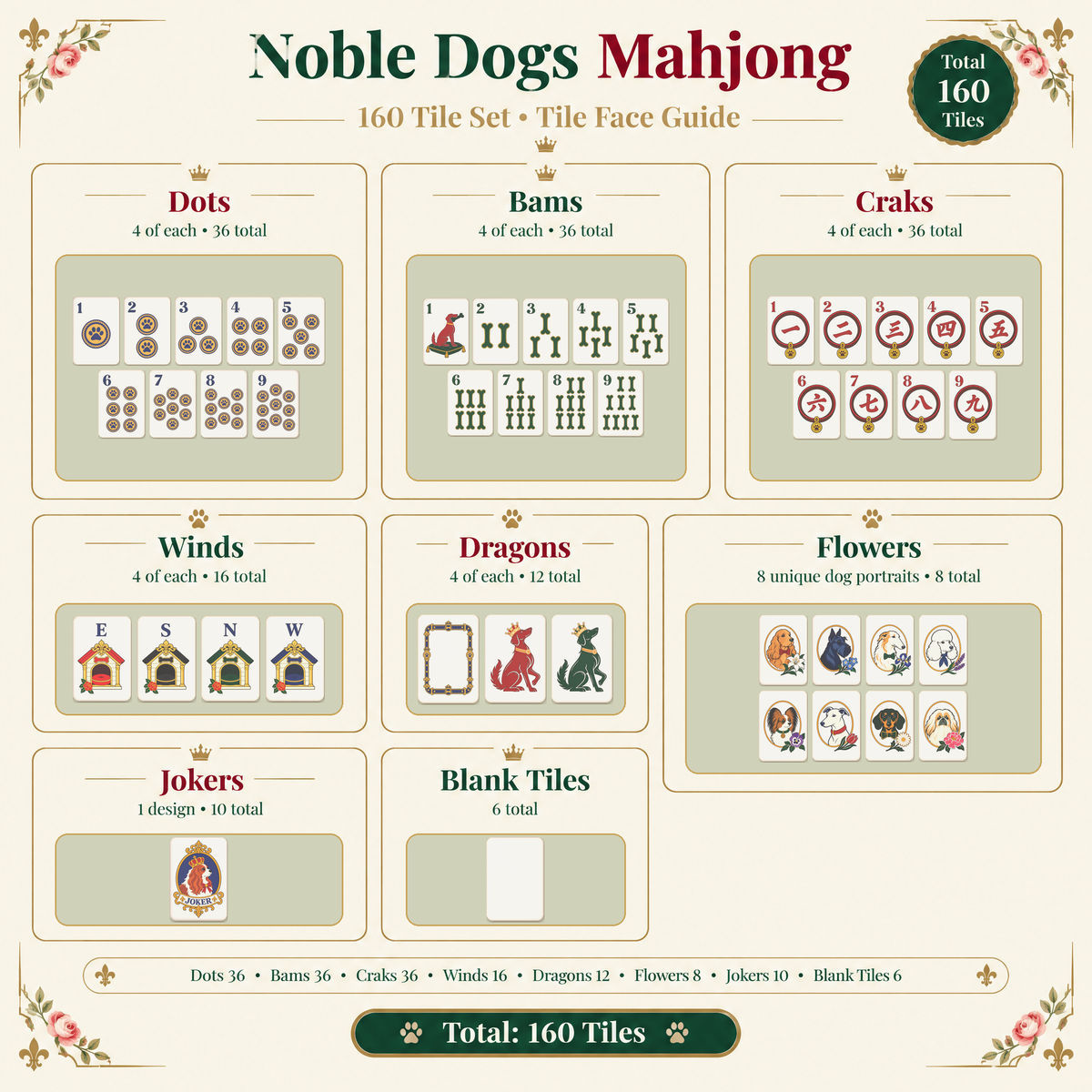
Siamese mahjong, also called Thai mahjong, uses 108 tiles (four suits: Characters, Bamboos, Circles, and Winds—no Honors or Flowers) and plays with melds called chows (numbered sequences like 1-2-3), pungs (three identical tiles), and kongs (four identical tiles). A winning hand contains four melds plus a pair; the core difference from American mahjong is that sequences (chows) are exposed and callable—you aren't restricted to pungs and kongs. Players draw and discard, building toward any valid combination from their own game board (no central card dictating the hand). Most Siamese games prioritize speed and pattern recognition over the rigid structure of American league play. Play typically involves four players, one round lasts 15–30 minutes, and tiles are marked with Thai numerals or symbols. If you're used to how to play American mahjong, Siamese rules are more permissive and flow-based; no specific seasonal hand card is required. 🀄 Shop best-selling mahjong sets →
What tiles does a Siamese mahjong set contain?
A standard Siamese set has 108 playing tiles: Characters (man) 1–9, Bamboos (soh) 1–9, Circles (pin) 1–9, and Winds (N/E/S/W), with four copies of each tile. There are no Dragons or Flowers—the game strips away honors that complicate American play. Each tile is traditionally marked with Thai script or numerals, though modern sets sometimes use international symbols for clarity.

How do you build a winning hand?
A winning hand (called "mahjong") consists of four melds (groups of three or four tiles) and one pair (two identical tiles). Melds fall into three types: chows (three consecutive numbered tiles from one suit, like 4-5-6 Bamboos), pungs (three identical tiles), and kongs (four identical tiles). You may draw a tile from the wall, add it to your hand, and discard one. When another player discards a tile you need for a chow, pung, or kong, you can call it and expose the meld—this is the key difference from American play, where only pungs and kongs are callable. The first player to complete four melds plus a pair and declare "mahjong" wins the round.
What's the difference between Siamese and American mahjong?
American mahjong uses 152 tiles (three numbered suits, Winds, Dragons, Flowers, Jokers) and restricts plays to fixed hands from an annual National Mah Jongg League card; sequences (chows) cannot be called or exposed. Siamese mahjong uses 108 tiles, has no annual card, and allows any valid combination of chows, pungs, kongs, and a pair—sequences are fully callable. American play emphasizes luck and pattern matching against a card; Siamese play rewards speed, flexibility, and real-time decision-making. The experience feels closer to Gin Rummy than to structured league play. For players who enjoy the social flow of tile games over rigid rule sets, Siamese feels more improvisation-based.
What winning hand patterns should beginners memorize?
Start with these foundational patterns: All Pungs (four three-tile groups of identical tiles plus a pair), All Chows (four consecutive-number groups plus a pair), Mixed Hand (two chows, two pungs, plus a pair), and All Terminals (using only 1 and 9 tiles from each suit in any meld). As you grow, learn Pung of Winds (a complete set of Wind pairs and melds), Flush (all tiles from one suit), and Dragon Honor (incorporating all three Dragons where the set includes them). Each pattern builds tile recognition and encourages you to spot combinations early. The payoff: faster calls, fewer discarded winning tiles, and stronger table presence.
Pattern Name | Composition | Difficulty | Winning Frequency |
All Pungs | 4 three-tile identical groups + pair | Easy | High |
All Chows | 4 consecutive sequences + pair | Medium | Medium |
Mixed Hand | 2 chows, 2 pungs + pair | Medium | High |
All Terminals | Only 1s and 9s in melds | Hard | Low |
Flush (one suit) | All tiles from single suit | Hard | Low |

How do you call a tile and expose melds?
When another player discards a tile you need, call it immediately (typically by tapping the table or saying "claim"). You expose the meld face-up on the table, remove one unwanted tile from your hand, and discard it face-up. The next player draws and plays normally. Exposed melds are seen by all players, which influences their discard strategy. If no one calls the discard, play passes to the next player, who draws from the wall. Speed matters: in competitive Siamese play, hesitation or a slow call can result in a passed opportunity. This open-hand style creates table tension and forces you to watch every discard, unlike American mahjong's quieter, card-driven rhythm.
🎁 See our most-loved mahjong sets & accessories →
Where can you learn Siamese mahjong rules in detail?
Online communities and YouTube channels dedicated to Thai or Southeast Asian mahjong are the best starting points; search for "Thai mahjong rules" or "Siamese mahjong tutorial." Local Thai community centers, libraries, or cultural organizations in areas with Thai populations often host weekly games and welcome learners. Some players share rule variations by region, so clarify house rules before your first game—Siamese play is more flexible than American league play, and regional tweaks are common. Books on Chinese mahjong also cover foundational meld logic, though Siamese rules are a distinct dialect. Joining a local table is faster than reading: experienced players teach by example, and you'll internalize patterns within a few sessions.
What's the strategic edge in Siamese winning hands?
The biggest strategic shift is flexibility over prediction. In American mahjong, you memorize the card and hunt for fixed patterns; in Siamese play, you adapt moment-to-moment. Pay attention to melds other players are building: if you see exposed pungs from Player A in Bamboos, don't discard Bamboos 4–6 late in the round. Watch pair timing: players often reveal their pair suit through early discards. Use chow awareness: sequences are fluid, so a 5 Circles discard might be risky if two players are holding 4s and 6s. The player who discards least carelessly wins. Also, call early: exposed melds are often stronger than hidden ones, and calling forces opponents to adjust. Speed + observation + minimal waste = consistent wins.
What to check before you buy a Siamese mahjong set
Tile size and weight: Ensure tiles are large enough to handle comfortably (standard is roughly ½ inch) and weighty enough not to slide during play.
Marking system: Choose tiles with numerals or symbols you can read quickly; Thai script is traditional but may slow new players.
Storage case: A padded bag or wooden box keeps tiles protected during transport and storage.
Set completeness: Verify the set includes all 108 tiles (four copies of each) plus any region-specific tiles or variations your local group uses.
Surface compatibility: If you plan to use a mat, confirm tile size matches the mat's grid or pocket design (if applicable).
For groups transitioning from American to Siamese play or exploring variants, our best-selling mahjong sets include designs and sizes that work across multiple rule systems. We also stock mahjong mats and travel bags sized for standard tiles, making it easy to move between game styles.
✨ Find your Mahstead set — free US shipping →

FAQ
Can I use an American mahjong set to play Siamese mahjong?
Not directly. American sets have 152 tiles (including Dragons, Flowers, and Jokers) that Siamese play doesn't use. You'd be discarding 44 tiles and still missing the numeric balance Siamese requires. Buy a dedicated 108-tile Siamese set for authentic play.
Do Siamese mahjong winning hands require a pair of Dragons like American hands do?
No. Siamese mahjong has no Dragon tiles. A winning hand is simply four melds (any mix of chows, pungs, or kongs) plus one pair—the pair can be any two identical tiles.
How long does a typical Siamese mahjong round last?
15–30 minutes, depending on player speed and house rules. Siamese play flows faster than American league play because there's no card lookup and melds are called on the fly.
What's the scoring system in Siamese mahjong?
Scoring varies by region and house rules. Some games award points based on pattern difficulty or the number of exposed melds; others use a simple winner-takes-all or points-per-loser system. Clarify scoring before play begins.
Can a beginner win a Siamese mahjong hand on their first game?
Yes. A simple "All Chows" or "Mixed Hand" is achievable quickly if you get favorable draws. Watch the table, recognize sequences early, and call tiles when you need them—luck and speed matter as much as experience.
Is Siamese mahjong easier to learn than American mahjong?
Easier in some ways, harder in others. Siamese has no annual card to memorize (easier), but you must recognize valid melds on the fly and react faster (harder). American mahjong rewards pattern-card literacy; Siamese rewards real-time flexibility.


View More
View More
View More
