
Shanghai Mahjong Tile Set: American vs. Chinese Play Compared
Last updated: Nov 23, 2026
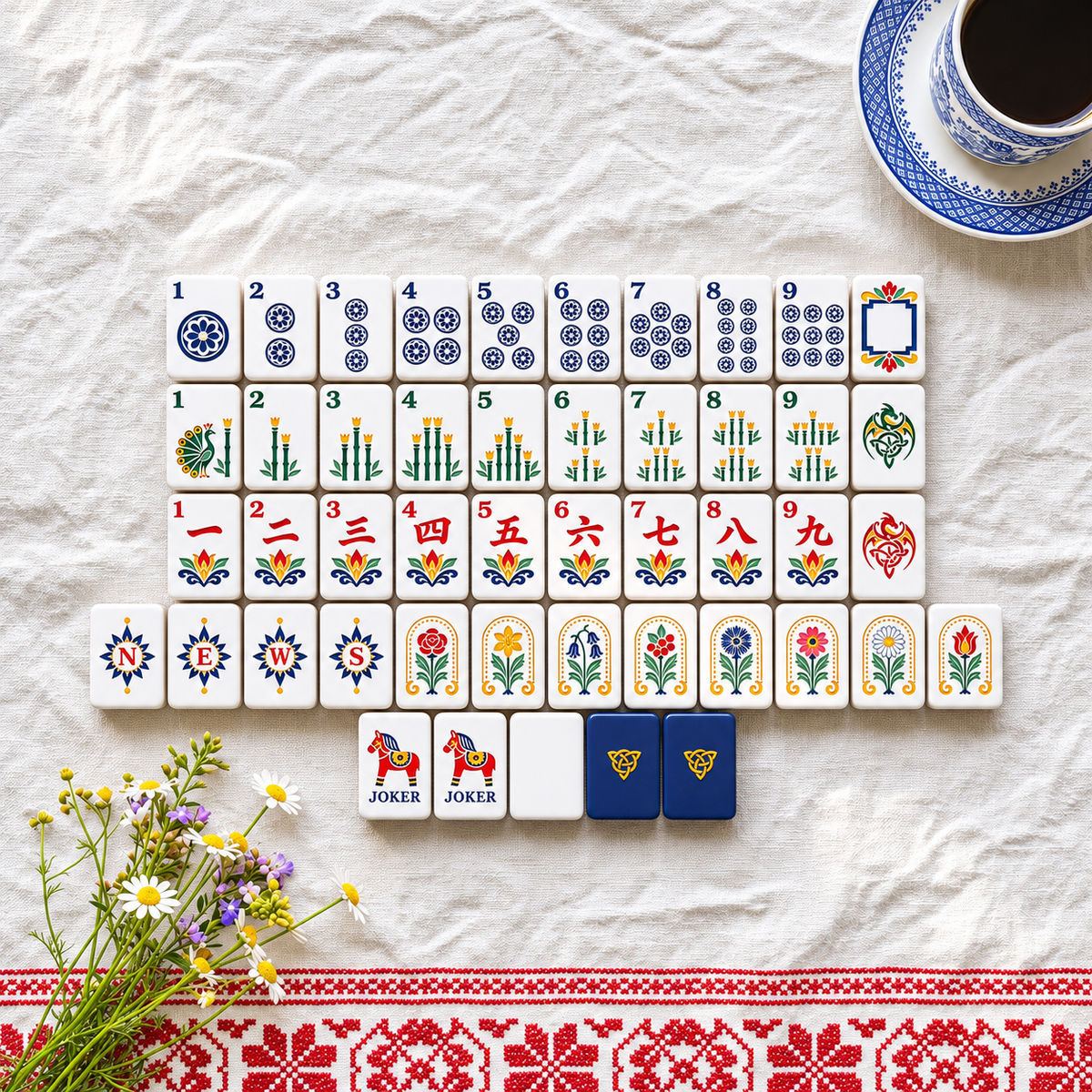
Shanghai mahjong is a Chinese variant played with 144 tiles across three numbered suits (Bamboo, Circle, Character), honor tiles (winds and dragons), and bonus tiles, without jokers. Players form melds—pairs, pungs (3 identical), kongs (4 identical), and crucially, chows (sequences like 2-3-4 of one suit)—that can be called and exposed during play, unlike American mahjong where only pungs, kongs, and higher sets are permitted. A Shanghai game runs 2–4 players and typically 1–2 hours. If you play American mahjong weekly with our engraved acrylic 160-tile sets, switching to Shanghai means learning a completely different hand logic, scoring system, and tile mechanic. Chinese sets cost less than American counterparts because they contain fewer tiles and no jokers; however, American players often find the call-and-expose rhythm unfamiliar. Before buying a Shanghai set, confirm whether your group plays the simplified Shanghai variant (Hong Kong rules) or classical Shanghai, as tile counts and hand patterns differ slightly. 🀄 Shop best-selling mahjong sets →
Why Shanghai Mahjong Plays So Differently from American
Shanghai mahjong allows chows—consecutive sequences of three tiles in one suit—that American mahjong bans entirely. In Shanghai, a player can call a pung of 5 Bamboo or a chow of 5-6-7 Circle and expose it on the table immediately; in American mahjong, how jokers work and the rigid hand card mean you build only in your rack until your complete hand matches the current year's card. Shanghai scoring depends on the specific melds and bonuses, not a League reference card. This makes Shanghai feel like an open, dynamic negotiation; American feels like a closed puzzle you solve before declaring. Neither is harder—they're fundamentally different games.

What Tiles Come in a Shanghai Set vs. American
A standard Shanghai mahjong set contains 144 tiles: 108 numbered tiles (Bamboo, Circle, Character, each 1–9 in four copies), 16 winds (4 each: North, East, South, West), 12 dragons (4 each of Red, Green, White), and 8 flower/bonus tiles. No jokers exist. An American set, by contrast, uses 152 playing tiles plus 8 jokers as wild cards that can fill any pung, kong, or higher meld, but never as a pair or single. The best-selling mahjong sets we carry are American acrylic 160-tile sets (152 playing tiles plus 8 spare jokers and blanks). If you want to play Shanghai mahjong, you'll need to source a Chinese-market 144-tile set from specialty retailers; it won't include jokers, and tiles are typically plastic or resin rather than the acrylic clarity we offer in American sets. Tile thickness, engraving depth, and surface finish differ too—American sets prioritize durability and visibility for the high-frequency calling of numbers.
Shanghai vs. Hong Kong: Which Regional Variant Matters
Shanghai classical (also called Shanghai Classic) uses the 144-tile base and complex hand patterns that vary by region; Hong Kong mahjong simplifies the rules and scoring, making it the beginner-friendly entry point within the Chinese family. Both prohibit jokers and require melds to be called and exposed mid-game. Hong Kong adds a "Kong bonus" (extra point for declaring a kong), speeds the tile draw, and uses a smaller card reference than Shanghai Classic. If your group plans to learn Chinese mahjong casually, Hong Kong is the logical start. If anyone has family in Shanghai or strong ties to classical play, Shanghai Classic demands deeper study of hand rankings and penalties. For American mahjong players, the leap to either Chinese variant is substantial—you lose the security of the NMJL card and the predictability of joker substitution, and you gain the fluidity of mid-game calling. Decide which regional rules your group prefers before buying tiles.
How to Pick a Shanghai Set That Fits Your Table
Feature | Who it's for | What to check | Red flag |
Lightweight plastic | Casual learners, travel | Tile clarity, chirp sound | Faded engraving or cracked tiles after a few plays |
Resin or acrylic (if available) | Weekly players, investment | Weight, corner durability, stack feel | Slippery surface or tiles that stick together |
Bamboo rack set | Serious players, display | Rack fit, pusher quality, felt lining | Racks that wobble or don't hold 13 tiles stably |
Simple label (no art) | Purists, teaching | Easy numeral reading, color contrast | Dim or ambiguous suit symbols in low light |
Art-printed tiles | Collectors, gift | Print quality, fade resistance, whether heat-treated | Peeling or bubbling imagery after washing |
Shanghai sets sold online typically arrive in a cardboard box with a simple divider tray; higher-end versions include a bamboo or wooden rack (not the acrylic pushers we use for American mahjong). Check the tile material—plastic sets are cheapest and lightest; resin and acrylic are heavier and last longer but cost more. For a group that plays weekly and may own multiple sets, we recommend starting with a standard plastic Shanghai set from a reputable Chinese retailer to learn the rules, then upgrading to a more durable build once the group commits. If your table is split between American and Chinese mahjong, buy engraved American mahjong sets from Mahstead and a separate 144-tile Shanghai set—the two systems don't cross over, and mixing tiles mid-game will cause chaos.
🎁 See our most-loved mahjong sets & accessories →

Shanghai Mahjong Strategy: The Call-and-Expose Rhythm
In Shanghai play, the game opens up the moment someone calls a pung or chow and exposes it; in American mahjong, everything stays hidden until someone wins. This means Shanghai players read the table constantly—watching which melds have been declared, which suits are flowing, which player might be building a long. Calling too early shows your hand's direction and lets opponents block you; calling late risks someone else completing the same meld first. There's no discard-and-wait safety net; every tile you draw signals your direction. American players often make the mistake of hoarding honors (winds, dragons) as if they were jokers; in Shanghai, honors are heavy and tie up your hand unless they're part of a kong. Learn to pivot: if you start building Bamboo and see two Bamboo melds already exposed, switch suits quickly. The player directly opposite you (South if you're North) can see your rack orientation and will read your pauses—be unpredictable. Practice by playing three rounds with the same group to build intuition around calling patterns.
Scoring Shanghai Mahjong: Points, Doubles, and Penalties
Shanghai mahjong scoring uses a multiplier system that can feel abstract to American players accustomed to point limits and the NMJL card's fixed values. A basic hand (e.g., one pung, one kong, one chow, one pair) scores a base value; if you include a "double" (such as all pungs, or a chow of terminal and honor tiles), you multiply by two. Discarding a tile that causes an opponent to win immediately is a penalty—you pay the winner double or triple, depending on house rules. Winning on a "self-drawn" tile (one you pull from the wall) vs. a "discard" also affects the multiplier. American mahjong's scoring is fixed by hand type and joker count; Shanghai's is fluid and negotiated, which means every group has house rules and you must confirm them before the first hand. Many casual groups simplify to a flat point per hand to avoid dispute. If your group is serious, buy or find a clear scoring reference chart (often printed on a card inside Shanghai sets) and read it aloud before you play—ambiguity will derail the game.
✨ Find your Mahstead set — free US shipping →
What to Check Before You Buy a Shanghai Mahjong Set
Tile Count & Format Verify the set contains exactly 144 tiles for classical Shanghai, or 144 + bonus/blank tiles if the seller adds spares. Do not assume a set sold as "Shanghai" is always 144—some vendors mix counts. Confirm there are no jokers included; if a set claims 160+ tiles, it's likely a hybrid or mislabeled.
Suit Symbols & Legibility Shanghai uses three suits (Bamboo = stalk symbols, Circle = coins, Character = Chinese numerals or words). In low light, poor-quality engraving blurs these; hold a sample or photo at arm's length and check that each symbol is distinct. Color-coded suits (often red bamboo, blue circle, green character) help, but some tiles use only line art.
Tile Material & Durability Plastic sets (~1.5 mm thick) are affordable and cheerful but can crack or fade after 100+ hours of play. Resin and acrylic sets are heavier, stack better, and withstand years of weekly use. Ask the seller for expected tile lifespan; reputable vendors give honest answers.
Rack Quality If the set includes a bamboo or wooden rack, inspect photos for visible cracks, uneven felt lining, or loose joints. Racks that tilt or don't grip tiles securely will frustrate players and slow the game. Some Shanghai sets have no rack; budget separately if your group needs one.
Storage & Case Most Shanghai sets ship in a cardboard sleeve or simple box. If you plan to store it long-term or travel, consider adding a fabric bag or hard case to protect tiles from dust, moisture, and breakage. Mahstead's mahjong bags and cases are designed for American sets but may fit a compact Shanghai set depending on dimensions—measure your tiles first.
Language & Instructions Confirm the set's instruction card (if included) is in English or a language your group reads. Many Shanghai sets come with Chinese-only rules cards; download a PDF translation or find a YouTube tutorial in advance to avoid confusion at the table.

FAQ
Can I use a Shanghai mahjong set to play American mahjong?
No. Shanghai sets lack the 8 jokers and have only 144 tiles instead of 152. American mahjong requires jokers as wild cards and the specific tile distribution. The two sets are incompatible.
How long does a Shanghai mahjong game take?
A typical Shanghai hand takes 10–15 minutes; a full game (usually 4 hands or a session of 1–2 hours) depends on group pace and scoring disputes. American mahjong runs about the same, but Shanghai can extend if players debate scoring rules.
What's the main reason Shanghai mahjong feels faster than American?
Players call and expose melds mid-game, opening the table instantly. American mahjong keeps all tiles hidden until someone wins, which can feel slower to observers but allows deeper strategic planning in your rack.
If I learn American mahjong first, how hard is it to switch to Shanghai?
It's a mindset shift, not just new rules. You lose the safety of the League card, jokers, and the closed-hand strategy. Most American players need 5–10 games of Shanghai to stop reaching for joker logic. Worthwhile if your group is multilingual or multi-regional.
Where can I buy a Shanghai mahjong set in the US?
Specialty mahjong retailers, online Asian housewares marketplaces, and some import shops stock 144-tile Shanghai sets. Mahstead specializes in American mahjong; for Shanghai, source from vendors who focus on Chinese variants and confirm the tile count and material before ordering.
What's the difference between Shanghai Classic and Hong Kong mahjong?
Hong Kong mahjong is a simplified variant of Shanghai with fewer hand types, faster scoring, and a "Kong bonus" rule. Hong Kong is easier for beginners; Shanghai Classic is more complex and region-specific. Both prohibit jokers and require calling mid-game.
Do I need a mahjong mat for Shanghai play?
A mat isn't required but helps protect tiles and the table surface. Shanghai mats are often smaller than American mats (which accommodate 152 tiles). Our American mats are designed for 160-tile sets; a Shanghai mat will be narrower but serve the same protective purpose.
Can I store Shanghai and American mahjong sets in the same bag?
Yes, if you have a large mahjong bag, though mixing tiles risks confusion during setup. We recommend separate bags or a divider to keep the two systems visually distinct and prevent accidental tile substitution.


View More
View More
View More
