
Riichi Mahjong vs Malaysian Mahjong: Key Rules & Differences
Last updated: Nov 23, 2026
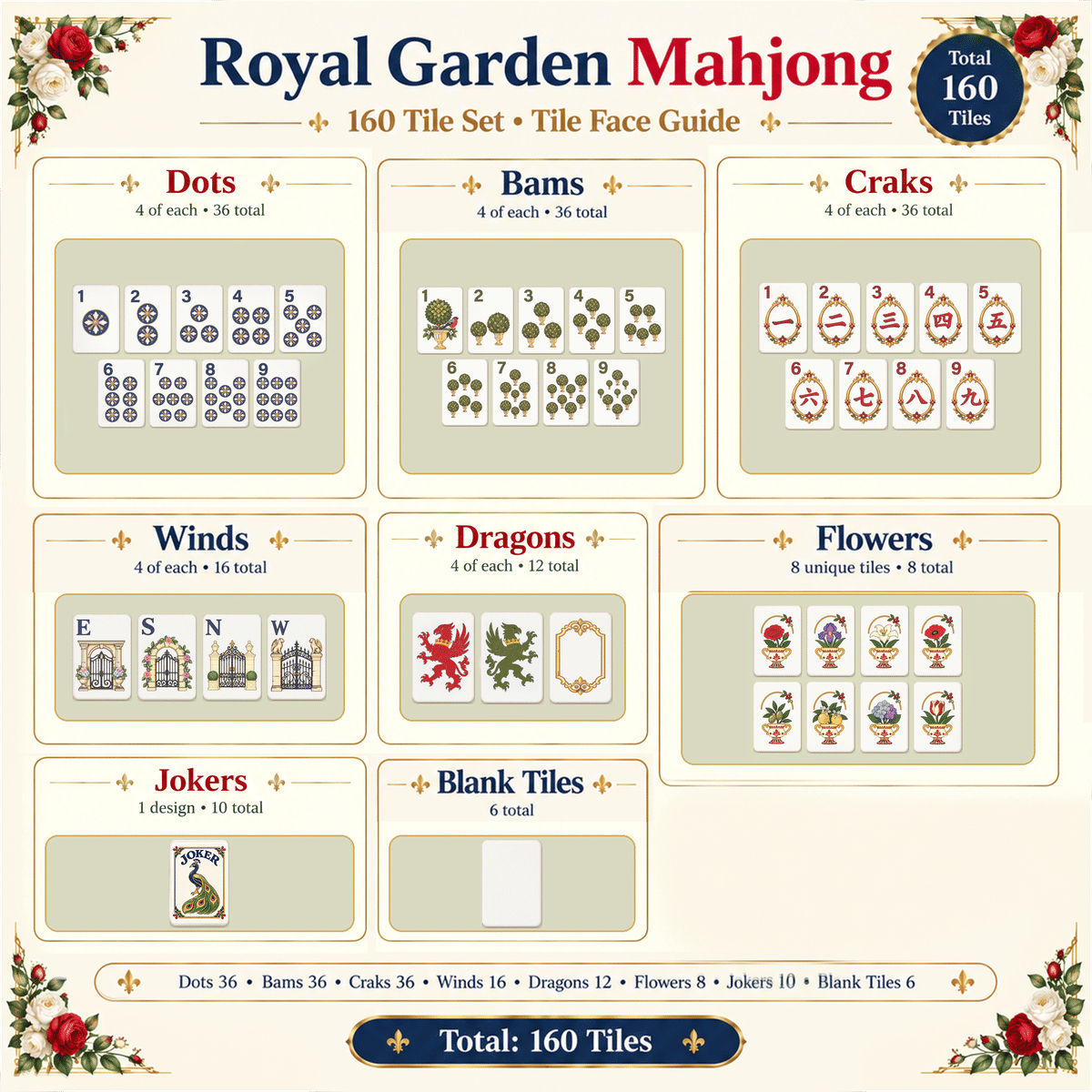
Riichi mahjong, the Japanese standard, uses 136 tiles across four suits (Bamboo, Character, Dot, plus Honours: Winds and Dragons) in sets of four, with no jokers; players draw and discard one tile per turn, declaring "riichi" (a ready hand with one tile to win) and earning bonus payments. Malaysian mahjong, played across Malaysia, Singapore, and Brunei, uses similar 136-tile structure but allows "kong" (adding jokers mid-hand), features different scoring, simplified winning patterns, and faster play; it evolved locally as a social game with looser hand requirements than Japanese riichi. Both demand 4 players and roughly 20–30 minutes per hand. Riichi is rule-heavy, tournament-standardized, and best for competitive players; Malaysian mahjong is casual, flexible, and popular in family and social settings. Neither uses the NMJL card or American hand patterns.
How do Riichi and Malaysian tile sets differ?
Both games use 136 tiles in the same four basic suits, but the composition and use of jokers sets them apart. Riichi uses exactly one copy of each tile (one 1 Bamboo, one 5 Character, etc.)—no duplicates, no jokers. Malaysian mahjong also starts with a similar 136-tile foundation but incorporates jokers (wild tiles) that can substitute for any tile in a hand, adding flexibility and speed. This single difference—joker integration—shifts the entire strategy and hand-building logic. In riichi, you must match exact sequences (chows: 1-2-3) and triplets (pungs: 3 identical) through pure draw-and-discard. In Malaysian mahjong, jokers allow you to "complete" patterns faster, making the game shorter and more forgiving for casual players. If you've learned riichi and switch to Malaysian rules at a table, expect confusion around which tiles count as jokers and how they're declared—clarify with the host before sitting down.

What is the core winning condition in each variant?
Riichi mahjong requires a player to form a complete hand of four melds (sets) and one pair, where a meld is either a sequence (chow: 1-2-3 of one suit) or a triplet (pung: three identical tiles). The winning pattern is rigid and tournament-standardized; your hand must follow patterns listed in official riichi rule books or on recognized score sheets. Malaysian mahjong has more fluid winning conditions; hands can consist of three or four melds plus a pair, and the specific patterns are looser—many house rules allow "pairs of pairs" or simplified triplet combinations. A riichi hand might require 1-2-3 Bamboo, 4-5-6 Character, three Red Dragons, and a pair of East Winds. A Malaysian hand might win with three pairs, two triplets, and a pair—pattern flexibility that appeals to recreational players. This difference means a hand valid in Malaysian mahjong may not score in riichi, so always confirm your table's rulebook before the first tile is drawn.
How do jokers and wildcards work differently?
In riichi mahjong, jokers do not exist. Every tile has a fixed identity; you cannot use a substitute or wild tile. This purity keeps the game logically tight and rewards pattern recognition and memory. Malaysian mahjong introduces jokers (often 8 or more in a full set) that can stand in for any tile a player needs. A player holding a joker can use it as a 7 Character, then as a 2 Dot, depending on which hand they're building. Jokers can be drawn from the deck or, in some Malaysian house rules, purchased mid-game. Some tables allow "kong-ing" a joker—swapping it out for the actual tile if you later draw it. This mechanic accelerates play and lowers the skill floor; new players can build winning hands faster because they're not trapped waiting for one specific tile. Riichi players accustomed to high stakes and pattern certainty often find Malaysian joker rules chaotic; Malaysian players coming to riichi often feel the rigid no-joker rule is punishing. Both viewpoints are valid—it's a design choice, not a quality judgment.
What are the key scoring and payment differences?
Riichi mahjong scoring is point-based and hierarchical. A hand's score depends on its pattern rarity (simple triplets score low; rare sequences score high), the number of melds, and bonuses for declaring riichi early. Payments flow from losers to the winner (and sometimes to the "ready" player who did not win), with amounts multiplied by East Wind (dealer) and winning conditions. A 3-point hand might pay 1,000–3,000 points per opponent; a rare hand can exceed 12,000 points. The math is complex and requires reference tables. Malaysian mahjong typically uses a simpler, flatter scoring system: all winning hands are worth the same base value (or near it), and payments are split equally among losers or paid per a simple multiplier. Some tables use chips or tokens; others tally cash directly. This simplicity is why Malaysian mahjong remains popular in casual family settings—you don't need a score sheet or calculator after each hand. If you're joining a riichi table, expect a 5–10 minute learning curve on scoring; at a Malaysian table, you'll learn the payout rule in under a minute.

Riichi vs. Malaysian: Which should you learn first?
Choose riichi if you want a skill-based, tournament-ready competitive game with global communities and standardized rules. Riichi's logical structure, pattern-matching depth, and vast rulebook make it ideal for serious players. Choose Malaysian if you value social play, casual Friday-night energy, and minimal rule overhead. Malaysian mahjong is easier to teach to newcomers and adapts to house rules flexibly. Consider your circle: if your friends in a riichi hotspot (Japan, parts of Europe, growing US groups) are already playing, join them and commit to learning riichi properly. If your family or social group in Malaysia, Singapore, or diaspora communities plays Malaysian-style, start there. Avoid switching between variants at the same table—confusion and disputes follow. Once you've played one variant for 10+ sessions, the other becomes easier to learn because the underlying tile-matching logic is the same. The variant difference is strategy and culture, not fundamental mathematics.
Aspect | Riichi Mahjong | Malaysian Mahjong |
Tile count | 136 (4 suits, 4 per tile) | 136 + jokers (varies by set) |
Jokers | None | 8–12 (house-dependent) |
Winning pattern | Rigid, standardized | Flexible, house rules |
Meld types | Chows (sequences) + pungs (triplets) | Triplets + simplified sequences |
Scoring | Point-based, hierarchical, tables required | Flat or simple multiplier |
Play speed | 25–35 min per hand | 15–25 min per hand |
Best for | Competitive, tournament play | Social, family, casual |
Learning curve | Steep (scoring, patterns, etiquette) | Gentle (rules adapt) |
Geographic hub | Japan, growing in Europe & US | Malaysia, Singapore, Brunei, diaspora |
How do you get started with either variant?
Join a local mahjong club or meetup before buying a set. Search your city's community centers, libraries, cultural associations, and online meetup boards for "riichi mahjong" or "Malaysian mahjong" groups; game cafés in urban areas often host open tables. Attend one session, observe, and ask players how they learned. Most will teach you the basics and let you play a few hands for free. Only then buy a set. Riichi sets are sold specifically as riichi 136-tile sets; Malaysian sets may be labeled Malaysian, Singapore-style, or simply as variant sets. Be aware that many general 160-tile best-selling mahjong sets are designed for American play, not riichi or Malaysian—the tile composition and markings differ. If you're committing to riichi, invest in a riichi-specific set with proper Japanese tile graphics and markings. For Malaysian play, any standard 136-tile set with jokers will work; many players use recycled American sets and simply ignore the NMJL card. Once you've chosen your variant, a dedicated set and a quality mat for regular practice will make play smoother and more enjoyable.
🀄 Shop best-selling mahjong sets →
What to check before you buy a set for either variant
Confirm the tile count and joker count. Riichi sets must be exactly 136 tiles with zero jokers. Malaysian sets vary; some have 136 + 8 jokers, others 136 + 12. Verify with your group's host before ordering.
Check tile markings. Riichi sets use Japanese characters and specific Wind/Dragon marks. American sets use NMJL symbols and English labels—these won't work for riichi. Malaysian sets are more forgiving; any clear, legible tile will do.
Verify that jokers (if you need them) are included. Some sets ship jokers as spare tiles; others don't include them at all. Read the product description carefully.
Test the tile size and weight in person if possible. Riichi players often prefer smaller, lighter tiles (roughly 18×25 mm); Malaysian and American players tend to prefer larger, heavier tiles (roughly 20×28 mm). Tile feel affects your comfort over 2+ hours of play.
Confirm you have all four winds and all three dragon colors (Red, Green, White/Soap). A broken or missing tile mid-game is a deal-breaker.
🎁 See our most-loved mahjong sets & accessories →
Why table rules matter more than variant name
The single biggest mistake new players make is assuming "Malaysian mahjong" means the same thing everywhere. In reality, house rules vary dramatically—Kuala Lumpur rules differ from Singapore rules, which differ from diaspora kitchen-table rules. The same applies to riichi; while the Japan Mahjong Association publishes official rules, many casual riichi groups tweak scoring or hand patterns. Before you sit down, always ask: What's your scoring system? Do jokers count? Can we kong mid-game? What happens if someone plays out of turn? Most hosts are happy to hand you a written rulebook or walk you through a practice hand. This 5-minute conversation prevents arguments and restarts. It's why finding an established group—not just a set—is your first priority. A beautiful set is useless if you're playing by three different rule interpretations at the same table.
✨ Find your Mahstead set — free US shipping →

FAQ
Can I use an American mahjong set to play riichi or Malaysian mahjong?
No, not without confusion. American sets have 152 tiles with jokers, NMJL-specific markings, and hand patterns from the annual card—a completely different system. Riichi requires exactly 136 tiles with no jokers and Japanese notation. Malaysian play can adapt more flexibly, but you'd still need to ignore or cover American symbols. Buy a variant-specific set to avoid frustration.
Is riichi mahjong harder to learn than Malaysian mahjong?
Yes, significantly. Riichi has complex scoring tables, standardized hand patterns, strict melds, and a steep rule hierarchy. Malaysian mahjong has simpler, flatter rules and adapts to house variations. If you're new to mahjong overall, start with Malaysian or American mahjong; riichi is best learned after you understand basic tile-matching logic.
Can I play riichi or Malaysian mahjong with fewer than 4 players?
Riichi is designed for 4 players and breaks structurally with fewer. Some house rules allow 3-player riichi, but it requires major adjustments. Malaysian mahjong is similarly 4-player standard, though some casual groups attempt 3-player versions. Always ask your group first; don't assume you can adapt it on your own.
How long does a typical game (session) take?
Riichi: 2–3 hours for four hands (a "round") because scoring and pattern-checking take time. Malaysian: 1.5–2.5 hours for four hands because scoring is simpler and play is faster. Actual hand length (draw to win) is 15–35 minutes for either variant, depending on luck and player speed.
Where can I find a riichi or Malaysian mahjong group near me?
Search your city's community centers, libraries, cultural associations (especially Chinese, Japanese, Malaysian diaspora centers), game cafés, and Meetup.com or Facebook groups for "[city] riichi mahjong" or "[city] Malaysian mahjong." Attend a session to learn before buying a set. If no group exists nearby, online communities (Discord, forums) can teach you the rules via video and text.
Do I need special tile holders or mats for riichi or Malaysian play?
A mat helps organize tiles and reduces table noise, but it's not required. Quality racks with pushers make tile management easier during long sessions. Many casual players skip both and stack tiles directly on the table. For frequent play, a mat and racks improve comfort and speed.


View More
View More
View More
