
Riichi Mahjong Daisangen Rules: Hand Patterns & Winning Strategy
Last updated: Nov 23, 2026
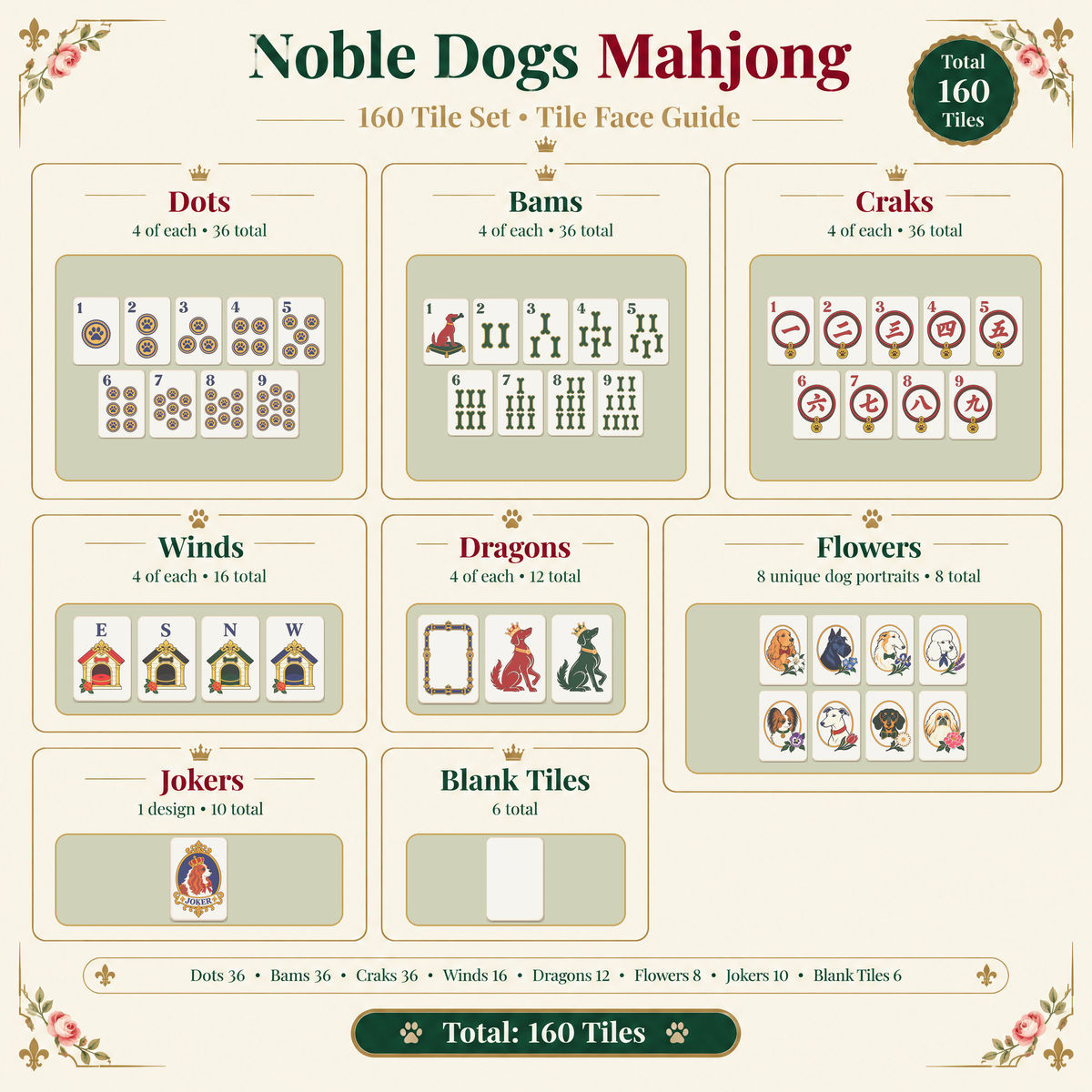
Daisangen (大三元) is a riichi mahjong hand that combines all three dragon honors—Red (Akadora), Green (Haku), and White (Hatsu)—into three separate pungs or a combination of pungs and kongs. The hand scores 13 base points (han) before multipliers, making it one of riichi's highest-value patterns. Unlike American mahjong, which uses a fixed card-based hand list, riichi awards points through han and fu (base unit) calculations: daisangen's 13-han value means it pays roughly 8,000 points at dealer or 5,300 at non-dealer in a typical game, depending on winning method. The hand must be melded (exposed) to count as daisangen; a closed hand containing dragons scores differently. Riichi mahjong plays with 136 tiles across four suits (Mans, Pins, Honors), no jokers, and no charlestoning—a fundamentally different tile economy than our 160-tile American sets.
Daisangen (大三元) is a scoring hand in riichi mahjong that combines all three dragon tiles into three separate pungs or a combination of pungs and kongs. The hand scores 13 base points (han) before multipliers, making it one of riichi's highest-value patterns. Unlike American mahjong, which uses a fixed card-based hand list, riichi awards points through han and fu (base unit) calculations: daisangen's 13-han value means it pays roughly 8,000 points at dealer or 5,300 at non-dealer in a typical game, depending on winning method. The hand must be melded (exposed) to count as daisangen; a closed hand containing dragons scores differently. Riichi mahjong plays with 136 tiles across four suits (Mans, Pins, Honors), no jokers, and no charlestoning—a fundamentally different tile economy than our best-selling mahjong sets.
What exactly is daisangen, and how do you form it?
Daisangen requires exactly three dragon pungs (three identical tiles in three separate groups), each using one dragon type: Red (Akadora), Green (Haku), or White (Hatsu). You can expose these melds at any time during play by calling them from discard or draw. The three dragons plus any valid pair and completed melds (chows or pungs of number tiles) complete the hand. Because riichi uses only 136 tiles with no wild tiles, forming daisangen demands deliberate focus: you're reserving three slots for dragons while building the rest of the hand. Many players mistake daisangen for "honroutou" (terminals and honors), which is a different 13-han hand using only edge tiles and dragon honors without requiring all three dragons.

How many points does daisangen pay, and does it vary by position?
Daisangen scores exactly 13 han (base points) before fu multipliers apply. At dealer (East), a closed-hand win (tsumo, self-draw) pays 16,000 points; open daisangen (melded) pays 12,000. At non-dealer, a closed tsumo pays 8,000, and an open win pays 8,000 from all players combined. These values assume normal fu (30 base), which is standard for hands with melds and a simple wait. If your daisangen includes extra complexity—a 5-tile open group (quint) or specific wait patterns—fu may increase, raising the payout. Riichi scoring differs completely from American mahjong, which uses a fixed hand card and pays based on season and pung/kong counts; there is no dealer bonus in American games, and payouts are per-player, not pooled.
What's the difference between daisangen and honroutou (thirteen orphans)?
Honroutou (all terminals and honors) is also a 13-han hand in riichi, but it uses only the nine terminal tiles (1 and 9 of each suit) and seven honors (four winds + three dragons), forming a unique pattern with no number sequences. Daisangen, by contrast, requires all three dragon pungs and any number melds; it does not restrict you to terminals. The most common mistake is confusing these two: a hand with all three dragon pungs plus number melds is daisangen, not honroutou. Honroutou is closed-hand only (tenpai means you hold 13 unique tiles and are waiting for any one), whereas daisangen must be open (melded) to claim full value—a closed hand with three dragon kongs scores differently under the "kokushi" family.
How does daisangen fit into riichi strategy and hand progression?
Early-game daisangen strategy means committing to dragon collection before the hand matures. Many players avoid dragon focus because discarding number tiles leaves you vulnerable; if the hand doesn't complete, you've built a slow, rigid structure. Winning with daisangen before mid-game is rare; it typically emerges from rounds where three or four dragons survive discard or where melds cycle the dragon tiles you need. In competitive play, skilled opponents read your dragon collection and discard accordingly, forcing you to pivot. The hand is strongest when you've secured two dragon melds early and are chasing the third while building number melds in parallel. Blocking opponents from daisangen—by discarding dragons yourself—is a defensive tactic that mirrors American mahjong's strategy of monitoring what suits and groups competitors are building.

How does riichi mahjong's daisangen compare to American mahjong dragon hands?
American mahjong has no equivalent "daisangen" hand rule, but the National Mah Jongg League card does feature patterns requiring all three dragons. These are fixed on the current year's card and worth a set base payment (typically 1 or 2 units per winning method). In riichi, daisangen's 13-han value is calculated, not listed; you score it by confirming the pattern and computing han and fu yourself. Riichi mahjong also allows players to call melds from the discard (chi, pung, kong), whereas American mahjong forbids sequences (chows) and only permits pung, kong, quint, and sextet exposures. A riichi hand with all three dragons might score higher or lower than an American hand of the same pattern, depending on fu and special conditions (tsumo, open/closed, dealer status). If you play both variants, expect to relearn strategy: riichi rewards aggressive melding and hand visibility; American rewards tile economy and careful discard reading.
Aspect | Riichi Daisangen | American Dragon Hand |
Tiles Used | 136 (Mans, Pins, Honors, no jokers) | 152 (Bams, Craks, Dots, Winds, Dragons, Flowers, Jokers) |
Hand Structure | Three dragon pungs + one pair + melds | Fixed card pattern with three dragons |
Point Basis | 13 han × fu (calculated per hand) | 1–2 units (fixed per year's card) |
Melds Required | Yes (open daisangen scores higher) | Depends on card; jokers allowed in melds |
Scoring Method | Dealer/non-dealer × closed/open | Points per card listing (1–4 units) |
Wild Tiles | None | 8 jokers in play (152-tile set) |
What should you check before learning riichi in a daisangen-focused group?
Before joining a riichi game, confirm house rules for scoring. Not all clubs play standard JPML (Japan Mah-jongg Association) rules; many use simplified or regional variants that alter daisangen payouts or han values. Ask whether the group scores fu strictly or uses simplified (mangan/haneman) breakpoints. Verify whether daisangen must be open or if a closed daisangen is recognized. Check whether the table uses electronic scoring or hand calculation; mismatches cause disputes. If you're learning from scratch, ask for a scoresheet and watch one complete hand resolve before playing money. Finally, confirm whether the group tolerates American mahjong players or expects pure riichi: the tile counts, melds, and hand lists are incompatible, so mixing variants mid-session is confusing and unfair.
🀄 Shop best-selling mahjong sets →
Why riichi mahjong requires a different tile set than American mahjong.
Riichi uses a 136-tile set: four of each Mans (万), Pins (筒), and Honors tiles, plus four sets of winds and three dragons (Red, Green, White). American mahjong's 160-tile sets are built for a completely different rule system: three 9-tile suits (Bams, Craks, Dots) plus Winds, Dragons, Flowers, and 8 jokers, with no player rotations and fixed hands from the league card. If you own an American mahjong set, you cannot legally play riichi with it—the tile face values, honor designs, and joker counts break riichi's probability logic. Riichi games require either a traditional Asian set or a modern mahjong set clearly labeled for riichi rules. Many Western mahjong clubs stock both to accommodate mahjong variants and prevent accidental mismatch; if you're joining a riichi-only group, ask whether they provide sets or expect players to bring their own.
🎁 See our most-loved mahjong sets & accessories →
How to practice daisangen without risking money or confusion.
Start by studying a riichi hand calculator online, feeding in a three-dragon pung arrangement and noting how han and fu stack. Many riichi sites offer free demo hands where you play out daisangen scenarios. Next, ask the host or a mentor to walk you through one daisangen win in a real game—before you play—so you see scoring firsthand. Many clubs run beginner sessions on weekends; daisangen is advanced, but watching it resolve clarifies the mechanics. At home, ask a riichi-playing friend to deal you practice hands: you'll see how quickly or slowly dragons appear and develop intuition for when a dragon focus is viable. Finally, play at low stakes (friendly games, no money) and announce daisangen as your goal openly; experienced players will feed you hints or spot your mistakes before they cost you. Once you've completed a closed-hand daisangen and an open-hand daisangen, the rule becomes intuitive.
✨ Find your Mahstead set — free US shipping →

FAQ
Can daisangen be a closed hand (tenpai), or must it always be open?
Daisangen must be melded (open) to score 13 han. A closed hand with three dragon kongs scores under a different pattern name (yakuman or a lower-value hand). Some variants allow "kokushi" (thirteen orphans, a 13-han closed-hand pattern including one of each terminal and honor), which beats or ties daisangen but has a different tile requirement.
If I discard a dragon, can opponents steal it to build their daisangen?
Yes. Any player can call a dragon discard to complete a pung or kong. If an opponent has two dragon pungs and you discard the third, they can pung it and expose their melds. This is why timing dragon discards is critical: hold them until safe, or discard them early when no one is obviously collecting.
Is daisangen harder to win with than other 13-han hands in riichi?
Daisangen is easier to track (three pungs are visually clear) but slower to complete (you need three melds of three identical tiles, a constraint). Honroutou (13 orphans) requires only tile collection, no melds, so it can complete faster from a closed hand. Kazoe yakuman (accumulating 13 han from cheaper patterns) is often faster than building a single daisangen.
Can I play riichi mahjong on an American mahjong mat or table?
Yes, the mat or table surface works for any mahjong variant. However, you cannot use American mahjong tiles or jokers in riichi. A mahjong mat designed for American play is larger and may not fit riichi's smaller 136-tile set neatly; consider a mat with adjustable zones or a dedicated riichi mat if you play regularly.
How do I know which variant my local club plays—American or riichi?
Ask the host directly. American clubs use the National Mah Jongg League card (updated yearly), a fixed hand list, and 160-tile sets with jokers. Riichi clubs use a different scoring system, han and fu calculations, and 136-tile sets. The two are incompatible; no club plays both simultaneously.
If I learn daisangen in riichi, can I play American mahjong afterward?
Yes, the strategies overlap (tile economy, opponent reading, discard logic) but the hand lists, melds, and scoring are entirely different. You'll need to memorize the current American league card and unlearn han/fu scoring. Many players enjoy both variants; the switching cost is time, not talent.


View More
View More
View More
