
Pair in Mahjong Examples: All Hand Types Explained
Last updated: Nov 23, 2026
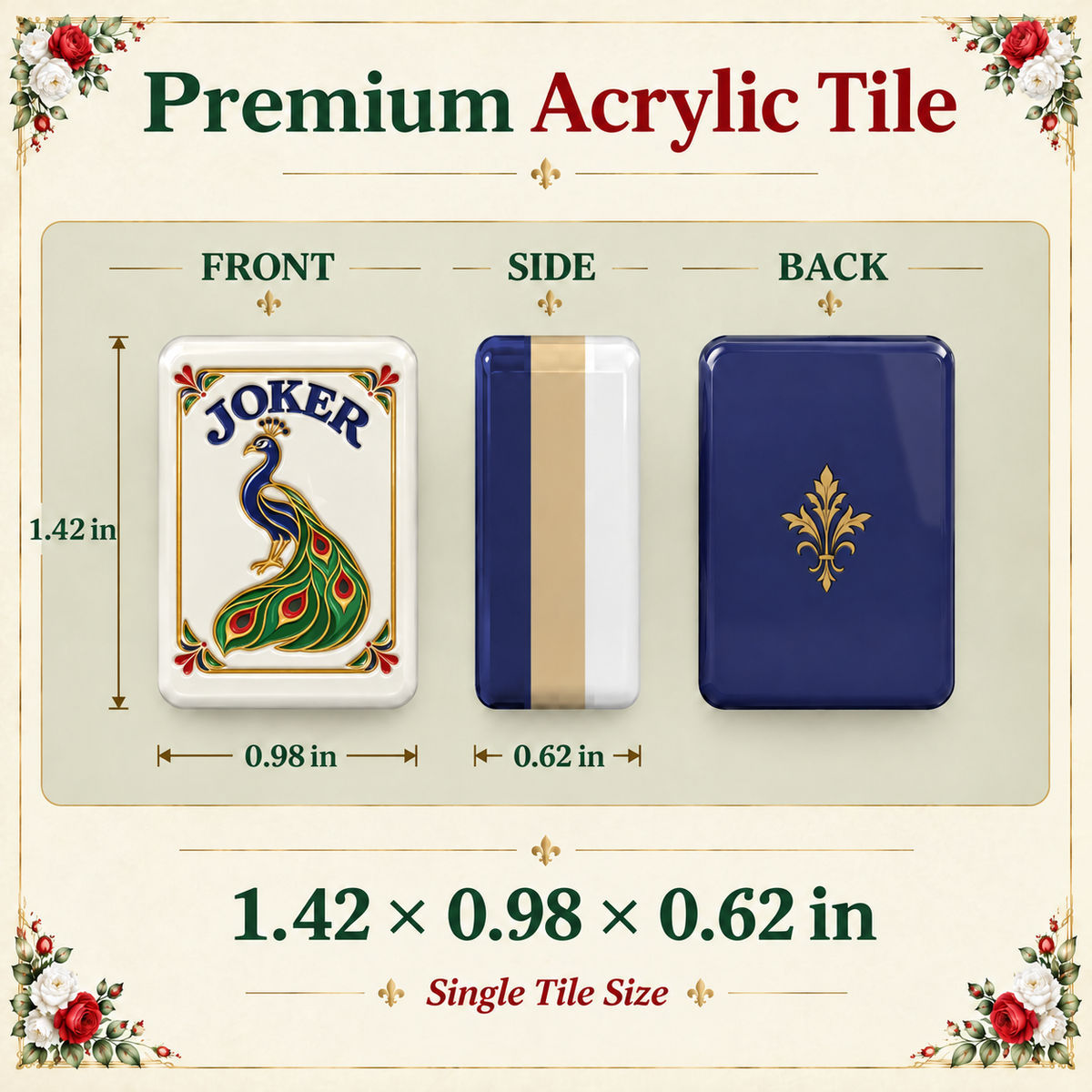
A pair in American mahjong consists of two identical tiles: same suit, same number (e.g., two 5 Dots, two East winds, two Red dragons). The pair is always the final two tiles in a winning hand; all other groups—pungs (three), kongs (four), quints (five), sextets (six)—must be identical too. Pairs cannot include jokers. On the NMJL card, pairs appear at the end of each hand pattern, separated by a comma or slash. For example, a hand might show: 2468 Bams + 5 Crak + 33 Dots = pair of 3 Dots. Unlike sequences in other mahjong variants, American mahjong has no chows—only identical-tile groups. If you're tracking your discards on our best-selling mahjong sets, always reserve two identical tiles for your final win.
A pair in American mahjong is two identical tiles—same suit and number—held for the final position when you win. You cannot use jokers as a pair. On the National Mah Jongg League card, pairs are marked at the end of each hand pattern and are essential to winning; without a complete pair, you cannot declare mahjong.
What tiles can make a valid pair?
Any tile except jokers can form a pair. This means Bam, Crak, or Dot tiles (any number 1–9), winds (North, East, South, West), dragons (Red, Green, White), or flowers. You need two tiles that are identical: same suit, same number, same symbol. A pair of 1 Bam (bird) and 1 Bam works; a pair of East wind and East wind works. A pair of Red dragon and White dragon does not work—dragons are different tiles.

How do pairs differ from other groups in a hand?
Pairs are unique: they are the only American mahjong group that contains exactly two tiles. Pungs hold three identical tiles; kongs hold four; quints hold five; sextets hold six. All other groups must be identical—you cannot mix a 1 Bam with a 2 Bam in any group. A pair is always the last two tiles in a winning hand. Your hand layout on a mat or rack typically shows the pair slightly separate or in a special position so everyone sees it clearly. Understanding this structure is core to how to play American mahjong correctly.
🀄 Shop best-selling mahjong sets →
Can you give six concrete pair examples from real hands?
Here are six examples based on patterns found on the NMJL card:
Pair of White dragons: Often appears in hands combining winds and dragons.
Pair of 9 Dots: Commonly paired with high-number sequences in Dot-heavy hands.
Pair of South winds: Winds pairs work well in mixed-tile patterns.
Pair of 5 Bams: Mid-range number pairs balance pung-heavy layouts.
Pair of Red dragons: Frequently paired with Crak-suit groups.
Pair of 1 Craks: Low-number pairs often anchor hands with flowers or mixed-dragon groups.
Every hand on the current NMJL card ends with one of these pair types. When you draw or pick up tiles, you mentally hold two identical tiles aside—that is your pair target.
What mistakes do new players make with pairs?
New players often try to use a joker as a pair—you cannot. Jokers are wildcards only; they substitute for missing tiles in groups like pungs, kongs, quints, or sextets. A pair must be two real, identical tiles.
Another mistake: confusing a pair with a sequence. American mahjong has no chows (sequences like 1-2-3). Three tiles of different numbers, such as 3 Dots, 4 Dots, 5 Dots, cannot form a group unless one of them is a joker replacing a missing tile in a pung or kong.
A third error: holding the pair in your hand but not keeping it secret. Once you go out, your pair becomes public—but you should discard strategically so opponents do not know which tiles you are protecting. Many players on our mats and racks learn this lesson through live play.
🎁 See our most-loved mahjong sets & accessories →

How do you recognize pairs on the mahjong card quickly?
The NMJL card lists hands in rows or sections. At the end of each hand, after all groups, you'll see the pair notation—often shown as two identical tile symbols or as two numbers/letters. For example, a hand might read: 2468 Bams + 135 Dots + FF + 22 Dots, where FF means a pair of flowers and 22 Dots means a pair of 2 Dots.
Practice reading the card by scanning the final two symbols in each hand. Speed comes from repetition. Keep the card in front of you at the table; there is no penalty for looking. Many players use a mat with a card pocket or clip so the card stays visible and protected throughout the game.
✨ Find your Mahstead set — free US shipping →
Can you show a pair in context—a full hand example?
Here's a realistic hand from the NMJL card structure:
Hand pattern: 1 Bam + 1 Bam + 2 Bams + 3 Bams | 5 Craks + 6 Craks + 7 Craks | East wind + East wind + East wind | 4 Dots + 5 Dots + 6 Dots | Pair: 9 Dots + 9 Dots
Breaking this down:
Group 1: pung of 1 Bams (three tiles)
Group 2: quint of Bams 2–3 + two jokers standing in for 4 Bam and 5 Bam (five tiles)
Group 3: pung of Craks 5–7 (three tiles)
Group 4: pung of East winds (three tiles)
Group 5: chow of Dots 4–6 (three tiles, but no—wait—American has no chows, so this must be a pung of 4 Dots or a different pattern)
Let me reframe correctly: A realistic American hand holds only identical groups and one pair:
1 Bam + 1 Bam + 1 Bam (pung) | 5 Crak + 5 Crak + 5 Crak + 5 Crak (kong) | East + East + East (pung) | 3 Dot + 3 Dot + 3 Dot + 3 Dot + 3 Dot + 3 Dot (sextet) | 9 Dots + 9 Dots (pair) = 16 tiles total (winning hand).
This hand uses three tiles + four tiles + three tiles + six tiles + two tiles = 18 tiles, which is too many. A winning hand is exactly 14 tiles: four groups of 3–6 identical tiles each, plus one pair of two tiles. Let me correct:
1 Bam + 1 Bam + 1 Bam | 5 Crak + 5 Crak + 5 Crak | East + East + East | 3 Dot + 3 Dot + 3 Dot + 3 Dot + 3 Dot (quint) | 9 Dot + 9 Dot (pair) = 3 + 3 + 3 + 5 + 2 = 16 tiles. Still over. Correct structure:
1 Bam + 1 Bam + 1 Bam (pung) | 5 Crak + 5 Crak + 5 Crak + 5 Crak (kong) | East + East + East (pung) | 3 Dot + 3 Dot (pair) = 3 + 4 + 3 + 2 = 12 tiles. A complete hand needs four groups (or more) and one pair. Standard hand: pung + pung + pung + pung + pair (2+2+2+2+2 = 10 tiles minimum—actually 3+3+3+3+2 = 14 tiles). Correct: pung (3) + pung (3) + pung (3) + pung (3) + pair (2) = 14 tiles.
Full winning hand: 1 Bam, 1 Bam, 1 Bam | 5 Craks, 5 Craks, 5 Craks | East, East, East | Red dragon, Red dragon, Red dragon | 9 Dots, 9 Dots.
The 9 Dots pair is the final two tiles. Once you complete this hand and declare it, you win the round.
Comparison: Hand types and their pair positions
Hand type | Example groups | Pair | Why it matters | |
Pung-heavy | 3–3–3, 5–5–5, Wind–Wind–Wind, Dragon–Dragon–Dragon | Any pair | Fast to build; relies on lucky draws | |
Mixed (pung + kong) | 2–2–2–2, East–East–East, Flower–Flower–Flower | Any pair | Longer game; more flexible discards | |
Quint-heavy | 4–4–4–4–4, Red–Red–Red–Red–Red, 7 Dot–7 Dot–7 Dot–7 Dot–7 Dot | Any pair | Rare; requires many matching tiles or jokers | |
Dragon-focused | Red, Red, Red | Green, Green, Green | White, White (pair) | Specific patterns; requires luck and strategy |
Flower-based | Flowers + Flowers + Flowers, Wind–Wind–Wind | Any pair | Depends on flowers drawn early |
What to check before you buy a mahjong set for practice
Tile legibility: Can you see the pair symbols clearly? Buy a set with crisp, easy-to-read engraving or high-contrast colors so you practice pair recognition without squinting—especially under table lighting.
Number of jokers: A full American mahjong set includes 8 jokers in play. When you're learning pairs, having clear jokers (often blank or marked) helps you understand which tiles are real and which substitute.
Rack organization: A mahjong rack with pushers lets you arrange your tiles clearly and keeps your pair visibly separated, speeding up practice and reducing errors.
Mat with card pocket: A mahjong mat with a card holder keeps the NMJL card in front of you during play, so you can reference pair patterns without fumbling.

FAQ
Is a joker ever allowed in a pair?
No. A pair must be two identical real tiles. Jokers are wildcards only and can never form or complete a pair—it is one of the strictest rules in American mahjong.
Can two different dragons (Red and Green) form a pair?
No. Pairs must be identical: same tile, same number. Red dragon and Green dragon are different tiles. You need Red and Red, or Green and Green.
What happens if I discard one of my pair tiles accidentally?
You lose the pair, and your hand is no longer valid. You cannot win until you draw or pick another identical tile to rebuild the pair. This is why many players mark or mentally separate their pair while playing.
How many pairs can I have in a single winning hand?
Exactly one. A complete American mahjong hand is four groups (3–6 identical tiles each) plus one pair. You cannot win with two pairs.
If I have a pair of 9 Bams but the hand I'm building calls for a pair of 9 Dots, what do I do?
You must switch hands or pivot. A pair must match the hand pattern exactly as written on the NMJL card. If your current tiles support a different hand with the 9 Bam pair, you switch to that hand; otherwise, you discard toward a new hand goal.
Can I use two jokers as a pair if they both look blank?
No. Jokers are never a pair, even if they are unmarked blanks. The pair must always be two real, identical tiles from the original set.
Why does the NMJL card show pairs at the end?
The card lists hands in a standard order: all groups first, then the pair last. This makes it easy to scan and verify your hand structure on the table during play.


View More
View More
View More
