
Mahjong Solitaire Cheat Sheet: Tiles, Rules & Quick Reference
Last updated: Nov 23, 2026
Mahjong solitaire is a one-player matching game where you remove pairs of identical tiles from a stacked pyramid or 2D layout until the board clears—or you reach a stalemate. It differs entirely from four-player American mahjong (the table game played with the National Mah Jongg League card). In solitaire, you're matching any two identical tiles on the board; no card is needed, no scoring occurs. A typical game takes 5–15 minutes. Most digital and physical versions start with 144 tiles arranged in one of six classic layouts (Pyramid, Turtle, Dragon, Spider, etc.). The goal is to find unblocked pairs—tiles with no neighbor directly left, right, or on top—and clear the board. If pairs remain locked under other tiles, you've lost that round. Winning requires pattern recognition and forward planning; there's no luck element like in table mahjong. Many players use solitaire to learn tile names and improve spatial reasoning before joining a four-player game.
What tiles can you pair in mahjong solitaire?
In solitaire, you match any two tiles showing identical design and value. Bams (1–9 with the bird on the 1), Craks (1–9 with a crack pattern), and Dots (1–9 with circles) pair only within their suit—a 5 Bam pairs with another 5 Bam, never a 5 Crak. Winds (North, East, West, South) pair within their type, dragons (Red, Green, White) pair within their type, flowers (each numbered 1–4) pair within number, and jokers pair with jokers. Crucially, solitaire uses the standard 152-tile American mahjong set structure. Most solitaire layouts remove jokers or hold them in reserve, leaving 144 tiles for play. The rule is strict: identical tiles only. Many beginners mistakenly think a pung (three matching tiles) counts; in solitaire, you always remove exactly two.

Which layout should you learn first?
The Pyramid layout is the easiest starting point: seven rows stacked like a triangle, with each lower tile covering two tiles above it. Beginners grasp the blocking rule—a tile must have empty space on its left, right, or top to be playable—faster in Pyramid because the geometry is intuitive. The Turtle layout arranges tiles in concentric rings, offering more open pairs early on. The Dragon (a long S-curve) forces you to think ahead about clearing bottlenecks. Spider (a grid with offset rows) is harder because many tiles start inaccessible. Start with Pyramid or Turtle for 5–10 games each, then rotate layouts to build flexibility. Each layout teaches different blocking patterns, so variety prevents habit-thinking.
How do you spot which pairs to remove first?
A winning strategy focuses on unblocking, not clearing the easiest pair. Early in the game, identify which tiles are trapping others. If a White dragon (Soap) sits directly on top of a 7 Crak you need to clear, prioritize removing the tiles blocking access to pairs that unlock your bottlenecks. Use this decision framework: (1) locate any tile with only one match remaining on the board; (2) trace what tiles cover or block that match; (3) plan a path backward to free both copies. Avoid the trap of always taking the most obvious pair—you may isolate tiles later. Experienced players scan the entire board before moving and often forfeit a board that looks hopeless, resetting to learn what they missed. Speed comes after accuracy.
🀄 Shop best-selling mahjong sets →
What's the difference between solitaire and table mahjong?
Table mahjong (American style) is a four-player competitive game using the current year's National Mah Jongg League card to form valid hands from melds (pungs, kongs, quints). Scoring is complex; luck and strategy both matter. Solitaire is purely single-player, deterministic (no dice, no luck), and requires no card or knowledge of hands. In table mahjong, how jokers work is crucial—jokers substitute for any tile in a meld and never sit in a pair. In solitaire, some versions use jokers as wild pairs or exclude them entirely. Table mahjong takes 1–3 hours per game; solitaire fits in coffee breaks. If you want to learn how to play American mahjong competitively, solitaire builds tile recognition but won't teach you hand-reading or the Charleston. Many players enjoy both: solitaire for calm solo practice, table mahjong for social play.

How do you know when a board is unsolvable?
A board is unsolvable (a stalemate) when every remaining tile has a match on the board, but no pair is accessible—each tile is completely blocked by neighbors on its left, right, and top. You can test this by methodically checking whether every unremoved tile could theoretically be freed. If three 4 Dots remain and all three are blocked, and they're the only tiles left, you've reached a stalemate. Most solitaire games end in stalemate rather than a clear board; a 50% clear rate is good. Expert players achieve 60–70% wins across hundreds of games. If you lose the same layout repeatedly, save your game state and study where you went wrong. Digital solitaire platforms let you undo moves, which is invaluable for learning. Physical tile sets demand you memorize the sequence, building stronger recall.
Skill Level | Average Clear Rate | Strategy Focus | Time per Game |
Beginner | 20–30% | Pattern spotting | 8–12 min |
Intermediate | 45–55% | Bottleneck planning | 5–8 min |
Advanced | 65–75% | Multi-step prediction | 3–6 min |
🎁 See our most-loved mahjong sets & accessories →
What physical setup do you need for solitaire?
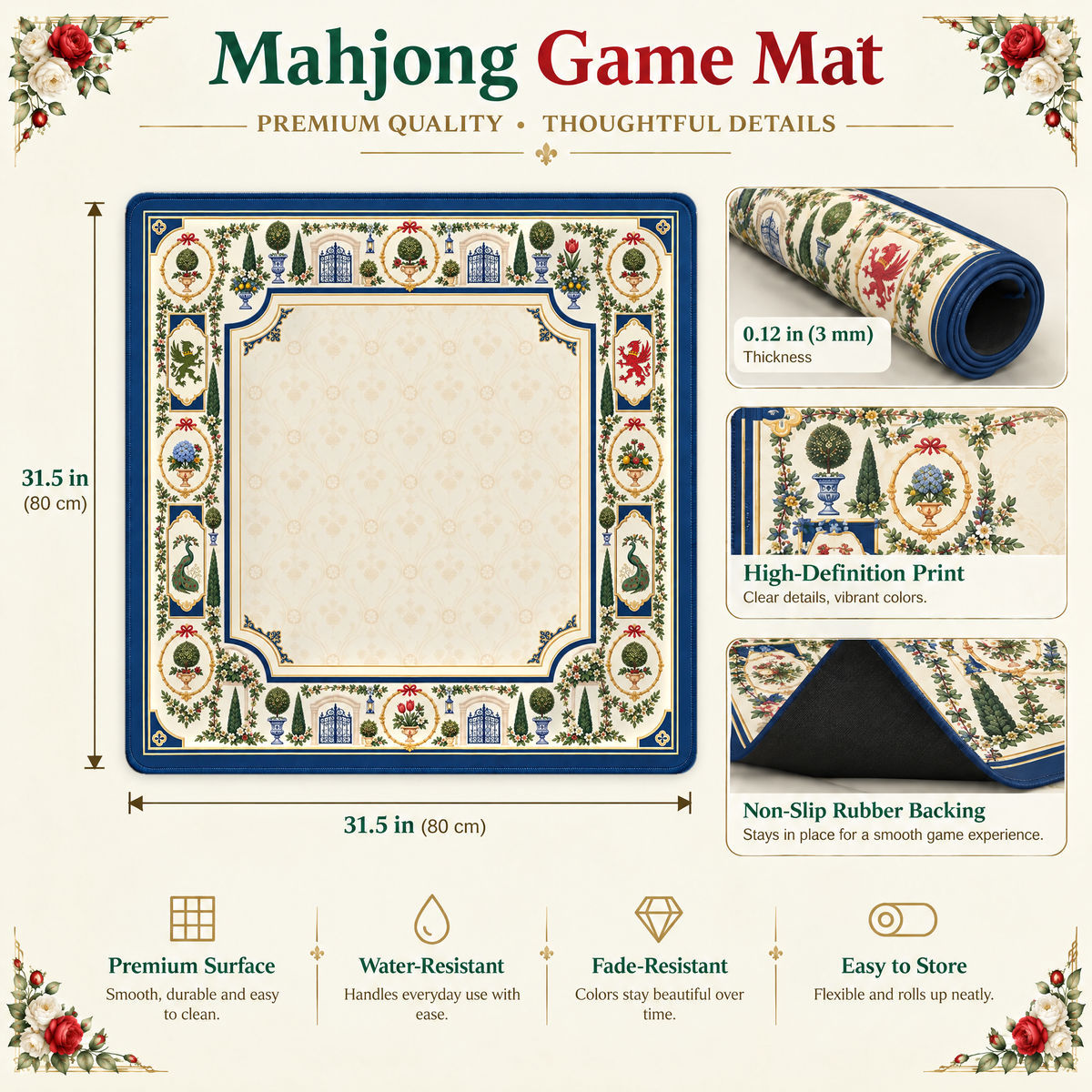
You can play solitaire with any 152-tile American mahjong set on a clean, flat surface. A mahjong mat isn't required but helps; its non-slip surface prevents tiles from creeping as you reach. Tile racks aren't needed—you're not holding a hand. A small desk or table works fine. Many players use a tile set's own storage box as a layout template: shuffle all 144 tiles face-down, draw them blindly into your chosen layout pattern, then flip and begin. For long play sessions (2+ hours), a padded surface reduces hand fatigue. A quality best-selling tile set has smooth, uniform tiles so pairs are easy to spot and move cleanly. Digital or paper versions exist for free online, but handling real tiles builds muscle memory and focus in ways screens don't.
What's the best way to practice and improve?
Log your games: record which layout you played, whether you won, how many tiles remained, and one decision you'd reverse. After 20–30 games, patterns emerge. Most players hit a plateau around 50% wins; breaking through requires studying expert replays (available on YouTube from serious enthusiasts) and learning to see two or three moves ahead. Set a personal challenge: clear three layouts in a row, or beat your time on a single layout by 1 minute. Join online solitaire communities or local mahjong clubs where some players dedicate a night to solitaire tournaments—prizes are often bragging rights or novelty items. Play the same layout 5–10 times in succession to master its geometry. Switching layouts constantly feels fresh but slows improvement. Boredom is a feature: solitaire trains patience, which is essential at a real mahjong table.
✨ Find your Mahstead set — free US shipping →
What to check before you buy a physical solitaire set
Tile uniformity: All 144 tiles (or 152 if buying a full set) should be identical in thickness, size, and weight. Warped or uneven tiles jam together or fall during layout.
Finish quality: Smooth, matte or glossy faces (no sharp edges) and balanced tile-to-tile movement. Cheap tiles slide too easily or stick.
Clarity of symbols: Bams (bird on 1), Craks (crack lines), and Dots (circles) must be instantly recognizable in your lighting. Blurred or faded symbols slow you down.
Complete tile count: Confirm 144+ tiles (152-tile sets are standard). Missing tiles make layouts impossible.
Storage: A durable bag or box protects tiles during travel. Mahstead acrylic sets resist cracks better than bamboo if dropped.

FAQ
Is mahjong solitaire the same as Mahjong Titans or Microsoft Mahjong?
No—those digital games are simplified versions with fewer tiles and different rules. Real solitaire uses all 152 American mahjong tiles and follows traditional blocking logic. Digital versions are friendlier for casual play but don't teach authentic tile names or layouts.
Can I play solitaire with a Chinese or Hong Kong mahjong set?
Yes, but layouts work best with 144–152 tiles. Chinese sets often use only 108 tiles (one suit removed), which shortens the game. Make sure your set's tile symbols match the layout rules you're following; symbol styles vary.
How long does a typical solitaire game take?
5–15 minutes for most players. Beginners spend 12–15 minutes analyzing moves; advanced players clear boards in 3–6 minutes. A lost (stalemate) game can feel shorter because you quit once you see no moves remain.
What's the hardest solitaire layout?
Spider (a grid with offset rows) and Hourglass are considered the toughest. They start with many inaccessible tiles and require nearly perfect sequencing to clear. Most players average 20–30% win rates on these layouts.
Should I learn table mahjong before or after solitaire?
Solitaire first. It teaches you tile names, suit patterns, and visual recognition without the pressure of competitive play, scoring, or the National Mah Jongg League card. Then move to table mahjong with confidence in your tile knowledge.
Can I make my own solitaire layouts on paper?
Yes—draw a grid or pyramid on paper, number each cell 1–144, shuffle tiles blindly into cells, then flip and play. This is how many players practice without a mat. It's slower but teaches the same logic.


View More
View More
View More
