
Mahjong Racks with Pushers: Size Guide & Buyer's Checklist
Last updated: Nov 23, 2026

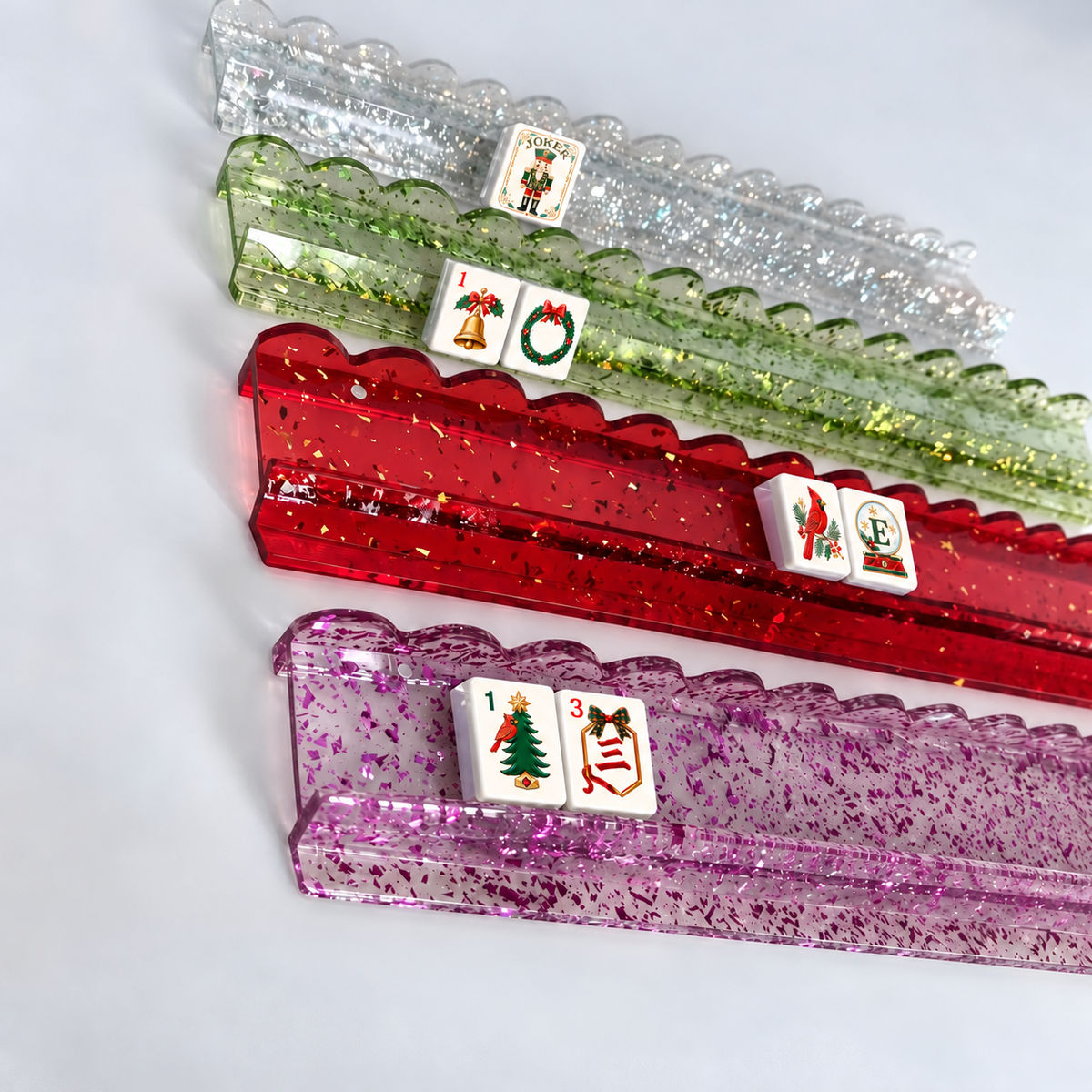
A mahjong rack with pushers is a wooden or acrylic stand that holds your 13 or 14 tiles upright at an angle, with a pusher stick attached to help you manage tiles without dropping them. Racks range from 8 to 15 inches wide and 2 to 4 inches tall, sized to fit the number of tiles you're holding and the space on your table. They're essential for American mahjong because they keep your hand private and organized throughout a four-player game. Most Mahstead racks come in pairs or singles and are made from durable acrylic or bamboo with smooth pushers. Width and height are the two specs that matter most: narrower racks fit tight tables, while wider ones give you room to spread and spot tiles easily. Always check your table's lip height and clearance before ordering.
What width fits your hand and table?
Most players choose between three widths: 8–10 inches (compact, single-player or crowded four-person tables), 11–13 inches (standard, fits most home and club tables), and 14–15 inches (spacious, tournament-size tables or players who prefer spreading tiles wide). If your table has a 1-inch lip or less, measure from the floor to the top of the lip; a standard 12-inch wide × 2.5-inch tall rack should fit. If your table is larger or you like elbowroom, go 13 inches or wider. Compact racks (8–10 inches) are ideal for new players or travel; mid-range (11–13 inches) suit weekly home games; wide ones (14–15 inches) work best in clubs or if you have large hands.
🀄 Shop mahjong racks with pushers →

How tall should your rack be?
Rack height typically ranges from 2 to 4 inches and affects two things: how easily you see your tiles and how much space you need above the table. A 2–2.5-inch tall rack (low profile) sits closer to the table surface, ideal for play on standard dining tables or when space is tight. A 3–3.5-inch tall rack (mid-height) provides a steeper angle, making tiles easier to read and manage without hunching—most weekly players prefer this. A 4-inch or taller rack (high profile) is best for tournament tables or if you have limited hand dexterity. Before buying, sit at your table and measure the vertical clearance from the table surface to the lowest overhang (light fixture, shelf, etc.); if it's under 4 inches, stick with 2–2.5-inch racks. The angle of the rack matters as much as height: a steeper angle (3+ inches) lets you glance down at tiles without lifting your head.
What's the difference between acrylic and bamboo racks?
Acrylic racks are lightweight, see-through, durable, and easy to clean—tiles don't stick, and you can customize them with engraving if you want a monogram or game night theme. They're modern, quiet, and work well with any tile color. Bamboo racks feel natural, warm, and traditional; they're heavier (more stable on a bumpy table) and produce a subtle sound when you slide tiles, which some players find satisfying. Bamboo can absorb moisture and may need light oiling over time; acrylic needs only a wipe-down. For durability and low maintenance, acrylic wins. For aesthetics and a classic feel, bamboo is the choice. Mahstead's best-selling mahjong sets often pair with either material depending on your tile style.
Should you buy a pair or a single rack?
American mahjong is played with four players, so ideally each player has their own rack. If you're hosting a weekly game or club, buy a set of four (or two pairs). If you're a single player learning at home or joining a game where some players already have racks, one or two singles work. Single racks let you test fit and comfort before committing to a full set. Pairs are common because they match and are convenient for shared tables; four singles allow flexibility if players have different height or width preferences. Most players eventually buy four racks of the same model to ensure consistency and a polished look. If you're buying racks as part of a complete setup—tiles, mat, dice—pairing them with a mahjong mat ensures everything scales together.

Pusher style: rod, stick, or integrated design?
The pusher is the small rod or stick attached to (or inserted into) the rack to help you slide tiles up without touching them directly. Separate pusher rods (removable, stored alongside the rack) are flexible and easy to replace if lost. Built-in pushers (permanently attached to the rack frame) are always ready and prevent loss but can't be customized. Angled pushers (bent or slanted at the top) are easier on your hand during long games. When choosing a rack, test the pusher's smoothness—it should glide under tiles without catching. Mahstead racks use pushers sized and weighted to match the tile thickness of standard American mahjong sets. Verify that your tiles fit snugly under the pusher but don't require force to move.
✨ Find your Mahstead set — free US shipping →
Comparison: Rack styles for different players and budgets
Rack Type | Width | Height | Best For | Why It Works |
Compact acrylic | 8–10 in. | 2–2.5 in. | Travel, beginners, tight tables | Takes minimal space, affordable, easy to store in a mahjong bag |
Standard acrylic | 11–13 in. | 2.5–3 in. | Home weekly games, mixed skill levels | Fits most tables, see-through, durable, room to spread tiles comfortably |
Tournament bamboo | 13–15 in. | 3–3.5 in. | Club games, tall players, wide tables | Heavier feel, premium look, steep angle reduces strain |
Engraved set (acrylic) | 11–13 in. | 2.5–3 in. | Gift, special occasion, proud host | Customizable with names or themes, same function as standard but unique |
🎁 See our most-loved mahjong sets & accessories →
What to check before you buy
Measure your table. Sit in your play position. Measure from the floor to the top of the table lip where you'll rest the rack. Note the width of your playing space (distance between you and the center of the table). Compare these to the rack dimensions.
Test the height angle. At a friend's house or club, sit at the table with a rack and tiles in place. Can you see all your tiles without hunching? Is your wrist at a natural angle when using the pusher? Jot down the approximate height you preferred.
Count your tile sets. If you're buying for a four-player game, you need four racks (one per player). If some players use your table's lip as a rest (no rack), calculate how many you actually need. A mahjong mat often has a raised edge that works as a natural rack for some players.
Check pusher compatibility. Verify that your tiles (standard American 160-tile sets with 1.5-inch tiles) slide smoothly under the pusher without jamming. If you're unsure, confirm the tile dimensions with your set's specs before ordering.
Factor in storage. Will you stack the racks flat in a closet, store them in a mahjong bag, or leave them on your table? Racks designed for easy stacking save space; some slot inside a carrying case alongside tiles and mats.
Material preference. Acrylic racks are lighter, translucent, and low-maintenance. Bamboo racks are heavier, feel traditional, and age beautifully. Neither is objectively better—it's personal. If you already own acrylic tiles or a modern mat, acrylic racks will coordinate. If you prefer a classic wooden table and bamboo accessories, match that aesthetic.
Real-world sizing examples
Scenario 1: New player, home table, limited space. Your dining table is 36 inches wide, 4-player setup. You buy a standard 12-inch acrylic rack at 2.5 inches tall. It fits comfortably in front of each player, leaves 6 inches of play space in the center, and tucks neatly under a standard chair. Pairs or a set of four are practical.
Scenario 2: Club or tournament player, dedicated table, wide setup. You play on a 48-inch round with a 2-inch lip. You choose 13-inch bamboo racks at 3 inches tall. Tiles are clearly visible at a comfortable angle; the added height clears overhead lights; the weight prevents tipping on an active table. You buy a set of four.
Scenario 3: Traveling player, multiple venues. You want compact, durable, and lightweight. You buy 8-inch acrylic racks at 2 inches that fit inside your mahjong travel bag alongside your tiles and a mini mat. Two or four racks depend on whether you're always the host or a guest.
All mahjong racks with pushers from Mahstead include one pair or single; compare dimensions and materials on the product page to match your table and style.
🎁 See our most-loved mahjong sets & accessories →
FAQ
Can I use one rack for all four players, or does everyone need their own?
In American mahjong, each player holds 13–14 tiles; you need at least one rack per player to keep hands organized and private. If you're hosting, buy four matching racks for a polished setup. Some players rest tiles on the table lip instead; this works but is less stable and less private.
What size rack fits standard American mahjong tiles?
Standard American tiles are 1.5 inches wide. Most racks range from 8 to 15 inches wide and accommodate 13–14 tiles with spacing. Check the product page for exact tile capacity; if tiles are snug at the ends, you've found the right fit.
Do I need a special pusher, or can I use any stick?
Pushers are sized and smoothed to match tile thickness and your hand comfort. A regular pencil or stick may scratch tiles or catch on them. Mahstead racks include matched pushers; if you lose one, contact us for a replacement rather than improvising.
What's the best height for my wrist and eyes?
A 2.5–3-inch tall rack at a 30–40-degree angle is ideal for most adults: your wrist stays straight, tiles are visible without hunching, and the pusher glides smoothly. If you have small hands or short arms, try 2–2.5 inches. If you're tall or prefer a steep angle, go 3–3.5 inches.
Can I customize or engrave my racks?
Mahstead's acrylic racks can be engraved with names, dates, or designs (see our engraved collections for style ideas). Bamboo racks are typically left natural but can receive a light engraving. Inquire on the product page about custom options.
How do I clean and maintain my racks?
Acrylic: wipe with a soft cloth and mild soap, dry immediately. Bamboo: dust regularly, wipe with a barely damp cloth, air dry completely. Avoid harsh cleaners or prolonged moisture. Pushers can be wiped clean or soaked briefly; let dry flat. Store racks flat or upright in a cool, dry place.
What if my racks are too tall for my table—can I cut them down?
Do not cut your racks; the structural integrity and pusher alignment will be compromised, and the tiles won't sit evenly. Instead, return the racks and order a smaller size. Mahstead supports exchanges if you measure incorrectly.


View More
View More
View More
