
Mahjong for Go Players: What Transfers and What Doesn't
Last updated: Nov 23, 2026
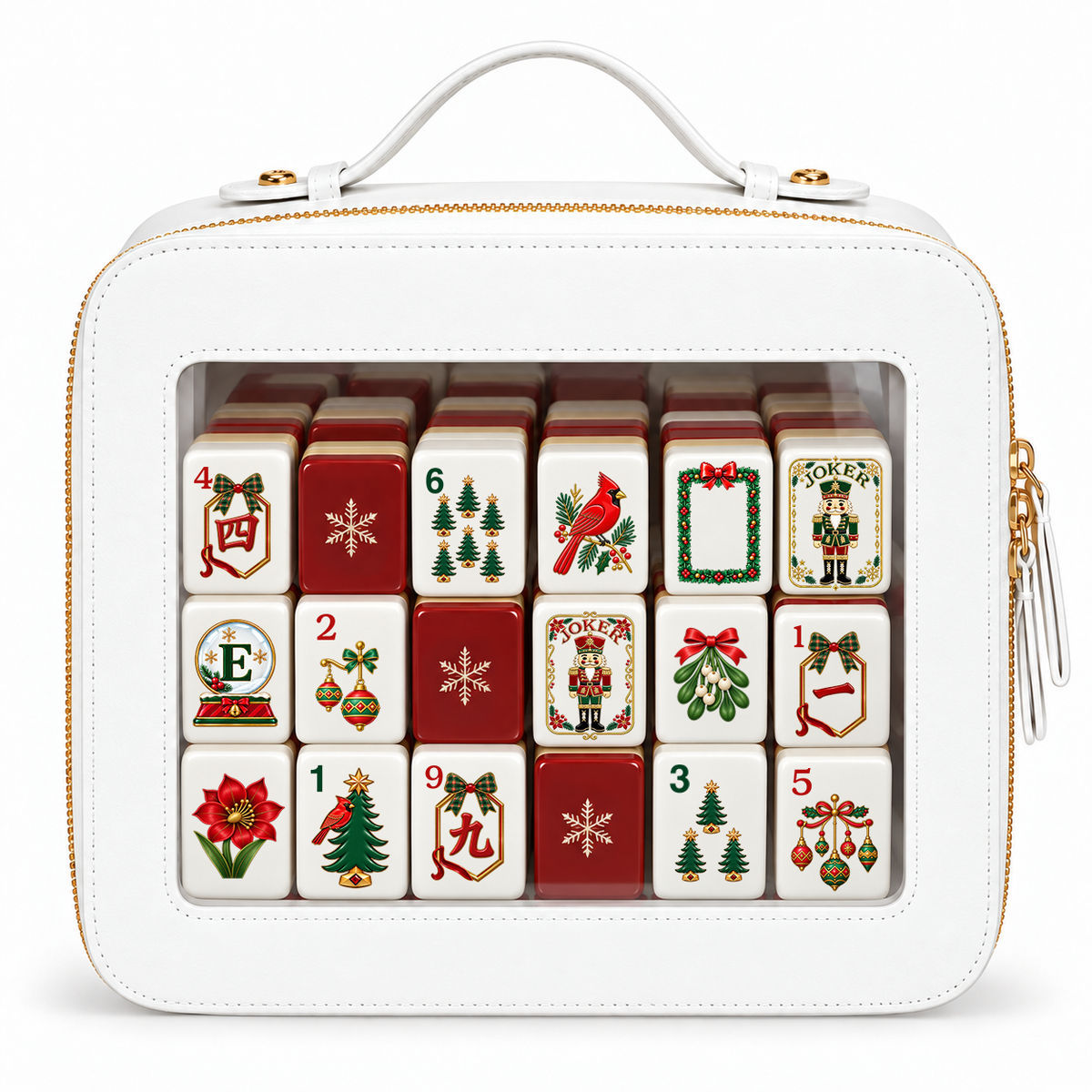
If you play Go, you're already comfortable with visual reading, tile pressure, and long-term position building. In mahjong, pattern recognition transfers directly—you'll spot tile combinations and gaps the way you read territory. But American mahjong (the most common Western variant) has no sequences (chows): you win only by collecting pungs (three identical tiles), kongs (four identical), and other groups defined by the National Mah Jongg League card issued each spring. Go rewards territory control; mahjong rewards a specific hand shape locked to that year's card. The tile count matters too—American sets use exactly 152 tiles plus 8 jokers in play, not the 136 of Hong Kong or the 136 of classical Chinese games. Your Go instinct for economy and reading ahead will help, but mahjong's rule structure is its own language. Start with how to play American mahjong to see the game's actual constraints, then pick a best-selling mahjong set to learn by playing rather than studying in the abstract. 🀄 Shop best-selling mahjong sets →
What Go Players Already Know (and Can Use Immediately)
Your Go mind is trained to spot patterns across empty space. In mahjong, the same skill matters: you'll look at your hand and the discard pile and see which tile draws are likely to complete a group. Go teaches you to read opponent pressure; mahjong teaches you to track which tiles are still active and which player is closest to winning. The discipline of keeping several lines of play in mind—your Go default—translates to holding multiple hand possibilities until the fourth tile in a critical sequence arrives. Neither game rewards panic; both reward patience and incremental advantage. You already know how to lose information as the game state changes. That translates directly: discard tracking in mahjong, like territory loss in Go, is irreversible.

Where Go Intuition Breaks Down (Three Hard Rules)
American mahjong has no chows. In Go, a line can be any length and any shape. In mahjong, you cannot play or expose 1-2-3 or 7-8-9 or any sequence of consecutive numbers—ever. You can only play identical tiles in groups of three, four, five, or six, plus pairs. This rules out the flowing combinations Go teaches. Jokers cannot fill a single tile or a pair. Go lets you adapt freely. Mahjong's jokers work only in exposed groups (Pung, Kong, Quint, Sextet) and must "replace" a tile inside that group—never stand alone. A common Go-player mistake: assuming a joker can plug a gap like an empty point. It can't. Hands are card-locked. Go rewards innovation; American mahjong rewards following the current year's card. Every legal hand comes from the National Mah Jongg League's official card. You cannot invent a hand, no matter how elegant. The card changes every spring, and all players use the same one.
Hands: Card-Locked vs. Territory-Free
Aspect | Go | American Mahjong |
Goal | Majority territory | Specific hand from annual card |
Game length | 150–250 moves | ~15 turns per player |
Flexibility | Infinitely many winning shapes | One card, ~60–80 legal hands |
Learning curve | Rules easy, mastery slow | Rules dense, patterns learnable in weeks |
Pressure buildup | Gradual over 2+ hours | Rapid; someone wins by move 40 |
The biggest shift: Go is generative (you create winning patterns); mahjong is restrictive (you match a predefined list). This feels limiting until you realize the constraint is the fun—spotting when a card pattern is live in your tiles, racing to complete it before an opponent does. Go teaches you to hold positions lightly. Mahjong teaches you to abandon hands midgame because a single discard kills your card path.
The Tile Economy: Go Stones vs. Mahjong Tiles
In Go, you place one stone at a time and it never moves. In American mahjong, you handle 14 tiles at once: 13 in your hand plus 1 drawn each turn, and you discard 1 each turn. That flow is relentless. A Go player used to spending 30 seconds on a move will be shocked when mahjong etiquette demands 5–10 seconds per discard. The pace teaches you speed-reading. You'll learn to scan your hand and the discard pile in parallel—which tiles are "safe" to throw (unlikely to help any opponent), which are "hot" (critical to someone's hand). Go teaches this via threat assessment; mahjong adds a temporal layer: a tile that was safe 5 turns ago is hot now.
American sets contain exactly 152 tiles in play: three suits (Bams, Craks, Dots—numbers 1–9, four of each), 16 winds (four each of North, East, West, South), 12 dragons (four each of Red, Green, and White), 8 flowers, and 8 jokers. A Go player used to binary outcomes (live/dead groups) will appreciate mahjong's discrete tile states: in your hand, in the discard pool, face-down, or in another player's exposed group. Tracking these is its own reading discipline.
🎁 See our most-loved mahjong sets & accessories →
Pattern Recognition: Your Strongest Edge
Here's where Go training shines. The National Mah Jongg League card contains patterns—symmetries, number progressions, honor sequences, like colors. A Go player's eye for shape immediately spots them. You'll look at a card section and see "all Bams 1–6, arranged four ways" and recognize it as a single pattern family. Go trains you to hold multiple variations of a shape (different rotations, different liberties); mahjong asks you to hold variations of a card section (different joker positions, different discards that unlock the path). The hardest part for a non-Go player is not the reading—it's the speed. You already work at that pace.
The card is refreshed every spring, so there's perpetual novelty. Go players typically prefer this: a new ruleset to explore, constraints to work within, patterns to master before the next cycle. The card usually contains 60–80 legal hands across several categories: Like Numbers (all 2s, all 5s), Like Suits (all Craks), Pairs and Honors, Consecutive Sets, and mixed styles. Your pattern-recognition instinct will guide you to the sections that suit your drawing style and hand flow.

Getting Started: What You Actually Need
If you've played Go, you're comfortable with equipment mindfulness. You need one 160-tile American mahjong set to practice, a mahjong mat to organize your hand, and a copy of the current year's card. The set includes all tiles, two dice, and a wind indicator. Racks with pushers are optional but worth the investment if you'll play weekly; they make hand organization instant and keep the table reading clean. A mat protects your table and speeds up tile movement. If you host games, a bag that fits your set is practical—mahjong accessories travel well.
Start with a standard engraved set from the best-selling collection; the tiles are readable, the weight is comfortable, and the case is durable. You don't need special decoration for your first month; learn the game first.
Unlearning One Skill: Speed of Discard
Go trains you to hold territory indefinitely. Mahjong demands discards every few seconds, and a hesitation broadcasts information. You'll feel exposed—and that's the point. Go players often over-analyze their discard because they're used to long deliberation. In mahjong, a 10-second pause signals to three opponents that the tile you're discarding matters to your strategy. Learn to discard quickly even when you're unsure. Consistency in discard speed, not perfection, is the skill.
What to Check Before You Buy:
Tile readability: Large, clear numbers and suits, especially if you're older or play in mixed lighting.
Mat size: Fits your table and your hand span comfortably (most mats are 27" × 27" or close).
Rack height: If using racks, ensure they don't obstruct your line of sight to other players' tiles.
Joker count: American mahjong uses 8 jokers in play; your set should have at least 8, plus a few spares.
Card access: Buy or download the current year's National Mah Jongg League card (issued each spring).
✨ Find your Mahstead set — free US shipping →
Learning Timeline for Go Players
Most Go players pick up American mahjong mechanics in 3–5 hours of play. The rules are denser than Go's, but your reading speed accelerates the pattern learning. Expect: first hour to learn tile names and hand structures, second hour to understand discard safety, third hour to track opponent pressure efficiently. By hour five, you'll be playing tactically—when to hold a hand, when to pivot to a backup, when to block an opponent's win. Months two and three are when you'll start to read the card fluidly and make discards almost subconsciously, the way you place Go stones. Go players typically become competent mahjong players faster than non-Go players, but both groups hit the same ceiling: reading other players and managing multiple live lines simultaneously.
The Hardest Transition: Card Dependency
Go rewards creative problem-solving. American mahjong's card is prescriptive. If your tiles don't match any of the 60–80 card hands for this year, you can't win—no matter how elegant your discard sequence. This feels arbitrary if you expect Go's generative freedom. Accept the constraint as the game's design, not a limitation. The card's specificity is what makes mahjong teachable in weeks instead of years. It's also what makes the game replayable: the card changes, you relearn, patterns shift. Go players usually embrace this once they've played a few rounds.

FAQ
Can I use my Go sense of "which region is strongest" to decide my winning hand?
Not directly. You can't invent a hand. You must match one on the current year's card. Read how to read the mahjong card to see how hands are named and structured—then your position reading becomes tactical (which card hand is safest to pursue given the discard pool).
Do I need to memorize the card before playing?
No. Play with the card in front of you for the first 10 games. Pattern recognition is faster than memorization—after 8–10 hours, you'll know 70% of hands by sight. Go players typically reach this milestone sooner than others.
What's the closest mahjong game to Go in feel?
Riichi mahjong (played in Japan) has more adaptive, territory-like hand-building, but it uses 136 tiles and different winning conditions. American mahjong is card-locked and faster. Start with American; if you crave fluidity, explore Riichi later.
Can I play with fewer tiles or a custom hand set like Go variants?
No. American mahjong is always 152 tiles plus 8 jokers, always the official card. There are no sanctioned variants. If you want flexibility, explore Chinese or Riichi mahjong separately—but American is the standard in North America.
How does the age of the card affect gameplay?
Every spring, the National Mah Jongg League releases a new card. Old cards are unplayable in sanctioned games, but many players practice with archival cards to train. Buy the current year's card; it's what your opponents will use.
If Go is about long-term thinking, how do I adapt to mahjong's 15-turn pace?
Go trains patience; mahjong teaches urgency. Hold two or three card paths in mind, not five. Discard decisively. By turn 10, someone is usually close to winning. Speed of decision, not depth of analysis, separates strong mahjong players.


View More
View More
View More
