
Mahjong for Canasta Players: Your Transition Guide
Last updated: Nov 23, 2026
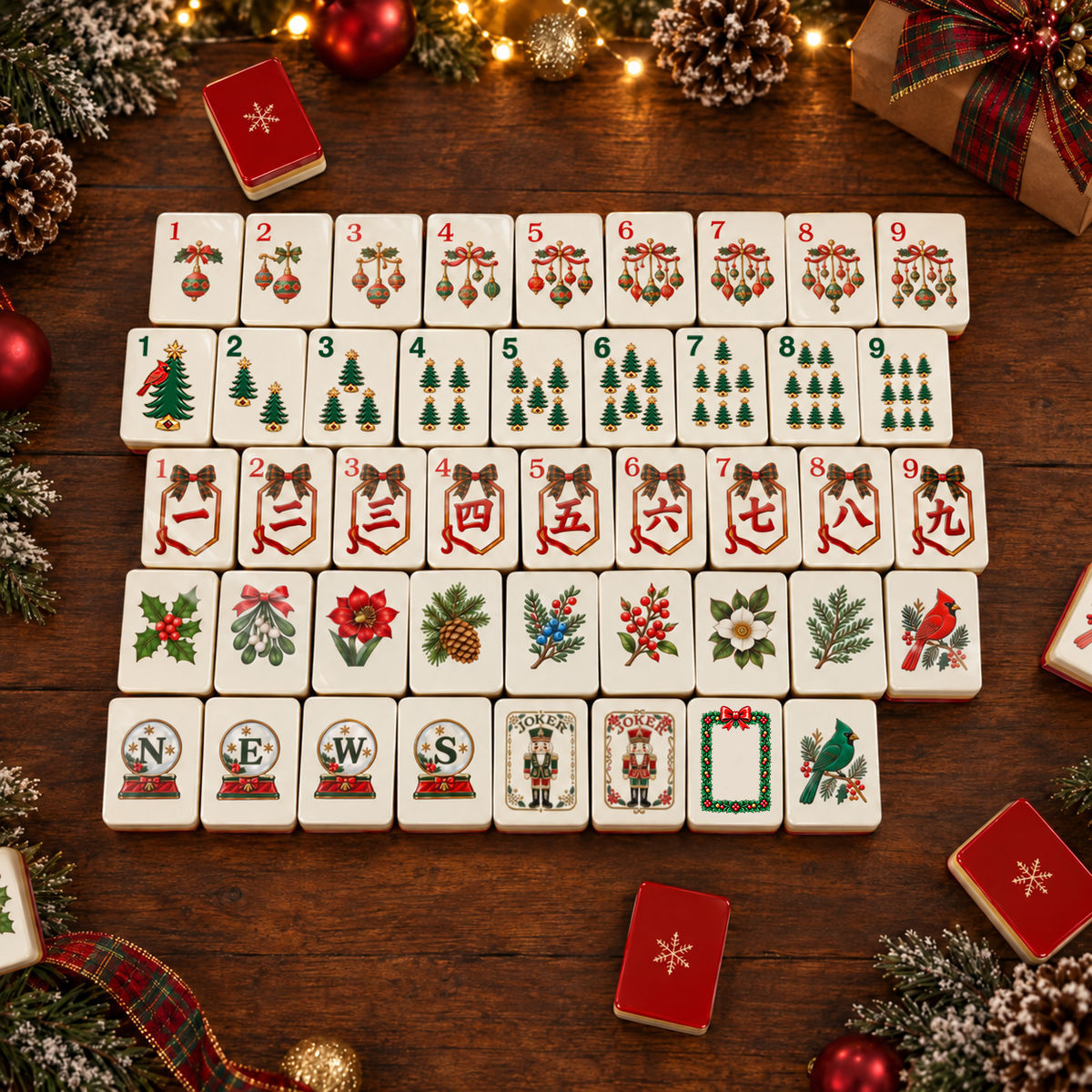
Mahjong and canasta share a core DNA: both reward pattern recognition, hand management, and strategic discard. American mahjong uses 152 tiles across three numbered suits (Bams, Craks, Dots 1–9), winds, dragons, flowers, and jokers. Unlike canasta's runs of any length, American mahjong hands come only from the current National Mah Jongg League card—a fixed yearly list of valid hand patterns. You'll recognize melds: pungs (three identical tiles, like canasta's sets), kongs (four), and longer groups; but American mahjong has no chows (sequences). The Charleston (tile-passing ritual before play) replaces canasta's opening draw. Scoring is point-based per the card, not meld-counting. Learning curve for canasta players: 2–4 weeks to competency. We recommend starting with best-selling mahjong sets so you're playing with quality tiles while you learn.
If you've spent years reading canasta hands—spotting melds, counting points, managing your discard pile—your brain is already wired for mahjong's tactical layer. Both games demand you see patterns, remember what's been played, and know exactly when to close your hand. But the tile language, hand vocabulary, and scoring logic are different enough that skipping the basics will cost you. Here's what we tell canasta players sitting down at our Thursday games.
What carries over from canasta, and what doesn't?
Canasta trains you to think in sets and sequences; mahjong uses sets, but only identical tiles. In canasta, you meld 3♠–4♠–5♠ (a sequence of spades). In American mahjong, you cannot meld sequences at all—only pungs (three 5 Dots), kongs (four 5 Dots), quints, and sextets. Your mental discipline around when to expose melds transfers perfectly; your muscle memory around "run the numbers" does not. Canasta's natural scoring (count pips, subtract melds) disappears. Mahjong scores are fixed per the yearly hand card: you either win (complete a valid hand) or you don't. No partial credit, no rounding—it sharpens strategy in a new way. The good news: hand management, tile counting, and reading opponents' discards are directly transferable.
🀄 Shop best-selling mahjong sets →

How does the tile system replace canasta's card ranks?
Canasta's deck has four suits (hearts, diamonds, clubs, spades) and ranks (Ace through King, plus Jokers and 2s as wild). Mahjong's 152-tile set has three numbered suits (Bams, Craks, Dots) that count 1 through 9, four copies of each—that's 108 tiles. Then come 16 wind tiles (North, East, West, South), 12 dragons (Red, Green, White), 8 flowers, and 8 jokers. Mentally: Bams = yellow tiles with bamboo symbols (or lines); Craks = red/orange with cracks; Dots = circles. Each suit functions like canasta's rank: you build vertical patterns (e.g., three 5 Craks, four 6 Bams). Winds and dragons are honor tiles—they don't number, they are the meld (three North tiles = a pung, just as valid as three 5 Craks). For canasta players, this feels like adding a second deck of face cards that don't follow rank order—they're pattern-matching tiles, period. A quick comparison:
Feature | Canasta | American Mahjong |
Card types | 4 suits × 13 ranks + wild | 3 numbered suits × 9 + 4 honors + flowers |
Total play pieces | 108 cards (2 decks) | 152 tiles (fixed set) |
Meld patterns | Sets (3+) + sequences | Pungs, kongs, quints, sextets (no sequences) |
Wild cards | 2s + Jokers | Jokers only (never in pairs, specific slots) |
Hand completion | Any valid meld combo | Only hands on current year's card |
The key shift: canasta's flexibility ("any run") becomes mahjong's rigidity ("card says so"). Expect this mental reboot to take 3–4 games.
Why American mahjong has no sequences—and what that means for your strategy
Canasta players live by sequences: 3–4–5 of spades is a sequence, and you build on it. American mahjong forbids sequences. You can only expose pungs, kongs, quints, or sextets—all identical tiles. A hand might look like: three 5 Craks, four 1 Bams, three Red Dragons, two Green Dragons, and a quint of West winds. Notice: no "runs," no "first, second, third"—pure grouping. This rule exists because American mahjong hands come only from the National Mah Jongg League card—a fixed yearly list. The card shows you exactly which hands win each year, so the game's designers have already baked in all legal patterns. Your job is to recognize them and build toward one. For canasta players, this removes the "invent a meld" freedom and replaces it with "match the card." It sounds restrictive, but it's actually sharper: you play 52 games of canasta, you've seen thousands of sequences. You play 52 games of mahjong, you've memorized the card, and your pattern-spotting becomes laser-focused. Strategy tip: keep a copy of the current year's National Mah Jongg League card face-up during your first 10 games. Your canasta instinct will scream "why can't I meld that run?"—the card will answer, every time.
🎁 See our most-loved mahjong sets & accessories →
The Charleston: mahjong's replacement for canasta's opening draw
Canasta begins with a draw: who deals, how many cards each player takes, what's the discard pile. Mahjong begins with the Charleston—a ritual of three rounds of tile-passing. Each player receives 13 tiles (dealt one at a time in a repeating cycle); then the dealer draws to 14. Before anyone plays, the four players pass tiles in a coordinated, choreographed exchange: first, everyone passes three tiles to the right; then three to the left; then three across the table. On the fourth round, you can pass back any tiles you drew in round three, or pass nothing. Understanding the Charleston takes one game to learn, two to feel natural. It's not random like a draw—it's ordered negotiation. You signal your hand-building by which tiles you pass; your opponents respond with their passes. Canasta players often love this because it removes pure luck and introduces psychology: "I passed three Dots, so they'll avoid Green Dragon." Compared to canasta's opening, the Charleston feels shorter, more intentional, and slightly less chaotic. One warning: don't overthink it your first game. The ritual is fixed; just follow the lead player's cues.

Scoring and winning: the biggest mind-shift
Canasta scores are arithmetic: add up melds, subtract deadwood, check for bonus points (going out, canasta premiums, etc.). Mahjong scoring is binary: you have a valid hand (from the card) or you don't. When you win, the card tells you the point value—fixed, no negotiation. A hand might be worth 30 points, another 40, another 50. You earn that flat amount when you complete it. Players who don't win that hand earn zero. (Ties and draw rules vary; check your local club's house rules.) For canasta players, this feels jarring: there's no "partial win," no scoring partial melds if someone goes out. You either finished the hand or you didn't. It sharpens decision-making: Am I one tile away from this winning hand, or should I pivot toward that hand? Canasta lets you hedge your bets mid-game; mahjong forces commitment. Over time, you'll find this clarity addictive. Scoring also resets with each year's card: a hand worth 30 points in 2024 might be worth 40 in 2025. This annual refresh is what keeps the game fresh for veterans—another parallel to how canasta has regional and tournament variations.
Setting up your first game: tile count, table space, and what you'll actually need
A regulation American mahjong set is 152 tiles (plus spare tiles), always played with exactly those 152 and 8 jokers. That's your standard. You'll also want a mahjong mat—a cloth or padded surface marked with four player zones—to keep the tiles organized and the game audible (tiles click pleasantly on a mat, clatter in a heap). A rack with pushers holds your hand so you can see your tiles without broadcasting them. Many canasta players already have a card table; a mat fits over it. For your first buy, we recommend starting with engraved American mahjong sets—they're durable, readable, and engraved designs make them memorable ("the pink one," "the one with my name"). Sizes vary; most sets fit a standard medium-sized box that ships with your purchase. If you host regular games and want to upgrade later, a travel bag or case keeps your set pristine and portable.
Canasta to mahjong: a quick checklist before your first game
[ ] Understand the tile suits: three numbered (Bams, Craks, Dots 1–9) plus honors and jokers.
[ ] Get a copy of the current year's National Mah Jongg League card; keep it face-up until you memorize the patterns.
[ ] Learn the Charleston: right, left, across, back—three rounds before play.
[ ] Accept that there are no sequences; melds are identical tiles only.
[ ] Remember: scoring is binary (win or don't win) and set per the card, not calculated.
[ ] Play 3–4 games before critiquing the rules; pattern recognition takes repetition.
What to check before you buy your first set
A 160-tile American mahjong set includes all 152 playing tiles plus spares. Check that your set's tiles are clearly marked (avoid embossed designs that wear and fade; favor engraved or printed). If you're playing with others, ensure the tiles are the same standard size (most are; confirm when ordering). Jokers should look distinct from regular tiles, and your set's case or bag should protect it from damage during storage. If you plan to host weekly games, a slightly heavier tile (thicker acrylic or bamboo) will outlast lightweight plastic. For canasta veterans, the sensory difference is immediate: mahjong tiles have weight and clack against each other in a satisfying way canasta cards never do.

FAQ
Can I use the exact canasta card to help me learn mahjong?
No. Mahjong's hand card is completely different: it's the National Mah Jongg League's official yearly list of valid patterns, not a reference tool. Use it, not canasta strategy.
Do I need to memorize all 152 tiles before my first game?
No. You need to recognize suits (Bams, Craks, Dots, winds, dragons, flowers) and count numbers 1–9. Memorization happens after 5–10 games, naturally.
In canasta, I count melds mid-game to adjust strategy. Does mahjong scoring work the same?
No. You don't score until you complete a valid hand from the card. Mid-game, you only track which tiles are gone and which hands are possible. Scoring happens at close only.
How long does a typical mahjong game take compared to canasta?
One hand of mahjong is roughly 15–25 minutes; one hand of canasta is 20–35 minutes. A full session (4 hands) is 1–1.5 hours for mahjong, 1.5–2 hours for canasta.
If I'm a strong canasta player, will I be strong at mahjong immediately?
Your pattern-spotting and hand-reading will help, but mahjong's fixed hand card and no-sequences rule mean you're starting fresh on strategy. Expect 4–6 weeks to play at an intermediate level.
Can we house-rule mahjong like we do canasta (skip the Charleston, modify scoring)?
Yes, among friends. But if you join a club or tournament, all play by the National Mah Jongg League rulebook. Learn standard first, then customize at home. ✨ Find your Mahstead set — free US shipping →


View More
View More
View More
