
Mahjong for Bridge Players: What Skills Transfer
Last updated: Nov 23, 2026
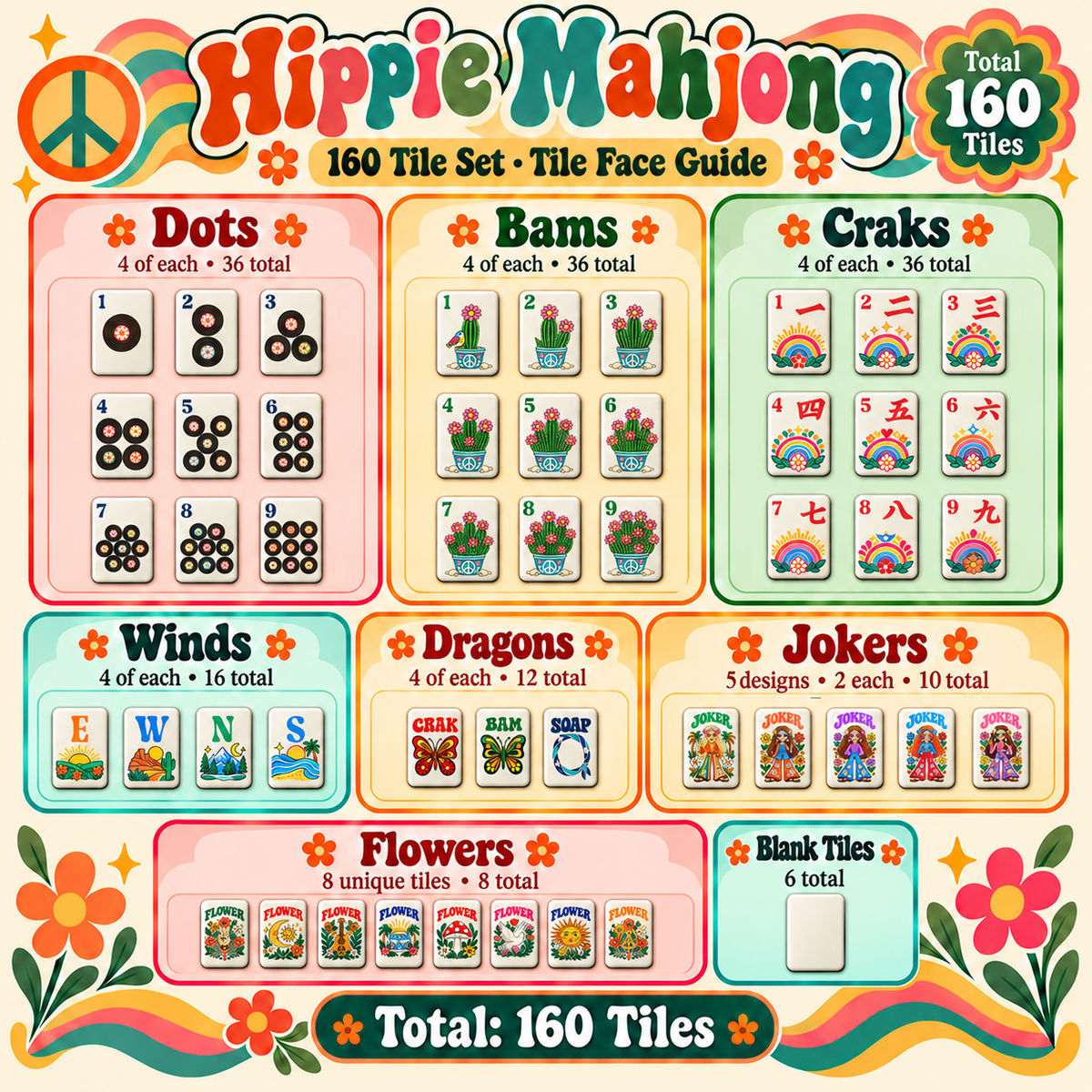
If you've mastered Bridge, you understand suits (we use three: Bam, Crak, Dot), value hierarchies, and reading opponents' plays. American mahjong does require spotting patterns within a 14-tile hand and managing discards strategically. However, the games diverge sharply: mahjong has no sequences or chows (a hand is pungs, kongs, and pairs only), no bidding phase, and no trump. Instead of 52 cards played in tricks, you draw from 152 tiles, pass tiles three times (the Charleston) before play begins, and match your hand to one of hundreds on the current National Mah Jongg League card—a fresh card every spring. Scoring is points-per-hand, not cumulative tricks. Most Bridge players pick up the mechanics in two or three sessions but spend months learning to read the card and recognize viable patterns quickly. The mindset shift—from sequences to sets, from bidding to grid-matching—is the real work.
Bridge teaches you to read the table: who has played what, what's left in the deck, who's fishing for which suit. In mahjong, the same skill applies. You track which tiles have been discarded, what your opponents are collecting, and which hands are still viable from the card. If three players have discarded high Dots and one keeps throwing Bams, you adjust your own holding. The hand-reading process is nearly identical; the tile distribution is just wider (152 tiles instead of 52 cards, eight jokers instead of face cards).
Your advantage as a Bridge player is also your blindspot. Bridge players think in sequences—1-2-3 of hearts, 4-5-6 of diamonds. American mahjong has no sequences. A valid meld is three identical tiles (a pung), four identical tiles (a kong), or five to six identical tiles (a quint or sextet). You cannot combine "3 Crak, 4 Crak, 5 Crak" into anything. Many Bridge players spend their first three games trying to assemble runs and getting stuck. Unlearning that reflex is step one.
Which Bridge skills transfer to mahjong immediately?
Suit tracking, hand discipline, and reading discard patterns all apply directly. In Bridge, you mentally sort your 13 cards into suits and know which honors are missing from the table; in mahjong, you do the same with 14 tiles across three suits and honors (winds and dragons). You've already practiced the habit of discarding "dangerous" cards (ones no one else wants) and keeping cards that multiple melds might use. The psychological read—observing when an opponent panics or draws quickly, signaling they have what they need—works in both games. Bridge players also grasp "blocking" naturally: if you need Red Dragons and no one has played one yet, you know they're either in someone's hand or in the wall (undrawn tiles). That strategic caution transfers completely.

Where do Bridge rules break down in mahjong?
Bidding, tricks, and trump do not exist in American mahjong. There is no contract to make or fail. Instead, every hand stands alone: you either complete a hand that matches one on the current card, or you don't. You don't "defend" or "go set"; you either win, tie, or lose that one hand. The card—the equivalent of Deal or Dummy in Bridge—is public and unchanging throughout the season; everyone sees the same 152 valid hands. This flattens the complexity: instead of bidding your way to a 3-no-trump contract, you and your opponents are all simultaneously hunting the same finite list of targets. Many Bridge players find this restrictive at first. "Why can't I just make up my own hand?" is a common question. The answer: American mahjong is a standardized game, more like chess than poker. The card ensures fairness and makes the game teachable.
How does hand-reading differ from Bridge to mahjong?
In Bridge, you count points and distribution to infer your partner's 13-card holding. In mahjong, you track tile count and available hands to infer what your opponents are chasing. If three Bams have been played and a player hasn't discarded a single Bam, they likely have a hand that needs Bams—perhaps a pung (three 6 Bams) or a concealed part of a hand using the card. This is simpler than Bridge hand-reading in one way: the hand list is fixed, so you're checking fewer hypotheses. But it requires speed and memory. The card has 152 hands, not infinite hands, so knowing the card well is essential. Many Bridge players take weeks to stop reflexively reading for "sequences" and start seeing the card as a reference table instead.
What's the first skill Bridge players should build?
Learn the card before sitting down for real games. The National Mah Jongg League card is published each spring and lists all legal hands for the season. Unlike Bridge, where you improvise within the Law of Bridge, mahjong is a closed system: only hands on the card are valid. Download the current card, print it, and spend an afternoon matching 10–15 sample hands to it. That single practice session cuts your learning curve in half. Bridge players typically grasp the card's structure (organized by like/kongs/pairs, number of jokers used, etc.) within the first read because you're used to memorizing complicated rules. The card is just a specification; it's not mysterious.

How long does a Bridge player typically take to play competitively?
Most Bridge players are game-ready in 3–5 sessions. You'll know the tile values, the pass (Charleston), and basic strategy by week two. Full card fluency and speed—the ability to spot a valid hand in seconds—takes 2–3 months of weekly play. This is faster than teaching mahjong to total beginners because you already understand hand management, opponent psychology, and pattern-spotting. What you won't have immediately is tile instinct: which tiles to chase early, when to pivot away from a hand, when to block. That comes from repetition. After 20 games, you'll play at the table's pace.
Skill | Bridge | Mahjong | Transfer? |
Suit hierarchy | Yes (hearts > diamonds, etc.) | Yes (Dots, Bams, Craks, plus winds & dragons) | ✓ Direct |
Sequence building | Yes (1-2-3 of a suit) | No (sets only, no runs) | ✗ Unlearn |
Opponent tracking | Yes (who played what) | Yes (tile discard log) | ✓ Direct |
Bidding phase | Yes (essential) | No (fixed hands on card) | ✗ N/A |
Defense play | Yes (you vs. others) | Indirect (you avoid dangerous discards) | ≈ Similar strategy |
Hand complexity | 13 cards, infinite combos | 14 tiles, 152 fixed hands | ≈ Bridge is broader |
Speed required | Moderate (trick-play cadence) | High (60-second hand recognition) | ✗ Mahjong faster |
Card memorization | No (implicit in rules) | Yes (152 hands per season) | ✗ New skill |
🀄 Shop best-selling mahjong sets →
What equipment do you need to start playing?
You need a standard American mahjong set (152 tiles plus jokers), a mahjong mat or table cover to protect surfaces and define the play zone, racks with pushers to organize your hand neatly (critical if you come from Bridge—you're used to clean hand management), and the current-year card printed or on your phone. For weekly play at home, a dedicated mat is worth the investment; it signals the game's importance and keeps tiles visible. If you travel to games, a padded travel bag prevents tile loss and damage. Bridge players used to managing cards tend to value durable, well-organized equipment; mahjong sets with engraved tiles or personalized themes add personality to a home game and make great gifts for other Bridge players transitioning to mahjong.
How does scoring translate from Bridge to mahjong?
Forget tricks and trick points. In American mahjong, every hand is worth a fixed point value based on complexity (how many melds use jokers, how many identical tiles, how many simples vs. honors). You settle after each hand: winner collects points from the three other players, or everyone settles with the winner. Games typically run 8–16 hands per session. This is simpler than Bridge scoring in one sense (no cumulative IMP conversion or vulnerability adjustments), but it requires you to learn a new table: the American mahjong scoring grid. Many Bridge players speed through scoring once they grasp that each hand is independent and payoff is immediate. No need to track rubbers or session standings; you settle and move on.
🎁 See our most-loved mahjong sets & accessories →
The Bridge player's first-week checklist
[ ] Download and print the current National Mah Jongg League card (available free online each spring).
[ ] Learn tile names: Bam (bamboo), Crak (cracker), Dot, Winds (North, East, South, West), Dragons (Red, Green, White).
[ ] Play one tutorial game with an experienced player calling out hands on the card.
[ ] Practice the Charleston (the three-way tile pass) until it feels natural—it's equivalent to dealing in Bridge.
[ ] Watch three sample hands scored on the card; trace how jokers affect point value.
[ ] Attend your first real game with printed card in hand; don't worry about speed or perfection.
[ ] After three games, ask another player to explain two hands you couldn't find on the card.
What to check before you buy: Mahjong sets vary in tile size, weight, and material. If you have hand mobility concerns, heavier tiles (bone and bamboo, or resin equivalents) are easier to grip than lightweight plastic. If you host weekly games, our best-selling collections include sets with racks and mats bundled together, eliminating separate purchases and simplifying setup.
✨ Find your Mahstead set — free US shipping →

FAQ
Can I play mahjong with Bridge-style bidding or house rules?
American mahjong is standardized; only hands on the current card are legal. You can play "open" or "closed" variants at home, but tournament play and club games follow the card exactly. If you enjoy bidding, Chinese or Riichi mahjong variants use auction phases—though these are separate games entirely.
How quickly can a Bridge player read the mahjong card?
Most Bridge players spot a valid hand in 30–60 seconds after their first 10 games. Card fluency (instant recognition) takes 8–12 weeks of weekly play. Experienced Bridge players often reach table speed faster because they're used to rapid hand evaluation.
Is there a "dummy" or partner advantage in American mahjong?
No. Mahjong is a four-player, all-versus-all game. There is no partnership, no "dummy," no bids to communicate strength. Every player is both ally and opponent depending on the hand.
Do I need to memorize all 152 hands?
No, but knowing the card's structure (sections organized by pung count, pair type, and joker usage) lets you navigate it quickly. Most players rely on the printed card during play and develop intuition for the rest.
Which Bridge skill is most useless in mahjong?
Bidding systems and trick-play conventions. American mahjong has no bidding phase or trick sequences. Also, your Bridge instinct to build runs is a liability; suppress it actively during your first five games.
Can I play mahjong online to practice before attending a live game?
Yes. Free online mahjong trainers exist (American Mahjong Game, Mahjong Time's NMJL variant). Online play is faster and forgiving—errors don't cost money—making it an ideal Bridge-to-mahjong bridge. Play 10–15 online hands before your first live session.


View More
View More
View More
