
Mahjong Competition Rules, Terms & Glossary
Last updated: Nov 23, 2026
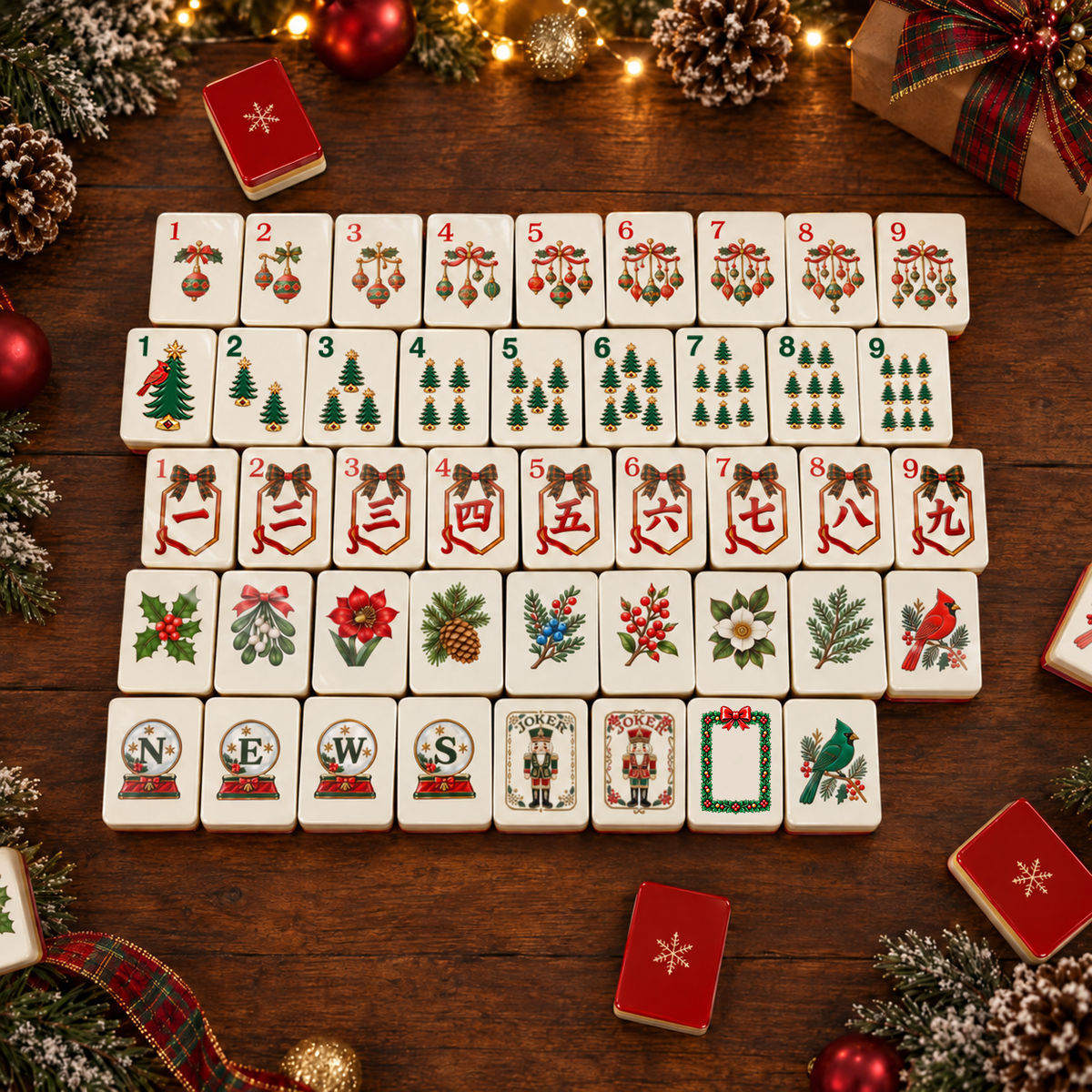
American mahjong competition follows the National Mah Jongg League standard: 152 tiles (three suits of Bams, Craks, Dots numbered 1–9, four of each; 16 winds; 12 dragons; 8 flowers; 8 jokers) played by four players seeking a winning hand from the current year's card. A legal hand must match exactly one pattern on the card, contain identical pungs (3 tiles), kongs (4), quints (5), or sextets (6), and use jokers only as tile replacements—never as a single tile or pair. Jokers cannot be stolen; the hand is called "mah jongg" and scored by round and hand type. Winning requires the discard tile from another player or a self-drawn tile, and the winner must announce before drawing next. Understanding these core rules and the specialized vocabulary—Charleston, exposure, dead wall, limit hand—separates casual players from those ready for sanctioned competition.
What does "mah jongg" mean in competition play?
"Mah jongg" is the winning declaration when you complete a legal hand matching a card pattern. In competitive American mahjong, you announce it immediately upon forming the final tile—whether drawn or called from a discard. The player cannot change their claim; the hand is scored and recorded. If your hand doesn't match the card exactly, the declaration is void and penalties may apply under league rules.

Which tiles form a legal pung or kong at the table?
A pung is three identical tiles (same suit, same number): 5 Bams, 5 Bams, 5 Bams. A kong is four identical tiles. You cannot mix numbers—1 Dot, 2 Dot, 3 Dot is a sequence, not a pung, and sequences are not exposed in American mahjong. Pungs and kongs must remain face-up on the table once exposed; jokers can replace tiles in pungs, kongs, quints, or sextets only after initial exposure, and a tile replaced by a joker is discarded or dead. This distinction from Chinese mahjong (which permits chow sequences) is fundamental to American strategy.
What is the Charleston and when must it happen?
The Charleston is the mandatory tile-passing ritual before the first discard. Each player passes three tiles to the right, then three to the left, then three across. Bonus passes (first right, second right, return) are optional—players decide as a group. After passes complete, play begins with East drawing from the wall. Learn the Charleston step-by-step →
How does the dead wall and kong work?
The dead wall is the last 14 tiles of the 152-tile wall, reserved for kong replacement and the final two draws. When you form a kong on your turn after mah jongg (a closed kong), you draw a tile from the dead wall to maintain a 14-tile hand. If the dead wall is exhausted and no mah jongg is declared, the hand is void and you pay all players a fixed penalty. Kong draws do not trigger the next player's turn.
Term | Definition | American Context |
Exposure | Pungs, kongs, quints, or sextets placed face-up on table | Triggered by ownership; once exposed, fixed |
Quint | Five identical tiles (rare; uses one joker) | Counts as single hand unit on card |
Sextet | Six identical tiles (two jokers) | Highest tile count in one unit; advanced hands |
Joker | Wild tile, replaces any single tile in exposed sets | Never a single tile, pair, or in a chow |
Dead hand | Hand that cannot be completed (e.g., mismatched units) | Forfeits all points; player pays all three opponents |
Limit hand | High-scoring hand capped at table limit | Typically 70–160 points; varies by venue |
Chicken hand | Low-scoring or common hand (slang) | Often worth minimum points; strategic play adjusts |
🀄 Shop best-selling mahjong sets →
What terms describe discard rules and calling?
In competitive play, "discard" is the tile placed face-up on the table after your draw; the discard is live for exactly three turns (your right, center, left player). "Calling" means claiming a discard to complete a pung, kong, quint, sextet, or mah jongg. You cannot call for a sequence in American mahjong. Priority: mah jongg calls override pung/kong calls. If multiple players call the same tile for mah jongg, the player closest to the discarder in turn order wins. A called tile must satisfy the hand on the current year's card—no exceptions. Understanding the card is essential here →
What are "like number" and "like suit" patterns?
"Like number" hands group tiles by matching numerals across different suits: all 5s (5 Bam, 5 Crak, 5 Dot, etc.). "Like suit" hands group by suit with varied numerals: 2 Bam, 3 Bam, 5 Bam, etc. These are card notation shortcuts. The current year's National Mah Jongg League card organizes hands by these structural categories to help players scan quickly. Confusing patterns costs time and invites errors during play.

How is scoring determined in league competition?
Scoring in American mahjong awards points for hand type, how the hand was completed (self-drawn vs. called), and bonus conditions (no jokers, all like suit, limit hands). The winner collects fixed points from each of the three players based on the card value. If a hand is declared dead or invalid, the declaring player pays all three opponents. Scoring rules are nuanced; learn the system → Venues and tournaments may adjust limit caps or bonus multipliers, so verify local rules before play.
What tiles must never form a pair in American play?
Jokers cannot form a pair under any circumstance, and the White dragon (also called "Soap") serves double duty: as the white dragon in the dragon suit (paired with other dragons) or as a zero placeholder in number sequences—but two White dragons cannot constitute a pair by themselves. A valid pair must be two identical tiles: two 3 Craks, two East Winds, two Red dragons. If your hand requires a pair that includes a joker, the hand is dead.
🎁 See our most-loved mahjong sets & accessories →
Why do competition rules ban sequences (chows) in exposure?
American mahjong differs fundamentally from Chinese and Hong Kong variants because chow sequences (1-2-3, 2-3-4, etc.) cannot be exposed or called. Only identical-tile sets (pungs, kongs, quints, sextets) count. This constraint defines the entire strategy: you build closed sequences in your hand but cannot play them openly. The rule exists to streamline scoring, reduce ambiguity, and maintain speed in tournament play. For deeper variant comparison →
What disqualifies a hand before mah jongg is called?
A hand is dead (invalid and cannot win) if it contains a pung with a joker and a matching single tile (redundancy), uses a joker as a pair, lacks exact card match, or includes an exposed set no longer on the table (a replacement joker was removed but the unit was never completed). If you declare mah jongg on a dead hand, you pay all three opponents and the tile is returned. Always verify your hand against the card before calling.
Before hosting or joining a league game: checklist
Confirm the current year's card. Hands change annually; old cards are invalid.
Verify house rules on limit caps and bonus scoring. Vary by venue and tournament.
Check exposure and kong replacement sequences. Some leagues allow optional bonus passes; others do not.
Ensure all 152 tiles plus 8 jokers are present. A complete 160-tile set with spares → prevents disputes mid-game.
Use a consistent mat and rack setup. A durable mahjong mat with clear tile spacing → and racks with pushers → reduce accidental exposures and speed play.
Designate a scorekeeper. League play demands accurate point tracking.
✨ Find your Mahstead set — free US shipping →

FAQ
Can I use a chow (1-2-3 sequence) as an exposed set in American mahjong?
No. American mahjong permits only identical-tile sets (pungs, kongs, quints, sextets) to be exposed and called. Sequences must remain concealed in your hand. This is the defining rule separating American play from Chinese and Hong Kong variants.
What happens if I call mah jongg but my hand doesn't match the card?
Your hand is dead. You pay each of the three other players a fixed amount (usually the hand value). The tile is returned and play continues. Always verify against the card before calling.
Can a joker ever be used as a single tile or a pair?
No. Jokers only replace tiles within exposed pungs, kongs, quints, or sextets. A joker cannot stand alone or form a pair. Using a joker in either way automatically voids the hand.
How long does the dead wall stay sealed, and when is it used?
The dead wall (last 14 tiles) is never drawn from normally. It is used only to replace tiles when a kong is formed, and to provide the final two tiles of the game if no mah jongg is declared. Once exhausted, the hand ends void.
Do all American mahjong venues use the same scoring system?
No. While the National Mah Jongg League card is standard, limit caps, bonus multipliers, and penalty amounts may vary by venue or tournament. Always confirm house rules before the Charleston begins.
What is a "limit hand" and why does it matter?
A limit hand is a high-scoring pattern capped at a table maximum (often 70–160 points depending on venue). Reaching the limit means the winner collects the cap value, not the card value. This prevents single hands from dominating the game economically.
Can I steal a kong discard the way I steal a pung discard?
No. In American mahjong, you cannot call a discard to form a kong. Kongs must be formed in your own hand and exposed only on your turn; they cannot be claimed from another player's discard.


View More
View More
View More
