
Mahjong Charcuterie Board: Host an Unforgettable Tile Night
Last updated: Nov 23, 2026
A mahjong charcuterie board is a thematic entertaining setup that centers an elegant American mahjong set (with 152 tiles plus jokers) as the visual anchor, surrounded by curated snacks, drinks, and seasonal décor on a single serving surface—typically a large wooden board, marble slab, or custom mat. Unlike traditional charcuterie that emphasizes cheese and cured meats, a mahjong board pairs light finger foods (crackers, fruits, cheeses, nuts, chocolates) with the game itself, creating a conversation starter. Hosting one takes 30 minutes to 90 minutes depending on prep; the game typically runs two to four hours. The cost basis depends on your set quality and food budget—an engraved American mahjong set is the anchor investment, with board and provisions scaling up from there. Avoid cluttering the tile-play zones; leave the center and each player's rack clear so tiles remain readable and protected from spills. 🀄 Shop best-selling mahjong sets →
Why is a mahjong charcuterie board becoming popular for entertaining?
Mahjong has moved from basement rec rooms into mainstream social culture, and the tiles themselves are now recognized as beautiful objects. A mahjong board marries that aesthetic appeal with the gathering ritual: guests see the game, the tiles, the setup—before they even learn to play. It works because it combines four entertainment layers: visual design (the tiles and board), the social ritual (passing, building walls, calling hands), food and drink, and conversation. The setup signals "this is intentional, not just a card game"—and that small gesture makes people feel welcomed and cared for.
How do you physically arrange a mahjong charcuterie board?
Start with your anchor: a large, stable surface (wooden board 24–36 inches, marble slab, or dedicated serving table). Position your mahjong set in the center or slightly off-center so it's visible but not in the way of play—a closed set (tiles stacked in the wall) works well as a sculptural object. Arrange a mahjong mat underneath if you want to define the play zone and protect the wood. Around the set, create zones: place cheeses and proteins on one quadrant, crackers and bread on another, fruits and sweets on a third, and glassware and small napkins in the fourth. Keep the edges of the board clear for active play. If using a mat, leave room for each player's rack and hand-building space—typically 8–10 inches per player on the perimeter. Small plates, napkins, and hand wipes belong at the sides, not near tiles.
What sets work best as mahjong charcuterie centerpieces?
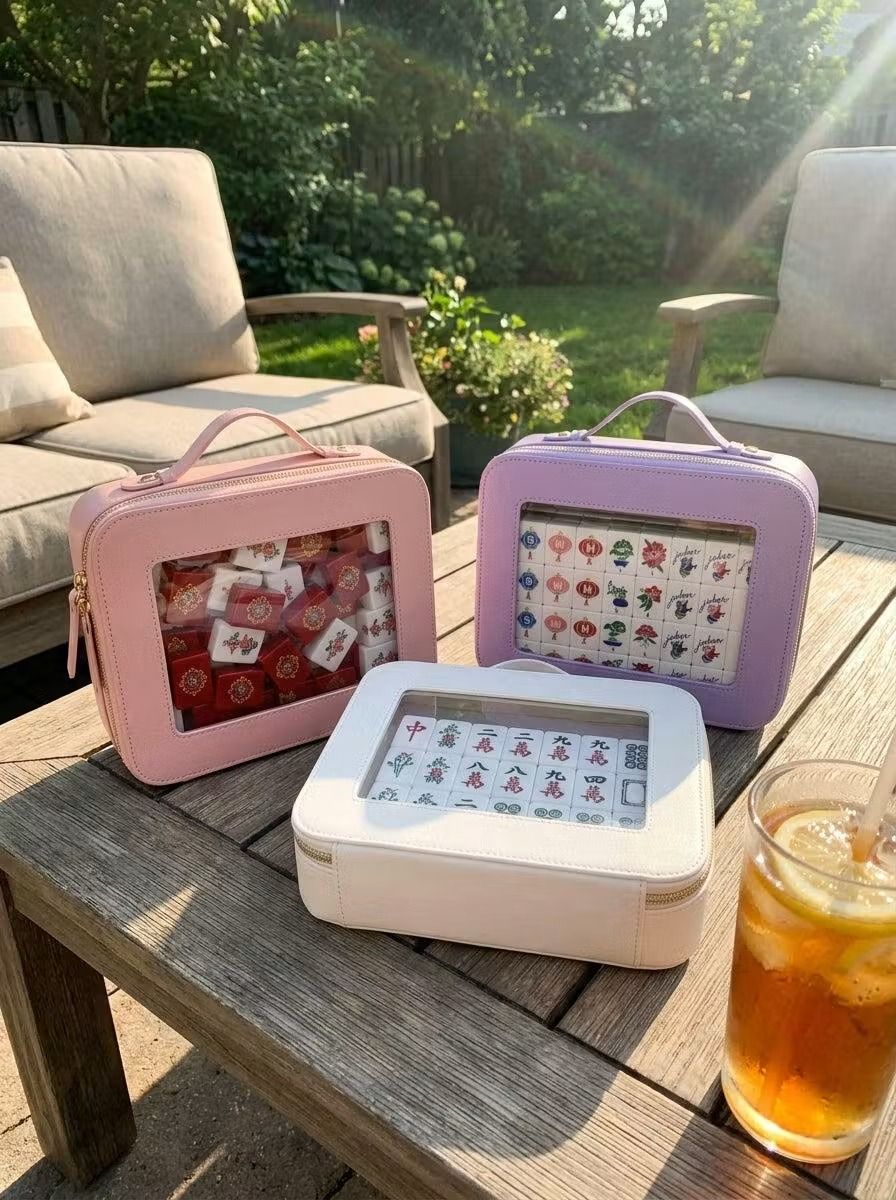
Sets with strong visual contrast photograph well and read easily across a table: deep forest or ocean tones with bright tile faces, bone-colored tiles with bold lettering, or jewel-toned designs. Engraved sets—personalized with names, dates, or in-jokes—create an even more memorable focal point; guests appreciate the craftsmanship and feel the gathering is special. Avoid sets with very small or faint tile markings; from three feet away, a player won't read the honor tiles clearly. Consider a set in a fun or themed design (seasonal colors, humorous engravings, holiday patterns) if the tone of your group allows it; this signals playfulness and makes the board feel intentional rather than formal. A 160-tile set is standard; it includes spare jokers for replacements, which is practical if a tile gets nudged into the food.
🎁 See our most-loved mahjong sets & accessories →
What food and drink pairings work with a tile-focused board?
Think "refined bites"—foods that don't leave greasy residue or crumbs that could soil tiles. Aged cheeses, nuts, dried fruits, and chocolate are ideal; they satisfy flavor curiosity without demanding a sauce bowl or fork. Offer water, sparkling water, wine, or cocktails in small glassware that won't tip easily. Avoid dips, spreads, and anything deep-fried or wet. The food should be approachable in one or two bites so players can eat with one hand and keep their other on tiles. Arrange items in small piles or on picks so guests serve themselves without reaching across the board. If you include nuts or crackers, set them away from the tile wall so crumbs don't drift into play. A cheese board that changes seasonally (spring cheeses and strawberries, autumn grapes and walnuts, winter nuts and dark chocolate) keeps repeat guests interested.
How do racks, mats, and accessories elevate a mahjong board experience?
A quality rack with pushers signals that everyone takes the game seriously; it helps newer players build their hand clearly and keeps tiles from sliding during the draw. A coordinated mat defines the play zone and protects the board from water rings and tile marks. Matching mahjong bags or cases can sit nearby (not on the board), suggesting the set travels and is cared for. Smaller touches—custom dice, a written hand-reference card, or scoresheets printed on nice cardstock—add polish without clutter. The rule of thumb: one or two refined accessories, not five competing designs. If your board is wood, a mat in a complementary color (not a busy pattern) frames the tiles and keeps the eye on the game, not the furniture underneath.
Setup Element | Why It Matters | Key Choice |
Set visibility | Guests' first impression and play clarity | Strong color, readable tiles from 4 feet |
Mat | Protects board; defines play zone | Neutral color or one accent tone |
Racks & pushers | Easier hand-building for newer players | One set per player, color-coordinated |
Food zones | Prevents spills near tiles | Four separate areas, no liquids near play |
Glassware | Reduces accidents | Small, wide base, placed at board edges |
Accessories | Signals intention and care | One or two items max; rest is clutter |
What common mistakes ruin a mahjong charcuterie board?
Overcrowding the play zone. Piling snacks in the center or stacking extra plates near the wall leaves no room for tile-building. Players will set food down on the mat and risk spilling on tiles.
Mixing hot and cold foods. A warm bread basket will fog a mat or create steam that curls tile edges. Keep items at room temperature or use separate coolers nearby.
Using a set that's too small or hard to read. Tiny tiles that look cute on a shelf become invisible during play. Test readability from the farthest seat before committing.
Forgetting about hand placement. If your board is too high, players' arms will tire. If too low, elbows knock food. Ideally 28–30 inches high, allowing players to sit comfortably with racks at waist level.
Skipping the mat. A mahjong mat doesn't just look polished—it gives tiles purchase so they don't slide when someone bumps the table, and it defines the boundary between "food zone" and "play zone."
What to Check Before You Buy
Board size. Measure your table and subtract 6 inches on each side for player reach. A 36-inch board fits four comfortably; 48 inches suits up to six with extra food space.
Tile readability. Order a sample or visit a local game group to see the set in real light. Dark tiles on a dark board are atmospheric but hard to play.
Mat thickness and grip. A thin, slippery mat frustrates players; a thick one with a textured backing keeps tiles stable and food spill-safe.
Racks and pushers fit your tiles. Not all racks suit all sets; check the product details or contact support before ordering.
Food prep time. A minimal board (cheese, nuts, crackers) takes 15 minutes. A staged, multi-element board takes an hour or more.
✨ Find your Mahstead set — free US shipping →
How long should a mahjong game on a charcuterie board last?
A single game of American mahjong typically runs 20–45 minutes once play begins. Most entertaining boards are designed for a two- to four-hour gathering: players rotate chairs, eat, chat, and play two to four rounds. Build in 20–30 minutes for teaching newcomers how to read the current-year card and understand the tile mechanics. The food should sustain the group for that stretch without requiring a formal meal—think appetizer board, not dinner substitute.
Can you set up a mahjong charcuterie board ahead of time?
Yes, with caution. Assemble the board up to two hours before guests arrive; keep perishables (cheese, cured meats) covered in the fridge until 30 minutes before play. Arrange tiles, racks, and mats the morning of so they're in place and dust-free. Do not build the complete board the night before—cheeses can dry out, crackers soften, and tiles collect dust. Keep beverages in a cooler nearby and pour drinks just before sitting down to play; this prevents accidental spills during the vulnerable setup period.
How do you teach newcomers on a mahjong charcuterie board?
Have a printed hand-reference guide (from the current National Mah Jongg League card) at each seat, and one copy large enough for the center of the board. Spend 10–15 minutes before food arrives explaining the tile types (suits, honors, flowers, jokers) and how to read a valid hand. Play one slow, teaching round where no one keeps score; let players ask questions. Once everyone has built a hand and called "Mahjong" once, confidence rises. The visual beauty of the board actually helps—it signals "this is special," so people pay closer attention rather than rushing through rules.
What's the difference between a mahjong charcuterie board and a mahjong table setting?
A charcuterie board is a curated, decorative spread that centers food and ambiance around the game; it works for 2–4 players and is meant to impress. A mahjong table setting is functional: a mat, racks, scoresheets, and water—emphasis on playability and comfort for serious or tournament play. A charcuterie board prioritizes aesthetic and social ritual; a table setting prioritizes speed and accuracy. You can merge them (add a beautiful mat and racks to your board), but the charcuterie board is explicitly designed to blend eating, hosting, and playing into one experience.
FAQ
How much does it cost to set up a mahjong charcuterie board?
The anchor cost is the mahjong set (varies by design and customization). Add a mat, racks, board or surface, and food. See current prices for sets and accessories. Food costs depend on your choices; budget $15–40 for a four-person gathering.
Do I need a special mat for a charcuterie board?
A mat isn't required, but it protects your table and signals intentionality. It also defines the play zone and keeps food spills away from the tile wall. Choose one that coordinates with your set and board.
Can I use a mahjong charcuterie board with newer players?
Yes. Print the current-year hand card at each seat, spend 15 minutes teaching tile types, and play one teaching round before scoring. The beautiful setup actually helps—people pay attention and feel invested in learning.
What tiles show up best on a wooden board?
Bone or cream-colored tiles with dark lettering, or jewel tones (blues, greens, purples) with bright accents. Test readability from the farthest seat before committing; dark tiles on dark wood disappear under poor lighting.
How do I prevent spills from ruining tiles?
Keep glassware at the edges of the board, not near the play zone. Use a mat with a waterproof backing. Avoid dips, sauces, and wet foods. Small napkins at each seat encourage quick cleanup.
Should I refrigerate food before guests arrive?
Yes, keep cheese and cured meats cold until 20–30 minutes before play. Arrange them on the board just before guests sit; this keeps them fresh and prevents condensation on tiles.


View More
View More
View More
