
Mahjong Bag for Small Tables: Compact Storage That Fits Your Game
Last updated: Nov 23, 2026
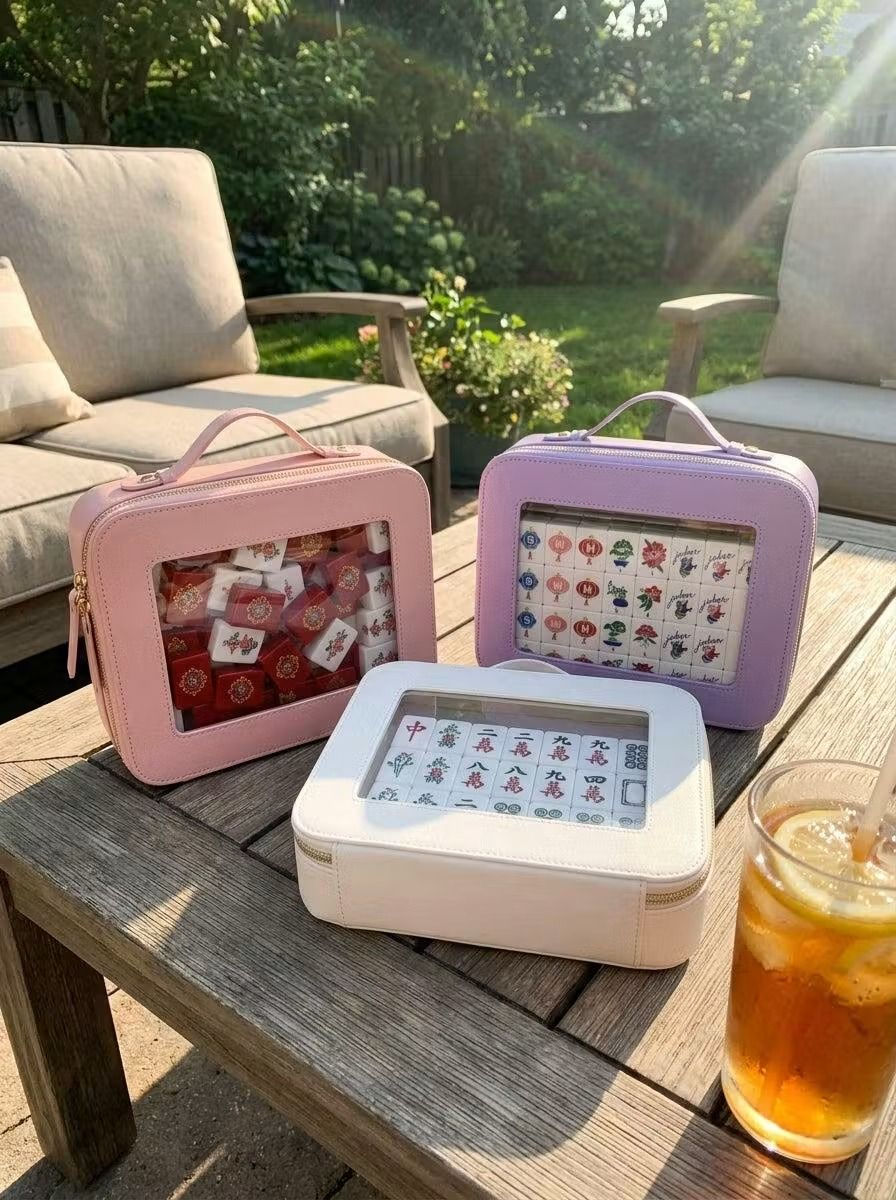
A mahjong bag for small tables is a compact carrier sized to hold a 160-tile American set (approximately 152 playing tiles plus spares), mats, racks, dice, and accessories without overwhelming limited furniture. Most soft-sided designs run 18–24 inches across and weigh 3–5 pounds empty; hard cases are stiffer but often bulkier. We recommend measuring your table depth first—if it's under 36 inches, choose a bag that closes to 16 inches or less so it stores vertically in a closet or under a shelf. Soft nylon or canvas bags cost less than rigid cases and pack flat; hard carriers protect tiles better during transport and stacking. Check whether the bag has interior pockets (jokers and dice), a handle for one-person carry, and whether zippers glide smoothly when full. Our travel-bag collection includes both styles; start there to see current options and match your space. 🀄 Shop best-selling mahjong sets →
How Do You Measure a Bag That Fits Your Small Table?
The first step is honest: measure the space where your bag will live. If your game table is 30–36 inches deep, a closed bag must compress to under 18 inches tall and 16 inches wide. Place your 160-tile set in its original box or a hard case and measure that as your minimum. Then measure the mat rolled or folded—mats add 2–4 inches depending on material. Add an inch for comfort, then compare that total against each bag's stated closed dimensions. Many players forget to account for rolled mats taking up length, not height. Our practice: we measure the set in the bag before checkout, then stack it against the nightstand or shelf it'll occupy. Bags that advertise "compact" but lack closed-dimension specs rarely fit small spaces as promised.
Soft Bag vs. Hard Case: Which Wins for Small Tables?
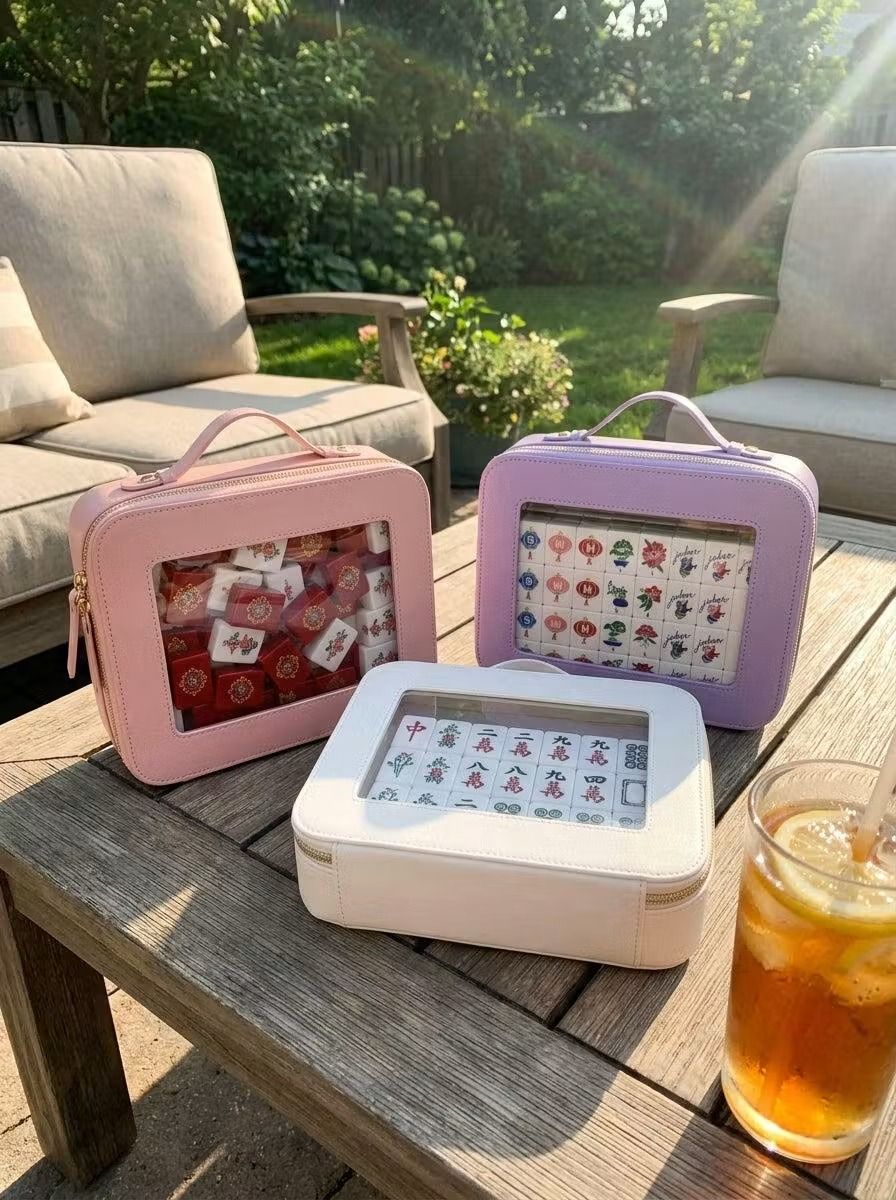
Soft nylon or canvas bags fold nearly flat when empty (store them in a drawer), compress slightly when full, and slip under a bed or between furniture. They weigh little and feel lighter to carry one-handed to a friend's house. Downside: tiles can shift during transport, and corners offer no impact protection if you bump a wall.
Hard plastic or reinforced cases protect tiles like luggage; they don't compress, so they take fixed space. They stack securely and sit stable on a cart. Downside: they don't collapse and demand a permanent shelf or closet slot.
For a small table, choose soft if you move your game weekly and storage is tight. Choose hard if your set lives in one room and transport is rare. A hybrid—soft exterior with hard-lined pockets—splits the difference but costs more and still doesn't collapse fully.
Feature | Soft Bag | Hard Case | Hybrid |
Folds flat? | Yes | No | Partially |
Tile protection | Fair | Excellent | Very good |
Fits under bed? | Yes | Rarely | Maybe |
Carry comfort | Light | Heavier | Moderate |
Best for | Frequent movers | Stayers | Both |
What Should Fit Inside Your Small-Table Bag?
A well-designed mahjong bag for small tables holds far more than the set itself. Start with your 160-tile set in its box or bag—that's your anchor. Then layer in: a mat (rolled or flat), a set of mahjong racks with pushers (one per player fits in an interior pocket), the current year's card, wind and round markers, dice, jokers, and maybe an extra blanks. Most bags we carry have one large compartment (for the set and mat) and two smaller zippered pockets. Interior pockets matter—they keep small tiles and dice from rolling loose inside. If your set includes custom engraving or gift wrapping, confirm the unwrapped dimensions before ordering. We always ask: can this bag hold one complete game plus snacks and a score pad? If not, it's not "all-in-one" and you'll need a second bag.
✨ Find your Mahstead set — free US shipping →

Can You Fit a Mat and Racks in a Small Mahjong Bag?
Yes—if you choose the right combination. A rolled mat (approximately 28×28 inches unrolled) compresses to 4–6 inches in diameter and slides into a bag's side pocket or lies flat along the bottom. Four racks with pushers—one per player—stack to about 2 inches tall and 18 inches long; they nestle alongside the set. The trick: don't fold the mat tight until after you've loaded the set and racks. Load order: set on bottom, mat rolled alongside, racks in the top pocket, dice and jokers in zippered compartments. Many bags marketed for mahjong now include a mat slot or elastic strap to cinch it. Before buying, check whether the bag lists mat capacity in its description. We've found that bags claiming "fits one set" often mean just the set—no room for a mat. Ask before you order. And if you own an oversized mat or prefer hard cases for your racks, you may need two smaller bags instead of one large one.
What's the Difference Between Travel and Tabletop Storage?
Travel bags prioritize portability: lightweight, collapsible, and with carry handles or shoulder straps. They're made to travel to a friend's house or a weekly game at a community center once a week.
Tabletop storage bags sit on or under the table during play. They're usually more rigid, have shorter handles, and keep accessories within arm's reach while tiles are being shuffled. They're less about moving and more about keeping the table organized.
For a small table, the distinction matters. If your table is 30 inches deep and you play at home weekly, a tabletop bag stored underneath works. If you rotate between houses every week, a travel bag that closes small is essential. You can't use a bulky travel bag under a card table—it'll hit your legs. But a rigid tabletop bag won't fit in a car trunk if you need to move it. Measure your car, your table underside, and your target storage shelf first. One bag rarely does both well.
🎁 See our most-loved mahjong sets & accessories →
What to Check Before You Order a Small Mahjong Bag
Closed dimensions (height × width × depth). Compare against your table depth, storage shelf, and car trunk. Never rely on words like "compact"—measure.
Interior pockets. Count them. One large pocket isn't enough for jokers, dice, and markers to stay sorted. Aim for at least two separate zippered sections.
Material and weight. Soft nylon is 1–2 pounds; hard cases are 3–5. If you carry it one-handed weekly, soft wins. If it lives in a closet, hard protects better.
Handle type. One handle is fine for occasional moves. Two handles (shoulder strap or carry grip on both short ends) makes a heavy bag bearable.
Whether the mat fits rolled or flat. Many bags say "mat slot" but require it rolled to a certain width. Measure your mat rolled and flat.
Warranty or return policy. Mahstead offers free US shipping, so returning a bag that doesn't fit your table is easy if you confirm the policy before checkout.
Interior lining. Felt or foam lining protects engraved tiles from scratches. Bare plastic allows tiles to slide and collide. Check product photos.
Seams and zipper quality. Press the zipper in the product photo—does it glide smoothly or look strained? Read whether other buyers mention zippers jamming when full.
Load a test set before the first game and confirm it sits flush inside. If tiles press against the lid or the bag bulges, it's too tight for weekly use—zippers will wear fast.
Our best-selling collection includes soft and hard carriers in multiple sizes. Measure your small table's depth and storage space, then compare bag closed dimensions on the product page. If you play with engraved American mahjong sets or Christmas mahjong sets, note that custom tiles may sit slightly taller in a standard set box—ask before ordering. For mat advice, read our guide on how to choose a mahjong mat—mat thickness affects how much space you'll need in your bag.
✨ Find your Mahstead set — free US shipping →

FAQ
Can I fit a 160-tile set, a mat, and four racks in one small bag?
Yes, if the bag is designed for mahjong. Load the set first (bottom), roll the mat alongside or on top, stack the racks in the top pocket. Confirm the bag's interior dimensions match your rolled mat and stacked racks before buying—most mahjong bags are built for this, but general duffels aren't.
What's the smallest bag size that holds a complete 160-tile set?
A 160-tile set unboxed (just tiles) is roughly 14×10×4 inches. A bag with an 18×12×6-inch interior will fit it comfortably. Add 2 inches if you want the set to stay in its original box for protection.
Do soft bags protect tiles from breaking?
Soft bags cushion tiles against jostling during transport but offer no hard-impact protection. If you drive rough roads or stack heavy objects on top, a hard case is safer. For gentle weekly moves between homes, soft is fine.
Should I remove the mat from the bag after every game?
Not necessary, but remove it weekly to air it out if the bag is sealed. Rolled mats in damp bags can develop odor or mildew. Store the bag unzipped in a dry closet between games.
Can I use a general luggage bag instead of a mahjong-specific one?
You can, but it won't protect your tiles as well. Mahjong bags have interior pockets designed to hold jokers, dice, and the card separate from tiles. General bags have loose interiors where tiles and metal dice collide, scratching engraved sets.
What's the weight limit for a small mahjong bag?
A full 160-tile set, mat, racks, and markers weighs 4–6 pounds total. Most soft bags handle 10+ pounds without issue. Hard cases are rated higher but weigh more empty. Check the product page for the bag's stated capacity.
Can I wash a nylon mahjong bag?
Spot-clean nylon with a damp cloth; don't submerge. Zippers can rust if soaked. For machine washable bags, check the product label—not all are. Air-dry completely before sealing to prevent mildew.


View More
View More
View More
