
Is Wright-Patterson Mahjong Hard to Learn?
Last updated: Nov 23, 2026
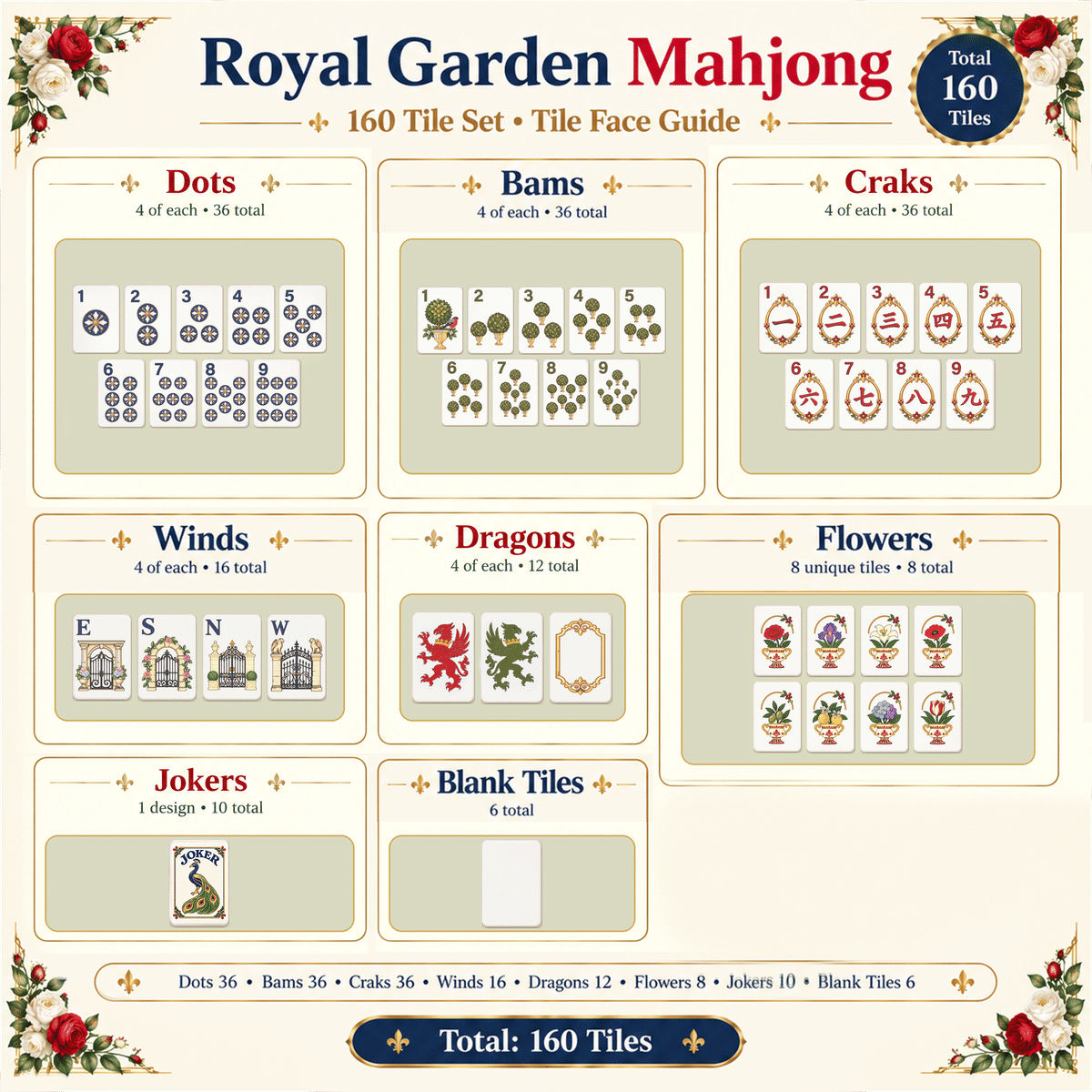
Wright-Patterson mahjong is a regional American variant played primarily in Ohio and surrounding states, using the standard 152-tile set but with different hand-building rules and a unique tile-passing system. It takes 2–4 hours to learn the basics (tile recognition, the passing ritual, how to form exposures) but 10–20 games to develop real pattern fluency. The difficulty sits between beginner-friendly and intermediate: scoring is simpler than standard American mahjong, but the hand card is less standardized, and players must memorize more position-dependent call sequences. Unlike the National Mah Jongg League card–driven model, Wright-Patterson relies more on house rules and regional memory, making it harder to find written resources. We recommend starting with a quality acrylic set from our best-selling collection, a clear mat, and a notebook—then finding a local game group (often at community centers or synagogues) where experienced players can teach you their specific house rules.
What Makes Wright-Patterson Different From Standard American Mahjong?
Wright-Patterson uses the same 152 tiles as American mahjong but strips away the hand card entirely. Instead of matching a specific pattern each hand, players build any valid combination—a shift that sounds simpler but actually requires deeper memorization. You must know which tile combinations count as valid endings (melds) and what constitutes a winning hand without referencing a published card. The Charleston (tile-passing opening) still happens but often with regional variations in direction or number of passes.

How Long Does It Really Take to Play Your First Game?
Your first game takes 3–5 hours, mostly spent learning tile names, understanding what counts as a pung (three identical tiles) versus a kong (four identical), and watching how the Charleston works. The actual gameplay rules—drawing, discarding, calling melds—take only 30 minutes to grasp. The hard part is remembering which combinations can end a hand and why. We suggest playing your first few games as an observer, taking notes on what winning hands looked like, then joining in. A clear mat and racks with pushers keep tiles organized and visible, making that learning curve much less steep.
🀄 Shop best-selling mahjong sets →
Where Do You Find Wright-Patterson Games and Rules?
Wright-Patterson is concentrated in Ohio, Indiana, and parts of Pennsylvania—rarely found in coastal cities or online. Your best path: call community centers, synagogues, and senior centers in your region and ask if they host mahjong nights; mention Wright-Patterson or "Ohio mahjong" by name. Facebook groups for regional mahjong players often post game schedules. Because house rules vary widely, the first night you attend, sit out, watch, and ask the host to explain their specific version. No two groups play identically. Once you find a game, ask if they have spare sets or a house set you can use while learning—many do.
What's the Actual Learning Curve: First Game to Competence?
A comparison of typical progression:
Stage | Time Invested | What You Master | Difficulty |
Session 1–2 | 6–10 hours | Tile names, pung/kong/quint shapes, Charleston order | High—overwhelming |
Session 3–5 | 15–25 hours | Which melds end hands, basic discard strategy, position play | Medium–high—pattern confusion |
Session 6–15 | 40–80 hours | Hand memory, probability reading, opponent tracking | Medium—building intuition |
Session 16+ | 100+ hours | Competitive speed, subtle positional calls, endgame timing | Low–medium—refinement |
Most players report genuine comfort (playing without constant rule clarification) after 8–12 games. Competence (winning regularly, reading the table) takes 30–50 games.
Is Wright-Patterson Harder or Easier Than Standard American Mahjong?
Wright-Patterson is easier to start because you don't memorize a 100-hand card; you just learn valid tile shapes. But it's harder to master because there's no official hand list—you must know patterns by sight and context. Standard American mahjong punishes you immediately if you play a hand that's not on the card; Wright-Patterson punishes you if you forget a valid hand exists. This inverts the learning curve: beginners feel less lost at first, but intermediates hit a wall when they realize pattern memory requires hundreds of examples, not a single card reference. If you're already comfortable with standard American mahjong, Wright-Patterson feels less foreign than it does for complete newcomers.
🎁 See our most-loved mahjong sets & accessories →

What Equipment Helps You Learn Faster?
A proper setup cuts learning time by 30–40 percent. You need a clear mat so all 152 tiles stay visible and organized; a dark, printed mat makes tile-reading harder when you're new. Racks with pushers prevent tiles from sliding during the Charleston and let you keep your hand tidy—critical when you're mentally managing new rules. An acrylic set with crisp, engraved characters (not printed) remains readable under poor lighting, a common problem in church basements and community-center card rooms. A dedicated mahjong bag keeps your personal set protected if you're traveling to games, and it shows respect to the host.
✨ Find your Mahstead set — free US shipping →
Common Mistakes New Players Make—And How to Avoid Them
Memorizing hands in the wrong order. New players often try to learn "easy" hands first, then "hard" ones—but Wright-Patterson hands don't scale that way. Instead, focus on hands you see played in your actual game group. Ask the host which three hands appear most often each session, then drill those.
Confusing position with hand validity. Position (East, South, West, North) matters enormously in Wright-Patterson—certain hands may only end from certain seats. Write this down immediately after each game.
Rushing the Charleston. The tile pass is where mistakes cascade. Count your passes aloud ("one, two, three") and always verify you have exactly 13 tiles before play starts. One miscount ruins the whole hand.
Not asking for clarification. House rules vary. If another player calls a winning hand and you don't understand why it counts, ask before the next hand starts. Experienced players expect questions; they'd rather teach than have you play wrong.
Playing too fast too soon. In your first 5–10 games, play slowly and announce what you're doing ("I'm discarding East Wind because…"). This trains your judgment and lets experienced players gently correct you.
What to Check Before You Buy a Wright-Patterson Set
Before investing in equipment, confirm with the game group you plan to join that they use standard 152-tile American mahjong sets (most do). Ask if they have a house preference for tile size or material—some groups use Catalin (vintage bakelite), others acrylic, others bamboo with bone. If you're joining an established group, there's no shame in borrowing a set for your first 2–3 games to make sure the game sticks.
Check that your mat is at least 36 inches square—Wright-Patterson, like all American mahjong, needs space for a true wall layout and a visible discard pile. A mat that's too small breeds frustration and play errors.
If you wear glasses or have vision trouble, look for sets with high-contrast tiles (acrylic with engraved or painted characters beats embossed or lightly printed). You'll be reading tiles from 3+ feet away across a table.
Our Pick: Equipment for Wright-Patterson Beginners
For a player learning Wright-Patterson, we recommend starting with a mahjong set from our best-selling collection—durable acrylic with clear markings—paired with a quality mat designed for American mahjong. Add racks with pushers to keep your hand organized during the confusing first games. Once you know you'll play regularly, a travel bag or case protects your investment and makes attending games easier.

FAQ
Can I learn Wright-Patterson online or from a book?
There is no comprehensive Wright-Patterson rulebook in print; the game is almost entirely taught mouth-to-mouth in regional groups. Online tutorials don't exist because regional house rules differ too much. You must find a local game and learn from players. A general book on American mahjong teaches you tile names and concepts, which helps, but won't teach you the specific hand patterns your group recognizes.
Is Wright-Patterson still played, or is it dying out?
Wright-Patterson has a small, stable player base in Ohio and adjacent areas—mostly retirees and multigenerational family groups. It's not growing, but it's not disappearing. Your chances of finding a game depend entirely on where you live; if you're in the Wright-Patterson stronghold, games are regular; elsewhere, you'll likely find none.
If I learn Wright-Patterson, can I play standard American mahjong?
Yes, but expect confusion for your first 5–10 games. The tile mechanics are identical, but having a hand card to reference will feel alien if you've been playing by memory. Most players who know both say switching is easier than learning either from scratch because you already know tiles and strategy—the card is just a crutch you have to learn to use.
What's the biggest mistake people make learning Wright-Patterson?
Trying to memorize the entire hand repertoire before their first game. You can't. Instead, learn 5–10 common hands that your specific group plays, then add more as you play. Each group has its favorites; memorizing hands from a different group wastes effort.
Do I need my own set to play Wright-Patterson?
No. Most groups have house sets, and many rotate lending sets to new players. You should eventually own one (for consistency and respect to your hosts), but borrow first and confirm you like the game. Once you're in, our best-selling sets ship free across the US and come in enough variety to match any player's preference.
How much does it cost to start playing Wright-Patterson?
Zero dollars if you borrow a set and attend a game at a community center (which costs $0–5 per session). A personal set runs between moderate and premium depending on material and finish. Most groups don't require you to own a set; they provide one. Start with borrowed equipment, play 10 games, then decide if buying in makes sense.


View More
View More
View More
