
How to Play Sichuan Bloody Mahjong: Rules & Strategy Guide
Last updated: Nov 23, 2026
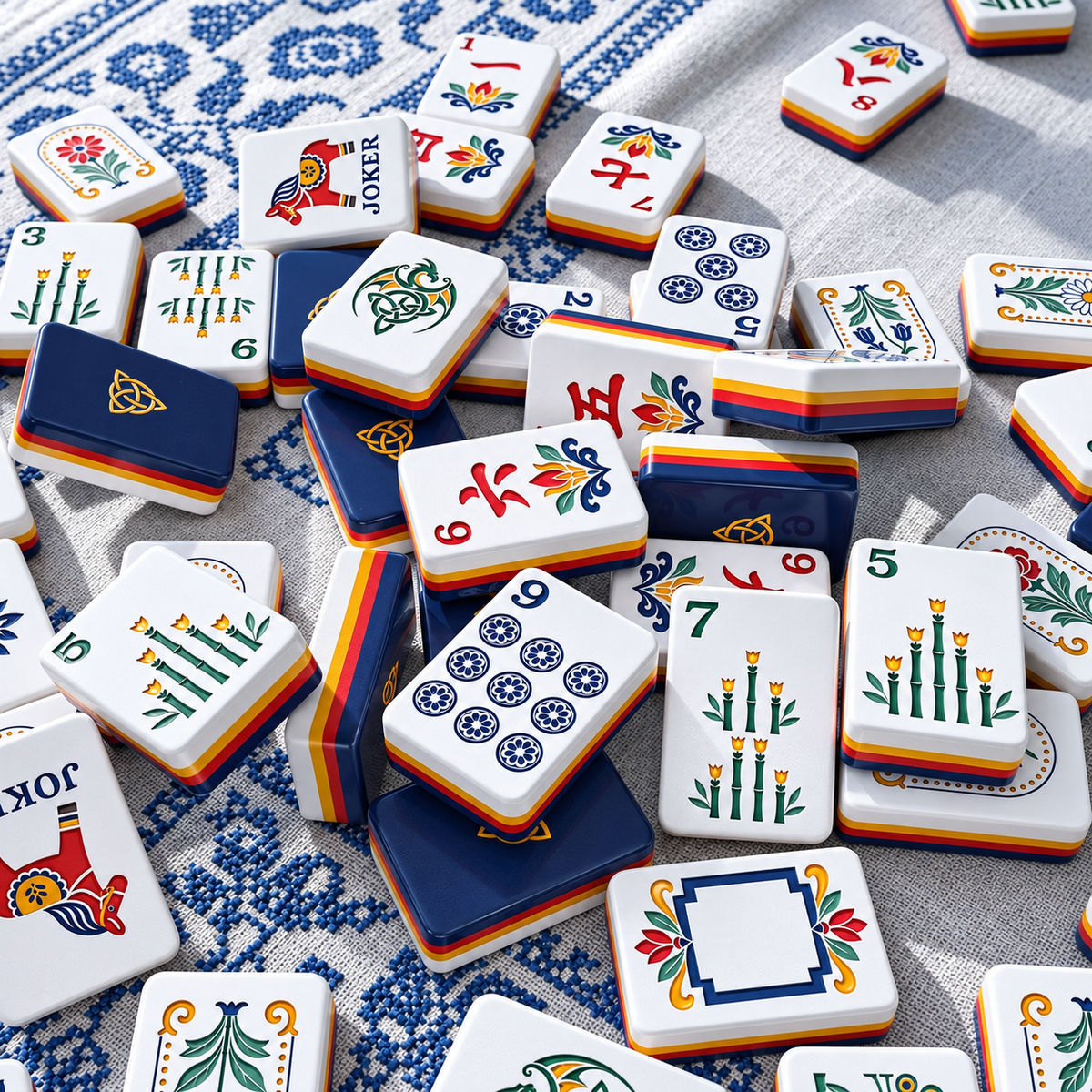
Sichuan Bloody Mahjong is a Chinese regional variant played with 136 tiles (Chinese-style: Bams, Craks, Dots 1–9, plus Winds and Dragons, but no Flowers or Seasons) and emphasizes high multipliers, aggressive Kong calls, and rapid hand advancement. Players draw and discard in turn; melding happens immediately (Pungs, Kongs, Chows/Sequences are all exposed and callable). Scoring multiplies based on the winning tile's source (self-draw, discard, Kong, or honor tile) and the hand's composition; a single hand can reach 8–16× base points. The game ends when one player "wins" (completes a hand meeting the standard: one pair + four melds) or scores a threshold (typically 10,000+ points over several rounds). Unlike American Mahjong, which uses the yearly card and forbids sequences in closed hand, Sichuan play allows all melds openly, plays year-round with fixed hand patterns, and values speed and table economy.
Sichuan Bloody Mahjong earned its name honestly: the game is ruthless, multipliers stack relentlessly, and a single miscalculation can wipe out a player's round score. If you've played American Mahjong or Hong Kong variants, Sichuan's logic is familiar—but the tempo and point compression are entirely different. We host games monthly with friends who've played in Chengdu and Beijing, and the learning curve is sharp but rewarding.
What exactly is the winning hand in Sichuan play?
A winning hand in Sichuan Bloody Mahjong is one pair (two identical tiles) plus four melds: Pungs (three identical), Kongs (four identical), or Chows (three consecutive numbers in the same suit, e.g., 2–3–4 Bams). The pair must not be an honor tile (Wind or Dragon) in most house rules; it must be a suit tile (Bam, Crak, or Dot). Your four melds can be any mix of those three types. A "chicken hand" (common, low-scoring opener) might be: Pair of 5 Dots, Pung of 1 Bams, Pung of 7 Craks, Chow of 4–5–6 Dots, Pung of East Winds. Winning is triggered by a 14th tile that completes the pair or a fourth meld. In Sichuan games, you announce your win immediately and total points before the next hand begins. This differs sharply from American Mahjong, where hands come only from that year's card and Chows cannot be exposed or called in your closed hand.

How do multipliers work and what makes scoring explosive?
Sichuan scoring multiplies your base hand value by a series of factors based on how and where you won. If you draw your winning tile yourself (self-draw), your hand multiplies by 1.5×; if the discard comes from another player, it's 1×. If you drew a Kong and then drew a replacement tile that completed your hand (a Kong win), the multiplier rises to 2× or 3×. Additionally, winning on an honor tile (Wind or Dragon) discard adds another multiplier layer: 1.5× to 2×. Hands that are "all simples" (no honor tiles in melds) gain 1.2×; hands with four Pungs (no Chows) gain 2×. These stack. A single hand—say, all Pungs, self-draw on a Kong replacement—might hit 3× × 2× × 1.5× = 9× base points in one calculation. Base points usually start at 8 (simplest hand); thus 8 × 9 = 72 points, scored to the winning player from all three opponents or split across the table depending on house rules. Over a session, one aggressive player racking up 5–6 wins can accumulate 500–1000 points while others stall. That's the "bloody" part: momentum is punishing.
What are the key differences from American Mahjong and Hong Kong variants?
Feature | American Mahjong | Sichuan Bloody | Hong Kong |
Tile count | 152 (+ 8 jokers) | 136 | 136 |
Hand source | Current-year card only | Fixed patterns (always same patterns) | Variable patterns, flexible |
Chow/Sequence rules | No Chows in closed hand; only exposed Pungs/Kongs callable | All melds (Pungs, Kongs, Chows) exposed and callable immediately | All melds exposed and callable |
Jokers/Wild tiles | 8 jokers per set, can replace any tile in exposed meld | No jokers; rare "blank" tiles in premium sets | 1–2 wild tiles, optional |
Scoring basis | Points per hand, additive | Multipliers on base (8 or 16), stacking | Points per hand, often higher base |
Play tempo | Measured, often slow (hand reads card) | Fast, rapid discard/call cycle | Medium-paced |
Pair rule | Pair must be honor or suit tile per card | Pair is almost always suit tile, rarely honor | Pair flexible, varies by house |
The most critical difference: in American Mahjong, you're constrained by the National Mah Jongg League card issued each spring—your hand must match that year's patterns exactly. In Sichuan and Hong Kong, you follow unchanging standard patterns. American play forbids Chows (sequences) in a closed hand and only allows exposed Pungs, Kongs, Quints, and Sextets to be called or shown; Sichuan and Hong Kong permit all three meld types to be exposed and called freely. Scoring in Sichuan is multiplicative and explosive; American scoring is additive and transparent from the card.
How do you call and meld in real time?
When a discard is tossed to the table, any player holding the matching pair of tiles (for a Pung), or three in sequence (for a Chow), or the fourth tile to a Kong, can call immediately by saying "Chi" (Chow), "Pong" (Pung), or "Kong" (Kong). If multiple players call the same discard, precedence goes Pung > Chow (Pung beats Chow); if two players call Pungs on the same tile, the player seated closest in rotation (typically East or the next player clockwise) takes it. Once called, you expose the meld on the table in front of you and place the discard into it. Your turn then passes to the next player (if you called a Chow), or you discard immediately (if you called a Pung). A Kong call freezes the play: you announce Kong, expose the four tiles, and draw a replacement from the end of the wall (or from a reserved Kong draw zone). You then discard, and play continues. This is radically different from American Mahjong, where exposure and calling are restricted; you cannot call a Chow at all, and only certain melds (Pungs, Kongs, Quints, Sextets) can be exposed. In Sichuan, the table stays dynamic and open—almost every tile discard triggers a decision from every player.

What's the best strategy to win consistently?
Winning at Sichuan Bloody Mahjong requires balancing three forces: hand speed (finishing quickly before multipliers bloat too far), tile safety (discarding uncontested tiles so you don't feed opponents), and tempo reading (knowing when the table is slow enough to chase a high-value hand versus when you must settle for a chicken win). Early in a hand, hold onto high-honor tiles (Winds, Dragons) because they offer multipliers; discard corner suit tiles (1, 9) that are harder to meld unless you're building a "terminals" specialization. Watch the Kong draws: if one player pulls three Kongs early, the winning tile is likely near and multipliers are climbing—shift to defense and discard safe tiles. If you're winning every hand, keep choosing speed over points; if you're behind, wait for a premium hand (all Pungs, honor-heavy, Kong win) so a single knockout swing balances the round. Crucially, discard what the player on your left (the next actor) discards if you can; that signals safety and slows their read. Avoid early 2–3 Chow runs; commit fully to a Pung-heavy structure or a single Chow sequence so you're not torn between two weak patterns. In our Friday games, players who survive are those who fold early hands into "live pairs" (pairs that can pair again if the board opens) and those who know when to go all-in on a Kong win. This differs from American Mahjong strategy, where you memorize the card and hunt specific patterns; in Sichuan, adaptability and table reading win.
What common mistakes kill your score?
Calling a Chow too early locks you into a slow hand and telegraphs your pattern to the table; withhold Chow calls until you're certain the hand pays out. Never Kong on the first two draws unless it's a terminal tile (1 or 9) or a Dragon—most Kongs discard safely and waste a valuable wall tile. Holding honor tiles too long kills your hand speed; if your pair isn't honor-rich, ditch honors by draw 8. Many players discard "safe" corner tiles (1 and 9 Bams) thinking they're harmless, but in Sichuan, those tiles complete high-value terminal melds; discard middle suit tiles (4, 5, 6) early and force the table to engage your safer pattern. Forgetting to count the wall: Sichuan play uses a 136-tile wall (or 136 tiles shared among four players). The hand is often close to the dead-wall limit; if you're on draw 12 and only one meld is complete, your hand is dead. Fold and discard a harmless tile to move to the next deal. The worst mistake is chasing a multiplier hand when you're behind on rounds—win the chicken hand, bank the points, and play defense next round.
🀄 Shop best-selling mahjong sets →
What equipment do you need to play Sichuan Bloody Mahjong?
Sichuan Bloody Mahjong requires a standard 136-tile Chinese mahjong set—Bams, Craks, Dots (numbered 1–9, four copies each), four each of the four Winds (East, South, West, North), three each of three Dragons (Red, Green, White), for a total of 108 suit and honor tiles plus 28 terminals/honors = 136. You'll also want a durable mahjong mat with a dedicated discard row and meld zones so tiles stay organized during rapid play; many Sichuan tables use cloth mats with clear grid lines. Racks with pushers help you organize your hand and push tiles forward as you meld or call—essential in fast games where fumbling delays turns. A mahjong travel bag protects your set during transport if you're visiting a friend's game. Dice (typically two or three six-sided dice, sometimes coin) determine the wall-break point each hand. We recommend keeping your set in a sturdy case or bag since Chinese-style acrylic tiles are slightly more brittle than American sets and benefit from padding during travel.
What to check before you buy a set
Before committing to a Sichuan set, confirm it contains exactly 136 tiles (four copies of 1–9 in each suit, four Winds, three Dragons, no Flowers or Seasons). Some acrylic sets marketed as "mahjong" actually contain 144 or 160 tiles designed for American play; those include extra jokers and Flowers and won't work for Sichuan. Check tile thickness (standard is 15mm or slightly thinner); thin tiles warp in humid climates, a concern if you're playing weekly. Verify the Dragons: Red, Green, and White should each appear exactly three times. Inspect the numbering on suit tiles—some cheaper sets use faint or rubbed-off stamps that fade within months. If you're in a humid region (Texas summers, coastal areas), acrylic is better than bone-and-bamboo; it resists mold and warping. Finally, ensure the case or bag has padding; loose tiles rattle during transport and can crack at corners. Our best-selling collection includes durable sets with clear tile markings and protective cases, suitable for regular home play and tournaments.
🎁 See our most-loved mahjong sets & accessories →
Where do you find games?
Sichuan Bloody Mahjong is played in most Chinese communities across North America, particularly in larger cities with established Chinese populations. Look for community centers, libraries, or senior centers that host game nights; many advertise in local newspapers or WeChat groups. Universities with Asian student associations sometimes host weekend tournaments. Private clubs—country clubs, synagogues with active game rooms, or recreation departments—may offer lessons or regular tables; call ahead to ask if they host Sichuan or Chinese-style mahjong nights. Online forums and social-media groups focused on mahjong often post local game schedules. Start by watching a few hands to learn the table's house rules (some tables play with wild tiles, others don't; some use different multiplier caps), and always ask the organizer or a veteran player to confirm the scoring system before you sit down. Many Sichuan tables welcome newcomers; expect to lose money at first, and budget accordingly for your first 3–4 sessions as tuition.
✨ Find your Mahstead set — free US shipping →

FAQ
Can I use an American mahjong set to play Sichuan Bloody Mahjong?
No. American sets have 152 tiles plus 8 jokers and include Flowers, which Sichuan doesn't use. American sets also lack the correct Dragon count (three each, not four). You need a 136-tile Chinese set specifically. Using the wrong set leads to confusing hand patterns and scoring errors.
What's the highest possible score in a single hand?
There's no hard cap, but scores reaching 200–300 points (base 8 × 25–37 multiplier) are rare and require a perfect storm: all Pungs, self-draw on a Kong replacement, on an honor discard, with bonus multipliers. Most winning hands range 30–80 points; over a 10-round session, a winning player accumulates 300–600 points total.
How is Sichuan play different from Hong Kong mahjong?
Both use 136 tiles and allow all melds to be called and exposed. The key difference is hand patterns: Sichuan uses fixed, unchanging patterns (all players play the same hands across sessions), while Hong Kong permits much more flexible hand composition. Sichuan scoring is multiplicative; Hong Kong is often points-based. Sichuan play is generally faster and more aggressive.
Do I need to memorize multiplier tables?
Not at first. Learn the core multipliers (self-draw 1.5×, Kong 2–3×, honor tile 1.5×, all Pungs 2×) and add them up mentally during the hand—most tables allow a 30-second pause to calculate after a win. Many tables keep a laminated multiplier chart on the table for reference. With 5–10 games, the math becomes automatic.
What if two players call the same discard?
The player with the higher-priority meld takes it: Pung (Pair+3) > Chow (Sequence of 3). If both call a Pung, the player seated in the correct order (East-first rotation, then South, then West, then North) takes it. If both are Chows, the player closer to the discarder in clockwise order takes it. The loser misses the tile and play continues.
Is there a time limit per turn?
Not officially, but Sichuan tables usually enforce an informal 10–15 second limit to keep the game moving. If you're building a complex decision (Kong versus discard, which tile to throw), announce "thinking" and most tables grant 20–30 seconds without complaint. Speed is valued; slow players are gently encouraged to focus or sit out a round.


View More
View More
View More
