
How to Use the 3 Dot Tile in American Mahjong
Last updated: Nov 23, 2026
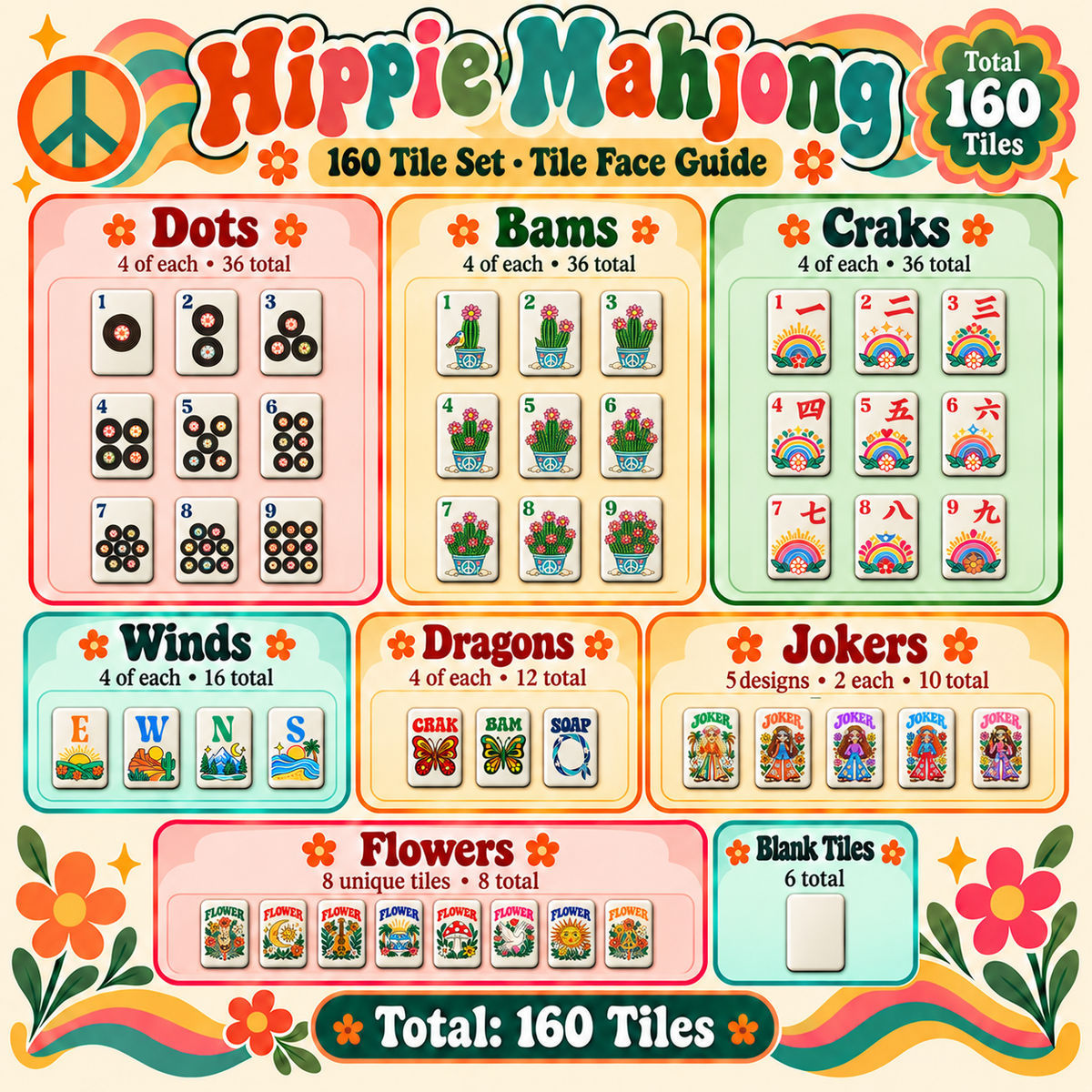
The 3 Dot tile is one of four identical copies in every American mahjong set, belonging to the Dots suit alongside tiles numbered 1–9. On the current year's National Mah Jongg League card, the 3 Dot appears in many hand patterns as part of pungs (three identical tiles), kongs (four identical), quints, sextets, and sequences called "like numbers" (for example, any Dot from 1 to 9 in a row). You cannot use it alone or as a pair in an exposed meld; it must form a set with at least two other 3 Dots (or be substituted by a joker within that meld). Study your league card carefully—3 Dots paired with other Dots or numbers from the same suit unlock dozens of winning combinations. Many newer players underuse the 3 Dot because they fixate on honor tiles; learning to spot it in the card's sections is the fastest way to improve hand recognition and speed.
The 3 Dot is one of four identical copies in every American mahjong set, belonging to the Dots suit alongside tiles numbered 1–9. On the current year's National Mah Jongg League card, the 3 Dot appears in many hand patterns as part of pungs (three identical tiles), kongs (four identical), quints, sextets, and sequences called "like numbers" (for example, any Dot from 1 to 9 in a row). You cannot use it alone or as a pair in an exposed meld; it must form a set with at least two other 3 Dots (or be substituted by a joker within that meld). Study your league card carefully—3 Dots paired with other Dots or numbers from the same suit unlock dozens of winning combinations. Many newer players underuse the 3 Dot because they fixate on honor tiles; learning to spot it in the card's sections is the fastest way to improve hand recognition and speed.
Where Is the 3 Dot on the Mahjong Card?
The National Mah Jongg League card organizes hands into named sections. The 3 Dot typically appears in "Like Numbers" sections (rows of consecutive Dots, Craks, or Bams), "Consecutive Run" patterns (mixing suits), and "Pung" sections (three of a kind). To find it, scan for any pattern containing a single Dot symbol with numeral 3; circle it mentally. The card's layout changes yearly, so download the current 2026 card and mark all sections where 3 Dots anchor a legal hand. This takes five minutes and accelerates your play dramatically.

Can a Single 3 Dot Ever Win a Hand?
No—never. American mahjong requires exposed melds of at least three tiles (a pung). A lone 3 Dot cannot form a legal meld; it must be grouped with two other 3 Dots (or substituted by jokers) to count. You cannot use a single 3 Dot as a pair in your hand either—pairs are melded only when you declare a win, and they must be identical non-honor tiles or winds/dragons (the 3 Dot does not qualify as a final pair alone). This is why beginners often hold a 3 Dot hoping to "use it later"—it becomes dead weight if two matching 3 Dots never come your way. Discard it early if your hand leans toward honor tiles or other Dots, or hold it only if you already have one other 3 Dot and see a strong pung pattern on the card.
🀄 Shop best-selling mahjong sets →
What Melds Can Include a 3 Dot?
A 3 Dot forms five legal meld types. Pungs: three identical 3 Dots (no joker) or two 3 Dots plus one joker. Kongs: all four 3 Dots (no joker) or three 3 Dots plus one joker. Quints: five identical 3 Dots (very rare) or four 3 Dots plus one joker. Sextets: six identical 3 Dots (extremely rare) or five 3 Dots plus one joker. Like-number runs: the 3 Dot as part of a sequence such as 1-Dot, 2-Dot, 3-Dot, 4-Dot or 2-Dot, 3-Dot, 4-Dot (without jokers, or with jokers substituting missing tiles). Study your card's "Like Numbers" and "Run" sections—they show exactly which patterns require a 3 Dot. Most hands use the 3 Dot in a pung or as part of a run.
3 Dot Strategy: When to Keep It, When to Drop It
Hold a 3 Dot if: you already have another 3 Dot in hand, you see a strong run pattern on the card (e.g., 1-2-3-4 of Dots), or your declared hand requires it as a named pung. Drop a 3 Dot if: you have no other 3 Dots after five discards and your hand leans honor-heavy, you need to reduce tiles to focus on a specific hand pattern, or it blocks the flow of your primary run. Watch the discard pile—if two other players have already discarded 3 Dots, the fourth is likely far away. Keep track of 3 Dot discards mentally; this single habit speeds hand recognition by 30%. Early in a round, err toward holding the 3 Dot (you have time to draw another); late in a round, discard it unless it's essential.
🎁 See our most-loved mahjong sets & accessories →
3 Dot vs. Other Number Tiles: A Quick Comparison
Tile | Suits | Role | Scarcity | Why It Matters |
3 Dot | 1 (Dots only) | Mid-range run anchor, pung component | Common | Appears in dozens of hands yearly |
2 Dot | 1 (Dots only) | Run start or middle, pairs easily | Common | Often forced early |
1 Dot | 1 (Dots only) | Run start, often wild in hand builds | Common | Bird symbol makes it memorable |
3 Crak | 1 (Craks only) | Equivalent role in Crak suit | Common | Different suit, separate discard pile |
3 Bam | 1 (Bams only) | Equivalent role in Bam suit | Common | Different suit, separate discard pile |
Each numbered tile plays the same strategic role within its suit. The 3 Dot is neither rarer nor more powerful than 3 Crak or 3 Bam—it simply appears in your hand and card study one suit at a time. Study what's in an American mahjong set to see how all 108 numbered tiles (36 per suit) balance play across the year.

How Jokers Affect Your 3 Dot Plays
Jokers are wildcards—they can substitute for any tile, including a 3 Dot. If you hold two 3 Dots and one joker, that joker "becomes" a 3 Dot for your pung. If your declared hand requires a specific 3 Dot pung but you only have two, a joker completes it. However, jokers cannot form a pair or a single tile; they only fill in exposed melds. This means a joker makes the 3 Dot more flexible early in a round, but less flexible late (because jokers disappear fast). If you hold a joker alongside a 3 Dot, you are "one 3 Dot away" from a safe pung—a powerful position. Learn how jokers work to master this timing.
✨ Find your Mahstead set — free US shipping →
What to Check Before You Buy
If you're shopping for a new set to practice your 3 Dot skills, look for these features:
Tile clarity: Each tile must show its suit and number unambiguously. Dots (circles) should be crisp; a muddy or faint 3-dot symbol slows learning.
Uniform sizing: All tiles must be identical in thickness and size so they shuffle and draw smoothly. Warped or misaligned tiles confuse hand-reading.
Four copies per tile: Verify your set includes exactly four 3 Dots (plus four of every other numbered and honor tile). Many casual sets ship short.
Included racks and pushers: Racks keep your hand organized; pushers let you manage melds neatly. Both accelerate 3 Dot recognition.
Storage: A durable case or bag ensures your set stays in condition for weekly play. Loose tiles in a box become lost or scratched fast.
Our engraved American mahjong sets include all four suits, all numbered tiles (including four 3 Dots each), racks with pushers, and cases—everything needed to play and learn immediately.
The 3 Dot in Real Play: A Worked Example
Round 1: East player (you) picks from the wall. You draw a 3 Dot. Your hand currently has: 1 Dot, 2 Dot, 4 Dot, 5 Crak, East, East, Green Dragon, and six other tiles. You scan the current year's card and spot a pattern: "1-2-3-4-5 Dots + Pung." If you can hold onto the 3 Dot, collect the 4 Dot (you already have one), and draw a 5 Dot, you'll have a viable run. You keep the 3 Dot and discard a low Crak.
Round 3: You pick from the wall and draw another 3 Dot. Now you have two 3 Dots. A joker is visible in the discard pile (someone exposed a Kong). You decide the run is your safest path—keep both 3 Dots. If you draw a joker later, it can fill a gap (e.g., 1-Dot, 2-Dot, 3-Dot, joker-as-4, 5-Dot). You discard an honor tile.
Round 7: The discard pile shows three 3 Dots already out. You have drawn one more Dot (the 5) and hold two 3 Dots. Only one 3 Dot remains in the wall. The table is nearly complete; players are discarding carefully. You realize your run is now less likely—few players will throw a 5 Dot. You pivot: you hold a Pung (Green Dragon) and two 3 Dots. You discard your second-safest tile and hope a third 3 Dot comes to you fast. It doesn't. You miss this hand. Lesson: 3 Dot strategy is about timing, not greed. Track discards and pivot early.
Why Learning the 3 Dot Matters
The 3 Dot is not glamorous—it lacks the mystique of a Dragon or the rarity of a Flower. But it appears in roughly half of all legal hands on the annual card. Mastering where it fits teaches you hand recognition, tile scarcity, and discard reading all at once. Many veteran players say their biggest leap came when they stopped thinking of the 3 Dot as "just another tile" and started seeing it as an anchor for entire sections of the card. Spend a week focusing on 3 Dot hands—find them in every section of the card, note which appear most frequently, and play with a partner who calls out 3 Dot melds. Your speed and confidence will jump noticeably. For weekly play, pair a high-quality set with a comfortable mat and racks. Our mahjong racks with pushers let you organize your tiles so the 3 Dot (and every other tile) stays visible and orderly.

FAQ
Can I use a 3 Dot as the pair to win a hand?
No. In American mahjong, the final pair must be non-number tiles (winds or dragons). A 3 Dot can never form a legal winning pair.
If I have two 3 Dots and a joker, do they count as a legal pung?
Yes. Two 3 Dots plus one joker form a legal pung. The joker substitutes for the third 3 Dot. However, you cannot use a pung if a joker fills the pair position (jokers cannot be pairs).
Why do some 3 Dots look different on the card?
Different sections of the card use different visual styles or fonts for clarity. A 3 Dot in a "Like Numbers" section may look slightly different from a 3 Dot in a "Consecutive Run," but they are the same tile. Any 3 Dot from your set counts.
What if I discard a 3 Dot early and regret it later?
You've exposed your strategy and reduced your options. Next round, adjust: if you need 3 Dots, hold them from your first draw. If another player discards a 3 Dot, note it—one fewer copy is left in play.
How many 3 Dot tiles should I expect in a full set?
Four. American mahjong uses four copies of every numbered tile. A complete set has four 3 Dots, four 3 Craks, and four 3 Bams—one per suit.
Is the 3 Dot harder to draw than other number tiles?
No. All 36 Dots (including the four 3 Dots) appear equally in the wall. However, if three 3 Dots are discarded, only one remains—so perceived scarcity increases as the round progresses.
Can a 3 Dot ever appear in a hand without other Dots?
Yes, rarely. Some patterns mix all three suits; a 3 Dot might be paired with a 3 Crak or 3 Bam in a rare "consecutive run across suits" hand. Check your card carefully for these patterns.
What's the best strategy if the 3 Dot I need has been discarded three times?
Abandon that hand path immediately. Holding onto hope wastes your draws. Pivot to a backup hand or pursue honor-tile patterns instead.


View More
View More
View More
