
How to Play Japanese Mahjong: Rules, Tiles & Winning Hands
Last updated: Nov 23, 2026
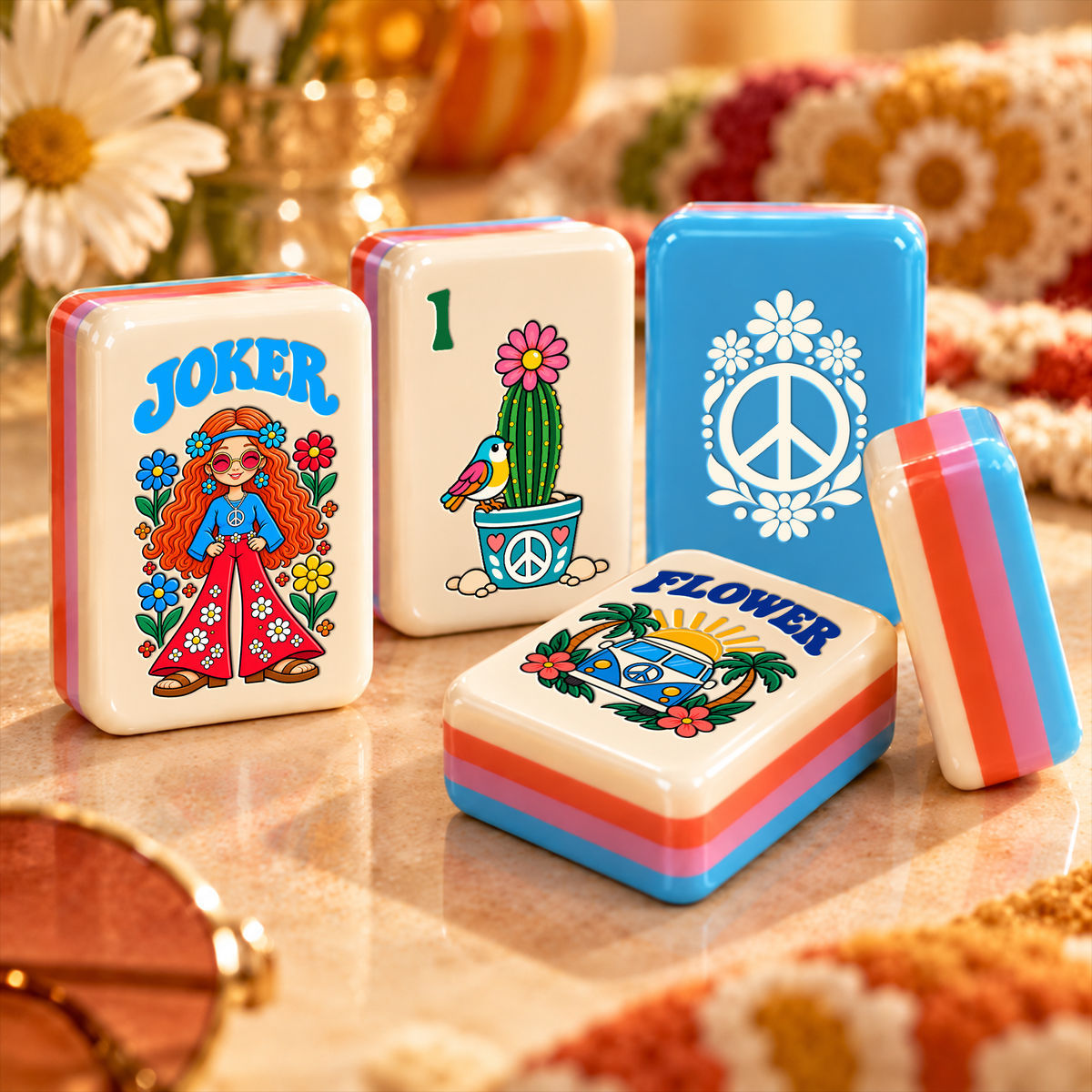
Japanese mahjong, also called Riichi mahjong, is played with 136 tiles across three suits (Bams, Craks, Dots numbered 1–9) plus 16 winds, 12 dragons, and 8 flowers. Players draw and discard tiles to form melds: pungs (three identical), kongs (four identical), chows (sequences like 2-3-4 of one suit), and pairs. The key difference from American mahjong: you declare Riichi (readiness) before winning, announcing you need only one specific tile. Each round lasts 15–30 minutes. A hand requires 14 tiles: four melds of three tiles each plus a pair. Japanese sets are compact; winners score based on hand difficulty and win type. Unlike American mahjong, chows are playable and called, jokers don't exist, and the National Mah Jongg League card is not used. Mahstead carries best-selling American sets, but Japanese play requires a dedicated 136-tile Japanese set purchased separately from specialist retailers. 🀄 Shop best-selling mahjong sets →
What tiles do Japanese mahjong sets contain?
A Japanese mahjong set holds exactly 136 tiles: three suits (Bams, Craks, Dots) with numbers 1–9, four copies each (108 total); 16 winds divided equally among North, East, South, West; 12 dragons split into Red, Green, White; and 8 flowers labeled 1–4 and seasons 1–4. There are no jokers, no blanks, and no substitutes. The tile thickness and size differ slightly from American sets—Japanese tiles are typically smaller and lighter, designed for faster dealing and the quick pace of Riichi play. Unlike American mahjong's 152-tile foundation, Japanese sets are lean and standardized across Japan, Southeast Asia, and competitive clubs worldwide.

How do you form winning hands in Japanese mahjong?
A winning hand needs 14 tiles: four melds (each three or four tiles) plus one pair. Melds come in three forms: pungs (three identical tiles—e.g., three 5 Dots), kongs (four identical—e.g., four East winds), and chows (three consecutive in one suit—e.g., 3-4-5 Bams). You may also hold tiles in your closed hand (concealed). The winning tile can come from the discard pile (called a win) or from the draw pile (a self-drawn win, which scores higher). A pair is always two identical tiles. Each meld type scores differently; a self-drawn hand from concealed tiles scores more than an exposed win. Sequences (chows) are fundamental to Japanese play and cannot be held privately like they can in some American variants—if you call a discard to complete a chow, the meld becomes visible.
What does Riichi mean and when do you declare it?
Riichi is a declaration of readiness: you announce that your hand needs only one specific tile to win, and you lock your discards face-up on the table as proof. You may declare Riichi only when you have nine points or more in your concealed hand and have discarded in turn. Once declared, you cannot change your hand except to draw and discard—if you draw the winning tile, you take it immediately. Declaring Riichi doubles your final score if you win, but if another player discards the tile you need and you don't take it in turn, you lose that chance and stay in Riichi until someone wins the round. It's a high-stakes announcement: other players know you're close and will play defensively. Riichi is not used in American mahjong; it's unique to Japanese (and some Chinese variants) and adds tactical depth.
How does Japanese mahjong scoring differ from American mahjong?
Japanese mahjong uses a point system based on hand complexity and win type. Scoring begins with a base value called "han" (levels of hand difficulty) multiplied by "fu" (tile combinations and wait type). A self-drawn win scores 50% more than a discard win. Declaring Riichi doubles points if you win. Hands range from 1-han (basic patterns) to 13-han (extremely rare). Americans familiar with the NMJL card system will find Japanese scoring mechanical and number-driven rather than pattern-card based. There is no "closed hand" or "open hand" designation as in American play; all concealed tiles count toward scoring. Round winds and seat positions affect who pays whom—East (dealer) pays differently than South. Scoring can seem complex initially, but once learned, allows for rapid calculation and keeps all players engaged between rounds.
How does the Charleston differ in Japanese mahjong versus American play?
Japanese mahjong has no Charleston. Play begins with a deal: the dealer draws 14 tiles, other players draw 13 each. The dealer then discards first. American mahjong, by contrast, uses the Charleston—a three-stage tile-passing ritual before play. In Riichi, players start the round immediately upon seating and organize their tile racks. The lack of a Charleston means Japanese rounds start faster and keep momentum high; players have less time to study opponent hands before play. For players used to American's strategic pre-game exchanges, Japanese play feels more reactive and skill-dependent on live reads and discards. Wall draw order is also different: Japanese play uses a fixed rotation, while American uses the broken-wall method based on dice. This simplification is intentional—Japanese mahjong prioritizes speed and scoring awareness over elaborate setup.
Quick Comparison: Japanese vs. American Mahjong
Feature | Japanese (Riichi) | American |
Tile count | 136 tiles | 152 tiles + 8 jokers |
Chows allowed | Yes, called and exposed | No chows ever |
Jokers | None | 8 per set |
Riichi declaration | Yes, high-reward readiness call | No equivalent |
Hand source | Current play only | NMJL card each year |
Scoring system | Han/Fu (points) | Pattern-card based |
Round duration | 15–30 minutes | 20–45 minutes |
Charleston setup | None | Three-stage exchange |
Dealer bonus | Yes, East pays/receives more | Yes, based on hand |
Pairs allowed | One pair per hand | One pair per hand |

Can you play Japanese mahjong with an American tile set?
Technically, no. American sets contain jokers, extra blank tiles, and are designed for 152-tile play with no chows. Japanese Riichi requires exactly 136 tiles, no jokers, and all tiles must be playable in sequences. You could use American tiles as a temporary substitute if you remove jokers and set aside extra tiles, but suit faces, size, and weight differ—dealing becomes awkward, and play loses fluidity. American sets are optimized for the NMJL card pattern system; Japanese sets are lean and rapid. If you want to learn Riichi seriously, invest in a proper 136-tile Japanese set from a specialist. The tile geometry, heft, and clicking sound of authentic Japanese tiles are integral to the experience.
🎁 See our most-loved mahjong sets & accessories →
Key differences in hand-building strategy
In Japanese mahjong, you must think in terms of "waits"—the tiles that complete your hand. Early on, focus on building a flexible wait: multiple tiles that could finish your hand reduce your risk of being stuck. Americans transitioning from the NMJL card system often overvalue specific patterns; in Riichi, adapt your hand on the fly based on discards and opponent moves. Declaring Riichi is aggressive: do it only when you have a solid wait and a safe discard sequence. Don't declare Riichi on a loose wait (many possible tiles) because other players will assume your wait is tight and discard cautiously. Read the discard pile: stacked 3s and 5s mean players are building toward 2-3-4 chows, so holding those numbers is risky. Self-drawn wins are worth aiming for; they score 50% higher and are harder for opponents to block. Speed matters—Japanese rounds move fast, and hesitation signals weakness.
What to check before you buy a Japanese mahjong set
Tile count: Confirm the set has exactly 136 tiles, not 144 or 152.
No jokers: Japanese sets never include jokers; American sets always do.
Chow-friendly faces: Check that Craks and Bams are clearly printed so 1-2-3 sequences are easy to spot.
Dealer marker: Ensure a clear East wind or dealer button is included for round rotation.
Rack compatibility: Some Japanese tiles are narrower; test your mahjong racks fit before committing.
Language: Confirm tiles use either Japanese numerals or Arabic numbers you can read quickly.
Thickness: Lighter tiles (< 6 grams each) suit fast-paced Riichi; heavier tiles suit leisure play.
✨ Find your Mahstead set — free US shipping →
Getting started: a beginner's checklist
[ ] Learn the 136-tile composition (three suits, winds, dragons, flowers).
[ ] Memorize the four meld types: pung, kong, chow, pair.
[ ] Practice forming hands on paper before playing live.
[ ] Study Riichi rules: when you can declare, what it locks, how points double.
[ ] Play a practice round with one experienced player teaching.
[ ] Download a scoring calculator app to speed up point tallies.
[ ] Join a local Riichi club or online group to play weekly.
[ ] Read hands aloud after each round to build recognition.
[ ] Watch one tutorial video on YouTube showing live play.
Where to find a Japanese mahjong community
Search online Riichi communities, Discord servers, and meetup boards in your city. Many universities host mahjong clubs open to non-students. Libraries and community centers occasionally run Asian game nights; ask if Riichi is offered. Larger cities have dedicated Japanese cultural centers or Asian social clubs; call ahead to confirm mahjong play. Online platforms allow asynchronous and real-time Riichi play with opponents worldwide. Start by observing a live game; rules clarify fastest when you see tiles flow. Once you join a weekly table, learning accelerates—experienced players spot your mistakes and explain scoring on the fly. The barrier to entry is low; the community is welcoming.

FAQ
Is Japanese mahjong harder than American mahjong?
No—different, not harder. Riichi scoring is more formula-based; American card patterns are more visual. Japanese rounds are faster, so decision time is tighter. Both require strategy; choose based on play style. American players often pick up Riichi in 3–4 weeks of weekly play.
Can I use American mahjong rules on a 136-tile set?
No. American play requires 152 tiles, jokers, and no chows. A 136-tile set lacks both the tile count and jokers. Use the correct tile set for each variant to avoid confusion and dead rounds.
What's the minimum number of players for Japanese mahjong?
Always four players. Japanese mahjong has no official 2- or 3-player variant (American has optional rules for those counts). With fewer than four, the game breaks; wind rotations and wall dynamics fail.
How long does a Japanese mahjong session last?
A single round (one dealer cycle, typically 4 hands) takes 15–30 minutes. A full session is usually 8–12 rounds, totaling 2–4 hours. Americans used to 45-minute games will notice Riichi is snappier.
Do I need to memorize all 136 tiles before playing?
No. Start by learning the three suits (1–9 of each), winds, dragons, and flowers. After one live session, recognition becomes automatic. Mahstead's best-selling sets are designed for American play, but the tile fundamentals (suit names, numerals) transfer to any variant.
What happens if someone discards the winning tile during Riichi?
If you've declared Riichi and another player discards your wait tile, you immediately claim it and win. You don't call it out—you simply take it and turn your hand face-up. Scoring then proceeds. If you miss the turn and don't take it, you stay in Riichi and wait for another cycle.
Are there online Japanese mahjong games I can learn from?
Yes—platforms like Tenhou and Mahjong Soul offer free online Riichi play with built-in tutorials. Play against AI or humans. Scoring is automatic, so you focus on strategy. Most have English interfaces and beginner-friendly rooms.


View More
View More
View More
