
How to Play Classical Chinese Mahjong: Rules & Setup Guide
Last updated: Nov 23, 2026
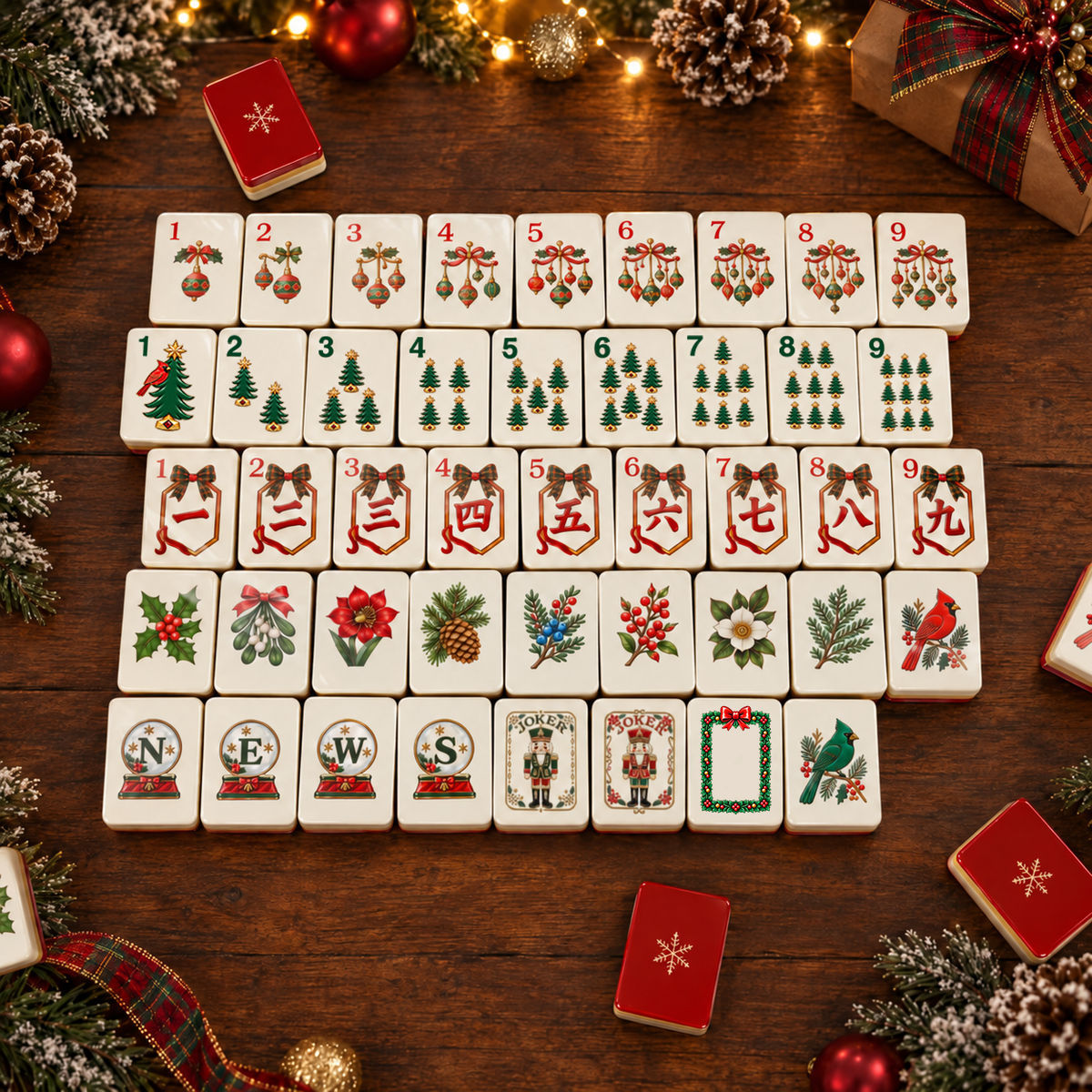
Classical Chinese mahjong uses 144 tiles—three numbered suits (Bams, Craks, Dots: 1–9, four copies each) plus winds, dragons, and flowers—and plays with four people drawing and discarding to form winning patterns. The core difference from American mahjong is the legal play of chows: three consecutive numbered tiles in the same suit (e.g., 3–4–5 Dots). A win requires 14 tiles arranged as four melds (pung, chow, or kong) plus a pair; most classical hands follow one of several standard patterns. Games last 10–30 minutes per round, typically best-of-four. Unlike American play, classical Chinese mahjong has no official League card—each region varies rules slightly—and no jokers are used in standard play.
What tiles are in a classical Chinese mahjong set?
A standard 144-tile classical set contains three suits: Bams (bamboo sticks, 1–9), Craks (characters, 1–9), and Dots (coins, 1–9), with four identical copies of each—totaling 108 suited tiles. The remaining 36 are honors: four each of North, East, South, West winds; four Red dragons (⚔), four Green dragons (生), four White dragons (白, called "Soap"); and eight flowers (marked 1–8, often split as Plum/Orchid/Bamboo/Chrysanthemum for each player). Some regional sets add an extra blank or two, but classical play uses all 144 tiles in active rotation. The tile count and composition are fixed across nearly all classical variants, though regional rulesets may weight certain hands differently.
🀄 Shop best-selling mahjong sets →

How does a classical Chinese hand win?
A winning hand in classical Chinese mahjong contains exactly 14 tiles: four melds plus one pair. A meld is either a pung (three identical tiles), a chow (three consecutive numbered tiles, same suit), or a kong (four identical tiles). The pair must be two identical honor tiles or a numbered pair. For example: three 5 Dots (pung) + 2–3–4 Craks (chow) + East wind + East wind + East wind (pung) + 7–8–9 Bams (chow) + Red dragon + Red dragon (pair). That's four melds plus a pair = 14 tiles, a legal win. A player wins by completing their hand through a draw or by claiming a discard ("hu" or "win"), depending on the variant rules in use at your table.
What's the difference between chows, pungs, and kongs?
A chow is three consecutive numbered tiles in the same suit: 1–2–3 Bams, 5–6–7 Dots, 9–9–9 plus next suit's 1 (no, that's wrong—chows never span suits). A pung is three identical tiles: three East winds, three 4 Craks, three Red dragons. A kong is four identical tiles and counts as a meld but also triggers a replacement draw, since you've used an extra tile. In classical play, chows can be called from any player's discard (you shout and take it immediately), whereas in some American-influenced variants, chows cannot be exposed. Pungs and kongs can always be called and exposed. Once you understand this distinction, hand-building strategy shifts entirely: classical players hunt for chows (sequences) to reach their goal quickly, while American players avoid sequences entirely.
How does turn order and discarding work?
The game begins after distributing tiles: East (dealer) draws 14 tiles; North, West, and South each receive 13. East goes first, drawing one additional tile from the wall, then discarding one unwanted tile face-up into the center discard pile. North then draws from the wall, plays one tile. West, South, and East cycle through draws and discards. Any player may claim (call) a discard to form a chow, pung, or kong immediately—interrupting the normal turn sequence. Once you claim a discard and meld it, your turn ends; normal turn order resumes with the next player drawing from the wall. If no one claims a discard, it stays in the pile and the next player draws from the wall. This continues until someone completes a winning 14-tile hand.
How does scoring work in classical Chinese mahjong?
Classical Chinese scoring is deeply regional: some play points (每局计分), others play money, and hand values vary. A basic system awards points for complexity: a self-drawn win scores higher than a claimed-discard win; "all one suit" (清一色) scores much higher than mixed colors; "all terminals and honors" (字一色) is the ultimate hand. Each region—Cantonese, Shanghai, Taiwanese, Riichi (Japanese)—has different point tables and doubling rules. Some use a base of 1,000 points per hand; others use 4–8 point increments per tile and multiply by doubling factors. A common beginner framework is: discard-claimed win = base; self-drawn win = double; each double (pair of dragons, all one suit, etc.) = multiplication. To play accurately, confirm the house rules with your group before the first hand.
🎁 See our most-loved mahjong sets & accessories →

Classical vs. American mahjong: which should you learn first?
Aspect | Classical Chinese | American |
Tiles | 144 (no jokers) | 152 + 8 jokers |
Sequences (chows) | Legal, can be called | Not played |
Pair rules | Any two identical tiles | Specific pair types per card |
Hand reference | House rules vary by region | Official League card (yearly) |
Learning curve | Flexible, rule-light | Stricter, card-dependent |
Game length | 10–20 min per round | 15–45 min per round |
Best for | Casual, family play | Competitive groups, tournaments |
If you're teaching absolute beginners and want fastest entry, classical Chinese is simpler: fewer tiles, no joker algebra, and hand patterns emerge naturally from sequences. If you play in a club setting or enjoy competition, American mahjong's structure and card-based hands reward study and memory. Most players find classical easier emotionally—there's less to memorize—but American more satisfying strategically—the card adds puzzle-solving depth.
What are common mistakes beginners make?
Tile counting errors: Beginners forget to count all 14 tiles in their hand before declaring a win; classical play requires exactly 14. Count aloud and confirm with one other player before calling "hu."
Confusing chow directions: A chow must be three consecutive tiles in ascending order: 1–2–3 (legal), 3–2–1 (illegal). You cannot wrap: 9–1–2 (illegal, no wrap-around).
Calling too slowly: In classical play, once a discard hits the table, the next player begins their draw. If you want to claim it for a meld, call immediately—hesitation forfeits your claim.
Forgetting the pair: New players build four perfect melds and then realize they have no pair. Review your hand after each draw: four melds plus one pair = win.
Not confirming house rules: Before play, ask: Do flowers count as a meld or bonus tiles? Can you call a discard after the draw-disciple cycles? Does East play twice (as both role and position)? Different tables, regions, and even family traditions vary widely.
How to choose a set if you're learning classical Chinese
A classical set needs clean, readable tiles—unambiguous number and suit markings, since you're calling hands quickly without joker aids. Look for sets with embossed or raised numbers, not printed-on designs that fade with shuffling. Medium-weight acrylic or bamboo tiles work well; very thin tiles slip and tilt easily. Include mahjong racks with pushers to keep your 14 tiles organized and hidden from opponents—a core skill in classical play. Many hosts use a mahjong mat to mark discard piles and protect the table; a felt or fabric mat makes tiles easier to read and quieter to shuffle. Store everything in a durable travel bag or case if you're moving your set between homes or hosting rotating games.
✨ Find your Mahstead set — free US shipping →
What to check before you buy
Tile visibility: Can you read all suit marks and numbers from arm's length? Print clarity matters in fast play.
Weight & balance: Do tiles shuffle smoothly without sticking or jamming? Cheap sets warp or have uneven finish.
Completeness: Does the set include 144 tiles, wind/dragon/flower tiles, and a wall rack or tray? Some sets omit flowers or include blanks you won't use.
Regional rules: If you're learning from a friend or club, ask which classical variant they play (Cantonese, Shanghai, Taiwanese, Riichi). Rules differ enough that learning the wrong hand patterns wastes time.
Space & hosting: Do you have table space for four racks + a discard pile + a tile wall? Classical play needs more room than solitaire or two-player practice.

FAQ
Can I use an American mahjong set to play classical Chinese?
No. American sets include 8 jokers and 152 tiles; classical play requires exactly 144 tiles and forbids jokers. The tile face designs and suit names also differ enough to confuse new players. Get a dedicated classical set.
How many people can play classical Chinese mahjong?
Standard classical mahjong is four-player only. Some regional variants support three or two players with rule tweaks (removing certain flowers, adjusting the wall), but the core game is designed for four equal seats.
Do I need to memorize winning hands like American mahjong?
No. Classical Chinese mahjong has no official hand list—you memorize hand patterns your group recognizes (all one suit, all terminals, etc.) and the point values. It's far more flexible than the rigid League card in American play.
What's the fastest way to learn classical Chinese mahjong?
Play 5–10 hands with experienced players and ask for corrections after each win. Classical rules are simple enough that hands teach themselves. Record any house-rule variations your group uses and review them before the next session.
Can I switch between classical and American mahjong easily?
Yes, but expect 1–2 sessions of confusion. American players struggle with chows at first; classical players over-focus on pungs. The tile counts and winning logic differ enough that your brain treats them as separate games after a few rounds.


View More
View More
View More
