
How to Deal in Sichuan Mahjong: Rules and Setup
Last updated: Nov 23, 2026
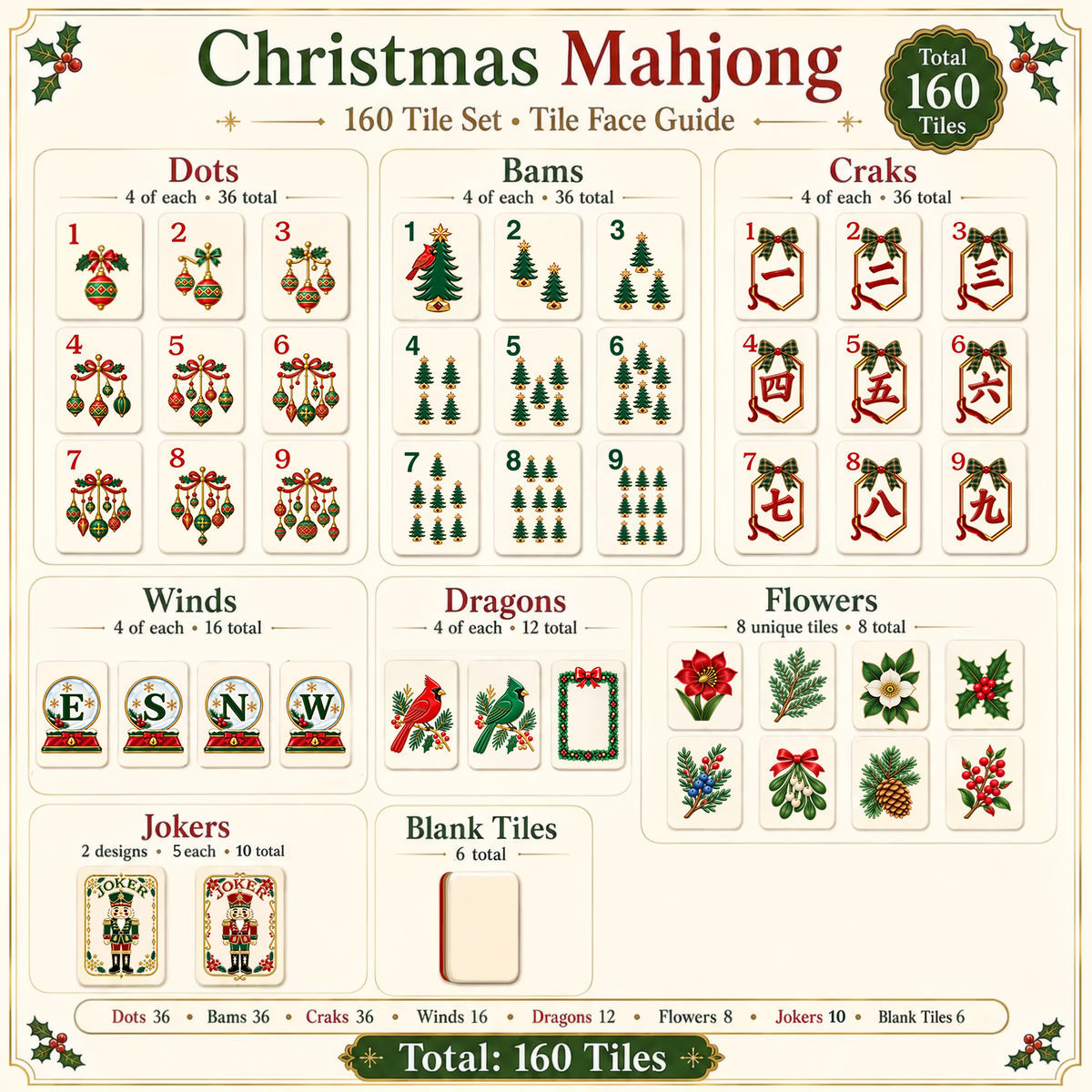
Sichuan mahjong deals tiles in a specific pattern: the dealer (庄) draws 14 tiles; each other player draws 13. Tiles are drawn from the wall in sets (usually 4 at a time, called a "quad") moving counterclockwise around the table. Unlike American mahjong's pre-shuffled 152-tile sets with flowers and winds, Sichuan uses a 108-tile deck (Bams, Craks, Dots: 1–9, four copies each) with no honors or flowers. The dealing ritual takes 30–60 seconds per round. Sichuan play emphasizes speed and hand concealment—tiles stay mostly hidden until melds are declared. Mistakes in dealing typically involve miscounting the wall or breaking the wall in the wrong seat; players using a best-selling mahjong set designed for American play must adapt the component count mentally, since Sichuan requires only the suited tiles.
What tiles go in the Sichuan wall before dealing?
Sichuan mahjong begins with a shuffled 108-tile deck: three suits (Bams, Craks, Dots), numbered 1–9, four identical copies of each. No winds, dragons, flowers, or jokers appear in classic Sichuan. Players arrange 108 tiles face-down, then form a long rectangular wall by stacking pairs in two rows—left and right—creating 54 pairs. The wall never moves during dealing; instead, players break in and draw sequentially.

How does the dealer initiate the draw sequence?
The dealer (庄) sits in a fixed position. Before dealing, another player rolls two or three dice to determine where the wall breaks. If dice show 7, count seven stacks clockwise from the dealer's right; break the wall there. The dealer then draws 14 tiles (four quads of four tiles each, plus two singles), placing them in hand and sorting by suit and number. Each non-dealer player draws 13 tiles in the same quad pattern. The dealer plays first—either discarding or declaring a meld—giving them a slight advantage.
What is the correct quad-drawing method step-by-step?
Step 1: After breaking the wall, the dealer's right-hand neighbor draws one complete quad (four tiles stacked together) from the left side of the break and places it in their rack.
Step 2: The dealer draws one quad immediately.
Step 3: The player to the dealer's right draws one quad.
Step 4: The last player draws one quad. This round-robin continues until each non-dealer player has drawn 13 tiles and the dealer has 14.
Step 5: No tiles are shuffled mid-game; draws proceed directly from the wall during play.
Players often fumble this by drawing non-quad stacks or misaligning the break—use a table with clear space and a sturdy mahjong mat to keep the wall stable and visible.
How does Sichuan's dealing differ from American mahjong?
Aspect | Sichuan | American |
Total tiles | 108 (three suits only) | 152 (three suits + winds, dragons, flowers, jokers) |
Dealer's opening hand | 14 tiles | 13 tiles (in some variants) |
Non-dealer opening | 13 tiles each | 13 tiles each |
Draw method | Quads of 4 tiles from wall | Individual tiles or sequences, no quads |
Wall formation | Player-determined break via dice | Pre-arranged wall rotation |
Honors/flowers | None | Required per National Mah Jongg League card |
Hand concealment | Tiles mostly hidden; melds only shown when declared | Many melds exposed during play |
The Sichuan method prioritizes dealer advantage and wall integrity; American mahjong prioritizes visible meld strategy and year-round hand validity.

What are the most common dealing mistakes and how to fix them?
Mistake 1: Breaking the wall incorrectly. Players sometimes count tiles instead of stack pairs. Fix: Stack the wall as 54 pairs (left and right rows), then count stacks, not individual tiles, when breaking.
Mistake 2: Dealer drawing first. In many Sichuan variants, the player to the dealer's right draws first, then the dealer. Fix: Check your regional rule before the first draw. Some play the dealer draws last.
Mistake 3: Miscounting the wall during a game. If the wall runs short before all players declare, someone drew extra tiles. Fix: Count wall pairs aloud before breaking: "54 pairs—go."
Mistake 4: Leaving a non-quad stack in the wall. If the wall doesn't break evenly into quads, someone discarded a tile back into the wall. Fix: Always return discards to the discard pile, never the wall.
Mistake 5: Not verifying hand size. After all opening draws, dealer should hold 14, others 13. Fix: Count your hand silently before playing. If counts don't match, re-deal.
These errors slow play and create disputes. Hosting weekly games with a clear, printed rule sheet and a reliable mahjong rack with pushers keeps hands organized and prevents miscounts.
🀄 Shop best-selling mahjong sets →
Why does the wall break matter in Sichuan dealing?
The wall break determines fairness. Rolling dice to break the wall randomizes where players draw from, preventing one player from habitually getting "good" tiles from a predictable position. In American mahjong, the wall rotates among players each hand; in Sichuan, the break varies within a single hand. A misplaced break can favor one player all session if not corrected. Always roll openly, announce the break number aloud, and have a neutral player confirm the break point. A wide, flat mahjong mat gives you the surface to mark and verify the break clearly.
What to check before you buy a set for Sichuan play
Tile count: Confirm the set includes 108 playable tiles (three suits, 1–9, four copies each). Standard Mahstead sets contain 160 tiles—suited to American mahjong—so you'll have extra tiles. This is not a problem; simply set aside the winds, dragons, flowers, and jokers before play.
Tile size and weight: Larger tiles (about 1 inch square) are easier to align into quads and stack for the wall. Check the product description for dimensions.
Material durability: Acrylic tiles hold up better than bamboo if you're shuffling and stacking daily. They also resist moisture from tea or condensation.
Rack design: A rack with pushers helps organize your 14 tiles neatly so you don't accidentally flip or lose tiles during the game.
Storage: After each session, store tiles in a sturdy bag or case. Sichuan games move fast; you don't want missing tiles mid-round.
🎁 See our most-loved mahjong sets & accessories →

FAQ
Can I use an American mahjong set to play Sichuan?
Yes. American sets include the 108 Sichuan tiles (three suits, 1–9) plus extras. Before play, set aside winds, dragons, flowers, and jokers. You'll have the 108 tiles you need.
Who decides the dealer in Sichuan?
Typically, the player with the highest dice roll becomes the dealer (庄) for that hand. Some groups rotate dealer each hand; others keep the same dealer for a full session and rotate only if someone wins.
How often does the wall break change?
The wall breaks anew each hand. After one hand ends, tiles are reshuffled, restacked into a new wall, and a new break is rolled—so the break position changes nearly every round.
What if the wall breaks in the middle of a tile pair?
Stack pairs carefully before rolling the dice to break. Count stacks aloud (54 pairs), then roll. If you land on an odd tile, recount; one pair was likely misaligned. Always restack and re-roll rather than draw a single orphan tile.
Is the dealer's extra tile (14 vs. 13) a permanent advantage?
Not always. Sichuan rules vary by region. Some give the dealer an extra tile; others make the dealer's hand 13 tiles and the player to the right starts with 14. Check house rules before game one.
Do I need special tiles for Sichuan, or is any mahjong set okay?
Any set with Bams, Craks, and Dots works. Mahstead's best-selling sets are designed for American mahjong but include all 108 Sichuan tiles, making them practical for both variants.
How do I know if I've drawn all my opening tiles correctly?
Dealer: count to 14. Non-dealers: count to 13. If totals don't match (e.g., dealer has 13, someone has 14), stop and re-deal. A mismatch usually means a miscount at the quad stage. ✨ Find your Mahstead set — free US shipping →


View More
View More
View More
