
Guangdong Mahjong: Rules, Tiles & How It Differs From American
Last updated: Nov 23, 2026
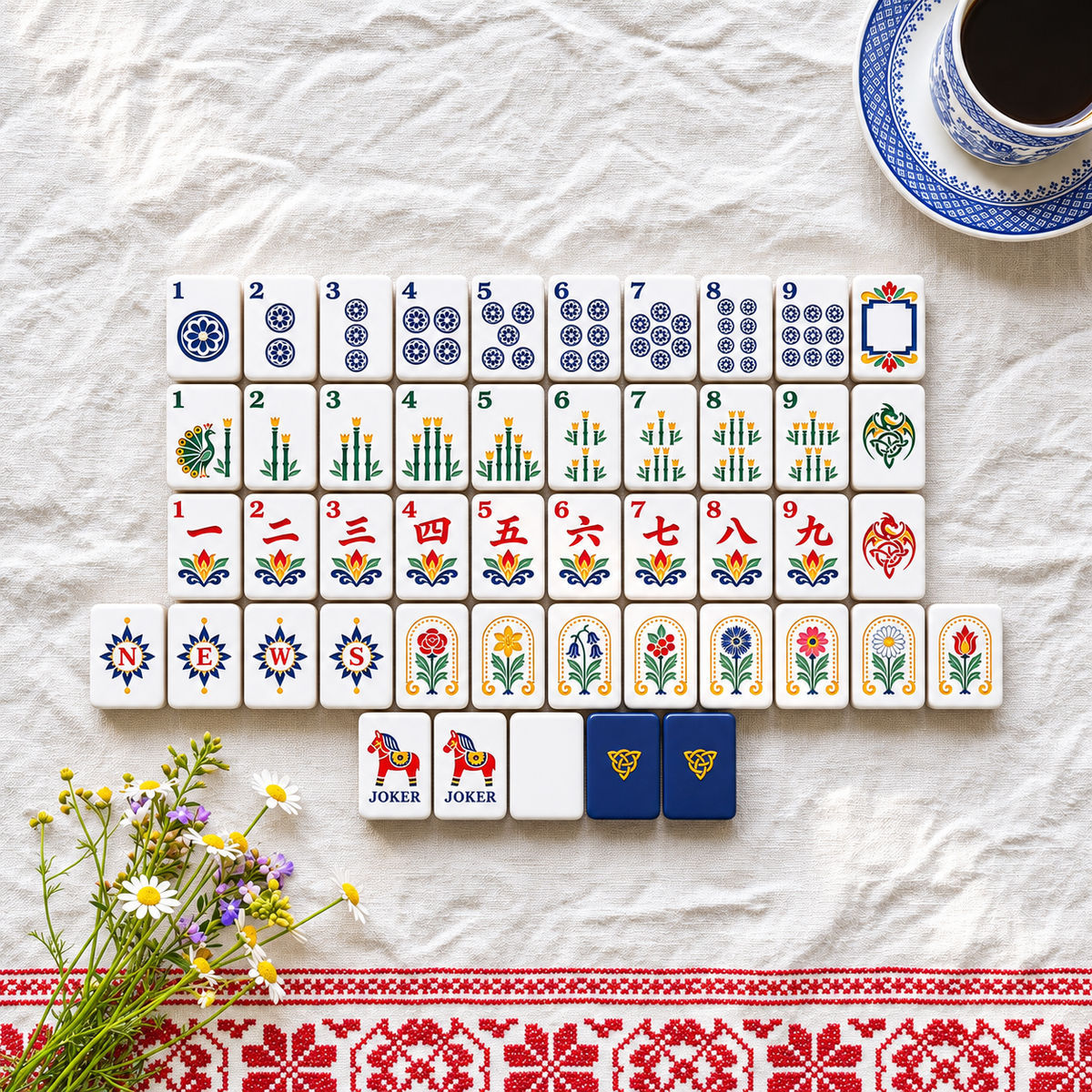
Guangdong mahjong (also called "Cantonese" mahjong) uses a compact 108-tile deck—three suits (Bams, Craks, Dots) numbered 1–9 in sets of four, plus 16 winds and 8 dragons; no flowers or jokers. Players draw and discard rapidly in turns lasting 2–3 seconds, aiming to form melds (pungs, kongs, chows, pairs) into a complete hand. A winning hand requires 14 tiles: four melds plus a pair. Unlike American mahjong's rigid annual card-based hands, Guangdong play uses flexible winning patterns and allows "self-drawn" (winning on your own draw) or "robbed" (winning by taking a tile just claimed by another player). The game moves fast—a typical round concludes in 15–20 minutes. Many Guangdong players begin with American mahjong for structure, then switch to Guangdong for speed and spontaneity. We host players who play both styles weekly, and the tile mechanics transfer well once you understand the hand-building differences.
Guangdong mahjong is a fast, high-action variant played across southern China with a 108-tile set, rapid discards, and looser winning conditions than American mahjong. Players draw and discard rapidly in turns lasting 2–3 seconds, aiming to form melds (pungs, kongs, chows, pairs) into a complete hand. A winning hand requires 14 tiles: four melds plus a pair. Unlike American mahjong's rigid annual card-based hands, Guangdong play uses flexible winning patterns and allows "self-drawn" (winning on your own draw) or "robbed" (winning by taking a tile just claimed by another player). The game moves fast—a typical round concludes in 15–20 minutes. Many Guangdong players begin with American mahjong for structure, then switch to Guangdong for speed and spontaneity.
🀄 Shop best-selling mahjong sets →
What tiles does a Guangdong set contain?
A Guangdong mahjong set holds 108 playable tiles, all used in every game. The three suits each run 1–9, with four copies of each number (36 tiles per suit = 108 total). Winds (N, E, W, S) number 16 tiles, and dragons (Red, Green, White) total 12. Unlike American sets, Guangdong decks exclude flowers, jokers, and blanks entirely. The compact size means faster shuffling, dealing, and play. Most Guangdong sets are carved or stamped bamboo or bone with simple markings; some include plastic or resin alternatives. When you own an American 160-tile set, you have four extra jokers and blanks beyond the 152-tile play count—Guangdong play would use only the 108-tile core, leaving many tiles unused.

How does hand-building differ from American mahjong?
American mahjong requires hands from that year's National Mah Jongg League card—fixed patterns you must match exactly. Guangdong mahjong lets you form any valid combination of four melds plus a pair, giving you thousands of winning hand options every game. A meld in Guangdong is either a pung (three identical tiles), a kong (four identical), or a chow (three consecutive numbers in the same suit, e.g., 2–3–4 Bams). Pairs must be two identical tiles. You win as soon as you hold 14 tiles arranged this way. American mahjong also allows quints and sextets (called exposures when claimed from another's discard), but Guangdong play rarely uses them outside specific house rules. This freedom means Guangdong play rewards fast pattern recognition and reads on your opponents' discards; American play rewards memorizing card combinations and strategic exposures over multiple hands.
What's the speed and pace like?
Guangdong mahjong is built for velocity. Each player's turn lasts 2–3 seconds: draw one tile, discard one. No long pauses for strategy. A complete game of four rounds (a "session") finishes in 60–90 minutes, versus American play which often runs 2–3 hours for the same duration. The rapid tile flow means you stay alert; a single discard can trigger a meld claim (pung, chow, or win) from any player at the table, and priority goes to the closest winning opportunity (win > kong > pung > chow). If no one claims a discard within 2 seconds, it's dead and play continues. This pace suits players who enjoy high-energy, reactive play over methodical hand planning. New Guangdong players often find American mahjong feels slow by comparison, and vice versa—American players value the structure that Guangdong play abandons.
How does winning and scoring work?
In Guangdong mahjong, you win when you achieve a complete 14-tile hand (four melds + pair) via two methods: self-drawn (you draw the winning tile from the wall) or claimed (you call "win" when another player discards your final tile). Self-drawn wins typically score higher (often doubling the payout). Scoring systems vary widely by region and house rules—some use point multipliers based on tile rarity (honor tiles, dragons) or hand complexity, others use flat bets. A common system assigns "points" per player (e.g., 1 point for a simple win, 2–4 for self-drawn or all-honor hands), and losers pay the winner. Unlike American mahjong, which uses elaborate scoring cards tied to specific named hands, Guangdong scoring is simpler and negotiable. Before each session, players agree on the point value and multiplier rules. Most home games use small stakes (pennies or nominal chips) to keep play social. Serious competitive play uses standardized scoring rules set by regional organizations.
What are the key differences from American mahjong?
Feature | American Mahjong | Guangdong Mahjong | Impact on Play |
Tile count | 152 playable + 8 jokers | 108 tiles (no extras) | Guangdong is compact, faster shuffle |
Hand source | Fixed annual card patterns | Any combo of 4 melds + pair | Guangdong offers more freedom, faster decisions |
Sequences (chows) | Cannot be called or exposed | Can be called and exposed | Guangdong play is more fluid, reactive |
Winning draw | Must match card hand exactly | Any valid complete hand | American requires memorization; Guangdong rewards reading opponents |
Turn speed | 10–30 seconds typical | 2–3 seconds (rapid) | Guangdong demands quick reflexes and attention |
Jokers | 8 included, used in hands | None | American hands can hide wildcards; Guangdong is tile-literal |
Flowers | 8 included (optional claim) | None (always in play) | American has a timing decision; Guangdong eliminates it |
Typical game duration | 2–3 hours | 60–90 minutes | Guangdong fits shorter sessions |
Scoring | Complex card-based points | Simple regional/house rules | American is standardized; Guangdong is flexible |
This table shows why players often choose one variant over the other: American mahjong suits slower, strategic play with fixed patterns; Guangdong suits speed, spontaneity, and quick reading of live play.

How do you move from American to Guangdong play?
If you already play American mahjong, your foundation transfers well: you know suits, honor tiles, wind positions, the four-player layout, and meld types. The jump to Guangdong is smaller than learning mahjong from scratch. Start by studying the 108-tile deck composition (three suits × 1–9, no flowers or jokers). Practice recognizing chows (sequences)—American play exposes them rarely, but Guangdong calls them constantly. Next, drill fast discard decisions: instead of consulting a card, scan your hand for gaps and plan three moves ahead. Play slowly at first (maybe 5–10 seconds per turn), then gradually quicken once patterns feel natural. Many players find chow recognition the hardest jump; spend a week drilling 1–2–3, 2–3–4, and 7–8–9 combinations until they're automatic. Join a casual Guangdong group (often found in community centers or cultural clubs in cities with large Cantonese populations) and ask experienced players to guide your first few hands. Most Guangdong communities are welcoming to American players because the learning curve is genuine but manageable. After 3–5 sessions, most American players feel comfortable with basic Guangdong play.
🎁 See our most-loved mahjong sets & accessories →
Where can you find Guangdong mahjong groups or learn the variant?
Guangdong mahjong thrives in communities with Cantonese populations, especially in major U.S. cities (San Francisco, Los Angeles, New York, Houston, Toronto). Check community centers, libraries, and cultural associations in neighborhoods with large Chinese populations—many host mahjong nights or beginner classes, some taught in Cantonese with English translation. Join online forums and meetup boards dedicated to regional mahjong variants; search for "[your city] Guangdong mahjong" or "Cantonese mahjong group." Many casual players advertise open-table weekly games. Universities with Asian student associations often host informal sessions. Books and YouTube channels focused on Cantonese mahjong offer rule overviews and hand examples (search "Canton mahjong tutorial" for video walkthroughs). Some players recommend learning basic Guangdong rules solo first (30–60 minutes), then joining a live game for context. Host a game yourself: buy a Guangdong set and invite experienced players to teach you and your friends in a relaxed home setting. The barrier to entry is low—most groups prioritize teaching over exclusivity.
What set and accessories suit Guangdong play?
Guangdong sets come in bamboo, bone, or acrylic, with simpler markings than American sets (no jokers to label, no blank tiles). For home play, an acrylic Guangdong set is durable and easy to shuffle on a cloth mat. You'll want mahjong mats with felt undersides to reduce tile noise and protect wood tables—Guangdong's fast pace creates louder impacts, so a quality mat pays off quickly. Skip American-specific accessories like pushers (unnecessary for Guangdong's rapid sorting); instead invest in a travel bag if you attend regular games away from home. If you already own an American set, check whether it's 108-tile-compatible (no—American sets use 152 tiles plus 8 jokers). You'll need a dedicated Guangdong set to avoid confusion. Many players keep both sets: American for structured weekly groups, Guangdong for casual fast play. Mahstead's best-selling mahjong sets include designs that work for both American and Guangdong players once you understand which tiles are which; however, a purpose-built Guangdong set (smaller, simpler) is worth the investment if you plan to play regularly.
✨ Find your Mahstead set — free US shipping →
What to check before you buy a Guangdong mahjong set
Tile count: Confirm it has exactly 108 tiles (no flowers, no jokers, no blanks). Some sets marketed as "Guangdong" still include American-style extras.
Tile size and weight: Guangdong tiles are often smaller and lighter than American tiles. Handle a sample if possible; some players prefer heavier tiles for better tactile feedback during rapid play.
Marking clarity: Check that suit symbols and numbers are deeply engraved or stamped so they're visible at arm's length during fast-paced play.
Case or bag: Guangdong sets travel frequently. Ensure it ships with a protective bag or case—replacement purchasing costs add up.
Material: Acrylic or resin sets are durable, quieter (less table impact), and easier to clean than bamboo or bone, which can stain or crack under heavy use.
Regional variants: Some Guangdong sets follow Hong Kong rules (slightly different hand values) or other regional tweaks. Clarify with your play group before buying so you don't end up with incompatible tiles.

FAQ
Can I use an American mahjong set to play Guangdong?
No. American sets have 152 tiles plus 8 jokers and 8 flowers; Guangdong uses exactly 108 tiles with no jokers or flowers. Mixing them creates rule confusion. Buy a dedicated Guangdong set—they're affordable and widely available.
Is Guangdong mahjong harder to learn than American mahjong?
Not harder, just different. American mahjong requires memorizing fixed annual hand patterns; Guangdong requires recognizing any valid 4-meld-plus-pair combo. American players often find Guangdong easier conceptually but faster-paced, which feels harder at first. Most American players adapt in 3–5 games.
How much money do people typically bet in Guangdong mahjong games?
Home games range from no-money play to penny-per-point stakes (typical stakes: 1–5 cents per point). Serious players may use 25–50 cent or dollar values, but social home play keeps it light. Agree on stakes before the first hand.
What's the difference between Guangdong and Hong Kong mahjong?
Both use 108 tiles and rapid play, but Hong Kong mahjong includes flowers (8 tiles = 136 total) and has different scoring rules and hand values. Some regional overlap exists, but they're distinct. Clarify which variant your group plays before joining.
Can I teach Guangdong mahjong to complete beginners, or should they learn American first?
Either order works. American mahjong teaches tile types and meld concepts systematically; Guangdong teaches speed and reactive play. Beginners with no mahjong background might find American's structure easier to follow initially, but Guangdong's simpler hand rules appeal to many newcomers. Start with whichever group is local to you.
Where do I find the rules for Guangdong mahjong scoring?
Scoring varies by region and house rules—there's no single standardized card like American mahjong's National Mah Jongg League card. Ask your local group or search "[your city] Guangdong mahjong scoring" online. Many communities publish house rule sheets. YouTube channels dedicated to Cantonese mahjong also walk through common scoring systems.


View More
View More
View More
