
Mahjong Circle Tiles 1 to 9: What They Are & How to Play Them
Last updated: Nov 23, 2026
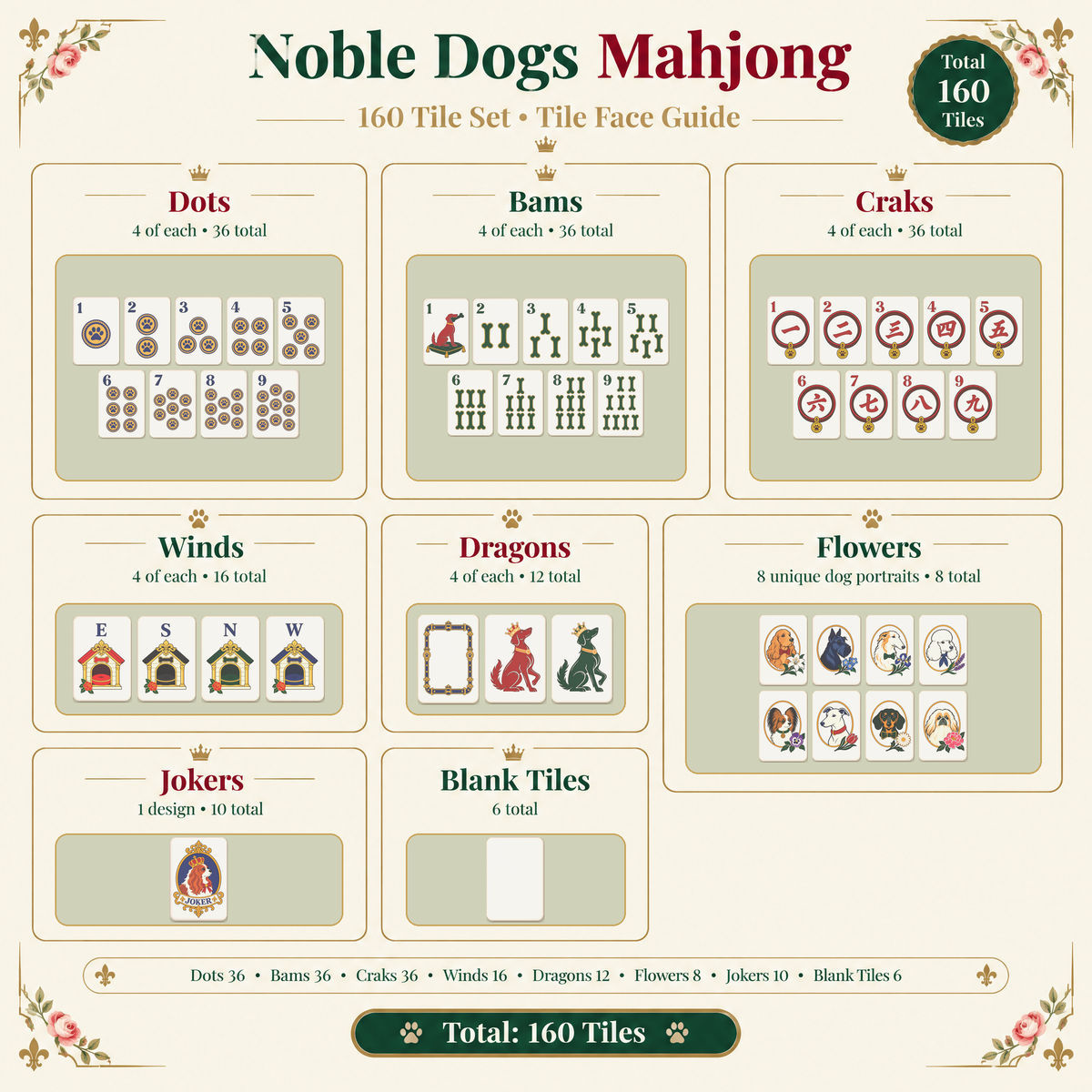
Circle tiles—also called Dots—form one of three numbered suits in American mahjong, alongside Bams and Craks. Each numbered circle tile from 1 to 9 appears four times in a standard 152-tile set, totaling 36 Dot tiles. The 1 Dot typically displays a bird instead of a single dot, a visual shorthand that helps quick recognition. On the mahjong card, Dots are often marked with a ⭕ symbol or listed as "circles." Dots pair with the White dragon (also called Soap), which serves as zero; this pairing means hands built around Dot sequences always include White. You'll encounter Dots in roughly half the hands on the current year's card, making them as essential as any suit. Our best-selling acrylic sets come with four copies of each numbered Dot from 1–9, so you're always ready to play any hand that calls for them. 🀄 Shop best-selling mahjong sets →
Why Are Circle Tiles Called "Dots"?
The name "Dots" reflects the tile face: a 1 Dot shows a bird (for luck); a 2 Dot shows two circles; a 3 Dot shows three, and so on through 9. This visual system makes scanning the table fast during live play. The term "circle" and "dot" are used interchangeably; they're the same suit. Older sets sometimes called them "wheels" or "coins," but modern American mahjong standardized "Dots."

How Do the 1–9 Dots Fit Into a Hand?
Dots appear in pungs (three identical Dots, like three 5 Dots), kongs (four identical Dots), and pairs—never in sequences, since American mahjong has no chows. The card calls for specific combinations: for example, "one pung of 1–2–3 Dots" really means "one pung of a single number (say 1 Dots) plus a pair of 2 Dots plus a set of 3 Dots"—each set is identical tiles. Beginners often misread the card and try to build sequences; they don't work in our game. Dots show up in roughly 50% of hands on the current card, so learning to recognize them quickly saves time.
What's the Difference Between the 1 Dot and Other Numbers?
The 1 Dot is the only numbered tile that doesn't display its number as dots; instead it shows a bird, traditionally a sparrow. This design comes from Chinese mahjong tradition and serves as an instant visual marker on a crowded rack. The 2–9 Dots show their count as plain circles, making them uniform and easy to count at a glance. The bird-marked 1 Dot is never hard to spot, so you won't confuse it with honor tiles or dragons when you're discarding quickly.
How Do Dots Pair With the White Dragon?
In American mahjong, the White dragon (Soap) is the "zero" tile and belongs exclusively with Dot hands. If a hand calls for "Dots and Whites," all Dot pungs and pairs must appear alongside White pungs or pairs; you cannot mix Dots with any other dragon or honor. This tie is strict: no Dot hand without Whites, no White hand without Dots. Understanding this pairing helps you scan the card faster and avoid invalid hand builds.
✨ Find your Mahstead set — free US shipping →
Why Does the Card List Dots in Different Ways?
The mahjong card uses shorthand to save space: Dots may appear as "⭕," "circles," "1–9," or "D" (for "D hand"). Some cards color-code them; others use symbols. Learning your card's system in your first game saves frustration mid-hand. Always keep the current year's card on the table, and ask your group's card keeper to explain any notation you're unsure about before the first hand starts.

Common Mistakes New Players Make With Dots
Mistake | Why It Fails | How to Fix It |
Building 1–2–3 as a sequence | American mahjong has no chows; only pungs (3 identical) | Read the card aloud; if it says "pung," grab three of the same number |
Mixing Dots with Red or Green dragons | Dots only pair with White | Memorize: Dots = White; Craks = Red; Bams = Green |
Confusing the 1 Dot bird with a dragon | The bird is a number tile, not an honor | Check the shape: bird = 1 Dot; dragons are square/solid symbols |
Playing a Dot hand without Whites | Hands always follow the card exactly | Before you draw, confirm your card row lists "Dots and Whites" or similar |
Reading Dots on the Card: A Step-by-Step Approach
Step 1: Locate the hand row you want to build (today's card is printed or displayed by your dealer).
Step 2: Look for the Dot notation—usually "⭕," "circles," or "1–9 Dots." Some cards show all three suits in one row; others split them.
Step 3: Count the sets. If the card says "pung of 1–2–3 Dots," note that you need one pung (three identical), one pair, and one set of 3 Dots. This is not a 1–2–3 sequence.
Step 4: Check the pair and honor requirements. If the row includes Whites, you must have them; if it lists a wind, that wind is part of the hand.
Step 5: Confirm your tiles match exactly before you call "Mah." One wrong Dot number or a missing White ends your turn and costs points.
What To Check Before You Buy a Mahjong Set
Dot clarity: Acrylic tiles should display the bird on the 1 Dot clearly, with no fading or printing blur on any numbered Dot 2–9.
Tile count: A standard set has four copies of each Dot 1–9 (36 Dots total) plus eight jokers and 108 other tiles. Mahstead's 160-tile sets include spare jokers so you never run short.
Engraving legibility: If you choose an engraved set, the Dot numerals should remain readable after play; cheap printing wears off fast.
Weight and balance: Tiles should feel smooth in your palm and stack evenly, so shuffling doesn't scatter the 1 Dot or other Dots off the table.
🎁 See our most-loved mahjong sets & accessories →
Pairing Dots With Your Setup
Once you understand how Dots work in hands, pair them with gear that keeps you organized. A mahjong rack with pushers helps you sort your tiles by suit—Dots in one section, Bams in another—so you don't mis-grab a Crak when you mean a Dot. A protective mat keeps tiles from sliding off the table during the Charleston, and a sturdy bag or case protects your Dot tiles from scratches during transport. Good gear doesn't teach you the rules, but it keeps you playing faster and with fewer fumbles.
Dots Across Different Mahjong Variants
American mahjong always uses Dots 1–9 as one of three numbered suits. Chinese, Hong Kong, and Riichi variants also include Dots, but they allow sequences (chows)—so a 1–2–3 Dot sequence is valid in those games, unlike American play. If you ever play with an international group, ask which variant is in use before the first hand; the presence or absence of chows changes everything. For now, if you're playing American, remember: Dots only combine in identical sets (pungs, kongs, pairs), never sequences.
What You'll Need:
A solid foundation starts with a quality set. Our best-selling acrylic mahjong sets ship with the full Dot complement (36 tiles: four of each number 1–9) plus full backup tiles for years of play. Free US shipping on every order.
For more detail on how tiles work across your entire set, see our guide to what's in an American mahjong set. If you're brand new, start with mahjong for beginners to learn the full game flow and how Dots fit into your first hands.

FAQ
Why does the 1 Dot have a bird instead of one dot?
The bird is a traditional Chinese symbol for luck and longevity. It also lets you spot the 1 Dot instantly during fast play, avoiding confusion with dragons or other honor tiles.
Can I use Dots in a sequence like 1–2–3?
No. American mahjong has no sequences (chows). You can only use Dots in identical sets: pungs (three 5 Dots), kongs (four 5 Dots), or pairs. Always check the card for the exact set required.
What dragon goes with Dots?
The White dragon (also called Soap) pairs exclusively with Dot hands. If your hand row lists "Dots and Whites," both must appear; you cannot mix Dots with Red or Green dragons.
How many of each Dot number do I get in a set?
Four. A standard 152-tile set includes four copies of each Dot from 1 to 9, totaling 36 Dot tiles. This ensures every player can build valid hands simultaneously.
Do I need to memorize all Dot numbers before I play?
No. Keep the current year's mahjong card on the table and refer to it as you build each hand. After a few weeks of weekly games, you'll recognize Dots on sight without checking.
What if my Dot tiles wear or fade?
Acrylic tiles from reputable makers last for years with normal care. Store them in a protective bag between games, avoid direct sunlight, and use a mat to prevent sliding and chips. If tiles do wear, a full set replacement is far cheaper than replacing random damaged tiles.


View More
View More
View More
