
Guangdong Mahjong Rules: How to Play the Cantonese Way
Last updated: Nov 23, 2026
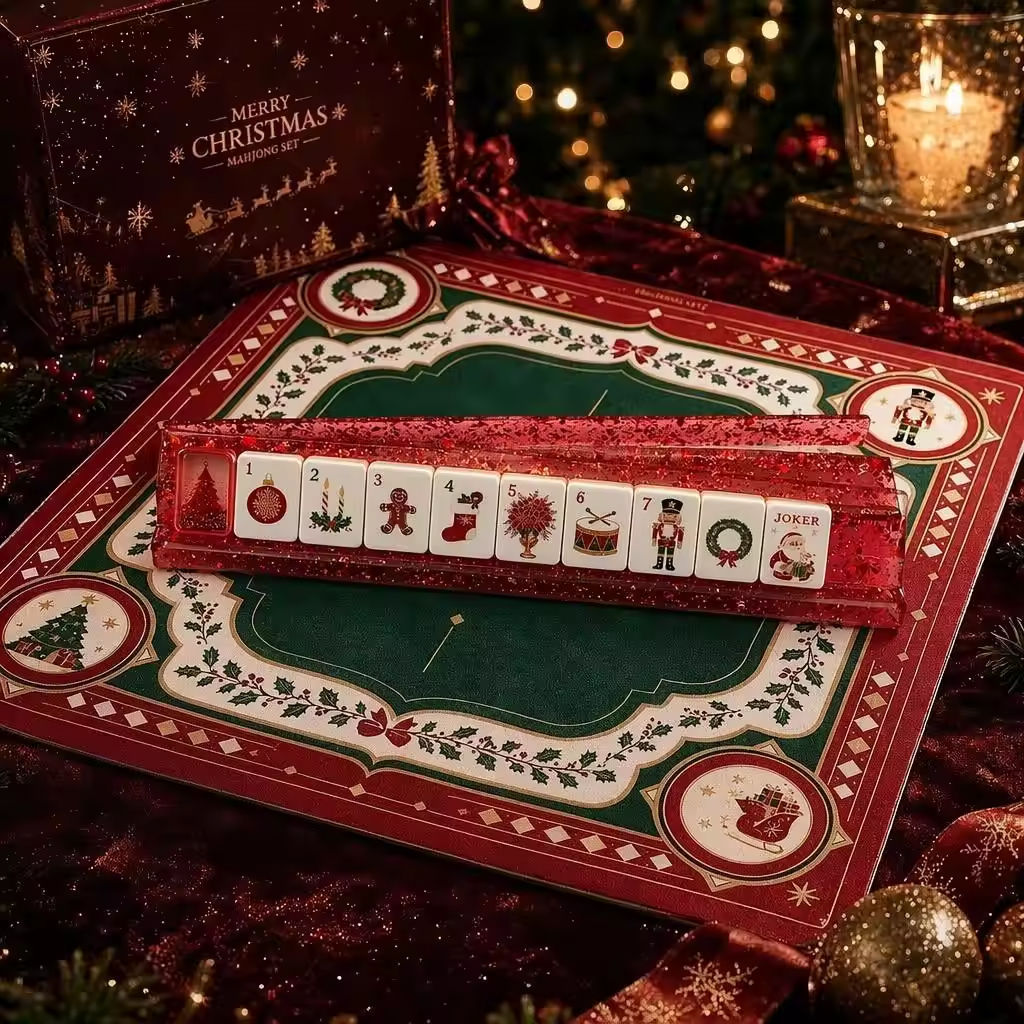
Guangdong mahjong is played with 108 tiles (three suits of 1–9, each four copies; winds; dragons; flowers) and typically four players. Unlike American mahjong, there is no hand card, no jokers, and no fixed hand list—instead, players score points based on the melds (pungs, kongs, chows) they hold and the final winning combination. Hands are won by drawing from the wall or claiming another player's discard, and winning is possible at any point during play, not just at the start of your turn. The game emphasizes rapid calculation: each pung, kong, and chow earns points depending on whether tiles are concealed or exposed, and the final hand multiplies that total. Guangdong mahjong requires 108 tiles, three to four players, dice, and a score sheet; games typically last 15–30 minutes per round. Mahstead's best-selling mahjong sets include the 152-tile American standard, but for Guangdong play you'll want a dedicated 108-tile Cantonese set or a flexible acrylic tile collection that lets you remove American-specific tiles.
Guangdong mahjong is the heartbeat of mahjong in Guangdong Province and Hong Kong. If you've watched Cantonese films, you've heard the rapid tick-tick-tick of tiles. The rules reward speed, calculation, and risk. Below we'll walk you through setup, core differences from American mahjong, hand-winning patterns, scoring, and what equipment you'll actually need.
What tiles does Guangdong mahjong use?
Guangdong mahjong plays with 108 tiles. You have three suits (Bams, Craks, Dots), each numbered 1–9, with four copies of each tile (36 per suit). You also get winds (4 each: North, East, West, South = 16 total) and dragons (4 each: Red, Green, White = 12 total). Some sets add one or two flowers; they are optional and some groups omit them entirely. The key difference from American mahjong: there are no jokers and no extra tiles. Every tile in play counts toward the game. This means tile economy is tighter and drawing errors end hands more abruptly. Players typically bring a second 108-tile set to rotate between rounds so one set rests while another plays.

How does Guangdong mahjong differ from American mahjong?
The structural differences are fundamental. American mahjong has a published hand card (issued annually by the National Mah Jongg League) that defines every winning hand; players study the card before play, consult it during, and hands must match exact patterns. Guangdong mahjong has no hand card. Any combination of pungs (3 identical tiles), kongs (4 identical), chows (three consecutive numbers in the same suit), pairs, and one eye (a pair of identical tiles) forms a legal hand. American mahjong uses 152 tiles plus 8 jokers; Guangdong uses 108 tiles, zero jokers. American play forbids calling chows (sequences)—only pungs, kongs, and quints are exposed. In Guangdong, chows are freely called and exposed. American hands are finished only at the start of a turn (after drawing); Guangdong allows "win on claim"—a player can win by claiming another player's discard mid-turn, even if it's not their draw. This makes Guangdong faster and riskier. Finally, American mahjong has fixed point values (usually printed on tiles or tracked by hand rank); Guangdong scoring is dynamic and cumulative, based on tile concealment, meld type, and final hand composition.
What are the core rules of play?
Setup: Four players sit around a table. One player is the dealer (typically chosen by die roll). The dealer draws 14 tiles from the wall; the other three players each draw 13. Play begins with the dealer discarding one tile face-up in the center. Players take turns in clockwise order. On your turn, you draw one tile from the wall (or claim a discard, if legal). You then meld tiles into pungs, kongs, or chows if you choose to expose them (optional; hidden melds are often worth more points). Finally, you discard one tile face-up. A discard can be claimed by another player to form a pung, kong, or chow (if you are ahead of that player in turn order). If a discard completes a winning hand—a set of melds plus one pair—the claiming player wins and play stops. If no one claims a tile and the wall runs out, the round is drawn. Winning hands must have at least one exposed or hidden pung/kong/chow; a pair alone does not win.

How is Guangdong mahjong scored?
Scoring is the heartbeat of Guangdong play. Each hand earns a base score that is multiplied or increased based on modifiers. Pungs are worth 2 points (exposed) or 4 points (concealed, drawn from wall). Kongs are worth 8 points (exposed) or 16 points (concealed). Chows are worth 1 point (always exposed). The pair is worth 2 points if it's a pung-like pair (e.g., pair of dragons) or 0 if it's a simple pair. The final winning hand's base score is the sum of all melds plus modifiers—for example, a hand with one concealed pung (4 points), one exposed kong (8 points), one chow (1 point), and a pair (2 points) = 15 points base. Modifiers then apply: all-concealed (no exposed melds) doubles the score; all-one-suit multiplies it; winning on the dealer's discard adds points; winning on a wall draw adds different points. Typical scoring ranges from 2 to 32 points per hand, paid by the losing players to the winner (or split according to house rules). The dealer stays until they lose; then the next player becomes dealer. Games end when players reach an agreed-upon total score (often 500 or 1000 points).
Meld Type | Exposed (Claimed) | Concealed (Wall Draw) | Chow | When to Expose |
Pung | 2 pts | 4 pts | N/A | When blocking rivals or quick winning |
Kong | 8 pts | 16 pts | N/A | When securing high value |
Chow | Always claimed | N/A | 1 pt | Often claimed to steal rivals' discards |
Pair | 2 pts (special) | 2 pts (special) | N/A | Reserved for final winning pair |
🀄 Shop best-selling mahjong sets →
What hands can win in Guangdong mahjong?
A winning hand in Guangdong mahjong is any legal combination of melds plus one pair, totaling 14 tiles. There is no fixed pattern—unlike the American card system, Guangdong allows infinite variations. A legal winning hand must have at least one exposed or hidden meld of 3+ tiles (pung, kong, chow); a pair of tiles is not a hand by itself. Examples: three concealed pungs + one chow + one pair (all different suits) is a win; two kongs + two pungs + one pair is a win; five chows + one pair is a win. The hand does not need to be all one suit or follow any rank pattern. However, some house rules forbid certain hands (e.g., "all pairs" or "seven pairs") so clarify rules with your group before sitting. The winning tile can come from the wall (a "draw win," worth more points) or be claimed from a discard (a "claim win," worth fewer). If a tile is claimed, the player whose discard caused the win must pay the winner; if a tile is drawn, all three other players pay equally (house rules vary). This mechanic makes late-game tile disposal a strategy—keeping "safe" tiles becomes crucial.
🎁 See our most-loved mahjong sets & accessories →
What equipment do you need to play Guangdong mahjong?
To play Guangdong mahjong, you need: a 108-tile Cantonese set (usually jade, bamboo, bone, or acrylic), a wind indicator or dealer button, two dice, a score sheet or app, and optional—a mat to protect the table and organize tiles. Because Guangdong games move fast and tiles take heavy use, many groups rotate between two sets (one plays, one rests) to extend tile life. Acrylic sets are durable and easy to clean, making them popular for casual home groups. A mahjong mat protects the table and speeds play by clearly marking each player's zone; mats designed for American mahjong (152-tile sets) can accommodate 108-tile play, though some groups prefer compact mats. Mahjong racks with pushers help organize hand tiles and are optional but useful for tracking melds. Because Guangdong play emphasizes speed, keeping tiles sorted and visible speeds your decisions. A padded mahjong bag or case is valuable if you transport sets between homes or groups.
✨ Find your Mahstead set — free US shipping →
What to check before you buy a Guangdong mahjong set
Tile count: Verify you have exactly 108 playing tiles, not 144 or 152. If buying a multi-set bundle, confirm each set is complete.
Tile clarity: Ensure numbers and suit symbols are deeply engraved or printed so they remain visible after years of play. Worn tiles cause misdeals.
Weight and feel: Test tiles if possible. Heavier tiles (bone, jade) slow play slightly but feel premium; acrylic or resin tiles are faster and more affordable.
No jokers: Guangdong sets should not include jokers or blanks. If your set has extra tiles beyond 108, confirm they are truly spares and not intended for play.
Storage: Check that the set comes with a box or bag. Loose tiles scatter and damage easily.
House-rule variants: Some regions play with flowers (optional), others omit them. Clarify with your group so you buy the right set.

FAQ
Can I use an American mahjong set to play Guangdong mahjong?
Technically yes, but not ideally. An American set has 152 tiles plus 8 jokers. You'd remove the jokers and extra tiles to get close to 108, but you'd have mismatched spares and miss Guangdong-specific conventions. A dedicated 108-tile Cantonese set is clearer and faster.
Is Guangdong mahjong harder than American mahjong?
Different, not necessarily harder. American mahjong requires memorizing the annual hand card and strategic tile-holding over many turns. Guangdong mahjong requires rapid mental arithmetic (scoring), quick decision-making (to claim or discard), and risk management (tile safety). Most players find Guangdong faster-paced and more social.
Do I need to know Chinese to play Guangdong mahjong?
No. Tiles are numbered 1–9 and labeled with universal suit symbols (Bams = circles, Craks = characters, Dots = dots). Wind and dragon tiles are sometimes labeled in Chinese characters, but house groups typically point and use their own shorthand (e.g., "Red," "Green," "White"). Learning basic callouts in Cantonese is fun but not required.
What's the difference between Guangdong mahjong and Hong Kong mahjong?
They are nearly identical. Hong Kong mahjong is the Guangdong variant played in Hong Kong, with slight local scoring variations. Both use 108 tiles, no hand card, and rapid play. Rules differ slightly from group to group; always ask locals before sitting.
How long does a Guangdong mahjong game take?
A single hand typically lasts 5–15 minutes. A full "session" (players reaching 500–1000 points) usually takes 1–2 hours. Guangdong games are much faster than American mahjong rounds, which often run 20–30 minutes per hand.
Can three or two players play Guangdong mahjong?
Yes, house rules vary. Some groups allow three-player Guangdong (each draws 14 tiles, one fewer wall position). Two-player is rare and typically uses modified rules. Ask your group how they adapt before joining.


View More
View More
View More
