
Flower Hand Mahjong Rule Explained: American Game
Last updated: Nov 23, 2026
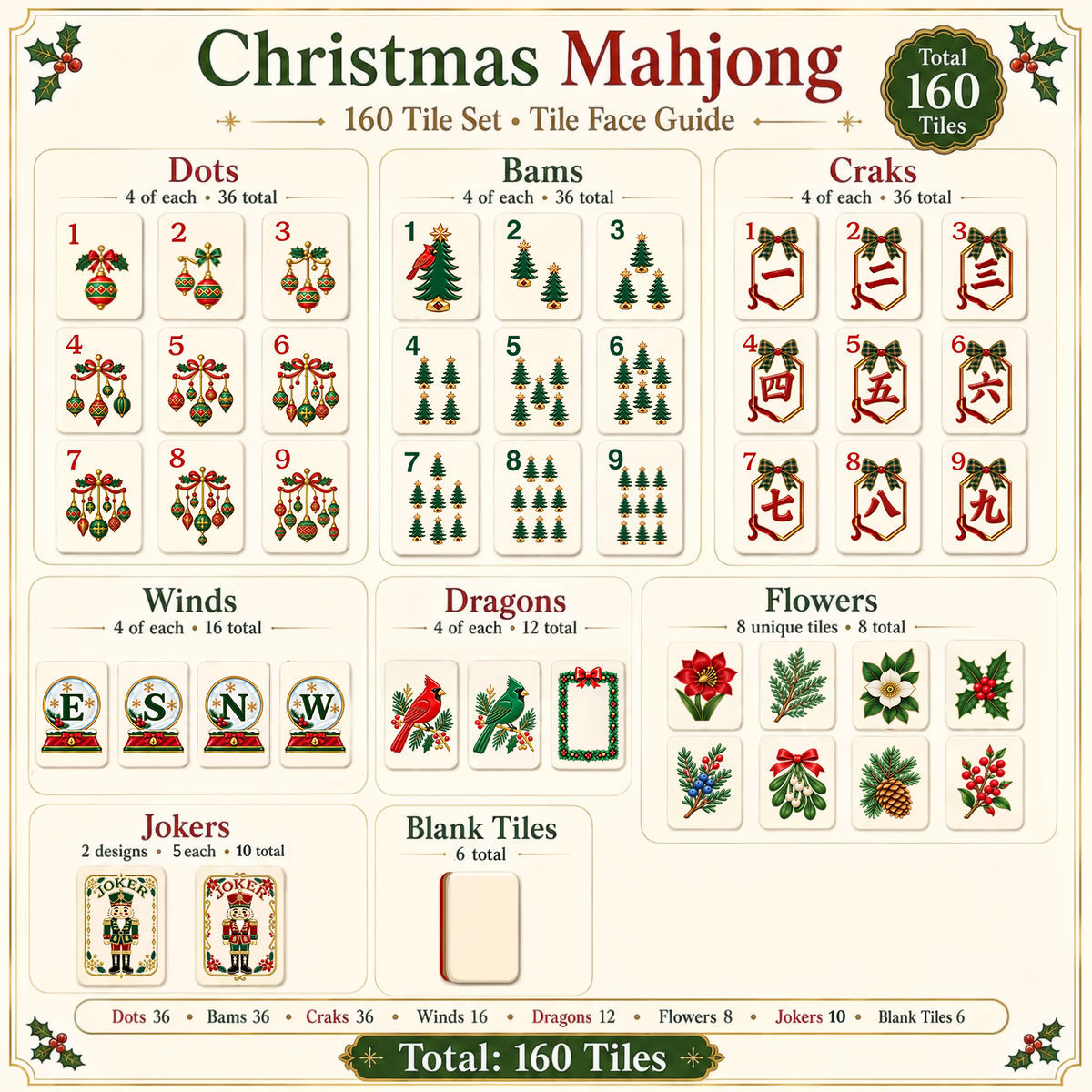
Flower hands in American mahjong consist of the eight flower tiles (four flowers: Plum, Orchid, Chrysanthemum, Bamboo, and four seasons: Spring, Summer, Fall, Winter), which are drawn separately from your hand during setup and play. When you draw a flower during play, you immediately replace it with a tile from the dead wall's end, keeping your hand at 14 tiles. Flowers are never discarded: they sit face-up on your rack and count toward your hand pattern on the National Mah Jongg League card. Unlike Bams, Craks, and Dots, flowers cannot form exposed pungs, kongs, or any melds—only jokers substitute for them. You need all eight flowers for certain specific hand patterns on the current year's card, and they're worth bonus points at settlement. Mahstead's best-selling mahjong sets all include the standard eight flower tiles needed for every hand type.
When you draw a flower tile during play, you keep it face-up on your rack and draw a replacement from the dead wall's end instead. This preserves your hand size and lets flowers accumulate without forcing a discard. The replacement tile counts as a drawn tile for that turn—if it's another flower, you draw again.
What exactly are the eight flower tiles?
The eight tiles consist of four flowers (Plum, Orchid, Chrysanthemum, Bamboo—each appearing once) and four seasons (Spring, Summer, Fall, Winter—each appearing once). They're separate from the numbered Bams, Craks, and Dots, with their own unique artwork. Unlike number tiles, flowers have no numeric value and cannot be combined into sequences or simple pairs. They appear on your American mahjong rack as individual display tiles, never grouped with suits or dragon winds. Every American best-selling set includes all eight.
🀄 Shop best-selling mahjong sets →

How do flower tiles affect my winning hand?
Certain patterns on the current National Mah Jongg League card require all or some flowers as part of the hand. You cannot win without completing the exact flower count your chosen pattern demands. Flowers never form melds themselves—they're always solo tiles on your rack. When you look at the card to find a valid pattern, check the flower section: some hands need all eight flowers, others need none, and some need two, four, or six. Your hand is complete only when you hold the exact tiles (number tiles, honors, and flowers) shown in a single valid pattern. This makes flower hands worth more points because they require precision: drawing unwanted flowers can block your path to victory or force you to abandon one pattern for another.
✨ Find your Mahstead set — free US shipping →
When do you draw a replacement flower tile?
You draw a replacement immediately after receiving the flower, before your turn proceeds. The replacement comes from the dead wall's rightmost end—the same source as regular drawn tiles during play. If that replacement is itself a flower, you draw again without delay. This continues until you draw a number tile or honor (Wind, Dragon). The replacement tile is considered "drawn" for turn-claiming purposes: if another player can claim it by calling a Mah Jongg or an exposed set, they have that right. This rule prevents flowers from accumulating mysteriously; they're simply swapped for regular tiles one at a time. Many new players forget this rule and discard flowers or hold them incorrectly, which breaks the hand.
Scenario | Your Action | Turn Effect |
Draw flower on your turn | Draw replacement from dead wall | Replacement counts as your draw; if another flower, draw again |
Draw flower during picking (dead wall) | Draw replacement immediately | Play continues; no turn claim |
Draw number tile | Keep it; no replacement | Your normal turn draw |
Replacement is a joker | Keep it; no further draw | Joker stays in your hand |

Can flowers be joker substitutes or form melds?
Flowers cannot be substituted by jokers, and jokers cannot replace flowers. Flowers are never exposed as pungs, kongs, quints, or sextets—only jokers and number/honor tiles form exposed sets. A flower tile must always sit face-up on your rack in its designated flower section. If a hand pattern calls for "all eight flowers," all eight must be in your hand in their natural state; no joker or wild tile can replace one. This strict rule prevents confusion and keeps flowers distinct from the rest of the tile pool. Some players accidentally try to build a pung with three flower tiles, which is invalid: flowers are solo display tiles only.
What's the difference between flower hands and regular hands?
Flower hands require one or more flowers as part of their winning pattern; regular hands need zero flowers. The current year's National Mah Jongg League card always shows which patterns require flowers and how many. When you study the card before play, you'll see sections listing patterns with specific flower counts. Some hands are all-flower combinations (all eight), others require exactly four or six, and some skip flowers entirely. The point value can differ: an all-flower hand typically scores higher because it's harder to assemble. To know whether a hand is valid, you must have the exact tile composition—flowers included—that appears on the card. If your hand matches a no-flower pattern, flowers you've drawn are "dead" weight; if it matches an all-flower pattern, every number tile you draw is the liability.
🎁 See our most-loved mahjong sets & accessories →
How do you practice flower hands with the right set?
Consistent play with a complete, durable American mahjong set builds your intuition for flower mechanics. Every time you play, you encounter flower tiles and learn when they block or accelerate your path to victory. The best-selling collection offers standard sets with clear, legible flower artwork so you recognize them instantly. Playing weekly with the same best-selling set and current year's card trains your eye and hand memory. Many serious players keep a mat or rack handy during practice sessions to organize flowers separately and avoid mistakes. The more hands you play, the faster you'll calculate flower impacts on your winning odds.
Common flower-hand mistakes to avoid
Discarding a flower — Flowers are never discarded; always draw a replacement from the dead wall.
Trying to form a pung with flowers — Flowers are solo tiles; no melds of three or more.
Forgetting to track replacement draws — When you draw a flower and then a replacement, that replacement is your turn draw.
Confusing flower count on the card — Always verify the exact number of flowers your pattern needs before declaring Mah Jongg.
Holding flowers when your pattern needs zero — Dead flowers in your hand block space for tiles that matter.
What to check before you buy
Flower artwork clarity: Can you distinguish Plum, Orchid, Chrysanthemum, and Bamboo at a glance?
Set completeness: Does the set include all four flowers and all four seasons (eight total)?
Tile organization: Does your mahjong rack have a dedicated flower section so you don't lose them mid-game?
Card year currency: Is your National Mah Jongg League card from the current season (2026)?
Joker count: Your set should have 8 jokers for standard American play; flowers are never jokers.

FAQ
Do all American mahjong hands include flowers?
No. Some patterns on the current card require zero flowers, others require four, six, or all eight. Check your chosen pattern on the card before declaring Mah Jongg.
What happens if I draw a flower when my hand already has seven flowers?
You draw a replacement tile from the dead wall. If you hold all eight flowers and draw another flower tile (which shouldn't happen), you'd immediately draw a replacement to restore tile count.
Can a joker replace a flower in a hand pattern?
No. Jokers cannot substitute for flowers, and flowers cannot be joker substitutes. Flowers are always their own tiles.
If I'm waiting for a number tile but keep drawing flowers, can I discard a flower instead?
No. Flowers are never discarded. You must draw a replacement from the dead wall and continue. If too many flowers come your way, that hand pattern may be impossible—switch patterns on your next draw if legal.
Are flowers worth more points than number tiles when you win?
Yes, generally. Hands requiring all eight flowers or specific flower combinations score higher than no-flower hands, reflecting the difficulty of assembling them.
In other mahjong variants (Chinese, Hong Kong, Riichi), do flowers work the same way?
No. Chinese mahjong uses flowers similarly (replacement draws from the living wall or wall end), but scoring and hand patterns differ greatly. Riichi mahjong does not use flowers. American mahjong flowers are unique to the American game and its National Mah Jongg League card.


View More
View More
View More
