
Filipino Mahjong Setup: Rules, Tiles & How to Play
Last updated: Nov 23, 2026
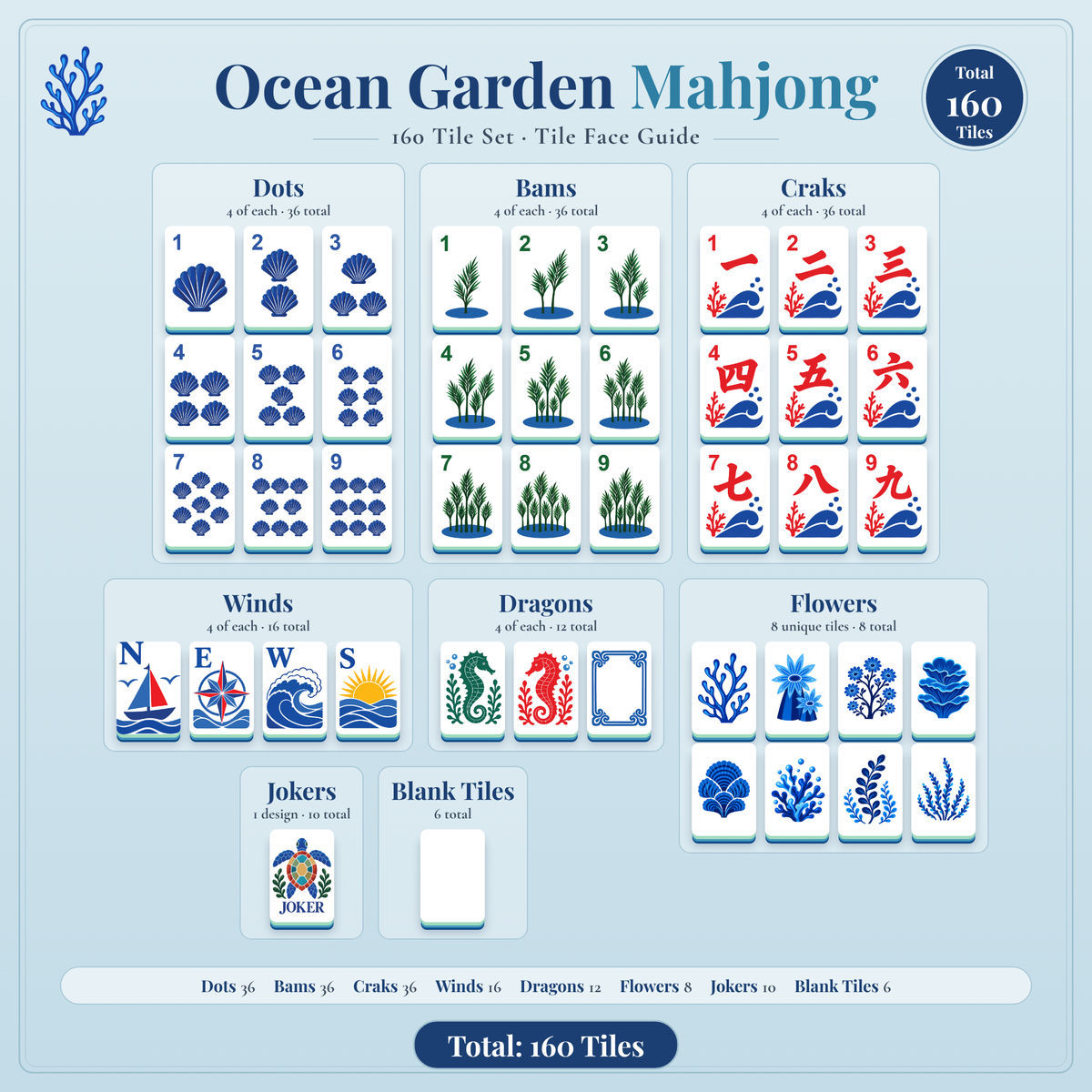
Filipino mahjong uses 144 tiles (three suits of 1–9, four winds, three dragons, eight flowers) and is played with four players who draw tiles from a live wall—no shuffling or the Charleston. Hands are formed during play from melds (pungs, chows/sequences, kongs, eyes) and drawn tiles, not pre-selected from a yearly card like American mahjong. A game takes 20–30 minutes per round; winning is called "mahjong" and scores vary by hand type and whether you win by draw, discard, or by luck (Kong's tail). Filipino play is noisier, more social, and faster than American; families often play multiple rounds in an evening. Unlike American mahjong's formal card-based format, Filipino play relies on memory, speed, and live bidding—no Jokers allowed. You'll need a 144-tile set (though some homes use 152-tile American sets), a mat to protect the table, and best-selling mahjong sets designed for quick play.
How is Filipino mahjong different from American mahjong?
Filipino mahjong removes the formal hand-selection card entirely. In American play, you choose hands from the current year's National Mah Jongg League card before the game begins. In Filipino mahjong, you draw tiles live and build combinations as you go—chows (sequences like 1-2-3 of one suit), pungs (three identical tiles), and kongs (four identical). American mahjong forbids chows; Filipino welcomes them. Filipino games finish in 15–30 minutes per round; American typically takes 45–90 minutes because of the pre-deal and card-reading. There are no Jokers in Filipino play, and the whole tempo is looser, louder, and built on quick decision-making and memory rather than strategic card-matching.

What tiles are in a Filipino mahjong set?
A standard Filipino mahjong set contains 144 tiles: 108 number tiles (Bams, Craks, Dots—four copies each of 1 through 9 per suit), 16 winds (four each of North, East, West, South), 12 dragons (four each of Red, Green, White), and eight flowers (two each of Spring, Summer, Autumn, Winter). Some families play with a 152-tile American set instead, simply removing the eight extra tiles before play; the core rules stay the same. The tile faces and sizes are nearly identical to American sets—roughly 1 inch by ¾ inch. Older sets use bamboo and bone; modern acrylic sets are lighter, quieter on the table, and easier to shuffle by hand. When you're buying or inheriting a set, confirm it's complete: count the three suits (36 tiles each = 108), add 16 winds, 12 dragons, and eight flowers to reach 144.
How do you deal and set up a Filipino mahjong game?
Four players sit around a table, each taking a side (North, East, South, West—assigned randomly or by prior agreement). The dealer (often East) shuffles all 144 tiles face-down and arranges them into a wall roughly 18 tiles long by two tiles high, divided into four sections—one per player. The dealer draws 14 tiles, other players draw 13 each; all tiles are arranged on a mahjong mat or bare table in front of each player. The dealer plays first, discarding one unwanted tile face-up to the center—the discard pile. Play moves clockwise (East to South to West to North). Each turn: draw one tile from the wall, make melds if possible (expose pungs, chows, kongs), and discard one tile. The game ends when someone forms a winning hand (usually four melds plus a pair, though variations exist) or the wall runs out. Dealing by hand takes practice; using mahjong racks with pushers makes organizing your 13–14 tiles faster and prevents fumbling.
🀄 Shop best-selling mahjong sets →

What are the winning hand types in Filipino mahjong?
In Filipino mahjong, a winning hand is usually four melds (pung, chow, kong, or mixed) plus one pair. Common hands include all pungs (no chows), all chows (no pungs), terminal chows (1-2-3 or 7-8-9 only), honors (winds and dragons), and mixed combinations. Some regions play "limit hands"—specific patterns worth more points (similar to American hand patterns but alive during play). Scoring varies: a draw win (Tsumo) scores higher than a discard win (Ron); winning on a Kong's tail (the last tile removed from a Kong) scores higher still. Doubles—two of the same limit hand type—multiply points. You call "Mahjong!" when you complete your hand, and the payment flows from the player whose discard you took (or from all players if you drew from the wall). Scoring can get complex; many casual home games simplify to flat points per win or a prearranged betting amount.
What table setup do you need to play Filipino mahjong at home?
You need a stable, smooth surface (dining table, card table, or dedicated mahjong platform), enough space for four players to sit comfortably, and ideally a mahjong mat to protect the table surface and cushion tile noise—Filipino games are lively and tiles move fast. A mat also gives you defined walls and discard areas. A tray or organizer helps keep tiles in neat rows. Mahjong racks with pushers are optional but beloved by serious players; they hold 13–14 tiles upright, hide your hand from neighbors, and speed up play. Good lighting is crucial—overhead lamps or a chandelier so all tiles are clearly visible. Some homes add a turntable (lazy Susan) in the center so the wall can rotate and dealing stays fair. A travel bag or case keeps your set safe if you rotate games between homes. If you play weekly, these comforts pay for themselves in speed and joy.
🎁 See our most-loved mahjong sets & accessories →
Setup Item | Why It Helps | Essential or Nice-to-Have |
Mahjong mat (bamboo, rubber, or fabric) | Protects table; defines walls; deadens noise | Essential |
Racks with pushers (one per player) | Organizes tiles; hides hand; speeds play | Nice-to-have for regulars |
Good overhead lighting | Prevents squinting; avoids tile-reading errors | Essential |
Turntable (12–18 inch) | Lets wall rotate fairly; reduces dealer fatigue | Nice-to-have |
Tile tray or organizer | Keeps spare tiles tidy; makes cleanup quick | Nice-to-have |
Travel bag with handle | Protects set en route; makes sharing easy | Nice-to-have for mobile games |
How do you prevent common Filipino mahjong mistakes?
Tile counting: Count your tiles at setup. It's easy to miscalculate who has 13 vs. 14, or to start with a missing flower. Missing one tile ruins the game.
Chow confusion: In Filipino play, chows are live (you can call someone's discard to complete a chow). In American, chows don't exist. If you mix rule sets, chaos follows—agree at the start whether chows are allowed and whether you can call them.
Kong protocol: After drawing or claiming a Kong, replace it by drawing from the Kong's tail (the end of the wall). New players often forget this and throw the game out of sequence.
Meld exposure: Once you expose a pung, chow, or kong face-up, you cannot reorder or hide it. Play clean from the start.
Dead wall misplacement: The Kong's tail must always be the last four tiles of the wall. Beginners sometimes take from the wrong end.
House-rule drift: If you switch between Filipino, American, and Hong Kong rules, remind everyone which game you're playing. Write it down if there are new players.
What to check before you buy:
Tile size & weight: Filipino play involves a lot of hand-shuffling. Tiles should fit comfortably in your palm—roughly 1 inch by ¾ inch—and weigh enough to feel solid but not so heavy that aching hands slow your game. Acrylic tiles are lighter than bone; bone lasts longer if you play daily.
Completeness: Count 108 number tiles (36 per suit), 16 winds, 12 dragons, eight flowers = 144 total. No more, no fewer.
Clarity of faces: Tiles should be marked clearly (printed or engraved) so you can read them at arm's length in normal room light.
Mat fit: If you buy a mahjong mat, measure your table first. A mat too small wastes space; too large and tile placement becomes awkward.
Storage: A set lives longest in a closed box or bag, away from heat and humidity. Acrylic won't warp, but edges can crack if dropped or packed carelessly.
✨ Find your Mahstead set — free US shipping →

FAQ
Can I use an American mahjong set to play Filipino mahjong?
Yes. American sets come with 152 tiles (144 plus eight spares). Remove the eight spare tiles and play with the standard 144. The core tile faces are identical—both use Bams, Craks, Dots, winds, dragons, and flowers. Rules differ, but the equipment is compatible.
How long does a round of Filipino mahjong take?
A single hand usually finishes in 15–30 minutes, depending on player speed and experience. A full evening of 4–8 rounds takes 2–3 hours. American mahjong rounds typically run 45–90 minutes because of pre-deal and card-reading.
Is there a hand-reference card for Filipino mahjong like the American League card?
No. Filipino mahjong is memorized—players learn winning patterns by playing. Some regions have informal "limit hand" guides, but there's no official yearly card. This makes Filipino play faster and more improvisational than American.
Do I need Jokers to play Filipino mahjong?
No. Jokers are only used in American mahjong. Filipino play uses only the 144 standard tiles with no wild cards or blanks. This keeps the game purely skill-based.
Can three people play Filipino mahjong?
Traditionally, no. Filipino mahjong is designed for four. Removing a player skews the wall size, tile odds, and social flow. If you have only three, use a 144-tile set and deal three hands of 14 tiles each, leaving 102 in the wall—but expect unusual patterns and house rules to emerge quickly.


View More
View More
View More
