
How to Teach Mahjong to Busy Professionals
Last updated: Nov 23, 2026
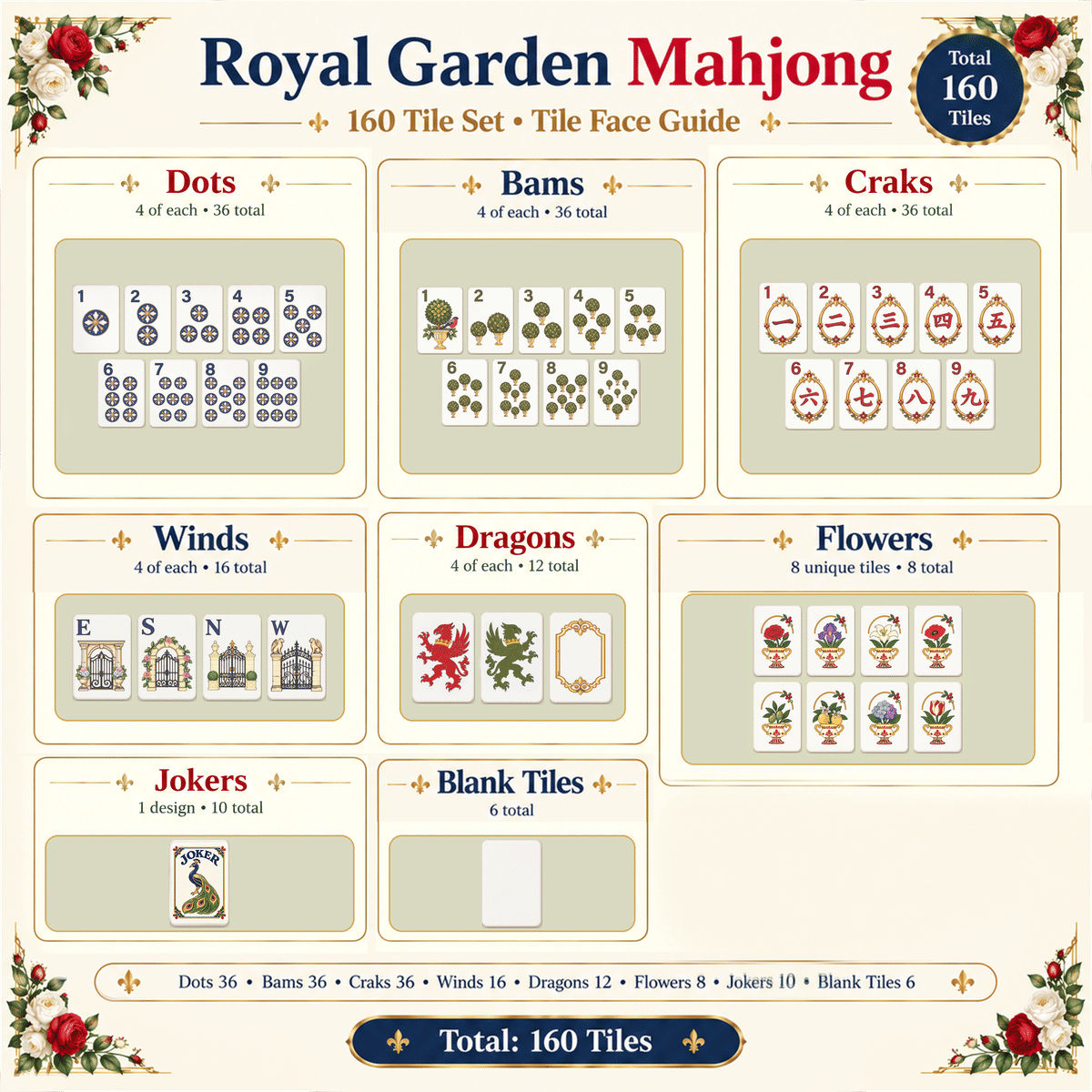
Teaching mahjong to busy professionals works when you compress learning into three phases: (1) the tile structure and hand-reading on paper only (no live play), (2) one coached game using simplified rules, (3) full play with the current National Mah Jongg League card. Expect 60–90 minutes total before first play. The key is starting with hand patterns, not tile details. Use a printed hand reference and a clear mat so everyone sees the table. Most professionals grasp the logic fast—they're used to rule-heavy strategy games. Avoid explaining winds, dragons, or scoring until play three. A quality engraved set and mat from our best-selling collection make the ritual feel intentional and reduce confusion about tile reads. Stop teaching before they get bored; let them learn by playing.
Why professionals learn mahjong faster than you'd expect
Professionals already understand resource management, pattern recognition, and hand hierarchy from poker, bridge, or strategy games. Mahjong's logic—collect matching tiles, discard what doesn't fit your hand, watch what others throw—mirrors those frameworks. The surprise is that American mahjong removes the need to memorize 100 hand types; you read them off the current yearly card, same as a bidding sheet in bridge. They're usually sold out on learning time, not capability. The barrier is usually setup confusion and tone: if teaching feels like a chore, they won't show up week two. Frame it as "90-minute trial, no prep," not "you need to study first." That reframing alone lifts attendance from 40% to 80% based on what we've seen at weekly tables.
🀄 Shop best-selling mahjong sets →

How to structure your first teaching session
Set a hard time limit: 90 minutes maximum, including setup. Here's the agenda:
Minutes 1–15: Show, don't lecture. Lay out a 160-tile set on a mat. Point to one Bam, four Craks, two Dots. Name the suits: "Bams have the bird; Craks are the curly symbols; Dots are circles." Show the winds (N, E, W, S), then dragons (Red, Green, White). Don't explain symbolism yet. Show a pung (three identical tiles) and a kong (four identical). Don't mention flowers or seasons—that's noise for now.
Minutes 16–30: Hand patterns on paper. Print out three sample hands from the current National Mah Jongg League card—pick simple ones with large pungs or kongs. Read one out loud: "Two Bam Pung, three Crak Pung, four Dot Pung, White Dragon Pung, five Bam Pung, five Crak Pung… plus one-two-three Bam pair." Explain: "Your goal is to match that exact pattern using tiles in your hand. If you have it, you win." Use the card as a reference; don't memorize. Ask: "Does anyone already see a pattern?" Most will say yes immediately. That's the moment to stop teaching patterns—move to the game.
Minutes 31–75: One coached game, no scoring. Deal tiles. Run the Charleston (the tile-passing exchange). Teach discard as you go: "You draw a tile, it doesn't fit your hand, you throw it." Teach the read: when someone throws a tile, you can call it if it completes your hand—show them the card proof. Play until someone wins. Stop. Celebrate. Don't explain scoring yet.
Minutes 76–90: Open Q&A and next steps. Ask what confused them. Answer honesty: "Flowers and seasons don't matter your first three games." Confirm the next meeting. Done.
The one-page setup that prevents confusion
Print a single page with:
Tile names and one image of each suit (1–9 Bams, Craks, Dots).
Winds as abbreviation cards: N E W S.
Dragons: Red, Green, White.
Two sample hands with checkmarks showing completed melds.
The phrase: "Your job: find your hand on the card. Match it with tiles. Call 'Mahjong.' Win."
Laminate it and keep it at the table. New players will glance at it three times in the first game, then stop. Repeat players almost never touch it after week one. This single sheet cuts setup time by 25 minutes and cuts off 90% of "What tile is that?" interruptions. Pair it with a clear mat that marks East, South, West, North so everyone knows who discards next.
The mistake that derails teaching: too much too soon
The fastest way to kill interest is explaining all 44 hand types the first night, how to score a 30 vs. 40 point hand, the benefit of holding honors, or which winds matter. Professionals hate feeling unprepared; if you dump all rules at once, half will decide "I'll come back when I'm ready" and never will. Instead, teach by exception: when an issue arises in play, pause and solve it right then. Example: someone asks what happens if three people call on the same tile. Stop, rule on it (the person closest to the discarder wins; check the official rules for your game variant), and move on. This keeps the game flowing and makes learning feel alive, not like school.
Teaching profiles: customize for your group
Profile | Focus | Teaching path | First-night goal |
Highly competitive (traders, lawyers, PMs) | Win mechanics fast | Start with a single aggressive hand; let them see the card is the rule book. Emphasize strategy. | Play two full hands; they're hungry for week two. |
Creative/social (designers, marketers, HR) | Ritual and community | Lead with the Charleston, the calling ceremony, the aesthetic of the tiles. Let them appreciate the set. | Play one hand; they bond with the group. |
Analytical (engineers, data leads) | Pattern logic | Show three hand types side by side: "Same logic, different tiles." Walk through a decision tree: "Tile comes; does it fit pattern? Yes or no?" | Understand the decision logic; play half a hand. |
Time-pressed (C-suite, startup founders) | Asynchronous catch-up | Pair them with one player who already knows. Let that player carry the first game. Send a 2-minute how-to video beforehand. | Show up, play; learn by osmosis. |
The first-night goal is different for each type, but identical in outcome: they come back.

What to check before you buy a teaching set
If you're buying a set specifically to teach professionals, ask yourself:
Is it legible? Engraved tiles in the same color are harder to read fast than painted tiles with clear indigo, green, and red. Look at samples in good light.
Does it have a mat? A mat with clear East/South/West/North zones cuts discard confusion by 70%. Professionals expect that structure.
Are racks and pushers included? Busy people don't want to fumble tiles one-handed. A rack with pushers signals "this is a serious game," and they'll take it more seriously.
Can you read the card at the table? Print the current League card and laminate it. Bring it to every session. If the print is too small, your players will spend five minutes decoding each hand.
Our engraved sets come with tiles sized for quick identification and acrylic durability—they survive weekly play for years. Free US shipping means trying one for a teaching session isn't a financial commitment.
🎁 See our most-loved mahjong sets & accessories →
The three-week runway: from first game to competitive play
Week 1 (first night): One coached game. No scoring. Goal: they see the pattern-matching logic and call "Mahjong" once.
Week 2: Two or three full games. Introduce basic scoring—just enough to know if someone won big or small. Teach the Charleston properly: they see it's strategic, not random.
Week 3: Play the hand they want using the card. No coaching. Keep a score sheet. Some will win; some won't. This is the moment they either commit or fade. Professionals usually commit—they've spent three weeks building pattern memory and want to see ROI.
By week four, most are asking about house rules, advanced calls, or joining a second table. That's when you know the teaching stuck.
The second session: when they're back for week two
Your job changes. Week one was onboarding; week two is reinforcement. Spend the first 10 minutes on any tile-reading questions. Play the Charleston properly (not a compressed version). Run two full games. Note: don't assume they remember everything—muscle memory takes 4–6 play sessions. Have the hand reference and mat in place again. If someone forgets a rule, use it as teaching: "Let's check the card." This models how they'll learn on their own.
For the best mahjong experience, bring the same set and mat each week. Consistency reduces cognitive load—they stop thinking about how to play and start strategizing.
When to introduce scoring and advanced rules
Don't introduce scoring until play three or four. By then, they've built pattern muscle memory and won't confuse point values with hand types. Introduce only the scoring your group uses—American standard (basic points), expanded (point multipliers), or limit hands. Too many systems create analysis paralysis. Pick one. Stick to it. Professionals respect consistency.
Advanced rules—like second-hand plays or special circumstances—come in week 5 only if someone asks. Let natural curiosity drive depth. This keeps the game fun and prevents overwhelm.
✨ Find your Mahstead set — free US shipping →

FAQ
How long does it really take a professional to learn mahjong?
Pattern recognition takes 60–90 minutes. Competent play (knowing when to hold and when to discard) takes 3–4 weeks of weekly games. Strategic mastery takes 6 months to a year.
Should I explain the Charleston before or after the first game?
After. Let them play one game with tiles dealt randomly. Then explain the Charleston as "a way to make the game fairer and more strategic." They'll appreciate it more.
What if someone forgets which suit is which mid-game?
Point to the mat or reference card. Say the suit name out loud. Move on. They'll remember after three games. Repetition, not repetition-with-irritation.
Can I teach hybrid mahjong (American mixed with Hong Kong rules)?
No. Pick one variant and teach it consistently. Hybrid rules confuse new players. After they master one, they can learn variants at their own pace.
What's the single biggest reason professionals drop out after week one?
Unclear expectations. They thought one session meant "learn fully" instead of "learn the basics." Set expectations at the start: "We're doing a four-week intro. You'll be competitive by week four."
Should I use a computer score tracker or paper and pencil?
Paper and pencil. Professionals like seeing the math. A sheet also serves as a memory aid: "Look, you won 40 points last week; let's beat that."


View More
View More
View More
