
Clear Mahjong Racks: Choose the Right Rack for Your Game
Last updated: Nov 23, 2026

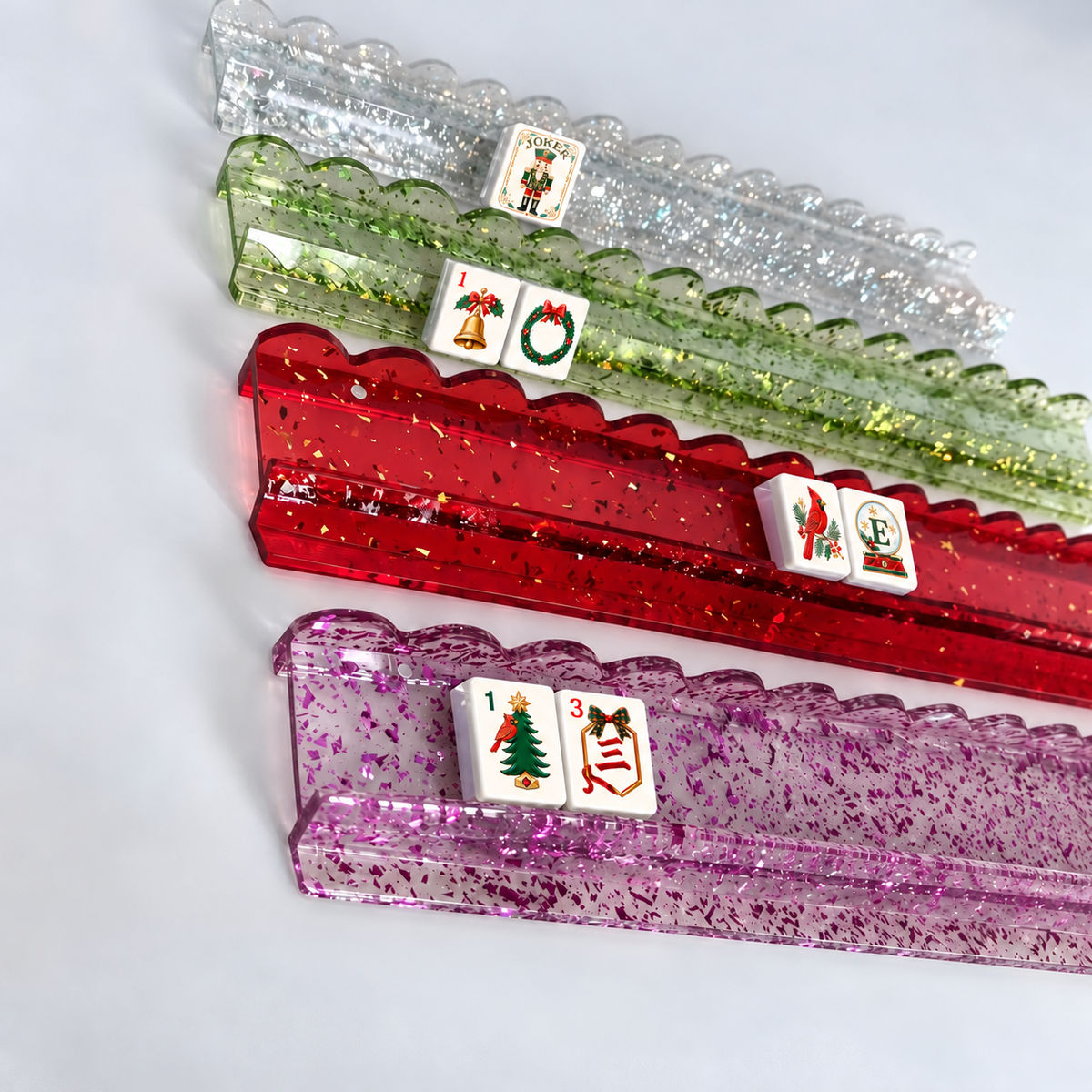
A clear mahjong rack is a tilted acrylic or plastic holder that sits in front of each player, displaying their 13 tiles vertically so opponents can't see them. American mahjong racks come in two main styles: fixed-angle racks (simple, lightweight) and racks with pushers (a slider mechanism that lets you pick tiles without lifting the rack). Most fit tiles 0.75–1 inch wide; our mahjong racks with pushers are designed to work with standard American sets and ship with everything you need. They're not required—you can hold tiles in your hand—but a quality rack keeps the table organized, protects your tiles from spills, and lets you focus on strategy instead of hand management. Cost varies by style and material; see current price on the product page. 🀄 Shop mahjong racks with pushers →
Why do experienced players use clear racks instead of holding tiles?
Holding 13 tiles by hand for a full game causes fatigue and hand cramps, especially if you play weekly for 2–3 hours. A rack removes strain, keeps your hand free to write scores or reach your drink, and signals confidence—you're not telegraphing anxiety by fumbling tiles. Clear acrylic also lets other players see your tile backs (to verify you have no extra tiles) without seeing the faces, which maintains integrity of play. That transparency is why many tournament players and serious home groups prefer them over wood or cloth holders.

What's the difference between fixed racks and racks with pushers?
A fixed rack is a single tilted holder—tiles sit in a groove and stay put until you lift one out by hand. It's simple, durable, and costs less. A rack with pushers has a slider mechanism: you move a knob or strip to push up individual tiles one at a time, so you pick with your finger without disturbing neighbors. Pushers slow your pick slightly but feel smoother and reduce fumbling, especially when you're learning. Many home players use fixed racks; pushers are popular with experienced players who value precision and less hand movement on the table.
What size rack do you need for your tile set?
American mahjong tiles are typically 0.75–0.9 inches wide, and a standard rack holds them snugly in a single row of 13 with no wobble. Before ordering, measure one of your tiles lengthwise and check the product description for rack depth (the slot width). If your tiles are chunky or engraved with thick designs, measure them first—some customized sets run slightly wider, and you want a rack that grips without forcing. Most Mahstead products specify compatible tile sizes; if you're uncertain, measure your tile and compare to the product specs. A rack that's too loose lets tiles lean or fall sideways; one that's too tight makes tiles hard to remove.
✨ Browse our best-selling mahjong sets →
How do you care for and transport a clear acrylic rack?
Clear acrylic racks are tough but scratch over time with rough handling. Wipe yours with a soft cloth and mild soap—never use abrasive scouring pads or harsh chemicals, which dull the finish. Store racks flat or upright in a dry place; acrylic can warp slightly if left in direct sun or near heat. When you travel, wrap each rack in a cloth or place it in a padded mahjong bag or case so it doesn't rub against other equipment. If tiles are still in the rack during transport, cushion them too so they don't shift or crack. Most racks last years with care; replacement is cheap enough, but good storage means you won't need one.

Which Mahstead racks work best with engraved or themed tile sets?
Our engraved American mahjong sets often feature custom artwork on tile faces and backs. A clear rack shows off that design beautifully—the transparency lets decorative backs be seen by players across the table. If your tiles have slightly raised engraving or ornamental edges, measure them before ordering, since those designs can add a few millimeters to width. Racks without pushers are neutral and let the tiles speak; racks with pushers give you the smooth handling advantage while still showcasing your investment. Pair your rack choice with a matching mahjong mat if you want a coordinated, polished table setup.
🎁 See our most-loved mahjong sets & accessories →
What to Check Before You Buy
Feature | Fixed Rack | Rack with Pusher | Best for |
Ease of pick | Lift by hand | Slide mechanism | Pushers if you play fast or have joint issues |
Price | Lower range | Higher range | Budget games: fixed; serious weekly groups: pusher |
Durability | Very high | High (moving part) | Both last years; pusher needs careful storage |
Tile visibility | Full back view | Full back view | Either shows design; pusher adds convenience |
Setup time | None | 10 seconds per rack | Fixed if you move racks often; pusher if play at one table |
Learning curve | Immediate | Few games | Beginners: fixed; experienced players: pusher |
What to check before ordering:
Tile width: Measure one tile lengthwise. Compare to product slot specification.
Quantity: Order one rack per player (typically 4). Spares are useful for repairs or a fifth player.
Set type: If tiles are engraved or chunky, confirm the rack tolerates that width.
Transport: If you travel to games, choose a rack that fits your mahjong bag or case.
Material: Clear acrylic is standard; confirm the product page shows transparent, not frosted.
How racks fit into your overall game setup
A rack alone isn't enough to run a smooth game. Pair it with a quality mahjong mat to protect your table and define play zones. Add a complete tile set (152 tiles plus 8 jokers, every suit and honor), and you're ready. Many weekly players keep a travel case so they can carry racks, mats, and tiles as one portable unit. If you're hosting or building your first game, start with one quality rack per player, a mat, and a set you love. You'll know within a few games whether you want pusher racks or prefer the simplicity of fixed ones.
For gift-givers, clear racks make excellent add-ons to a best-selling set or Christmas mahjong set. They signal that the recipient is serious about play, and they're practical from day one.
✨ Find your Mahstead set — free US shipping →
FAQ
Can you use a mahjong rack if you're left-handed?
Yes. Racks are neutral—you pull tiles from either end. Some left-handed players prefer the rack on their left side of the table instead of the right, which a pusher rack makes easier since you don't have to reach across your body to slide the mechanism.
Do clear racks scratch easily?
Acrylic scratches with rough handling over time, but light daily use causes minimal damage. Soft cloth storage and avoiding abrasive cleaners keep them looking clear for years. A few fine scratches don't affect function and won't show during play under typical lighting.
What happens if a tile gets stuck in the rack?
Remove it gently by lifting one neighbor tile first to create space, or warm the rack slightly with your hands (heat expands plastic a hair). If a tile cracks inside, stop play and replace it. Never force a stuck tile—you'll damage the rack. Always measure tiles before ordering to prevent this.
Can you use racks with 5-player mahjong?
In standard 4-player American mahjong, you use 4 racks. If you're experimenting with a 5th player (non-tournament), you can add a 5th rack, though 2- and 3-player variants have different tile counts and hand styles. Check the house rules before adding a rack.
How many racks should you buy at once?
Buy one per player (minimum 4 for a standard game). Two spares are sensible if you host regularly—one as backup if a rack cracks, one if a fifth player joins occasionally. Racks are easy to store and don't deteriorate, so extras gather no penalty.
Do you need to buy racks from the same maker as your tile set?
No. Any quality rack that fits your tile width works. We design ours to work with American mahjong tiles across all sizes and styles, including engraved sets. Verify tile width matches rack specs and you're set.


View More
View More
View More
