
Classical Chinese Mahjong Special Hands: Types and Scoring
Last updated: Nov 23, 2026
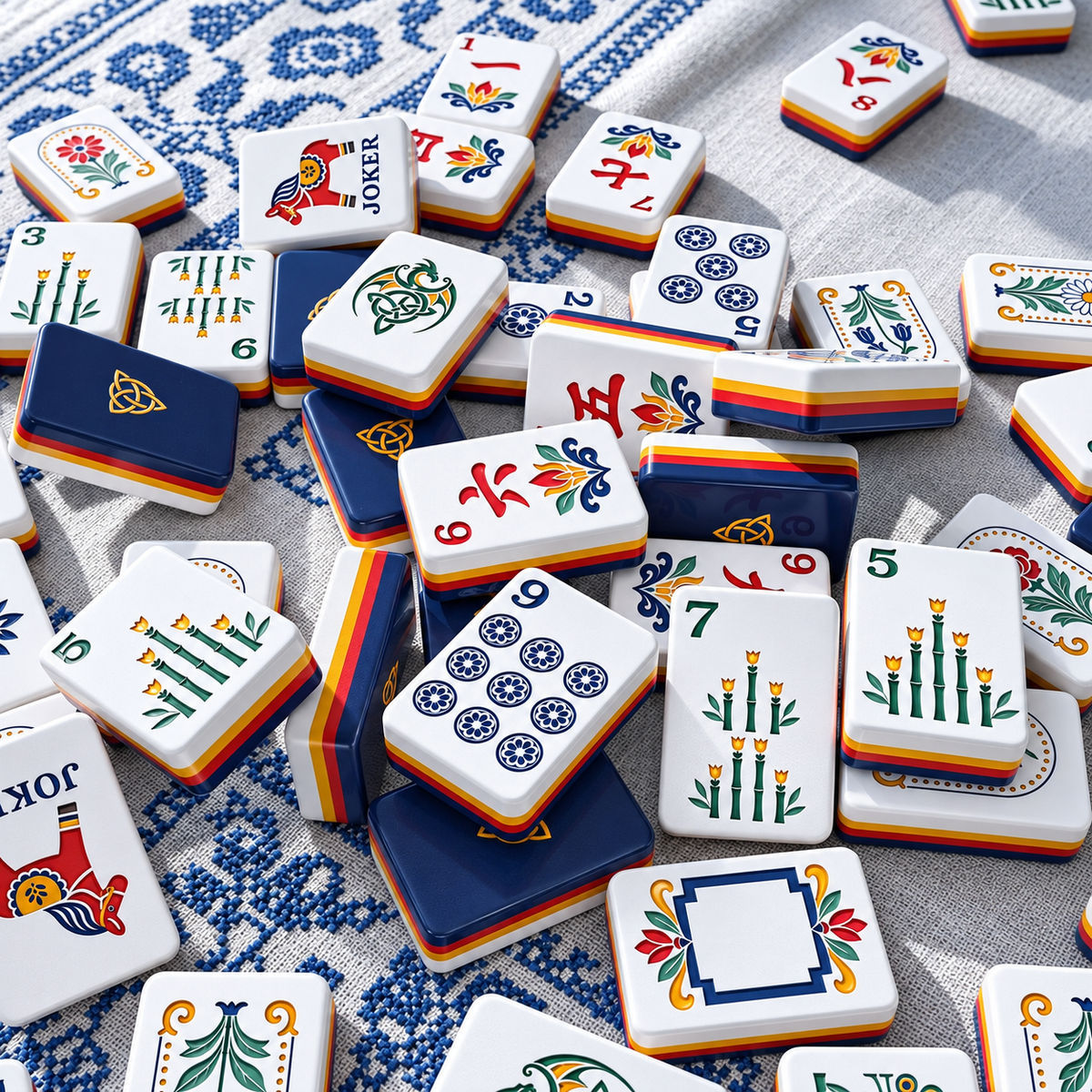
Classical Chinese mahjong special hands are predetermined tile combinations that score bonus points beyond base hand value. The most common categories include All Honors (only winds, dragons, and flowers), All Terminals (1s and 9s only), All Simples (2–8 within suits), Seven Pairs, Thirteen Orphans (one each of every terminal and honor, plus a pair), All Pung (only triplets), and All Green (only Green Dragons and Green Bams: 2, 3, 4, 6, 8). Unlike American mahjong, which uses a seasonal card with fixed hands, classical Chinese variants use rule sets where special hands are defined by tile composition alone—no sequential chows are barred from appearing. Scoring multiplies the base hand value (usually 1 point) by the hand's fan rank, typically 1–8 fan for common special hands, 13 fan for Thirteen Orphans. Each variant (Hong Kong, Cantonese, Taiwanese, Riichi) weights these categories differently; Riichi emphasizes concealment and seven-pair combos, while Cantonese play often rewards honor-heavy melds.
Classical Chinese mahjong rewards mastery of special hand types—from All Honors to Seven Pairs—that carry premium scores. Understanding these hand patterns transforms your play strategy and separates casual players from serious competitors at the table.
What are the most common special hands in classical Chinese play?
Classical Chinese mahjong defines special hands by tile composition—no season card limits them. The most widely recognized special hands include All Honors (only winds, dragons, flowers), All Terminals (1s and 9s exclusively), All Simples (2–8 within each suit), Seven Pairs (seven separate pairs, each identical), and All Pung (every meld is a triplet or kong, no sequences). All Green (Green Dragon + Green Bams only: 2, 3, 4, 6, 8) is prized for visual cohesion and high fan value. Thirteen Orphans (one of each terminal, each wind, each dragon, plus one pair from that set) is the hand rarest to complete because it requires 13 specific tiles to be drawn without forming illegal melds mid-game. Each special hand type appears in Hong Kong, Taiwanese, Cantonese, and Riichi rule sets, though scoring multipliers and concealment requirements differ significantly.
🀄 Shop best-selling mahjong sets →

How does scoring differ between special hands and regular hands?
Base hand scoring in classical Chinese mahjong typically awards 1 point, then multiplies that by the hand's fan rank—a rating from 1 to 13 fan. Common special hands score 1–3 fan; mid-tier specials (All Honors, All Terminals, Seven Pairs) score 3–5 fan; premium hands (All Simples, Thirteen Orphans) reach 8–13 fan. A 3-fan All Pung hand scores 8× base (2³), while a 13-fan Thirteen Orphans hand scores 8192× base (2¹³) in many Cantonese rule sets. By contrast, American mahjong uses the National Mah Jongg League card to define hands deterministically—each hand pattern on the card scores the same points regardless of tile shape. Chinese special hands reward tile strategy: achieving concealment (drawing all tiles yourself, not calling discard) often doubles or triples fan rank. In Riichi mahjong, concealed hands score 1 mangan (8,000 points for non-dealer) or higher; open hands half that. The penalty system also shifts: in Hong Kong play, a misnamed hand ends your turn and forfeits points; in Taiwanese play, you must pay all three opponents directly if you fail to complete your declared hand.
What tiles create the rarest and most valuable special hands?
Thirteen Orphans stands as the rarest because it requires exactly one terminal (1, 9 Bam, 1, 9 Crak, 1, 9 Dot) and one honor (North, East, South, West, Red Dragon, Green Dragon, White Dragon) plus one pair from that set. Drawing these 13 unique tiles while avoiding legal melds forces you to wait until the final draw or a specific discard. Once complete, it scores 13 fan (highest non-limit hand) in most classical Chinese variants, paying out 32,000 points or higher depending on dealer status and rule set.
All Green follows closely in rarity because it limits playable tiles to just Green Dragon, 2 Green Bam, 3 Green Bam, 4 Green Bam, 6 Green Bam, and 8 Green Bam—only six distinct tiles repeated four times each across your hand, melds, and the draw. This 4-tile suit restriction (no 1, 5, 7, 9) creates both visual beauty and strategic bottleneck: you compete directly with other players for the same limited pool.
Seven Pairs requires drawing or calling seven separate, identical pairs with no sequences or triplets—a 14-tile hand of pure doubling. The challenge lies in abandoning all meld-building; you must memorize which single-pair tiles have been played, then discard strategically to keep seven different pairs alive. In Riichi play, a concealed Seven Pairs hand doubles its mangan payout.
Special Hand | Key Tiles | Tile Count | Rarity | Base Fan |
Thirteen Orphans | 1, 9 + all honors (one each + pair) | 14 | Extreme | 13 |
All Green | 2, 3, 4, 6, 8 Green Bams + Green Dragon | 14 | Very high | 6–8 |
All Terminals | 1, 9 Bam, Crak, Dot only | 14 | High | 8 |
All Honors | Winds, dragons, flowers only | 14 | High | 6–8 |
Seven Pairs | Any seven identical pairs | 14 | Moderate–high | 2–3 |
All Simples | 2–8 Bam, Crak, Dot only | 14 | Moderate | 2 |
All Pung | Only triplets and kongs | 14 | Moderate | 3 |
The rarity ranking shifts based on discard patterns: if opponents quickly discard all remaining 1 and 9 tiles, All Terminals becomes unachievable; if Green Bam tiles run out early, All Green vanishes from the table.
How do honor tiles and flowers affect special hand strategy?
In classical Chinese mahjong, honors (winds North, East, South, West and dragons Red, Green, White) occupy two roles: they complete All Honors and All Pung hands directly, and they "block" hands that forbid honors, like All Simples. Holding an honor tile commits you: keep it for an All Honors combo, or discard it early to pursue All Simples. Flowers (Spring, Summer, Autumn, Winter) in classical Chinese play function as separate draws—when you draw a flower, you immediately draw a replacement from the wall, outside normal turn order. This means flowers boost hand speed for certain special hands but create unpredictability. A player chasing Thirteen Orphans needs all four honors but zero flowers (since each flower draw delays tile declaration); a player building All Honors welcomes flower draws because they cycle fresh tiles into the wall.
Blind honor waits (declaring you will complete a hand only with a specific honor tile discard) are legal in most classical Chinese variants but broadcast your strategy to opponents—they stop discarding that honor. Expert players disguise their honor waits by building two simultaneous special hands: one requiring Red Dragon, the other requiring White Dragon, so calling either tile wins the game.
🎁 See our most-loved mahjong sets & accessories →

How do the major variants—Hong Kong, Taiwanese, Cantonese, Riichi—weight special hands differently?
Hong Kong mahjong (the strictest classical ruleset) scores Thirteen Orphans at 13 fan, All Terminals at 8 fan, and All Honors at 6 fan; concealment (winning from the wall, not a discard) doubles fan rank. Discard sequences are rigid: the 14th tile drawn must be named before melding or the hand is illegal. Winning requires declaring your hand type aloud.
Taiwanese mahjong distributes fan more evenly across special hands; Thirteen Orphans still scores highest (13 fan), but many mid-tier hands (All Pung, All Simples, Seven Pairs) score 3–4 fan instead of Hong Kong's 2 fan. Taiwanese play allows more flexibility in concealment: you can declare after your third meld, accelerating game pace.
Cantonese mahjong (played widely in Southern China and overseas Chinese communities) emphasizes bonus tiles (flowers and seasons in some regional rules); Thirteen Orphans scores 13 fan, but it also recognizes "Thirteen Wonders" (Thirteen Orphans + one more of any orphan, the 15th tile completing the hand), which scores variable fan based on local convention (8–13 fan). Discard rules are most relaxed: you may sort your hand and name your waits openly.
Riichi mahjong (Japanese variant) reorganizes special hands into yaku categories; "Thirteen Orphans" becomes Kokushi (13 fan), "Seven Pairs" becomes Chiitoitsu (2 fan when concealed), and "All Terminals" becomes Honroutou (2 fan). Riichi requires a riichi declaration (betting 1,000 points) before your final draw and winning only on discard—you cannot win on a draw after riichi unless you already concealed your hand earlier. Scoring jumps to point-based payouts (8,000–32,000+ points) rather than fan multiplication, making high-value hands more accessible to recreational players unfamiliar with exponential multiplication.
Comparison basis: These rule sets are documented in the World Mahjong Organization framework (Riichi) and regional conventions published by local mahjong associations in Hong Kong, Taiwan, and Guangdong province; Cantonese rules vary by city, so always confirm house rules before sitting down.
What common mistakes do new players make when chasing special hands?
Mistake 1: Holding onto the wrong honor tiles too long. Beginners often keep every honor, believing an All Honors hand is imminent, then discard tiles other players need for All Simples or All Terminals. Result: you stay "dead" (unable to win) while opponents complete faster hands. Fix: count the remaining honors in the wall after three players' discards; if fewer than four remain of your target honor, pivot to a different hand type.
Mistake 2: Calling melds prematurely when concealment doubles your fan. Calling a pung (triplet) from a discard exposes your hand and locks you into meld-only completion. In Hong Kong and Taiwanese play, winning a concealed All Honors hand scores double fan compared to calling one pung early. Fix: stay concealed until you hold 12 tiles of your special hand; only call if doing so completes your hand immediately.
Mistake 3: Ignoring the discard pile history. Each discard tells a story: if three 1 Bams have been discarded, All Terminals is now mathematically impossible (only four copies of each tile exist). New players keep pursuing dead hands. Fix: scan the discard pile before each turn; eliminate hands requiring tiles that have already been played by three or more players.
Mistake 4: Declaring Thirteen Orphans too early. You need exactly one of each terminal and honor, plus one pair. Declaring the hand before holding all 13 unique tiles reveals your strategy—opponents stop discarding that pair tile. Some rule sets penalize premature declaration (you lose points if another player discards your pair before you complete it). Fix: count your unique orphans; only declare when you hold 12 unique orphans and are one pair away.
Mistake 5: Misunderstanding concealment in rule variants. In Riichi, a "concealed" hand means drawing all 14 tiles yourself; in Cantonese play, concealment often means the final tile comes from the wall (not a discard), and you may have already called three melds. New players mix these rules across variants. Fix: always confirm the host's rule set (Hong Kong, Taiwanese, Cantonese, or Riichi) before game start; ask: "Does concealment require zero called melds or zero called melds after declaring?"
✨ Find your Mahstead set — free US shipping →
What equipment helps you practice special hands effectively at home?
A high-quality mahjong set with durable, readable tiles accelerates practice because you can distinguish honors and terminals instantly—blurry engravings slow down hand-building drills. Our best-selling mahjong sets use acrylic construction and clear indexing, so every tile remains legible after years of play. A padded mahjong mat protects tiles during practice shuffles and speeds wall-building because the ridged surface keeps tiles from sliding during draws.
When practicing Thirteen Orphans or All Green, a mahjong rack with pushers helps you organize tiles before calling melds—you can visually verify all 13 orphans are present, or confirm all Green tiles are available. This prevents the mistake of counting a tile twice or overlooking a missing terminal. A sturdy mahjong bag or case lets you carry your set between practice sessions without tile loss or warping.
What to check before you buy a mahjong set for learning classical Chinese hands
Tile clarity: Every Bam should show 1–9 clearly; every Crak and Dot labeled distinctly. Smudged engravings cause you to misdraw during rapid practice.
Tile thickness and weight: Thinner tiles (below 3 mm) slide during wall-building, disrupting shuffles. Heavier acrylic (3.5 mm+) gives realistic table feel and reduces tile sticking mid-draw.
Complete inventory: Verify you have four copies of every number in each suit (1–9 Bam, Crak, Dot = 36 tiles per suit), four winds (N, E, S, W), three dragons per suit (Red with Craks, Green with Bams, White with Dots), and eight flowers. Our 160-tile sets include spares to replace wear-and-tear tiles over months of play.
Storage durability: Tiles stored loosely shift and chip; a fitted case or divided bag keeps tiles organized and protected, especially if you practice different variants (classical Chinese + American) and need to swap tile inventories quickly.

FAQ
Can I use American mahjong tiles to practice classical Chinese special hands?
Not reliably. American sets use wind and dragon face designs unique to American mahjong rules; they lack the fine indexing (small numbers/suit symbols) classical Chinese play requires to distinguish 2 Green Bam from 3 Green Bam at a glance during rapid play. Additionally, American sets may lack flowers or use jokers differently. A dedicated classical Chinese set ensures accuracy.
What is "concealment" and why does it double my score in Hong Kong play?
Concealment means drawing all 14 tiles yourself without calling any melds from opponent discards. In Hong Kong mahjong, a concealed hand scores double fan rank (a 3-fan hand becomes 6-fan). This rewards pure strategy and memory over tile-calling reflexes. In Riichi, concealment specifically means the winning tile comes from your draw, not a discard; in Cantonese play, rules vary by city.
Can I win on a flower draw in classical Chinese mahjong?
No. In most classical Chinese variants, when you draw a flower, you immediately draw a replacement tile from the "dead wall" (a reserve section not part of the main draw wall). That replacement tile enters your hand normally. Flowers do not count as winning tiles but do speed up hand completion because you cycle through the wall faster.
How many fan is Thirteen Orphans, and what does it pay out?
Thirteen Orphans is 13 fan (the maximum in most classical variants). In Hong Kong play, 13 fan pays 8192 points per opponent (2¹³ base points) if you are the dealer, or 4096 per opponent if you are not. In Riichi, Kokushi is 13 fan but pays in mangan units (8,000 points for non-dealers, 12,000 for the dealer). Always confirm your house rule set's scoring table before game start.
What is the difference between All Pung and a "pung hand" in American mahjong?
In classical Chinese play, All Pung means every meld (all four of your melds, plus your pair) is a triplet (pung) or quartet (kong)—zero sequences allowed. This is a special hand category worth 3+ fan. In American mahjong, there is no "All Pung" hand type; the National Mah Jongg League card specifies hand patterns each season, and many include mixtures of pungs and sequences. The rule systems are fundamentally different: American mahjong has a fixed card; classical Chinese defines hands by tile composition alone.
How do I know if a discard means my opponent is chasing a special hand?
Watch what they discard and when. If an opponent discards flowers early (typically kept for bonuses), they likely chased an All Simples hand (no honors allowed). If they discard every honor but one, they chase either All Simples or All Terminals. If they hoard 1s and 9s but discard middle tiles (2–8), they signal All Terminals. Expert players "false-signal" by discarding strategically to hide their real hand; always track what's left in the wall, not just what they discard.


View More
View More
View More
