
Is Taiwanese Mahjong Hard to Learn? A Player's Guide
Last updated: Nov 23, 2026
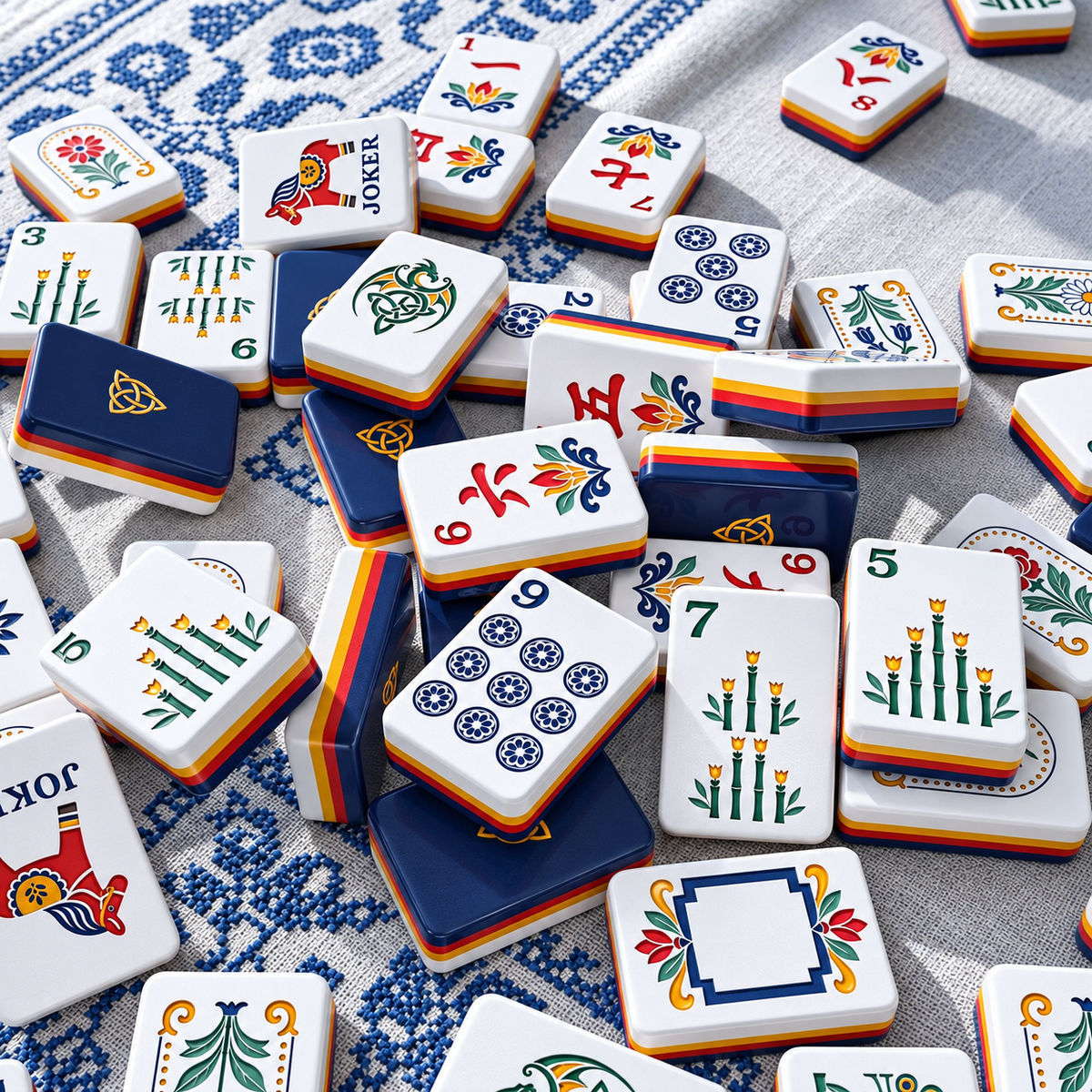
Taiwanese mahjong is moderately harder than American mahjong for beginners because it uses hand patterns you must build rather than match to a yearly card, requires memorizing point values instead of reading a printed hand list, and allows chows (sequences like 1–2–3 Bams) that American players never encounter. A complete Taiwanese set uses 144 tiles: three numbered suits plus honors (winds and dragons). If you've played American mahjong or rummy-style games, the learning curve is 2–4 weeks; for complete beginners, expect 6–8 weeks of regular play to recognize common hands and scoring combos. The core challenge isn't the tiles—it's the freedom: you're building hands by logic, not by reference. Mahstead's best-selling mahjong sets come designed for American play, but understanding Taiwanese fundamentals enriches how you approach any variant.
How is Taiwanese mahjong different from American play?
The biggest difference: American mahjong hands are locked to one printed card per year (the National Mah Jongg League card), and chows (sequences) cannot be exposed or called. Taiwanese mahjong is open-ended—you build winning combinations from logic and memorized patterns, and sequences (chows) are fully playable. American uses 152 tiles; Taiwanese uses 144 (no extra jokers). American players declare melds early; Taiwanese players often hide their hand until winning or nearly winning. Scoring in American mahjong is a point value printed on the card; Taiwanese scoring stacks multipliers based on hand complexity, bonus tiles (flowers and seasons), and winning method.

Can someone play both American and Taiwanese mahjong well?
Yes, but they require separate mental frameworks. American mahjong trains pattern-matching against a fixed menu; you learn to spot which lines on the card fit your tiles, and the Charleston tile-passing ritual adds strategy. Taiwanese mahjong trains hand-logic: you recognize that holding 1–2 Bams plus a third Bam is the seed of a pung (trio) or a chow (if you catch a 3). Many players alternate between variants and find Taiwanese slower but more social—because the hand-building is less rushed and hands don't "expire" each spring. The learning overlap is real: both require tile-counting discipline, wind-and-dragon familiarity, and fast mental math. If you know American mahjong well, Taiwanese feels more flexible and less formulaic.
What are the core hand types in Taiwanese mahjong?
Taiwanese winning hands are built from four melds (groups of three or four tiles) plus one pair:
Pung (刻): three identical tiles (e.g., three 5 Dots)
Kong (杠): four identical tiles
Chow (順): three consecutive numbered tiles in the same suit (e.g., 4–5–6 Craks)
Pair (將): two identical tiles
A winning hand looks like: pung + chow + pung + chow + pair. Or: kong + kong + pung + chow + pair. The variety is enormous compared to American mahjong's fixed-card approach. All four melds must be "clean"—no mixing honors with numbers, and every pung or chow must follow suit rules. A common mistake: beginners think they've won when they're one tile away (called "waiting" or ting), then play defensively instead of pushing for the actual win. The fastest way to internalize these is to play weekly: your hands start forming patterns after 3–4 games.
How long does it take to recognize winning patterns?
For someone with mahjong background (American or Hong Kong players): 2–3 weeks of weekly games before you see 70% of common hands quickly. For complete beginners: 6–8 weeks. The real jump happens around week four or five: your brain stops translating tiles into concepts and starts seeing hands the way experienced players do—a chow, a waiting pair, a pair of pungs forming. Taiwanese play online is slower than in-person, so table practice accelerates learning. Scoring patterns take longer (8–12 weeks) because they layer on top of hand recognition: you must know not only that you've won, but whether you've earned a double (fan), a triple, or a "clean hand" (all chows, no honors) bonus. Many learners play "points neutral" for the first month—everyone pays a flat fee, no scoring math—to build hand-speed first, then add scoring once patterns stick.
What setup and equipment do Taiwanese players actually use?
A Taiwanese set uses a standard 144-tile layout: Bams (1–9), Craks (1–9), Dots (1–9), four winds (North, East, South, West), three dragons (Red, Green, White). No flowers, no jokers, no extra tiles—the simplicity is one reason Taiwanese and Hong Kong variants are faster than American play. Most Taiwanese players use bamboo tiles (heavier, louder, more traditional) or acrylic. Racks are optional but useful for hiding your hand from opponents and organizing melds while you're deciding. A mat is essential if you're playing on an unpadded surface: it protects tiles and muffles the noise that can annoy neighbors during late-night games. The best-selling mahjong sets are configured for American play, but acrylic sets designed for any 144-tile variant work well for Taiwanese learning. If you're a serious learner, mahjong racks with pushers help you organize and conceal your hand layout, and a quality mahjong mat saves your table surface and keeps the game quiet.
Setup Element | American Mahjong | Taiwanese Mahjong | Why It Matters |
Tile count | 152 (8 jokers) | 144 (no jokers) | Taiwanese games end faster; American has more discard variety. |
Racks & pushers | Optional | Recommended | Taiwanese hand concealment is stricter; racks are valuable for competitive play. |
Mat surface | Any soft cloth | Padded felt or rubber | Taiwanese play is faster, louder; a mat protects the table and reduces noise complaints. |
Hand reference | Printed yearly card | Memorized patterns | American players consult a card mid-game; Taiwanese players must recall hand shapes. |
Scoring tracker | Printed card values | Calculator or app | Taiwanese point multipliers are complex; most serious games use a dedicated score-keeper. |
🀄 Shop best-selling mahjong sets →

What mistakes do Taiwanese mahjong beginners make most?
Playing too defensively when winning is near. Beginners hold back, afraid to discard a "useful" tile. In Taiwanese play, if you're one tile away (waiting), you must actively threaten—discard to push opponents to draw from the wall or pass the discard pool. Hesitation costs you the winning tile.
Forgetting that chows must be consecutive and same-suit. New players occasionally try 1 Bam–2 Crak–3 Dot (three different suits) and think it's valid. It isn't. Chows are always: 1–2–3, 4–5–6, 7–8–9 within one suit only.
Misunderstanding honors (winds and dragons). Winds and dragons cannot form chows—only pungs or kongs. If you hold East wind, you need two more East winds to make a pung, not East–South–West.
Ignoring tile counts. Each tile exists in exactly four copies. If three 7 Dots have been discarded and you're waiting for a 7 Dot, that's mathematically impossible. Counting visible tiles is how you shift from hope to strategy.
Declaring a win too early or playing with a hand that isn't actually winning. Always double-check: four melds + one pair, melds are valid, pair is real. A false win can mean forfeiture of the round or money penalty depending on house rules.
How does Taiwanese scoring work compared to American?
American mahjong scoring is a single lookup: find your hand on the card, read the points. Done. Taiwanese mahjong scoring is multiplicative: you earn a base point (often 2 or 4 per opponent), then multiply by the number of "fans" (doubling units) your hand contains. A hand with one fan (e.g., "all pungs, no chows") pays double. A hand with two fans ("all pungs" + "no terminals") pays quadruple (2 × 2). Some hands have bonus fans for holding flowers (in variants that use them) or for winning by "draw" versus "claim" from a discard. The math isn't hard—it's just cumulative rather than flat. A Taiwanese scoring example: your winning hand earns base 2 points × 3 fans (for three specific pattern bonuses) = 8 points. Each of the three opponents pays you 8 (or 16 if they declared, 24 if they declared and lost). By contrast, an American mahjong hand might be worth 60 or 70 points, looked up in one second. Taiwanese scoring rewards building "bigger" hands (more fans), not just any winning combination.
🎁 See our most-loved mahjong sets & accessories →
What resources help you learn Taiwanese mahjong faster?
Weekly games with patient players. This is the fastest learning. One night a week for a month is better than two hours of video alone.
Hand flashcards or apps. Many free Taiwanese mahjong learning apps (search for "麻將" or "Mahjong" on your phone's app store) show hand combos and let you practice recognition without stakes.
Scoring cheat sheet. Write down the most common fan combinations and post them at the table for the first 4–6 weeks. After that, they'll feel automatic.
Mixed-experience table. Play with one or two experienced Taiwanese players and two learning players. The experienced players can give quiet guidance without slowing the game.
Video tutorials focusing on hand patterns, not rules. Most YouTube channels cover the rules in the first 10 minutes; skip that if you've read the rules. Jump to videos that show 15–20 real hands and ask "what hand is this?" over and over.
What to check before you buy a Taiwanese mahjong set
Tile count: confirm it's 144 (no jokers, no extra blank tiles). Sets labeled "full set" usually meet this.
Suit legibility: Taiwanese tiles often have smaller fonts than American sets. Test readability under your table lighting if possible.
Weight and feel: bamboo tiles are traditional but crack over time; acrylic is durable and lighter to carry.
Carrying case or bag: if you're traveling to games, a mahjong bag or case protects tiles and simplifies setup.
Racks compatibility: if you plan to buy racks later, measure your tiles first—some racks are sized for specific tile heights.
✨ Find your Mahstead set — free US shipping →

FAQ
Is Taiwanese mahjong the same as Hong Kong mahjong?
Similar, but not identical. Hong Kong mahjong includes flowers and bonus tiles; Taiwanese uses fewer flowers or none. Hand patterns overlap 70%, but scoring rules and winning conditions differ. Most of what you learn transfers between the two, but they are distinct variants.
Can I learn Taiwanese mahjong from YouTube videos alone?
You can learn the rules, but playing live is essential. Video teaches tiles and hand shapes; live play teaches rhythm, tile-reading speed, and when to play defensively. Plan for at least one in-person game per week to internalize patterns.
Do I need a mat to play Taiwanese mahjong?
Not strictly, but it's strongly recommended. Taiwanese play is faster and noisier than American mahjong. A mat protects your table, muffles tile clatter, and signals to others that you're serious about the game. It also gives your tiles a consistent, stable playing surface.
How many jokers does a Taiwanese mahjong set have?
Zero. Taiwanese sets use exactly 144 tiles with no jokers or blanks. This is a key difference from American mahjong, which includes eight jokers in a standard 152-tile set.
If I know American mahjong, how long until I'm comfortable with Taiwanese?
About 3–4 weeks of weekly games. Your tile-recognition and hand-thinking are already strong. The main adjustment is learning that chows are playable, patterns are open-ended rather than card-locked, and scoring is multiplicative. Most American players find Taiwanese more intellectually satisfying once patterns click.
What's the best way to practice Taiwanese mahjong online?
Use apps like Tenhou or Mahjong Soul (these cater to Japanese and Hong Kong variants, which share structure with Taiwanese). Play "practice mode" with no money stakes to build speed. Note that some online platforms use slightly different scoring or hand rules, so clarify the variant before joining live games.
Are Taiwanese mahjong tiles smaller or larger than American tiles?
Typically slightly smaller, and the numbers and suit symbols are finer. This makes Taiwanese tiles look more elegant but harder to read at a distance. If you have vision concerns, look for sets with larger print or try acrylic tiles (clearer than bamboo for contrast).


View More
View More
View More
