
Chinese vs. Taiwanese Mahjong: Rules, Tiles & Key Differences
Last updated: Nov 23, 2026
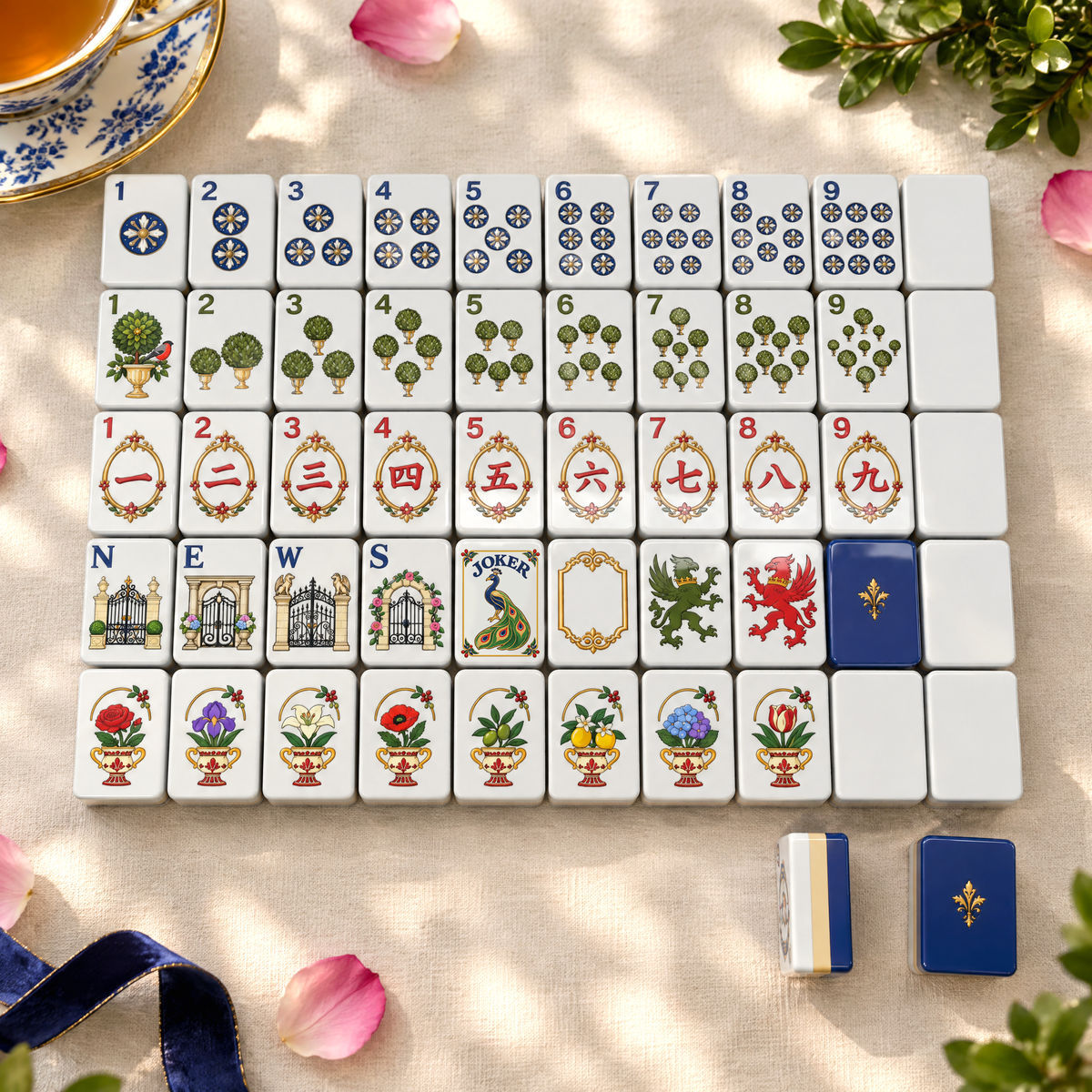
Chinese mahjong (Cantonese style) and Taiwanese mahjong are distinct regional variants that diverged from classical mahjong centuries ago. Chinese mahjong uses 136 tiles (no flowers or seasons), emphasizes melded sequences called chows alongside pungs, and awards points based on hand rarity and concealment. Taiwanese mahjong uses 144 tiles (includes flowers and seasons), prioritizes seven-pair hands and specific scoring patterns, allows both sequences and triplets, and plays with a simpler point system. American mahjong, by contrast, uses 152 tiles with fixed hand patterns from the National Mah Jongg League card—no chows allowed—and requires jokers in exposed sets. If you're hosting international players, clarify which variant everyone knows before dealing; each demands different tile sets and rule cards, and Mahstead's best-selling mahjong sets are built for American rules, though players learning other variants often start with American sets to understand the fundamentals.
What tiles do each variant use?
Chinese mahjong contains 136 tiles: four copies each of numerals 1–9 in three suits (Bams, Craks, Dots), four winds (North, East, West, South), three dragons (Red, Green, White), and nothing else—no flowers, no seasons, no jokers. Taiwanese mahjong adds eight flower tiles and eight season tiles to that base, reaching 144 tiles total. American mahjong uses 152 tiles: the same suits and numerals as Chinese, plus all four dragons and all four winds, plus eight flowers and eight jokers (jokers never play alone or in pairs). The joker is crucial in American play; without it, most hands cannot be completed because American hands are fixed and rigid. Chinese and Taiwanese players read traditional tile designs; American sets use Arabic numerals and English letters for speed and clarity. If you learned American mahjong first, Chinese and Taiwanese tiles look deceptively similar but require different counting and honor detection.

How do the hand patterns differ?
Chinese mahjong hands form from one-eyed melds (eyes, or pair) and three-part melds (four chows, four pungs, three chows and one pung, etc.). A chow is three consecutive tiles of the same suit—for example, 2 Bam, 3 Bam, 4 Bam. Pungs are three identical tiles like three 5 Dots. Players declare when they have four melds plus a pair, and the hand ends immediately. Taiwanese mahjong permits chows and pungs but emphasizes seven-pair hands (seven separate pairs) and hands that follow specific patterns such as all terminals (1s and 9s) or all honors (dragons and winds). American mahjong has no chows or sequences that can be exposed; hands consist entirely of pungs (three identical tiles), kongs (four identical), quints (five identical), or sextets (six identical). All American hands come from the official National Mah Jongg League card and must match a listed pattern exactly. A hand like "1 Pung, 2 Pung, 3 Pung" is invalid in American mahjong unless the card for that year prints it.
What are the scoring systems?
Chinese mahjong scoring is the most complex: you earn points (called "fan" or "faan") for specific combinations—concealed pungs, all terminals and honors, all one suit, seven pairs, and dozens of other rare hands. Each fan multiplies the base score, so scoring can exceed table stakes rapidly. Taiwanese mahjong simplifies this: players tally fans for similar patterns but use a fixed limit system, meaning the maximum payout per hand is capped. American mahjong awards points only for closed (concealed) hands or open (exposed) hands, with bonus points for limiting the number of jokers used or achieving all-number or all-honor melds. American scoring emphasizes strategy around joker usage and concealment; a hand that exposes many melds scores less than an identical hand played closed. Because American hands are standardized, everyone calculates the same way—no ambiguity about whether a hand qualifies. American mahjong scoring follows strict rules printed on scorecards; Chinese and Taiwanese scoring requires memorized reference tables.
Which variant is fastest to learn?
American mahjong is often easiest for rank beginners because hands are printed on the card—you match your tiles to a listed pattern, not memorize hundreds of possible hands. However, you must understand the card notation, which takes practice. Chinese mahjong is faster to start (four chows/pungs plus a pair, period) but harder to master because scoring rules are extensive and regional variations exist. Taiwanese mahjong occupies the middle ground: seven-pair hands are simple to recognize, but scoring patterns and flower/season uses require study. Players typically spend 2–3 weeks learning American mahjong patterns, 1–2 weeks learning Chinese hand formation (but months mastering scoring), and 2–4 weeks learning Taiwanese rules. Many players first learn one variant, then branch into others. Starting with American mahjong gives you tile literacy and game rhythm; switching to Chinese afterward feels less intimidating.
Can you play multiple variants with one set of tiles?
Not cleanly. A 136-tile Chinese set lacks flowers and jokers, so you cannot play American mahjong or Taiwanese mahjong without adding extra tiles. A 144-tile Taiwanese set has no jokers, making American play impossible. A 152-tile American set like those from Mahstead includes extra jokers and works for American rules but presents clutter if you're learning Chinese (you'll miscount the layout). The best practice: buy a dedicated set for each variant you play seriously. If you host games mixing variants, keep separate sets in labeled bags so players grab the right one. Mahstead offers travel bags and cases designed to hold one complete set; if you own two or three variants, invest in distinct cases to avoid mid-game confusion. The cost of a second set is far less than the frustration of mismatched tile counts derailing a game night.
Variant | Tile Count | Flowers | Jokers | Hand Type | Complexity | Best For |
Chinese | 136 | No | No | Chows + Pungs | Very High | Experienced players, regional play |
Taiwanese | 144 | Yes | No | Chows + Pungs + Pairs | High | Mixed skill levels, pattern lovers |
American | 152 | Yes | Yes | Pungs, Kongs, Quints only | Medium | New players, weekly casual games |
🀄 Shop best-selling mahjong sets →

What rule variations exist within each variant?
Chinese mahjong has no single official ruleset—Cantonese, Shanghai, and other regional schools disagree on whether certain hands score higher or whether flowers count. Players in Guangdong follow one scoring table; players in Shanghai follow another. Before you sit down, ask "What house rules?" and negotiate. Taiwanese mahjong is more standardized but still permits house tweaks (some tables pay double for seven-pair hands, others don't). American mahjong is the most rigid: the National Mah Jongg League publishes one card each spring, and that card governs all sanctioned play. If your local club plays American, everyone uses the same card. This rigidity makes American easier for beginners but less creative for veterans. When you join a new group, always ask which ruleset they follow and whether they've adopted house tweaks; a "friendly game" may not use official rules at all.
How do the winning mechanics work?
In Chinese mahjong, a player wins by declaring when they hold one eye and four melds, period. No special draws, no bonus hands—matching the structure ends the hand. In Taiwanese mahjong, the player wins by completing a listed pattern (seven pairs, all terminals, specific suit combinations) and declaring; again, the declaration triggers the payout. In American mahjong, a player wins by exposing or concealing a hand that exactly matches a pattern on the current year's National Mah Jongg League card. The hand must be played to the card; a hand that is "almost there" does not count. American winners also interact with draws: if nobody wins by the time the wall is depleted, the hand is a draw and no one scores. Chinese and Taiwanese games rarely end in draws; American games end in draws regularly. This difference affects strategy dramatically—American players must sometimes discard high-value tiles defensively to prevent an opponent from winning, whereas Chinese and Taiwanese players focus on building their own hand.
Which variant suits which type of player?
Chinese mahjong attracts players who love mathematical complexity and cultural depth. Scoring is like a puzzle; mastering it takes years and feels rewarding. Players in Chinese communities often play for small stakes and view the game as a lifetime study. Taiwanese mahjong appeals to players who want structure without extreme complexity—you recognize seven-pair hands and clear patterns, but you're not drowning in fan calculations. Taiwanese play is social and fast-moving. American mahjong suits players who want clear rules, no ambiguity, and an even learning curve. Everyone at the table uses the same card; no one can argue about whether a hand "counts." Americans also love the competitive league structure—tournaments exist, rankings are tracked, and a winning hand is objectively correct. If your friends include a mix of backgrounds, offer to rotate variants or pick one and commit to learning it deeply as a group.
What should you buy if you're learning a second variant?
If you know American mahjong and want to learn Chinese, buy a dedicated 136-tile set with clear tile markings (numerals and suit symbols). If you know American and want Taiwanese, purchase a 144-tile set. Do not try to "convert" an American set by removing jokers; you'll lose pieces and confuse yourself. Also buy a rules card, reference guide, or scorecard specific to that variant—many variants are unwritten regional traditions, so a printed guide helps. When choosing a set, prioritize readability: can you see the numbers and suits from across the table? Acrylic tiles are durable and slide smoothly; bamboo and bone sets look beautiful but wear faster and can be slippery. Mahstead's best-selling mahjong sets use acrylic and engraved numerals, making them ideal for learning American rules; when branching to other variants, look for sets with similar clarity and durability. Also invest in a padded travel bag or case labeled with the variant name—this prevents mix-ups if you own multiple sets.
🎁 See our most-loved mahjong sets & accessories →
What to check before you buy
Tile count: Confirm your chosen variant (Chinese = 136, Taiwanese = 144, American = 152). Buying the wrong count wastes money.
Tile markings: American sets use Arabic numerals; Chinese and Taiwanese sets use traditional characters. Both are fine, but switching styles midstream is confusing.
Jokers: American play requires jokers; Chinese play forbids them. Check the set description.
Racks and pushers: Some variants prefer racks with pushers to organize melded tiles; others play without racks. Ask your group before buying.
Regional availability: Chinese and Taiwanese sets are common in specialty Asian stores and online; American sets are widely available. Mahstead specializes in American sets; if you need a different variant, verify the seller before purchasing.
Set condition: Used sets may have missing tiles or faded markings. New sets come complete; inspect upon arrival.

FAQ
Can I play American mahjong with a Chinese or Taiwanese set?
No. American mahjong requires jokers (which Chinese sets lack) and a fixed tile count of 152. Chinese and Taiwanese sets will be short tiles, making play impossible.
Which variant has the fastest average hand?
Taiwanese mahjong often ends fastest because seven-pair patterns are straightforward to build. Chinese mahjong can be quick or long depending on scoring complexity. American mahjong speed depends on how fast players recognize card patterns.
Do I need a different mat or rack for each variant?
No. A mahjong mat with pushers or racks works for any variant. The tile count changes, not the playing surface.
If I know American mahjong, will Chinese feel familiar?
Partially. Tile suits and numerals are identical, and pungs work the same way. But American players find the absence of fixed hand patterns, the presence of chows (sequences), and the complex scoring deeply foreign at first.
Can a beginner pick up Chinese or Taiwanese mahjong in one evening?
Chinese and Taiwanese hand formation takes 1–2 hours to understand at a surface level. Scoring takes weeks to internalize. American mahjong typically requires 2–3 hours of practice before a new player plays smoothly.
Are Taiwanese and Chinese mahjong compatible if I learn both?
Mostly yes. Tile composition overlaps (Taiwanese adds flowers and seasons to the base Chinese set). However, hand patterns and scoring rules differ, so mixing them midgame causes errors. Learn them as separate games.
What's the easiest variant for a solo player to practice?
American mahjong is easiest to practice alone because you can lay out the card and arrange tiles against it without memorizing scoring tables. Chinese and Taiwanese require opponents or a training partner to discuss hands.
If my local group plays Chinese but I own an American set, can I buy extra jokers to adapt it?
No. Chinese mahjong forbids jokers entirely. Jokers would sit unused and could confuse play. Buy a proper 136-tile Chinese set instead.


View More
View More
View More
