
Chinese Official Mahjong Rules: Complete Guide for Western Players
Last updated: Nov 23, 2026
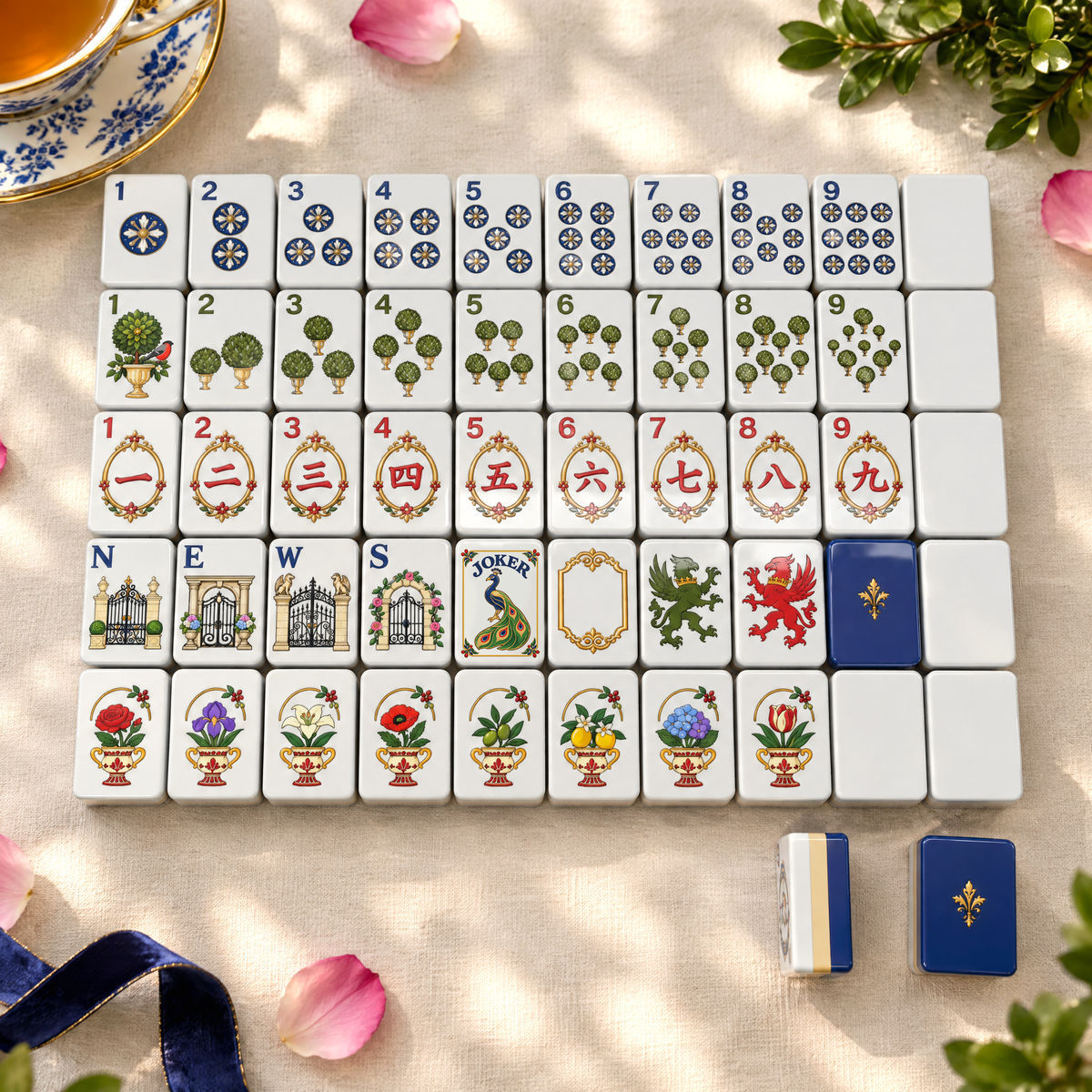
Chinese official mahjong uses 144 tiles (three suits of 1–9 in Bams, Craks, and Dots; 16 winds; 12 dragons; 8 flowers), and a player wins by forming four melds (pungs, kongs, or chows—runs of three consecutive numbers in one suit) plus a pair. Unlike American mahjong, chows are allowed and central to play; players can declare and expose them, and jokers do not exist in standard Chinese rules. Hands are not drawn from a reference card; instead, winning patterns follow fixed logic (e.g., all pungs, a mixed sequence hand, or a "heavenly win" if East draws a winning tile immediately). The hand-drawing and discard cycle is faster, and scoring depends on the point value of your hand (fan) and the base unit (fu), with payments flowing between players based on who discards the winning tile and your seating position. A game uses exactly 144 tiles; sets sold in the West often include extra jokers and blank tiles for house rules. Mahstead's best-selling mahjong sets support American play; if you're learning Chinese rules, confirm your set includes the standard 144-tile count and lacks jokers before play.
What are the four winning melds in Chinese mahjong?
A winning hand in Chinese mahjong contains exactly four melds (groups) plus one pair (eye). A meld is three identical tiles (pung), four identical tiles (kong), or three consecutive tiles in one suit in numerical order (chow). For example: three 5 Bams (pung), four 2 Craks (kong), 4-5-6 Dots (chow), and three 1 Winds (pung), plus two 3 Bams (pair) forms a legal win. Chows cannot include the same suit mixed with numbers wrapping around zero; 8-9-1 is not valid, nor is 9-1-2. American mahjong forbids chows entirely, so this is the single biggest mental shift for Western players learning Chinese rules.

How do you draw and discard tiles in Chinese mahjong?
The game begins with East drawing 14 tiles; each other player draws 13. East then discards one tile face-up onto the table center, and play passes counter-clockwise (or clockwise, depending on regional house rule). Each player in turn draws one tile from the wall and discards one, keeping 13 tiles in hand at all times. If a discarded tile completes a meld for another player—a pung, kong, or chow—that player can claim (win) it immediately, or pass. The first player to form four melds plus a pair, either by drawing from the wall or claiming a discard, declares "mahjong" and wins the round.
What is "fan" and "fu" scoring in Chinese mahjong?
Fan (翻, or "double") measures the hand's complexity and rarity; fu (符, "base points") counts the hand's structural components. A hand needs at least one fan to be valid; typical scoring awards 1–8 fan for patterns like a pung of dragons (1 fan) or an all-chow hand (1 fan), with bonuses for concealed melds (unrevealed pungs or kongs declared at win). Fu is calculated by counting exposed melds (1 fu each), the pair type (honor or terminal pairs worth more), and the drawing method (self-draw vs. discard claim). Total hand value in points is determined by multiplying base points (usually 20 fu × 2^fan) by the seating arrangement (East pays double; non-East players pay or receive evenly). A beginner's hand might be worth 1–2 fan; a strong hand 6+ fan. American mahjong assigns a fixed point value per hand from the reference card, so Chinese scoring is more math-intensive and requires mental calculation at the table.
Can you win on your first tile (heavenly win) in Chinese mahjong?
Yes. A "heavenly win" (or "blessing of man" if another player wins first draw, or "heavenly hand" if East wins on the first draw before anyone else plays) is worth extra points and occurs when a player forms a winning four-pung or four-chow hand without picking up any tiles from active play—drawing only from the original deal or drawing the very first tile from the wall. This is rare and prized because it signals either luck or a table error (if East discards winning first). Some versions of Chinese mahjong reward this with bonus fan; other house rules ignore it. American mahjong has no analogous rule because all hands come from the reference card, and the game structure prevents such immediate wins.
What are the main regional differences in Chinese mahjong rules?
Chinese mahjong has no single "official" ruleset; major variants include Cantonese (Hong Kong), Shanghai, Sichuan, and Taiwanese styles, each with unique hand-pattern requirements, scoring multipliers, and restrictions on chows. Cantonese/Hong Kong mahjong is the most widely played internationally and allows chows; Taiwanese mahjong restricts them to specific hand patterns and uses 16 flowers instead of 8. Shanghai mahjong forbids open chows in many cases and emphasizes pung-heavy hands. Sichuan emphasizes bonus tiles (flowers, seasons) and jokers (called "lao" or "big ghost") that rank above standard tiles. Japanese Riichi mahjong uses a simpler 34-tile base (one copy of each tile) dealt four at a time, hidden hand declarations, and a completely different win/payment structure. When learning Chinese mahjong, confirm with your group whether you're playing Cantonese (the safest default), ask about flower values, and clarify whether jokers are in play—house rules differ radically. American mahjong is entirely separate; the 152-tile deck, hand reference card, and no-chow structure make it a distinct game.

Comparison Table: Chinese vs. American Mahjong
Feature | Chinese (Standard) | American |
Tile count | 144 | 152 (+ 8 jokers) |
Suits | Bams, Craks, Dots; Winds; Dragons; Flowers | Same, no flowers in standard NMJL |
Chows allowed? | Yes, core to play | No, never |
Jokers | None in official rules | Required in every hand |
Hand source | Logic-based patterns | NMJL reference card (annual) |
Winning melds | 4 melds + 1 pair | 4 melds + 1 pair (jokers count as tiles) |
Scoring | Fan + fu (fan doubles points) | Fixed point value per card line |
Joker placement | N/A | Never in pairs; in pungs/kongs/quints only |
Exposed melds | Pungs, kongs, chows allowed | Pungs, kongs, quints, sextets allowed |
Reference card? | No | Yes, mandatory annual card |
🀄 Shop best-selling mahjong sets →
What to check before you buy a Chinese mahjong set
If you're learning Chinese official rules, verify the set contains exactly 144 tiles and lacks jokers (unless your house explicitly adds them). Many sets marketed as "144 tile" actually include spare jokers or blanks—ask the seller whether the playing count is truly 144 and nothing more. Check that tiles are printed with clear numbers (1–9) in each suit and legible wind/dragon characters; cheap sets often have smudged paint that makes reading difficult mid-game, especially under table lighting. Confirm the tile size: most Chinese sets use smaller tiles than American sets (typically 27–28 mm vs. 30+ mm for Western play), which can feel cramped for players with larger hands or lower vision. If you're hosting weekly games with mixed skill levels, a set with raised numbers on all four sides helps newer players read tiles faster without picking them up. Fabric mats or wood racks aren't strictly required for Chinese play, but a cloth playing surface protects tiles and reduces noise—especially important if you're learning in a shared space.
How to teach Chinese mahjong to American players
Start by emphasizing that chows (1-2-3, 4-5-6, 7-8-9 in one suit) are legal and encouraged in Chinese play; this is the biggest mental hurdle. Play three practice rounds where players openly declare all melds and discuss the logic out loud. Use a cheat sheet showing 3–4 simple winning patterns (all pungs, mixed chows, dragon pung) pinned at the table; don't overwhelm with fan/fu until players grasp hand formation. Let everyone play East (the role that draws first and discards last), so turns feel fair. Expect the first session to last 30–40 minutes per round; Chinese mahjong is slower than American because no reference card speeds up hand confirmation. If your group comes from American mahjong, warn them that jokers don't exist, so every hand must be formed from the 144 tiles only—no wildcards to rescue a near-miss.
🎁 See our most-loved mahjong sets & accessories →
Why learn Chinese mahjong if you already play American?
Chinese mahjong teaches the original tile logic that all Western variants inherit; it's faster to read a hand once you understand chows and fan/fu are simply different scoring language, not a harder game. Many international tournaments and multi-generational families play Chinese mahjong, so learning it opens doors to broader mahjong communities. The math (fan × fu) sharpens mental arithmetic, and the speed and fewer-tile deck make it ideal for quick weeknight games. If you already host American mahjong nights, adding a Chinese round once a month keeps the group engaged and breaks up repetition. Finally, Chinese mahjong requires no annual reference card, so you can play anywhere without updating rules yearly—a practical freedom American players don't have.
✨ Find your Mahstead set — free US shipping →

FAQ
Do I need a joker in Chinese official mahjong?
No. Standard Chinese mahjong uses 144 tiles with no jokers. Some house rules add jokers as wild tiles, but official play forbids them entirely. Always confirm your group's house rules before buying a set.
Can a chow wrap around in Chinese mahjong, like 9-1-2?
No. Chows must be consecutive within the same suit without wrapping (1-2-3 through 7-8-9 only). A 9-1-2 is illegal because it treats the sequence as circular, which standard rules do not allow.
How do I calculate fan and fu at the table quickly?
Assign 1 fan for simple hand patterns (dragon pung, mixed chows) and add 1 for each concealed meld. Count fu by adding 1 per exposed pung/kong and bonus points for terminal or honor pairs. Many players reference a small fan/fu chart on the table or use a calculator until they memorize common hands.
If I learn Chinese mahjong, can I switch to American mahjong easily?
Yes, with effort. The biggest shift is that American mahjong forbids chows, requires jokers in every hand, and uses a reference card instead of logic. Many players play both; start with one variant per night to avoid confusion, and review the house differences before each game.
What is the most beginner-friendly Chinese mahjong variant?
Cantonese (Hong Kong) mahjong is the most widely taught internationally and has the clearest hand patterns. It allows chows, uses the standard 144-tile set, and has consistent fan/fu scoring. Taiwanese and Shanghai variants add house-rule complexity that frustrates learners, so start with Cantonese and branch out once you're comfortable.


View More
View More
View More
