
Chinese Mahjong Tournament Rules: Play Like a Pro
Last updated: Nov 23, 2026
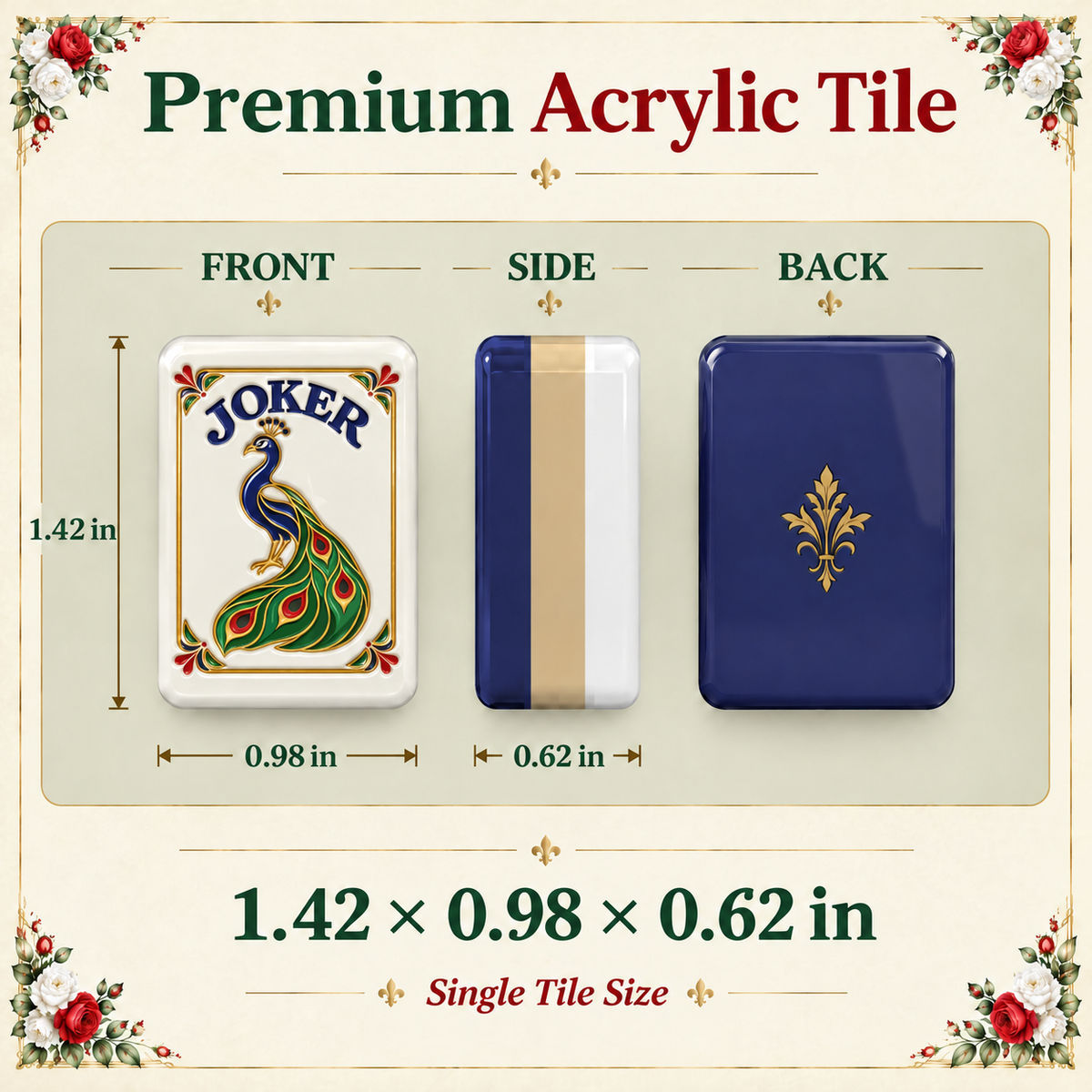
Chinese mahjong tournaments run under standardized national rulesets that vary slightly by region (Mainland, Hong Kong, Taiwan). Most use 136 or 144 tiles (four suits: Bams, Craks, Dots, Honors—each with four copies of 1–9, plus Dragons and Winds). Unlike American mahjong, Chinese variants allow sequences (chows) of three consecutive tiles in one suit, exposed alongside pungs (three identical) and kongs (four identical). A winning hand (called "Mahjong" or "Hu") must consist entirely of melds and a pair, scored by hand type and multiplier value ("fan" or "points"). Tournaments use a fixed seating rotation, play 4 rounds, and rank players by cumulative score. No annual card is needed—hand types are memorized or referenced in official guides. Preparation includes learning the standard hand catalog, practicing fast tile recognition, and understanding draw/discard rhythm under time pressure. Mahstead offers high-quality acrylic sets suitable for home practice that mirror tile sizing and weight used in tournament play.
Chinese mahjong tournaments operate under a structured ruleset designed for fairness and consistent play across regional and international competition. Unlike American mahjong—which pins all legal hands to the current year's National Mah Jongg League card and prohibits sequences altogether—Chinese tournament play allows and requires sequences as core meld types. The game emphasizes hand ranking, bonus calculations, and a closed-hand mechanic (tiles stay face-down until declaration). Understanding these differences is essential before entering any Chinese mahjong tournament, whether local, provincial, or international.
What tiles and counts do Chinese tournaments use?
Most Chinese tournament formats play with 136 tiles (144 in some regional variants). The standard 136-tile set contains four suits—Bams, Craks, Dots, and Honors—each with 1–9 in the numbered suits plus a 10-tile Honors suit (four Winds: N, E, S, W and three Dragons: Red, Green, White). Each tile exists in four copies. The draw consists of 13 tiles per player (East dealer draws 14); one tile remains in the wall as the "Kong dead zone." Gameplay draws from the wall one tile at a time; discard occurs after the meld window closes, keeping hand size constant until "Mahjong" is called.

How do sequences differ from American pungs?
Chinese mahjong requires and rewards sequences (or "chows"): three consecutive tiles of the same suit, such as 4–5–6 Dots or 1–2–3 Bams. A single hand may contain one, two, or more sequences, always mixed with pungs (three identical tiles) and kongs (four identical). American mahjong forbids sequences and allows only exposed pungs, kongs, quints, and sextets. A Chinese tournament hand always ends with exactly one pair (two identical Honors, Dragons, or numbered tiles); the pair cannot be part of a meld. This structural rule—sequence + pung + pung + pair, for example—is rigid and foundational to hand legality.
What hand types win and how are they scored?
Chinese tournament scoring assigns "fan" (or "points") to hand types based on rarity and complexity. A basic winning hand (1 fan) might be "One Pung, One Sequence, One Pair." Higher-value hands include "All Pungs" (no sequences), "Dragon Pung" (a pung of one Dragon type), or "All Honors" (only Wind and Dragon tiles, no numbered suits). Some hands—like "All Chows" or "Seven Pairs"—carry 2–3 fan. The rarest hands (e.g., "Thirteen Unique Honors," "All Green," or "All Terminals") score 6–8 fan or a table maximum. Each fan doubles the base score or adds a fixed increment (rule variant). Scoring multipliers apply if a player draws from the wall (higher) versus discarding (lower draw). Regional rulebooks define the exact fan table; players memorize or reference printed hand catalogs during tournament play.
🀄 Shop best-selling mahjong sets →
How does play tempo and draw-discard order work in tournaments?
Tournament play enforces strict turn order: the dealer (East) draws from the wall first. After tile recognition and meld evaluation, the player discards one tile face-up. Each subsequent player (South, West, North, back to East) either passes or calls a meld (pung, kong, or chow) on the most recent discard. If called, the meld is rotated and exposed; the player who made the meld discards next. If the discard passes all three players uncalled, play moves to the next player's draw. Time pressure is common: tournament rules often set a 10–30 second draw-and-discard window per player, enforced by a table judge. Under this tempo, tile organization in a rack, hand memory, and rapid decision-making become competitive skills. Errors—such as exposing a tile prematurely, calling a dead tile (one already used in a kong), or declaring a dead hand—result in penalties or automatic loss of the hand.

What are the major regional rule differences in tournaments?
Mainland China, Hong Kong, Taiwan, and international federations each maintain distinct tournament rulesets. Mainland tournaments (e.g., under the "National Mahjong Competition Rules") define a 136-tile set with 8 Flowers and 8 Seasons; winning hands score by a tiered fan system with a fixed top-score cap. Hong Kong mahjong ("HK Mahjong," often 144 tiles) emphasizes multiple winning tile types and "goaltenders" (tiles that declare as Mahjong); scoring uses a point multiplier called "doubles" and reward for self-drawn ("tzing") versus discarded wins. Taiwan's variant allows a slightly wider hand catalog and regional celebratory melds. International tournaments ("WMJC" events) typically adopt Mainland rules for consistency but may layer local house rules on draw-tie protocols and kong penalties. Before entering a specific tournament, confirm which ruleset applies: ask the organizer for the official hand catalog and scoring document, and practice under that exact frame for 4–6 weeks to build pattern recognition.
🎁 See our most-loved mahjong sets & accessories →
Variant | Tile Count | Hand Structure | Scoring Basis | Best For |
Mainland/National | 136 | Sequences + Pungs + Pair | Fan-based multiplier | Official domestic tournaments |
Hong Kong | 144 | Sequences + Pungs + Pair | "Doubles" multiplier + bonus tiles | Regional & international play |
Taiwan | 136–144 | Sequences + Pungs + Pair | Mixed fan/point system | Local tournament circuits |
American | 152 (no sequences) | Pungs, Kongs, Quints + Pair | Hand type on annual card | Weekly games, not tournaments |
What should you practice before your first tournament?
Competitive Chinese mahjong demands skill drilling in three areas: (1) Hand memorization—learn the official hand catalog by category (sequences, pungs, Honors, mixed, special). (2) Tile and suit recognition—practice rapid visual scanning to spot melds in your hand under a 10-second time limit. (3) Discard strategy—study which tiles are safer to discard early (high Honors, terminals) and which increase danger (mid-range Dots, Craks common in many hands). Join a local practice group 4–8 weeks before tournament entry; play under tournament tempo with a phone timer. Track your win rate and which hand types you call versus miss. For home practice, a high-quality best-selling acrylic set with clear tile markings and a sturdy rack accelerates pattern recognition because tile feel and visual clarity match tournament environments more closely than entry-level plastic tiles.
What to check before you buy a set for tournament prep
Tile material: Acrylic or bone-bamboo resin tiles are standard for tournaments; avoid thin plastic.
Tile size: Verify the set fits your hand comfortably; tournament tiles are typically 30–32 mm.
Meld visibility: Ensure Dragons and Honors are easily distinguishable at a glance.
Rack depth: A rack with pushers allows fast tile hiding and exposure mimics tournament mechanics.
Tile count: Confirm you have the correct tile inventory for your ruleset (136 vs. 144 tiles).
Spare tiles: Extra blank tiles or jokers are useful for marking Kong dead zones during practice.
✨ Find your Mahstead set — free US shipping →

FAQ
Can I use the same tile set for American and Chinese mahjong tournaments?
No. American mahjong uses 152 tiles with no sequences and a fixed annual hand card; Chinese tournaments use 136–144 tiles with sequences and open hand catalogs. Tile counts, suit compositions, and legal hand structures are incompatible. Each requires its own set to play by tournament rules.
How long does a typical Chinese mahjong tournament last?
A standard tournament runs 4 rounds (East, South, West, North seating rotation); each round takes 1–2 hours depending on player count and time-per-hand limits. A full tournament typically spans 4–8 hours plus breaks. Check the tournament schedule before registering.
What does "fan" mean and how does it affect my score?
"Fan" (or "points") is the hand-ranking multiplier in Chinese scoring. A 1-fan hand (e.g., "All Chows") scores the base value; a 2-fan hand doubles it, and so on. Higher-rarity hands (6+ fan) often hit a table maximum cap. Study the official hand catalog for your ruleset to learn which patterns yield the highest fan.
Is drawing a tile from the wall worth more than a discarded tile?
Yes, in most Chinese tournament rulesets. A self-drawn win ("tzing") scores higher than a win off a discard because it demonstrates hand management skill and luck. The bonus multiplier varies by ruleset; confirm in your tournament's official scoring guide.
How do I know which tiles are "dead" or forbidden to call?
Dead tiles are those already exposed in a Kong on the table or discarded in a previous round. Tournament play displays them openly; the dealer or judge may mark Kong dead zones. Always verify before calling a meld; calling a dead tile results in a hand penalty or automatic loss.
Where can I find the official hand catalog for my tournament?
Request it from the tournament organizer or check the national mahjong federation website for your region (Mainland, Hong Kong, Taiwan, etc.). Hand catalogs are printed booklets or PDFs; some tournaments provide them at registration. Study it for 4–6 weeks before your first match.


View More
View More
View More
