
Chinese Mahjong Minimum Points to Win: How Much Do You Need?
Last updated: Nov 23, 2026
In Chinese mahjong, you must score at least 8 points (2 fan × 4 base points) to win most games, though house rules vary widely. Unlike American mahjong—which relies on the National Mah Jongg League card and fixed hands—Chinese variants (Cantonese, Shanghai, Sichuan, Riichi) use pattern-based fan scoring: a "fan" is a pattern multiplier, and you combine fans with base points to reach the threshold. Winning requires declaring "mahjong" (called "hu" or "tsumo" in variants) with tiles that match your declared pattern. Riichi mahjong, played with 136 tiles and simpler patterns, typically needs just 1,300 points minimum. Rules and minimums shift dramatically by region and house custom, so clarify your group's rules before starting—we recommend keeping a printed reference card at your table.
Chinese mahjong scoring differs fundamentally from American mahjong. Instead of matching hands to a seasonal League card, Chinese variants use fan-based pattern recognition. A fan is a scoring multiplier: each pattern (a straight, a pung, a terminal tile sequence, etc.) contributes one or more fan points. You must accumulate enough fans and base points to cross your table's winning threshold—typically 8 points minimum in casual play, though competitive games may demand 12 or 24 points.
The core principle: tiles alone don't win; only valid pattern combinations crossing the point floor do. This means a "near-win" hand with 7 points stays locked until you draw or discard into a valid, higher-scoring pattern.
What does "fan" mean and how does it score?
A fan is a scoring unit that multiplies your hand's base value. Most Chinese variants start with a base of 2, 4, or 8 points per fan—the exact number depends on whether you drew the winning tile (self-drawn, or "tsumo") versus another player discarded it. One common system: 1 fan = 2 points base, 2 fan = 4 points, 3 fan = 8 points, escalating to maximums of 78 or 88 points at top tiers. Each pattern you complete—a pung of Dragons, a sequence of terminals, a hand of all one suit—adds one fan. Simple hands score 1–2 fan; complex hands (all honors, outside sequences only, matching wind and dragon) score 5+ fan. The table's agreed threshold (often 8 points) is your unlock: once you hit it and declare mahjong, you win the round.

How do fan combinations work in practice?
Imagine you hold Craks 2-3-4, a pung of Red Dragons, a pung of White Flowers, and Dots 1-1. You draw Dots 1, completing a pung. Let's score:
Pung of Dragons = 1 fan (2 points base).
Pung of Flowers = 1 fan (2 points base).
Pung of Dots = 1 fan (2 points base).
Simple sequence = 0 fan (no bonus for straights in basic rules).
Total: 3 fan = 8 base points. In most house games, 8 points meets the minimum to win. You declare mahjong; the hand scores and settles. If your minimum were 12 points (6 fan), this hand would still be locked. Variations swap in bonus patterns: all simples (no terminals or honors) add 1 fan; a hand of all one suit adds 2 fan; all terminals add 2 fan. Bonus stacking is where casuals often disagree—some rules say bonuses combine freely; others cap them or forbid certain stacks. Ask before the first tile falls.
What's the difference between Riichi, Cantonese, and Shanghai rules?
Riichi mahjong (Japanese variant, 136 tiles) is the most standardized internationally. Standard winning threshold: 1,300 points or higher, depending on discard circumstances and pattern rank. Patterns are codified; fan is called "meld rating" and ranges from 1–6 han (han = fan equivalent). A single-han hand (e.g., one pung of your wind, one of the round's wind) scores ~1,000–1,300 points—just enough to cover the minimum. Double han scores 2,000+. Riichi is rule-dense but consistent across clubs.
Cantonese (Hong Kong) mahjong uses 144 tiles, allows 13 orphans (one each terminal and honor per suit), and typically requires 4–5 fan minimum in casual games, or 6 fan competitive. Scoring uses a "base" of 8, 16, or 32 points per fan depending on hand complexity and whether you self-drew. The "limit" (maximum) is often 78 points for casual tables. Cantonese allows many Hong Kong-specific bonuses (flower melding, "eyes" of matching winds/dragons).
Shanghai/Sichuan mahjong is more variable. Shanghai often demands 8 points (2 fan) minimum on a base of 4, though some clubs set it at 12 or 24 points. Sichuan allows melds of simples only, bans certain honors patterns, and can require 5+ fan minimums. No universally binding authority exists—each table's written rules take precedence.
The takeaway: if you're joining a new group, ask "What's the winning minimum in points?" and "How many fan does each pattern count?" before sitting down. We've watched newcomers lose gold over a 4-point vs. 8-point threshold miscommunication.
Why does American mahjong score completely differently?
American mahjong scoring is not fan-based; it's card-based. The National Mah Jongg League card (updated every spring) lists 78–100 legal hands for that year only. Each hand has a fixed point value (typically 20–120 points per win, depending on the hand's rarity and difficulty). You match your tiles exactly to a hand on the card and declare mahjong if you've won.
There's no "minimum threshold" in American play—your hand either matches the card or it doesn't. You can't partially score; no hand that's "close" counts. American mahjong also forbids sequences (chows) in exposed melds; you may only expose pungs (3 identical), kongs (4 identical), quints (5), and sextets (6). Chinese variants allow sequences freely.
If you've played American, switching to Chinese feels radical: you're suddenly playing patterns and fans instead of memorizing a card. Many players find Chinese more mathematical and improvisational; Americans find it more regimented and familiar. The good news: knowing both makes you adaptable.

How do regional house rules change the winning minimum?
House rules vary by neighborhood, culture, and table age. Here are the most common shifts:
Variant | Base Minimum | Usual Range | Why It Shifts |
Riichi | 1,300 points | 1,000–2,000 | Speed of play; competitive vs. casual |
Cantonese casual | 4–5 fan (32–40 pts) | 4–6 fan | Table preference; how loose/tight the group plays |
Cantonese competitive | 6 fan (48 pts) | 6–7 fan | Official club rules; regional federation rules |
Shanghai | 2 fan (8 pts) | 2–6 fan | Enormous variation; ask explicitly |
Sichuan | 5 fan (varies) | 5–8 fan | Honors bonuses; dragon/wind combos shift scoring |
Money games often raise the minimum (6+ fan or 1,500+ points) to slow rounds and raise stakes. Friendly family games lower it (2–4 fan) to speed play and keep everyone in the pot. Competitive club play tends to standardize (Riichi: strict 1,300; Cantonese: 6 fan official).
The worst scenario: sitting down, playing 20 minutes, and discovering your "winning" hand is below the table's threshold. Prevention: ask your host or the most senior player to write down the exact minimum, how fan stack, and whether draws are possible if two players tie on points.
🀄 Shop best-selling mahjong sets →
What tiles and accessories help you master different scoring systems?
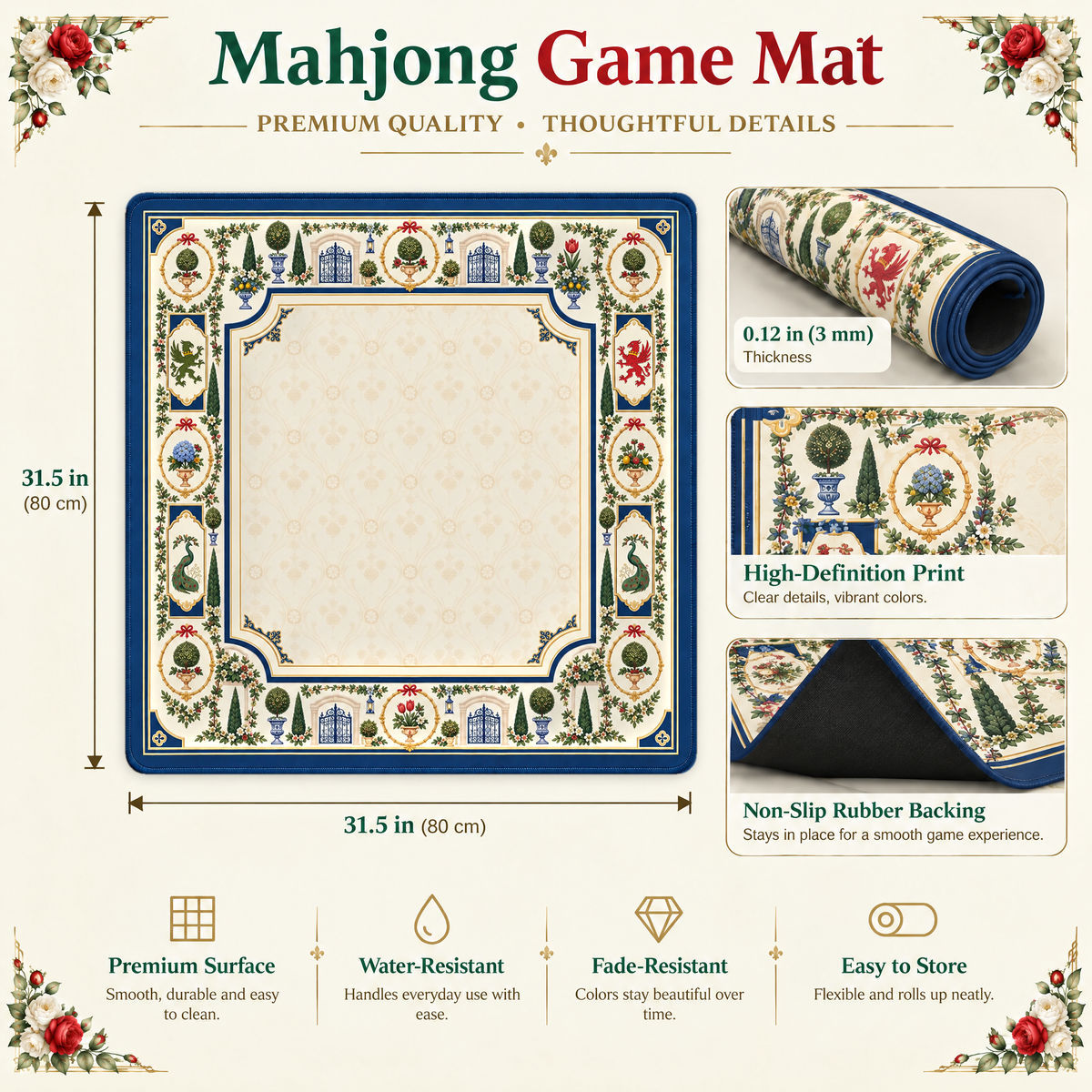
To stay sharp across variants, you need the right reference setup. Keep a printed or laminated scoring card at the table—most Chinese clubs sell region-specific versions. We recommend playing with a durable mahjong mat with a reference area so everyone can see the fan/point chart during play.
For Riichi players, invest in a set with clear tile pip markings (numbers and suit symbols must be legible under low light). For Cantonese, a set with distinct flower designs helps you ID bonus tiles faster. Our best-selling sets are acrylic with engraved numerals, so pips never fade during hundreds of rounds—crucial for avoiding scoring disputes.
A rack with a pusher keeps your tiles tidy and prevents the accidental, mid-calculation tile shift that costs you points. And if you travel between game venues (or play multiple variants), a sturdy bag or case protects your set's tile faces and alignment—scoring disputes often stem from damaged, misaligned tiles that look alike under poor lighting.
🎁 See our most-loved mahjong sets & accessories →
When do draws happen, and how do scoring minimums affect them?
A draw (or "tie") occurs when the deck runs out before anyone completes a legal winning hand. In American mahjong, draws are uncommon (nearly all hands on the card are reachable within 16 draws). In Chinese variants, draws are normal, especially at high minimums.
If your table's minimum is 24 points (6 fan), expect more draws: fewer players will qualify fast enough. If it's 8 points (2 fan), the first player to complete any small pattern wins quickly—draws are rare.
Some rules allow "walls" (consolation payouts): if no one wins after the deck closes, the player closest to winning collects a small pot. Others simply replay. Ask before the first wall is broken: "What happens if nobody wins?" and "Does the minimum matter for a draw round?" Some groups lower the minimum in the next hand after a draw, to accelerate play; others keep it fixed.
What to check before you buy:
Ensure your set's tile size matches your table's racks (1 1/4″ or 1 3/8″ standard).
Confirm the set contains exactly 144 tiles (Chinese) or 152 tiles (American); extra jokers/blanks are spares and never enter play.
Test tile weight and shuffle ease—light, slippery tiles invite misdeals and disputes.
Verify engraving is legible; faded pips cause scoring confusion and delays.
✨ Find your Mahstead set — free US shipping →

FAQ
Is 8 points always the minimum to win in Chinese mahjong?
No. 8 points is common in casual Cantonese and Shanghai play, but Riichi requires ~1,300 points, and competitive Cantonese often demands 12+ points. Always ask your table's rule keeper before the first hand.
Can I win a 7-point hand if I'm one fan short?
No. A hand below the agreed threshold is "incomplete" and stays locked. You must draw or wait for a discard that pushes you to the minimum or above to declare mahjong legally.
How do American and Chinese scoring thresholds compare?
American mahjong has no "minimum points"—your hand must match the year's League card exactly or it doesn't win. Chinese uses a fan/point threshold (typically 2–6 fan, or 8–48 points). They're incompatible systems; the games aren't cross-scored.
What if two players qualify to win in the same discard?
Most rules say the player closest to the discard source wins (e.g., the player after the discarder gets priority). Some use "first declared" (fastest to call mahjong). Clarify this before play; it settles disputes instantly.
Do bonuses (all one suit, all terminals) always count toward the minimum?
Usually yes—bonuses add fan, which raises your point total. However, some house rules cap or forbid certain bonus stacks. Write down your table's bonus rules visibly; it prevents replayable hands.
Can the winning minimum change mid-game?
In most games, no—the minimum is set for the round. In very casual family play, some groups reset it per hand (e.g., "8 points for this hand, 12 for the next"). This is non-standard; only accept it if stated explicitly before dealing.


View More
View More
View More
