
Can You Play Mahjong Without Racks? Yes—But Here's Why You Shouldn't
Last updated: Nov 23, 2026
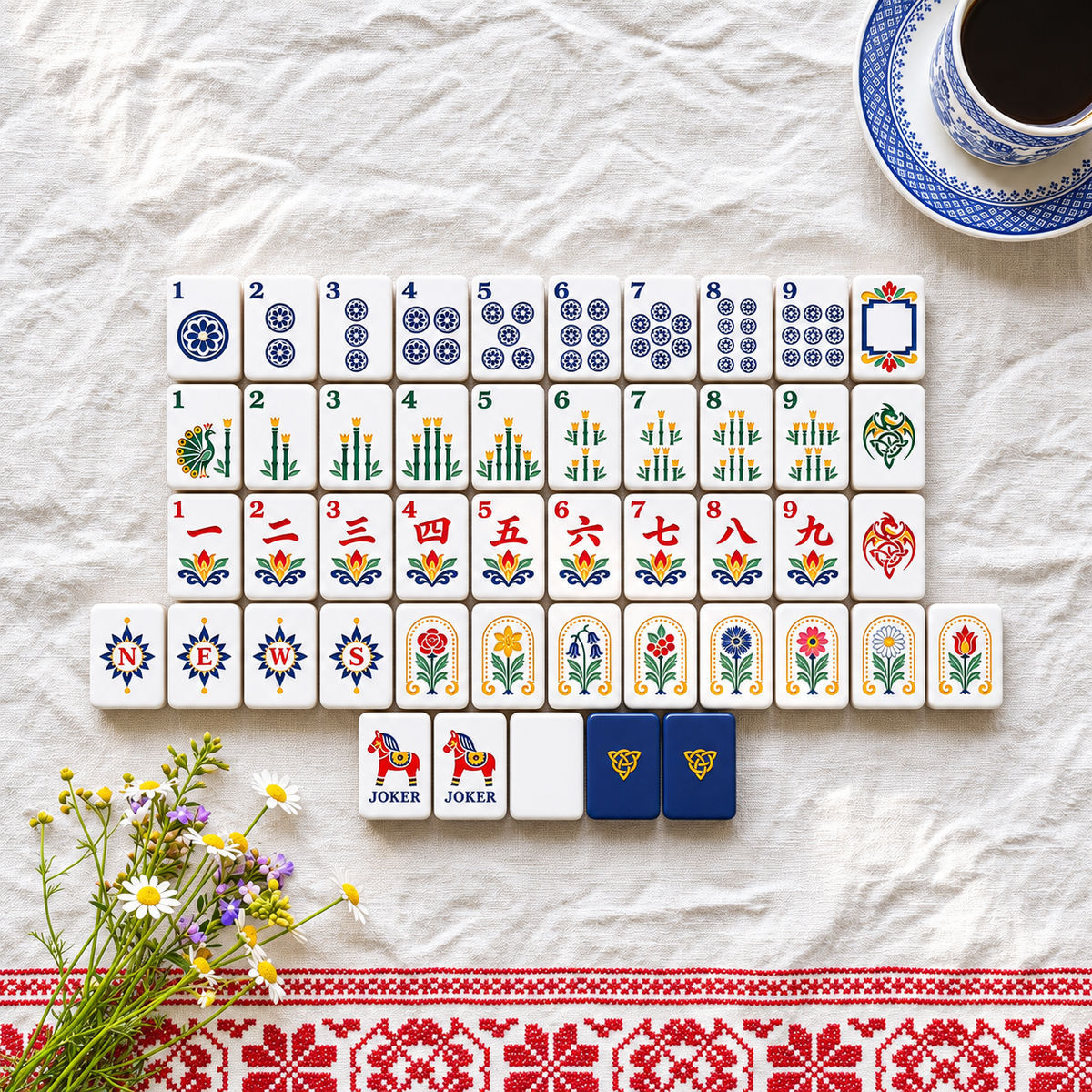
Yes, you can play mahjong without racks. Many casual players use their hands alone, especially in living rooms or at smaller tables. However, American mahjong is designed for racks with pushers. They hold all 14 tiles of your hand, hide your count from opponents, keep tiles from accidentally mixing, and let you push played tiles forward cleanly—all critical for fair play at four seats around a standard table. Racks cost little relative to a full set and solve the three biggest non-rack problems: tile spillage, accidental exposure, and slow turns. If you're hosting regular games, racks aren't optional; if you're learning solo or playing once a year, you can start without them and upgrade as your group standardizes.
Yes, you can play American mahjong without racks—many casual players hold their tiles in hand. But we've hosted hundreds of games and run the numbers: groups that add racks within the first month stop making dealing errors, finish rounds 15–20% faster, and stay friendlier when no one accidentally flashes their hand. Here's the honest breakdown.
Do you really need racks to play a legal game?
No. The National Mah Jongg League does not mandate racks in the official rules. Your hand is valid held in your palm, arranged on a table edge, or propped against a bag. What matters: you hold exactly 14 tiles, expose only what you've declared (pung, kong, quint, sextet), and don't let opponents see your unrevealed tiles. A rack is a convenience tool, not a license requirement.

What problems does holding tiles in your hand create?
Unracked play spawns four repeating headaches. First: tiles slip, stack crooked, or fall into your lap mid-turn, forcing a reshuffle and argument about which tile went where. Second: your tile count becomes visible—if your hand tilts or spreads, the player across sees you have 13 vs. 14, tipping off your readiness. Third: pushing a discard tile takes two hands and two seconds; a rack pusher does it in one flick. Fourth: tiles rub against skin, pick up moisture, and mark or warp faster than stored tiles. None of these block you from playing a full, legal hand. They just waste time and build tension.
When should you skip racks?
Skip racks if you're learning the game solo, practicing with a friend casually, or playing once a year with low stakes. If you're the teacher in a group of absolute beginners, you might hand-play your demo hand so students focus on rules, not equipment. You should also skip them if your table is cramped—a full rack needs 3–4 inches of width per player, and some card tables don't have that. And if you're traveling light (airport lounge, vacation cabin with minimal luggage), hand-play is the fast workaround. But the moment your group meets weekly or monthly, or money is on the table, racks become the norm. They're not luxury; they're infrastructure.
How do racks change the pace and feel of a game?
Racks eliminate the micro-delays that add up. Without a rack, every turn includes: hold tiles, read your hand, decide, reach for a tile, push it forward (or fumble it), wait for it to settle. With a rack, you: read your hand (same), decide, tap the pusher. The tile moves. The visible tempo is crisp. More importantly, racks let you keep both hands on the table—one steadies the rack, one operates the pusher or grabs a new tile from the wall. This rhythm is so ingrained that tournament players find hand-play feels clumsy. At our table, we notice beginners relax faster when we give them a rack; their hands stop fidgeting once the tiles are held securely.
What's the cost and size difference between rack styles?
We carry racks with pushers in bamboo and acrylic, with and without engraving. Bamboo racks are lighter, quieter (tiles don't clack), and slope gently; acrylic racks are transparent, durable, and work well on mats with printed designs you want to see. All hold 14 tiles in a single row. The pusher—a smooth rod or bar that slides forward—is the core feature; it's built into every rack we sell. Sizes are standard: roughly 20–22 inches long, 2 inches tall, 1 inch deep. None are bulky, and they stack flat for transport in a bag or case. See current price on the product page; quality racks are affordable insurance against the dozen small catastrophes that derail a casual night.
🀄 Shop best-selling mahjong sets →

What's the practical setup: racks, mat, and tile count?
A standard American mahjong game uses exactly 152 tiles and 8 jokers—no more, no fewer. Each player gets one rack. You also want a mat (printed with zones and tile borders, keeps walls aligned and discards organized) and a travel bag or case to transport everything safely. The mat serves a second purpose: its surface grip prevents tiles from sliding off the table during draws, and its zones tell you exactly where to place racks, the wall, and the discard pile. Without a mat, even racked players on a bare table feel sloppy. Here's the sequence: unroll mat, set one rack per seat, build the wall in the center, deal. No hand-play needed. This is the default setup in every organized game we've attended.
Setup Element | With Racks | Without Racks | Impact |
Tile security | Enclosed, visible tile count hidden | Loose, easily spilled, count exposed | Fewer dealer errors, faster play |
Turn speed | 2–3 seconds per move | 5–7 seconds (hold, read, push, resettle) | Rounds finish 15–20% quicker |
Beginner learning curve | Faster (hands stay put) | Slower (manage tiles + rules) | Racks recommended for groups |
Space needed | 4 inches per player | 6 inches per player (hand spread) | Compact tables may need racks |
Spillage risk | Minimal (enclosed) | High (tiles fall) | Racks prevent misdeals |
Cost | Budget-friendly | None (tiles only) | Racks add $X per set (see product page) |
How do you transition from hand-play to racked play?
If your group starts hand-playing and wants to move to racks, the switch is painless. Buy one set of racks and teach one player the pusher motion—usually takes 10 seconds. The pusher is not a skill; it's a habit. On turn one, everyone places their hand in the rack; by turn three, no one thinks about it. The only gotcha: remind new rack players not to lift tiles out and back repeatedly. Instead, you read your hand in place and tap the pusher. If you do try to juggle tiles like in hand-play, you'll accidentally knock a neighbor's rack. We've seen players revert to old habits for one round; gently redirect them, and they stay with racks. The learning friction is zero.
🎁 See our most-loved mahjong sets & accessories →
What should you check before you buy?
Before you commit to racks, confirm three things:
Table size: Measure the width of your playing surface. Four racks need at least 16 inches minimum; 20+ is comfortable. If you're playing on a card table (30–32 inches), you're fine. If you're on a sofa side table or tiny coffee table, hand-play may be your only option until you upgrade furniture.
Tile material and finish: If your tiles are heavy ceramic or thick acrylic, they need sturdy racks that don't flex. Lightweight racks work for resin or bamboo tiles. Check the weight tolerance on the product page.
Ongoing maintenance: Bamboo racks absorb humidity and can warp; store them flat and dry. Acrylic racks don't warp but can crack if dropped. Budget for occasional replacement if you play multiple times weekly.
For a group that plays weekly, we recommend investing in a full setup: a best-selling set with 160 tiles, four racks, a mat, and a bag or case. This bundle costs roughly what you'd spend on coffee and snacks for a month, and it transforms the game from "let's try this" to "this is what we do now." The coherence matters—players who show up to a well-organized table stay longer and invite friends.
✨ Find your Mahstead set — free US shipping →
What other players are doing right now
We've noticed three patterns. Casual groups (meet 1–2 times yearly) start without racks and rarely upgrade. Hobby groups (meet monthly) buy racks after 3–4 sessions and keep them forever. Serious groups (weekly or tournament) have never known hand-play—they inherit organized table culture. If you're in the second category, this is your moment: racks are the 20% improvement that costs 5% of your set's total outlay.
For guidance on setting up your first game, see our mahjong for beginners guide. To learn how racks with pushers work in detail, we've written a full breakdown. And if you want to see what a complete set contains before you buy, read what's in an American mahjong set.

FAQ
Can you legally win a hand while playing without racks?
Yes. The National Mah Jongg League rules don't mandate racks. Your hand is legal held in your palm as long as only you know your tile count and you expose only called melds. Racks are optional tools, not requirements.
Do racks slow down the game or speed it up?
They speed it up. Without racks, reaching for tiles, reading a splayed hand, and pushing discards takes longer than rack-based play. Most racked games finish one round faster than hand-played rounds, especially with new players.
Can you use racks on a mat, or do they compete for space?
Racks and mats work together. A good mat is designed with rack zones—spaces where racks sit at the four compass points around the tile wall. The mat actually organizes rack placement, preventing crowding.
If I buy a mahjong set without racks, can I add them later?
Yes. Racks are independent of sets. You can buy a set today and add racks with pushers anytime. They're compatible with any American mahjong set (all use 14-tile hands).
What's the difference between a bamboo and an acrylic rack?
Bamboo is quieter, lighter, and has a traditional feel; acrylic is transparent, durable, and works well if your mat has printed designs you want to see. Both hold 14 tiles and come with pushers. Choice is personal; either works.
Should beginners use racks or learn without them?
Beginners learn faster with racks. Racks keep tiles organized so new players focus on rules and strategy instead of managing tiles. After three games with racks, hand-play feels awkward—the racks train good habits.


View More
View More
View More
